Bio-Layer Interferometry (BLI) Service

Real-time, label-free binding analysis for affinity, kinetics, competition, and clone-ranking decisions in drug discovery.

Bio-Layer Interferometry (BLI) Service gives you a real-time, label-free way to study molecular interactions when the key question is not only whether binding happens, but how strong it is, how fast it forms, how fast it dissociates, and how candidates compare across a discovery workflow.

We use BLI to support affinity and kinetics characterization, clone ranking, competition studies, and epitope binning in projects where clear interaction data can help move a program forward with stronger technical confidence.

Whether you are comparing antibody clones, evaluating a receptor-ligand interaction, or deciding whether BLI or an adjacent method is the better fit, we frame the project around the scientific question you need the data to answer.

Key Advantages:

  • Real-time, label-free interaction analysis for practical project decisions.
  • Affinity and kinetics can be reviewed within the same study design.
  • Useful for ranking, competition, and clone differentiation workflows.
  • Built around study-fit assay design and clear QC checkpoints.
  • Delivered as decision-ready outputs, not raw curves alone.
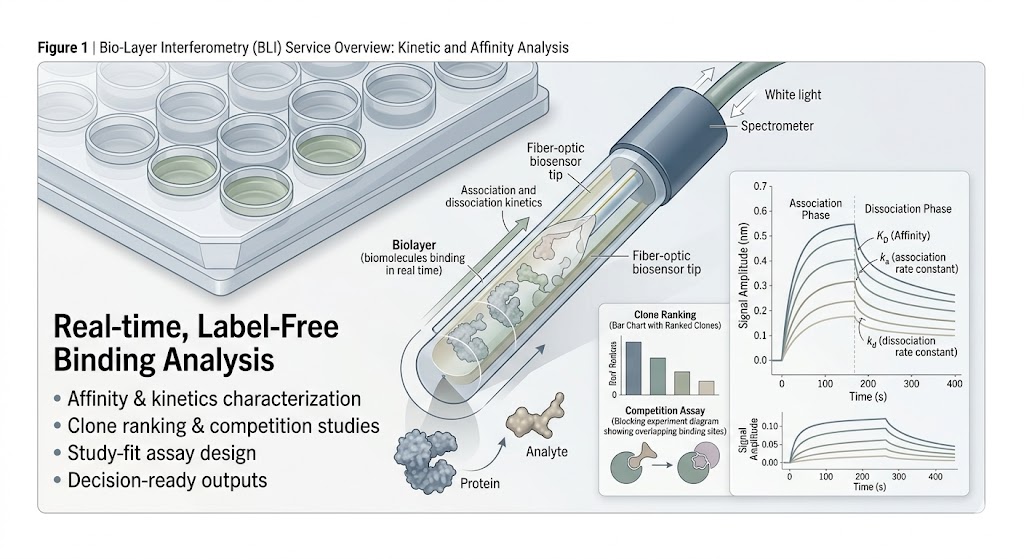
Bio-Layer Interferometry service diagram showing biosensor loading, analyte association, dissociation, and label-free binding analysis workflow.
What Is BLI Service Overview Why Choose Us Workflow QC Deliverables Demo Sample Technology Comparison Platform Fit Case Study FAQ References

Real-Time, Label-Free Binding Analysis for Drug Discovery

BLI is an optical biosensor method that monitors interaction-dependent signal changes at the biosensor tip as molecules associate and dissociate in real time. For project teams, that matters because the output is not limited to a single endpoint. You can review sensorgrams, compare candidates under matched conditions, and extract affinity and kinetics parameters when the data quality supports fitting.

In discovery-stage work, BLI is often most useful when you need to answer practical questions such as whether a candidate shows measurable binding, how multiple binders rank under the same design, whether an interaction looks fast-on or fast-off, whether two binders compete for a similar region, and whether a result package can help narrow candidates before deeper follow-up studies.

This makes BLI especially valuable when interaction evidence needs to support scientific review, candidate prioritization, or next-step study design rather than simply add another isolated readout.

What BLI can answer in binding and interaction studies

  • Affinity characterization
  • Kinetic comparison
  • Hit or clone ranking
  • Competition assessment
  • Epitope binning
  • Interaction specificity review
  • Condition-to-condition comparison

Why BLI is useful for affinity, kinetics, and ranking

Because the method records association and dissociation in real time, it can provide more context than an endpoint-style binding signal. That added context is often what helps a team decide whether a result is promising enough to justify the next stage of work.

Where BLI fits in discovery-stage decision-making

BLI often fits best when your team needs a practical interaction readout that is fast enough for comparative work while still informative enough to support candidate prioritization, clone down-selection, or follow-up study planning.

What Our BLI Service Can Support

We position BLI as a fit-for-purpose interaction service rather than a generic instrument run. The goal is to align assay design, output type, and interpretation with the actual decision your project needs to support.

That means the service is most effective when the study question is already clear: affinity comparison, kinetic review, clone ranking, competition, epitope binning, or a method-fit decision before moving into deeper orthogonal work.

MODE 1

Affinity and kinetics characterization

Suitable for antibody-antigen, protein-protein, receptor-ligand, peptide-protein, and selected higher-mass analyte formats where real-time association and dissociation behavior are central.

  • Supports concentration-dependent interaction review.
  • Useful for affinity-oriented interpretation and matched-condition comparison.
  • Can support parameter extraction when signal quality and study design are appropriate.
MODE 2

Antibody screening and clone ranking

Useful when multiple clones appear promising and a ranked, interaction-focused comparison is needed before deeper development work.

  • Supports clone-level comparison under a consistent assay design.
  • Helps differentiate candidates by association and dissociation behavior.
  • Can support down-selection logic for subsequent studies.
MODE 3

Competition studies and epitope binning

Useful for projects that need to compare binders beyond simple positive-or-negative interaction confirmation.

  • Supports pairwise and grouped competition views.
  • Useful for epitope-related differentiation in antibody programs.
  • Helps organize candidate behavior into review-ready categories.
MODE 4

Method-fit evaluation for difficult projects

Useful when the project decision is not only about execution, but also about whether BLI is the right first method.

  • Supports method-fit discussion for difficult analyte classes.
  • Useful when BLI is being weighed against Surface Plasmon Resonance (SPR).
  • Can be positioned alongside adjacent techniques when BLI is not the best standalone option.

Why Teams Choose Our BLI Service

Study design built around the analytical question

We begin from the decision your team needs to make. That may be clone ranking, affinity comparison, competition review, or a broader interaction-validation step. Biosensor choice, loading strategy, concentration design, and control setup all depend on that question.

Clear QC logic before kinetic interpretation

We treat signal behavior, reference performance, concentration response, and fit quality as part of the analytical logic rather than afterthoughts, helping keep the final output aligned with what the data can actually support.

Decision-ready outputs, not raw curves alone

We structure outputs so your internal team can review signal behavior, parameter tables, candidate-level comparisons, and interpretive notes in one place, making scientific and project review more efficient.

Fit-for-purpose guidance alongside adjacent methods

When BLI is not the best standalone answer, we can help place it within a broader evidence path that may include Affinity Selection–MS (AS-MS), Native ESI-MS for noncovalent complexes, Ligand-Observed ESI-MS Binding Assays, or HDX-MS / HDX-driven Epitope Mapping.

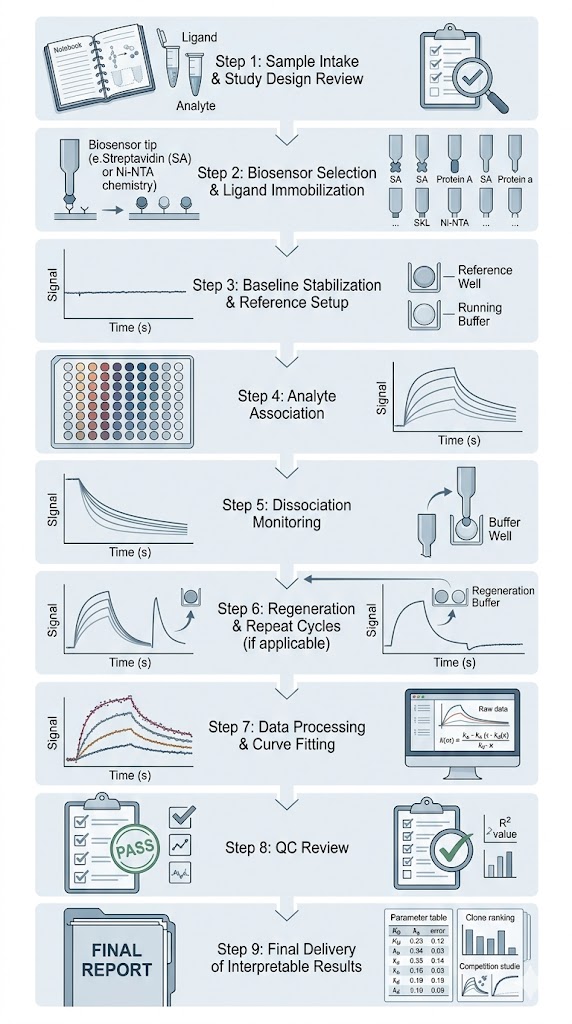
Technical Workflow of a BLI Experiment: From Sensor Loading to Kinetic Fitting

A useful workflow section should explain both how the technology works and how the project moves from sample intake to interpretable results. In BLI, the technical workflow and service workflow are closely linked because study design decisions directly affect what the final data can support.

1

Ligand capture or immobilization on the biosensor

Once the project scope is defined, the experimental workflow begins with biosensor format selection and ligand capture strategy. Depending on sample format and study goal, the assay may use biotin capture, Protein A or Protein G capture, His-tag capture, or another compatible loading approach. The technical goal here is to create a stable, interpretable starting surface rather than to maximize loading at any cost.

2

Baseline stabilization and reference setup

Before analyte measurement begins, the run needs a stable baseline and an appropriate referencing strategy. Blank controls, matched matrix references, and baseline behavior matter because drift or background effects can distort apparent binding behavior. This is also where sample readiness and assay setup converge at the service level.

3

Association phase across analyte concentrations

During association, the biosensor is moved into analyte solutions so the instrument can track signal increase over time. A concentration series is usually more informative than a single test point because it helps show whether the response behaves in a concentration-dependent way for candidate comparison, affinity estimation, kinetic fitting, and ranking under matched conditions.

4

Dissociation phase and signal decay monitoring

After association, the biosensor is moved into buffer to monitor dissociation. This phase helps show whether a candidate appears to come off quickly, remain more stable, or differ meaningfully from another binder under the same design. For some projects, dissociation behavior is more informative than absolute signal height.

5

Regeneration, repeat cycles, and assay repeatability

When the assay format allows it, regeneration can help reuse the sensor surface for repeated cycles. Repeatability across cycles can improve confidence that the observed interaction pattern is not a one-off artifact. Where regeneration is not appropriate, that should be treated as a format constraint rather than forced into the study.

6

Data processing, curve fitting, and parameter extraction

After signal acquisition, the project moves into data processing and interpretation. This may include baseline handling, referencing, concentration-series review, curve inspection, fit assessment, and extraction of affinity or kinetic parameters where justified. The raw signal is turned into structured sensorgram views, comparison-ready outputs, parameter tables, and interpretive notes tied to the original project question.

Technical workflow of a Bio-Layer Interferometry experiment showing biosensor loading, baseline stabilization, association, dissociation, regeneration, and data fitting.

QC Checkpoints That Matter in BLI Data Interpretation

BLI data are only useful when the quality logic is clear. This is often where confidence is built, because it shows how the project moves from signal generation to credible interpretation.

Signal quality and baseline behavior

We review whether the baseline is stable, whether signal amplitude is sufficient for the intended interpretation, and whether the response pattern is usable across the planned concentration series. Stable baseline behavior is especially important in comparative projects.

Reference subtraction and non-specific binding control

Reference subtraction helps separate interaction-related signal from background behavior. Non-specific interaction patterns, baseline instability, and matrix-driven noise should be addressed before a ranking or kinetic conclusion is presented.

Surface performance and regeneration suitability

A good-looking first cycle is not enough. Surface consistency, loading repeatability, and regeneration suitability all affect whether multi-cycle comparisons remain interpretable.

Fit quality and interpretation boundaries

We treat fitted outputs as one layer of evidence rather than an automatic endpoint. Where fit quality, signal strength, or assay design limit interpretation, that should be stated clearly in the final result package.

Typical Deliverables From a BLI Study

  • Processed sensorgrams and fit overlays where appropriate
  • Association and dissociation views
  • KD, ka, and kd tables when supported by the assay
  • Condition- or candidate-level comparison tables
  • Affinity ranking, clone comparison, or competition summaries
  • Presentation-ready visuals for internal team review
  • Raw run files, processed export tables, and parameter summaries when appropriate
  • Analysis notes for internal technical review

This service does not require a bioinformatics-heavy pipeline in the omics sense, but data processing still matters. In the BLI context, the analysis layer is best framed as structured analytical review rather than sequence-level computation.

Minimum analytical deliverables: referenced sensorgram processing, condition-to-condition comparison logic, fitted or non-fitted result summaries as appropriate, parameter tables where supported, and report-ready visual outputs.

Optional analytical add-ons: expanded comparison tables for multiple candidates, deeper ranking logic for clone or condition panels, annotated result packages for internal project discussion, and documentation of key analysis settings used for interpretation.

Typical Demo Results You Can Expect to Review

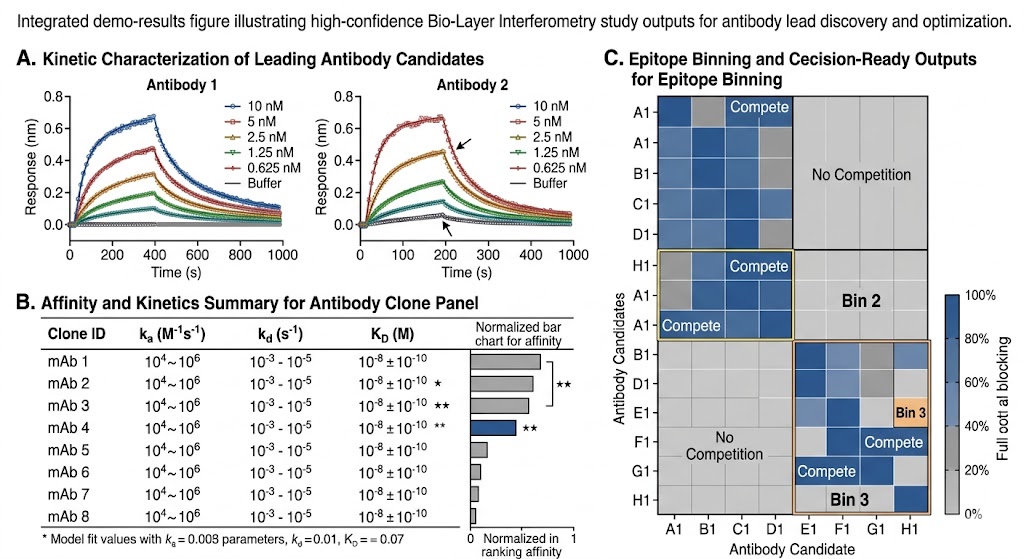
BLI demo result composite showing sensorgram fit overlay, kinetics comparison, and competition or clone-ranking summary.

Integrated BLI demo outputs for project review

For BLI, three demo result types usually communicate the method best without overcomplicating the page: a sensorgram and fit overlay, a kinetics or affinity comparison panel, and a competition or clone-ranking decision view. Sensorgram views help confirm signal behavior and interpretability, comparison panels help support ranking and candidate triage, and competition-style outputs help with clone differentiation and pair selection logic.

Sample Requirements for BLI Projects

Sample RoleTypical FormatRecommended InputPreferred ContainerKey QC CheckpointsNotes
LigandAntibody, protein, biotinylated molecule, tagged recombinant protein≥0.2 mg/mLLow-bind tubeIdentity, purity context, tag or capture compatibility, visible particulatesProvide buffer composition and molecular weight when available
AnalyteProtein, peptide, binder panel, selected higher-mass interaction partner≥0.1 mg/mLLow-bind tube or plate-ready aliquotConcentration context, solubility, dilution plan, non-specific binding riskA concentration series is usually more informative than a single-point test
ControlPositive binder, negative control, blank or reference conditionProject-specificMatching matrixBaseline suitability, reference design, known interaction contextControl design affects interpretation confidence
Matrix-sensitive sampleFormulated protein, buffer-sensitive material, partially purified preparationProject-specific reviewLow-bind tubeMatrix compatibility, solvent content, background signal riskFlag special buffer components before assay setup

Before submission, it is helpful to provide molecule identity, target-analyte pairing, concentration context, buffer composition, tag or capture format when relevant, known stability or solubility concerns, and the exact decision you want the data to support.

BLI studies often benefit from early review of buffer composition, detergent or solvent content, matrix-matched controls, stability concerns during assay handling, and whether the design is intended for kinetic fitting or qualitative comparison.

BLI vs SPR: How to Choose the Right Label-Free Binding Method

DimensionBLISPROther Orthogonal Methods
Core readoutReal-time, label-free interaction signalReal-time, label-free interaction signalDepends on platform
Best-fit roleComparative binding review, affinity and kinetics, clone ranking, competitionHigher-sensitivity interaction analysis and deeper kinetics-focused follow-upUsed when the project question shifts beyond a single binding readout
ThroughputOften well suited for comparative panel-style studiesUsually stronger when precision is prioritized over panel throughputVaries by method
Assay handling logicDip-and-read workflow with flexible biosensor optionsSurface-based flow system with strong kinetic reputationMethod-dependent
Suitability for direct small-molecule workProject-fit review is important and may not be ideal as a first choiceOften preferred when direct small-molecule kinetics are centralSome MS-based or orthogonal tools may be better for selected formats
Competition or binning supportStrong use case, especially for antibody programsAlso useful, often in more sensitivity-focused workflowsVaries
Main client question it answers wellWhich candidate looks more promising under this study design?Do we need higher-sensitivity kinetics or more refined interaction analysis?Do we need orthogonal evidence beyond label-free binding?
Typical next stepCandidate prioritization, follow-up validation, or method escalation if neededDetailed follow-up analysis or confirmationMechanism, complex-state, or orthogonal validation studies

Selection strategy:

  • Choose BLI when comparative interaction behavior is the first question.
  • Choose SPR when higher-sensitivity kinetic detail is the first question.
  • Add orthogonal methods when the project needs binding plus structural or mechanism-layer evidence.
  • Use adjacent MS-based methods when the main uncertainty is not kinetics alone, but binder identity, complex-state behavior, or orthogonal confirmation.

How BLI Fits With Our Broader Binding and Mechanism Platforms

When to extend from BLI to SPR

If your project starts with comparative binding but later needs more refined kinetic interpretation, Surface Plasmon Resonance (SPR) is often the natural next step.

When MS-based binding methods may add value

If your question shifts from interaction strength toward binder identity, mixture complexity, or orthogonal binding confirmation, methods such as Affinity Selection–MS (AS-MS), Native ESI-MS for noncovalent complexes, and Ligand-Observed ESI-MS Binding Assays can add useful context.

When mechanism-focused follow-up becomes necessary

When interaction confirmation is no longer enough and the project moves into epitope- or mechanism-oriented questions, HDX-MS / HDX-driven Epitope Mapping can help extend the evidence path.

Why a broader evidence path matters

BLI can act as a practical entry point into a broader evidence chain, helping you answer the current interaction question while keeping the next technical question in view.

Case Study

Published BLI Workflow and Output Example for Interaction Validation

Background

Researchers studying ribosome-protein interactions needed a real-time, label-free method to evaluate binding behavior and determine whether the interaction could be measured in a way that supported affinity interpretation and control-based comparison. A published study, Application of bio-layer interferometry for the analysis of ribosome-protein interactions, provides a useful example of how BLI can be structured for interaction validation.

Methods

The study used a BLI workflow that included ligand preparation, sensor loading, baseline stabilization, analyte association, dissociation monitoring, and concentration-dependent data review. The experimental design also included a negative-control comparison and concentration-series analysis, which made the output more useful for interpretation rather than simple signal display.

Results

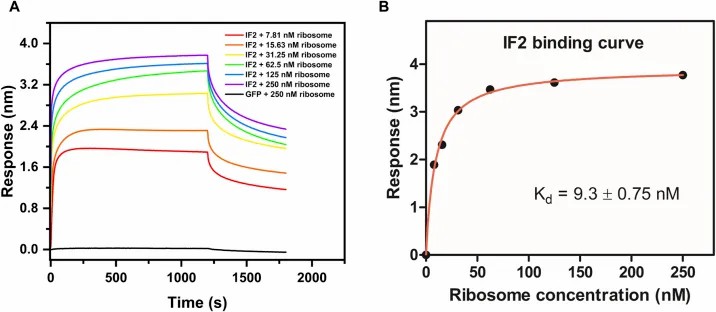
For page-level communication, the most relevant figure is Figure 4 from the paper. The figure presents sensorgram-style binding data and an affinity-curve view for the IF2–70S ribosome interaction, along with a negative-control comparison. This is useful because it illustrates three result types that matter in a service context: real-time sensorgram output, concentration-dependent interaction review, and control-based interpretation rather than signal-only reporting.

Conclusion

This literature example shows why BLI remains valuable when the project needs more than a binary binding answer. A well-structured BLI study can produce interpretable sensorgrams, comparison-ready views, and affinity-oriented evidence that helps a research team decide what to test next.

Illustrative BLI case-study visual inspired by published Figure 4, showing sensorgram output and affinity-curve style comparison for interaction validation.

Illustrative case-study visual inspired by published Figure 4 showing sensorgram-style and affinity-curve style outputs for interaction validation.

FAQ

Frequently Asked Questions

What types of interactions are best suited for a BLI service?

BLI is commonly used for antibody-antigen, protein-protein, receptor-ligand, peptide-protein, competition, and clone-ranking studies where real-time, label-free interaction data can support project decisions.

Can BLI be used for direct small-molecule binding analysis?

It can be considered in selected cases, but direct small-molecule work often needs careful method-fit review. If higher sensitivity or a more direct small-molecule interaction format is central, SPR or an adjacent method may be the better first choice.

What sample information should be prepared before a BLI feasibility discussion?

The most helpful starting information includes molecule identity, target-analyte pairing, concentration context, buffer composition, tag or capture format, and the exact decision you want the data to support.

What deliverables are typically included in a BLI study?

Typical deliverables include processed sensorgrams, fit overlays where appropriate, parameter tables, comparison-ready visuals, summary notes, and raw or reusable outputs when applicable.

When should I choose BLI instead of SPR?

Choose BLI when comparative interaction review, clone ranking, competition, or practical affinity and kinetics assessment is your first decision point. Choose SPR when higher-sensitivity kinetic detail is the main priority.

Can BLI support competition assays or epitope binning?

Yes. BLI is frequently used for competition-style designs and epitope binning workflows, especially in antibody and biologics-related projects.

What technical factors most often affect data quality in BLI experiments?

Common factors include biosensor format, loading consistency, baseline stability, concentration design, matrix effects, non-specific signal, regeneration suitability, and the match between assay design and project question.

Can BLI data support clone ranking or candidate triage?

Yes. Comparative sensorgrams, affinity-oriented summaries, and competition logic can all support clone ranking and candidate prioritization when the study design is built for that purpose.

Plan a BLI study with the MassTarget™ team

Share your target, analyte format, and study goal, and our scientists will help design a BLI strategy aligned with the decision your project needs to make.

Disclaimer: This service content is provided for research use only. It is intended for scientific and preclinical research applications and is not designed for diagnostic or clinical decision-making.

Online Inquiry

Please submit a detailed description of your project. We will provide you with a customized project plan to meet your research requests. You can also send emails directly to for inquiries.

* Email
Phone
* Service & Products of Interest
Services Required and Project Description