Affinity Selection Mass Spectrometry (ASMS) for High-Throughput Hit Discovery

Accelerating hit identification and ligand discovery through high-throughput, label-free screening.

Affinity Selection Mass Spectrometry (ASMS) has emerged as a critical platform for modern drug screening, enabling researchers to rapidly evaluate compound–target interactions without the need for reporter assays or target immobilisation.

At Creative Proteomics, our ASMS service is designed to address discovery-stage challenges: limited in-house mass spectrometry resources, long assay development times, and the need for robust, data-rich hit lists.

Leveraging our integrated SEC–RP-UPLC → high-resolution MS workflow, we deliver high-throughput, data-rich hit lists for small molecules, fragments, and macrocyclic/linear peptide libraries.

Key Advantages:

  • High-throughput screening of mixed compound pools, compatible with affinity selection mass spectrometry screening workflows.
  • Support for challenging targets, including membrane proteins, protein complexes, and induced-proximity modalities (e.g., molecular glues).
  • Rapid turnaround times and scalable throughputs across biotech, pharma, and academic discovery programmes.
  • Robust data output and documentation ready for both internal review and external partnerships.
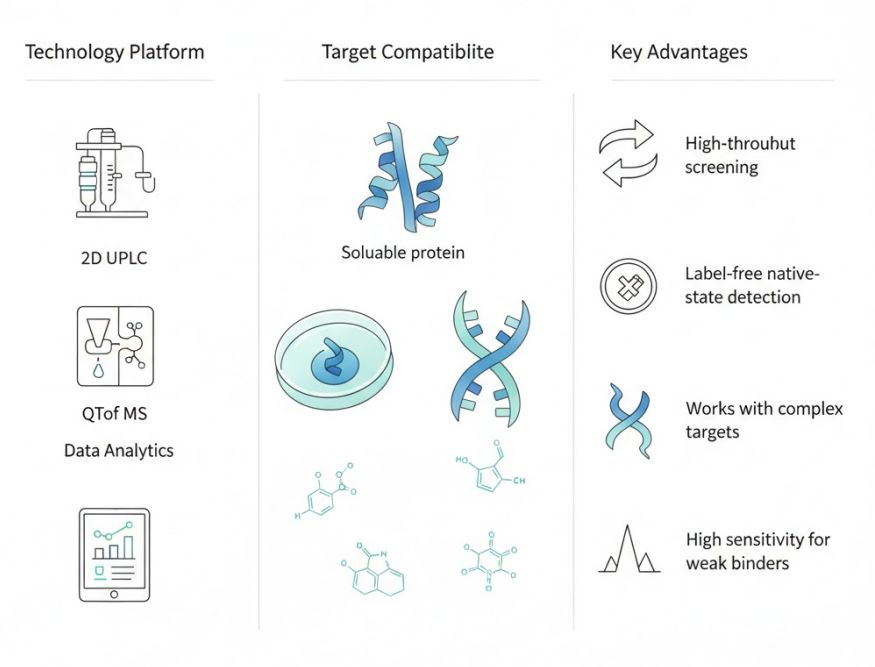
Affinity Selection Mass Spectrometry (ASMS) technology platform diagram featuring UPLC, QToF MS, data analytics, diverse biomolecular target compatibility, and four key advantages.
What Is ASMS Service Overview Technology Comparison Sample Demo Case Study FAQ

What Is Affinity Selection Mass Spectrometry (ASMS)?

Affinity Selection Mass Spectrometry (ASMS) is a label- and immobilisation-free screening technique that enables drug-discovery teams to detect ligand–target interactions directly via high-resolution mass spectrometry.

The process begins with mixing a target biomolecule (e.g., protein, RNA, or a protein complex) with a pooled library of candidate compounds. After incubation, bound ligand-target complexes are separated from unbound small molecules—typically via size exclusion chromatography (SEC) or ultrafiltration—and the retained compounds are eluted and analysed by LC-MS to identify binding events.

Key Benefits of ASMS

Mixed-library throughput

Pools of hundreds or thousands of compounds can be screened simultaneously, substantially reducing assay development time and consumable usage.

Broad target compatibility

Because no reporter is required, ASMS works for soluble proteins, protein complexes, RNA/DNA targets, and challenging classes like membrane proteins.

Minimal target modification

The target remains in a near-native state (no surface immobilization or tagging), improving relevance for discovery.

High sensitivity and specificity

With high-resolution MS, even weak binders can be detected; hit rates in published workflows often fall in the 0.5 %–1.5 % range.

Why It Matters for Discovery Teams

For biotech, pharma, and academic groups facing limited in-house MS capacity, difficult targets, or high-diversity chemical libraries, ASMS provides a streamlined alternative to conventional HTS (High-Throughput Screening). Traditional fluorescence- or enzyme-based assays often require extensive development, suffer from interference, and may not suit novel target classes. ASMS bypasses these issues by detecting binding directly and with broad applicability.

Service Overview – Creative Proteomics ASMS Capabilities

Affinity Selection Mass Spectrometry (ASMS) at Creative Proteomics is designed to support discovery-stage research across small molecules, fragments, macrocyclic peptides, and emerging induced-proximity modalities. Our platform integrates 2D UPLC separation, high-resolution QToF mass spectrometry, and advanced informatics to deliver high-quality, data-driven hit identification for a wide range of biological targets. All workflows are label-free, solution-phase, and optimized for native-state binding detection.

We offer multiple ASMS screening modes to accommodate diverse target classes and library formats:

MODE 1

Small-Molecule ASMS Screening

Ideal for early hit identification from diverse or focused chemical libraries.

  • Supports pooled screening from 100–1,000 compounds per run.
  • Detects direct binding events with high sensitivity.
  • Suitable for proteins, complexes, and RNA targets.
MODE 2

Fragment-Based ASMS Screening (FBLD)

Designed for low-molecular-weight libraries, including enantiomeric fragments.

  • High-resolution detection enables capture of weak, transient interactions.
  • Low protein consumption compared with conventional biophysical assays.
MODE 3

Macrocyclic & Linearizable Peptide Library Screening

ASMS enables rapid evaluation of libraries that are difficult to assess with HTS.

  • Suitable for linearizable macrocyclic peptide libraries.
  • Identifies binders without immobilization or fluorescent tags.
  • Effective for intracellular and shallow-pocket targets.
MODE 4

ASMS for Molecular Glue & Ternary Complex Discovery

Supports early discovery of induced-proximity agents.

  • Detects ternary complex stabilization via comparative binding enrichment.
  • Compatible with E3 ligases, POI–ligase pairs, and binary/ternary readouts.
  • Direct-to-biology screening of unpurified synthetic mixtures is available.
MODE 5

ASMS for Membrane Protein Ligands

Optimized for transporter, receptor, and channel targets.

  • Native-state workflows using compatible detergents or nanodiscs.
  • Temperature-controlled incubation preserves target stability.
  • Useful when functional assays are unavailable or difficult to develop.
MODE 6

Direct-to-Biology ASMS (Screening of Unpurified Reaction Products)

Enables ultra-rapid triage of crude mixtures and combinatorial libraries.

  • Avoids purification bottlenecks.
  • Reduces time from synthesis to screening.
  • Effective for early triaging in medicinal chemistry campaigns.
MODE 7

Custom ASMS Method Development

For specialized target classes or custom library designs.

  • Buffer optimization and stability assessment.
  • Custom cut-window configuration in SEC–ASMS.
  • Specialized informatics workflows for large libraries.

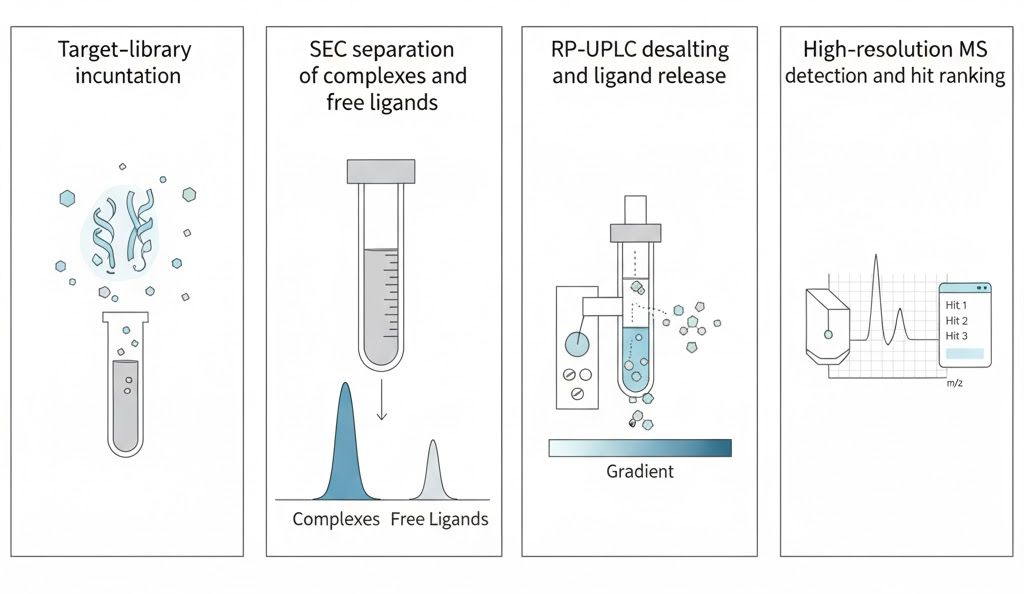
ASMS Workflow

The workflow consists of four essential stages:

1

Target–library incubation

Proteins, complexes, or membrane targets are incubated with pooled compounds under optimized native conditions.

2

Separation of bound vs. unbound compounds

Size-exclusion chromatography (SEC) isolates protein–ligand complexes from free small molecules.

3

Desalting and elution by RP-UPLC

Ligands dissociate and enter the mass spectrometer for detection and identification.

4

High-resolution MS detection & data analysis

Mass spectra are acquired, aligned, and filtered to generate ranked hit lists.

To explore technique-specific workflows, see:

SEC–ASMS

Ultrafiltration AS-MS

Magnetic Bead–ASMS (MagMASS)

PUF-MS

FAC-MS

SAMDI-MS

Traceless-SAMDI MS

CIAS-MS

Applications

ASMS is most impactful when researchers encounter challenges that conventional screening approaches cannot easily solve. Below are representative research scenarios where ASMS provides a clear technical advantage.

When No Functional Assay Exists

Many targets lack measurable biochemical activity or require complex multi-component systems.

ASMS provides a direct binding readout, allowing discovery to begin without developing a reporter assay.

Common scenarios:

  • Novel protein folds
  • RNA or non-enzymatic targets
  • Targets with no known substrate

ASMS solves: identifying binders early, without needing assay development.

When Target Stability Limits Traditional Screens

Large complexes, membrane proteins, and intrinsically disordered proteins often lose activity in plate-based HTS systems.

ASMS maintains native conditions, making it suitable for targets that are:

  • difficult to purify
  • unstable at room temperature
  • incompatible with immobilisation

ASMS solvesASMS solves: screening under gentle, low-stress conditions.

When Binding Is Weak or Transient

Fragment hit discovery and early chemical exploration often involve low-affinity interactions.

ASMS can detect weak or short-lived binding events due to high-resolution mass detection.

ASMS solves: capturing early-stage seeds that other assays miss.

When Libraries Are Large but Purification Is Slow

Early medicinal chemistry often generates many crude reaction mixtures.

Direct-to-biology ASMS allows crude products to be screened without purification.

ASMS solves: fast triage of chemical space and rapid cycle times.

When Looking for Induced-Proximity or Ternary Complex Behaviour

Molecular glues and other induced-proximity modalities require screening beyond binary binding.

ASMS measures relative enrichment between binary and ternary complexes.

ASMS solves: identifying candidates capable of complex stabilization.

When Orthogonal Validation Is Needed

ASMS offers a strong orthogonal method to confirm hits identified by:

  • virtual screening
  • biochemical assays
  • NMR or thermal-shift methods

ASMS solves: rapidly confirming true binders with minimal sample consumption.

When Studying Ligands for Hard-to-Drug Targets

Targets with flat, extended, or dynamic surfaces (e.g., PPIs, transcription complexes) are difficult for traditional screens.

ASMS supports unbiased detection of ligands that bind unconventional pockets.

ASMS solves: finding binders for challenging interaction surfaces.

Platform Instrumentation

Creative Proteomics’ ASMS platform integrates advanced chromatography, high-resolution mass spectrometry, and data analysis systems to support sensitive and reproducible drug screening workflows. Our instrumentation is engineered to maintain native-state conditions, resolve complex mixtures, and provide high-precision mass accuracy for confident hit identification.

Module CategoryInstrument / SystemCore CapabilityWhy It Matters
ChromatographyACQUITY UPLC 2DSEC + RP dual-mode separationPreserves native-state complexes and removes free ligands
Mass SpectrometryXevo G3 QTofHigh-resolution, accurate-mass detectionSensitive to low-affinity or weak binders
Informaticswaters_connectAutomated hit calling + database supportScalable for pooled library analysis
Stability ControlsTemp-controlled modules4 °C sample stabilityIdeal for membrane proteins and fragile targets

Technology Comparison : ASMS vs. Alternative Techniques

TechniqueCore PrincipleTypical ApplicationsKey StrengthsKey Limitations
ASMS (Affinity Selection Mass Spectrometry)Incubate target + compound pool → separate bound/unbound → analyse bound ligands by high-resolution MS.Early hit identification, fragment libraries, membrane proteins, protein-complex screening
  • Label-free, no immobilisation required
  • Compatible with complex or difficult targets
  • Can screen pooled libraries (↑ throughput)
  • Provides binding detection but limited kinetic/thermodynamic detail
  • Requires target of sufficient size for separation
SPR (Surface Plasmon Resonance)Immobilise one binding partner on a sensor chip → flow analyte → measure real-time binding kinetics.Kinetics & affinity profiling, small-molecule/antibody binding, high-value leads
  • Real-time kinetics (k_on, k_off)
  • Highly sensitive for low-nanomolar binders
  • Requires immobilisation (may alter target)
  • Typically lower throughput for large libraries
ITC (Isothermal Titration Calorimetry)Measures heat change upon binding → gives stoichiometry, affinity, enthalpy/entropy.Mechanistic studies, detailed thermodynamic profiling
  • No immobilisation or labels
  • Full thermodynamic characterisation
  • Large amounts of purified protein required
  • Low throughput; not ideal for large-scale screening
Ultrafiltration/PUF–MS (UF-ASMS / PUF-MS)Use membrane filtration to separate bound/unbound compounds → MS detection.Screening of mixtures or natural product extracts
  • Useful for complex mixtures
  • Lower instrumentation complexity than some methods
  • May have less clean separation than SEC-based ASMS
  • Lower specificity in some cases

Sample Requirements

Sample TypeRequired AmountConcentrationPurityBuffer ConditionsNotes
Protein Target50–200 µg1–10 µM≥90% preferredMS-compatible (no glycerol, low detergents)Provide sequence, tags, and known ligands
Protein Complex100–300 µg1–5 µM≥85%Native buffer preferredIndicate stoichiometry
Membrane Protein200–500 µg1–5 µM≥80%DDM/LMNG acceptableProvide stabilization conditions
Small Molecule Library1–5 mg or 10 mM stock-≥90%DMSOCan screen unpurified libraries (Direct-to-Biology ASMS)
Fragment Library1–5 mg-≥95%DMSOProvide SDF if available

Deliverables

  • Ranked list of hits
  • SEC and RP-UPLC chromatograms
  • MS spectra + isotopic patterns
  • Ternary vs binary binding plots
  • Recommended follow-up validation assays

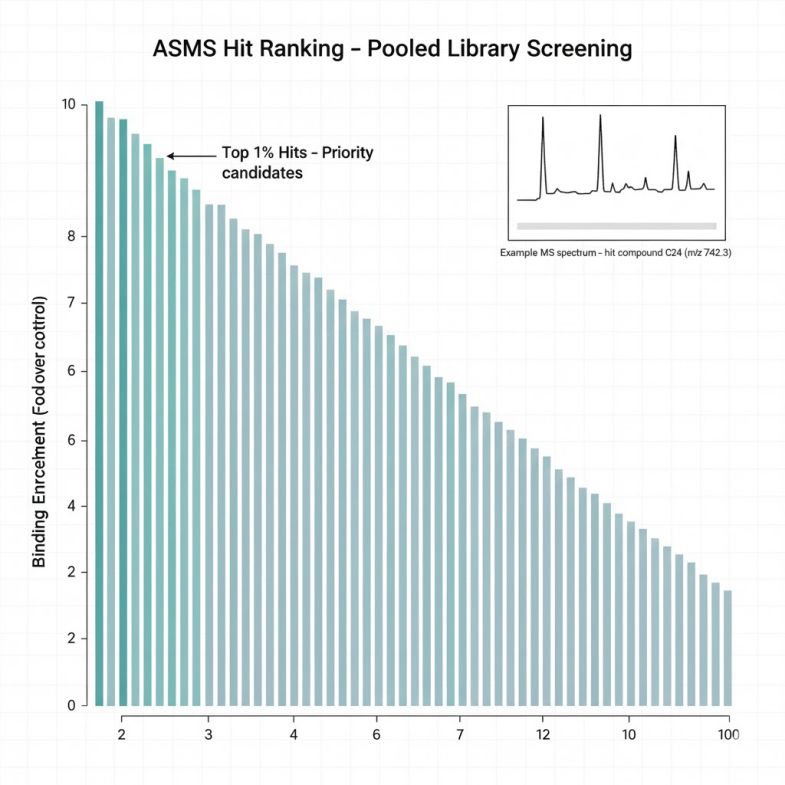
Representative ASMS Demo Data

ASMS hit-ranking bar plot showing binding enrichment for pooled library screening.

Example ASMS hit ranking plot

Case Study: ASMS for Natural Product Ligand Discovery

do Amaral B.S., de Moraes M.C., Cardoso C.L., Cass Q.B. “Affinity selection mass spectrometry (AS-MS) for prospecting ligands in natural product libraries.” Frontiers in Natural Products 4:1562501 (2025). https://doi.org/10.3389/fntpr.2025.1562501

Background

Natural product libraries offer rich chemical diversity, yet screening these for ligands is challenging due to complex mixtures and a lack of functional assays. The authors aimed to apply the technique of affinity selection mass spectrometry (AS-MS) to identify small-molecule ligands from natural product extracts for a variety of biological targets.

Methods

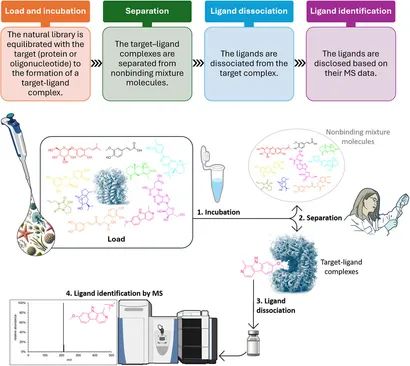
The study used AS-MS in solution-phase (and also immobilised target formats) to incubate protein or biomolecular targets with natural product extract mixtures. The bound ligands were separated, dissociated and identified via high-resolution LC-MS/MS. Key steps included:

  • Incubation of target + extract library.
  • Size-exclusion or affinity-based separation of complexes.
  • Dissociation of the ligand and analysis via high-resolution mass spectrometry.
  • Annotation of ligands using accurate mass, isotopic pattern and database matching.

Results

The authors successfully detected ligand-target interactions from natural product libraries across multiple target types (soluble proteins, membrane proteins, nucleic acid–protein complexes). They demonstrated that AS-MS provides a label-free binding readout and can annotate multiple ligand classes (orthosteric, allosteric).

Conclusions

The study concluded that AS-MS is a versatile, high-throughput compatible technique for ligand discovery from complex natural-product libraries, especially when functional assays are unavailable. It expands the screening capability to challenging target classes and facilitates chemical annotation of hits. The authors noted that careful setup of assay conditions and annotation workflows is critical for success.

ASMS workflow diagram incubation separation mass spectrometry natural product screening.

Schematic representation of the AS-MS workflow used for natural-product ligand discovery.

FAQ

Frequently Asked Questions

Q: What is affinity selection mass spectrometry (ASMS), and how does it differ from traditional high-throughput screening?

Affinity selection mass spectrometry (ASMS) is a label-free, solution-phase approach that incubates a biomolecular target with a pooled compound library, separates bound from unbound molecules (e.g., via size exclusion chromatography), and uses high-resolution mass spectrometry to identify retained ligands; unlike traditional high-throughput screening, ASMS does not require target immobilization or functional read-outs, making it particularly suited to difficult targets and enabling affinity selection mass spectrometry screening of large, mixed compound pools.

Q: Which types of targets are compatible with ASMS services?

ASMS screening supports a broad range of targets, including soluble proteins, protein–protein complexes, membrane proteins (in nanodiscs or detergent micelles), RNA and DNA targets, because it measures direct binding rather than relying on activity assays—a major advantage when using affinity selection mass spectrometry for challenging target classes.

Q: How do I prepare my library or compounds for ASMS screening?

When commissioning ASMS, provide a well-characterised compound set (e.g., small molecules, fragments or macrocycles) ideally with concentrations suitable for pooled screening; a brief buffer review, compound solubility check and library annotation enhance success, aligning with affinity selection mass spectrometry protocol guidelines—our team consults on pooling strategy, concentration and buffer compatibility to maximise hit detection.

Q: What kinds of results and data deliverables can I expect from an ASMS screen?

Clients receive ranked hit lists with accurate-mass identification, isotopic pattern confirmation, chromatogram snapshots and binding-enrichment metrics derived from our affinity selection mass spectrometry screening techniques for small molecule drug discovery, enabling follow-up decisions on hit prioritisation.

Q: Is ASMS appropriate for fragment-based or macrocyclic peptide library screening?

Yes—affinity selection mass spectrometry with linearizable macrocyclic peptide libraries is fully supported, and ASMS excels at fragment screening because it can detect weak or transient binding events; this makes it a powerful choice when traditional functional assays fail or when early-stage chemistry is exploring novel scaffolds.

Q: How does ASMS compare with other binding-screening techniques like SPR or ITC?

While SPR (surface plasmon resonance) and ITC (isothermal titration calorimetry) provide real-time kinetics and thermodynamic parameters, ASMS offers high-throughput, pooled-compound screening and label-free detection with minimal assay development—this contrast highlights why many discovery groups adopt AS-MS screening as a complementary or primary tool for early hit identification.

Reference

  1. Prudent, R., Annis, D.A., Dandliker, P.J. et al.Exploring new targets and chemical space with affinity selection-mass spectrometry. Nat Rev Chem 5, 62–71 (2021).
  2. Prudent R, Lemoine H, Walsh J, Roche D.Affinity selection mass spectrometry speeding drug discovery. Drug Discov Today. 2023
  3. Muchiri RN, van Breemen RB.Drug discovery from natural products using affinity selection-mass spectrometry. Drug Discov Today Technol. 2021 Dec;40:59-63. doi: 10.1016/j.ddtec.2021.10.005. Epub 2021 Oct 21. PMID: 34916024; PMCID: PMC8688860.
  4. Zhang P, Ye X, Wang JCK, Baddock HT, Jensvold Z, Foe IT, Loas A, Eaton DL, Hao Q, Nile AH, Pentelute BL.Reversibly Reactive Affinity Selection-Mass Spectrometry Enables Identification of Covalent Peptide Binders. J Am Chem Soc. 2024 Jun 5;146(22):15627-15639. doi: 10.1021/jacs.4c05571. Epub 2024 May 21. PMID: 38771982.

Plan an ASMS campaign with the MassTarget™ team

Share your target and library details and our scientists will design a tailored ASMS screening strategy for your discovery program.

Online Inquiry

Please submit a detailed description of your project. We will provide you with a customized project plan to meet your research requests. You can also send emails directly to for inquiries.

* Email
Phone
* Service & Products of Interest
Services Required and Project Description