MassTarget™ Platform

MS-based drug discovery for targets, mechanisms, and screening funnels

MassTarget™ combines chemoproteomics, thermal proteomics, imaging, high-throughput MS, and multi-omics to support research-only drug discovery programs from early target discovery to hit-to-lead.

3

Integrated discovery paths

150+

MS-based modules

End-to-end

From disease → target → drug

Tech Platform

MS technologies for binding, stability, imaging, and high-throughput screening.

Drug Discovery Solutions

Workflows for Disease → Target, Drug → Target, and Target → Drug projects.

Case Studies & Resources

Data-driven applications, whitepapers, and project examples.

Partners

Supporting discovery teams across pharma, biotech, and academic centers with MS-based target ID, degrader projects, and screening programs.

>120

discovery MS projects

>60

target ID / MoA studies

10+ yrs

proteomics & MS experience

DRUG DISCOVERYSOLUTIONS

Three MS-enabled discovery paths

MassTarget™ supports three complementary discovery strategies: starting from disease biology, from phenotypic hits, or from known targets. Each path is powered by a tailored combination of MS technologies.

From disease, drug, or target to MS-enabled decisions

The platform links samples, MS modules, and decision points along the drug discovery cycle.

01 Disease → Target Mechanistic targets
02 Drug → Target On/off-target map
03 Target → Drug Screenable assay

Path 01
Disease → Target

Path 02
Drug → Target

Path 03
Target → Drug

Disease → Target Discovery

Starting from patient cohorts or preclinical models, we use quantitative proteomics and multi-omics to define pathways and convert biomarkers into actionable therapeutic targets.

Drug → Target Deconvolution

For phenotypic hits, PROTACs, and molecular glues, we map target engagement, off-targets, and mechanisms of action directly in complex proteomes and cells using MS-based chemoproteomics and thermal proteomics.

Target → Drug Discovery

When the target is known, MassTarget™ builds MS-based assays for fragment and covalent screening, biophysical validation, and high-throughput profiling to feed medicinal chemistry with clean hits and mechanistic data.

MassTarget Tech Platform

MS technologies behind the workflows

The platform is organized into modular MS capabilities that can be combined for custom programs or used as stand-alone services.

Label-free Binding & Affinity MS

Direct binding and affinity assessment without labels in native or complex matrices.

AS-MS Native ESI-MS DEL–MS
BLI / SPR

Chemoproteomics & Covalent

Activity- and reactivity-based profiling to map ligandable and covalent sites proteome-wide.

ABPP / isoTOP-ABPP Covalent fragments Reactive residue profiling SuFEx chemoproteomics

Thermal & Structural Proteomics

Thermal shift and footprinting MS to report on conformational and stability changes upon binding.

TPP / PISA CETSA-MS LiP-MS / LiP-Quant HDX-MS / XL-MS

Target Fishing & Interactome MS

Pull-down, proximity labeling, and complex-centric MS to capture direct and network-level targets.

AP-MS / Co-IP BioID / APEX / TurboID Nanodisc MS Protein microarrays

Cell-based & Imaging MS Platforms

From intact cells and organoids to spatial MSI for drug distribution and engagement.

Cellular metabolomics CETSA-cell MALDI / DESI MSI Single-cell MS

High-throughput MS Screening (HT-MS)

Label-free, miniaturized MS readouts for enzyme panels and hit discovery.

RapidFire LC–MS Microfluidic HT-MS SAMDI / Traceless-SAMDI AEMS / AMI-MS

ADME / PK by MS

Mass spectrometry-based ADME, metabolite ID, and PK profiling to support early discovery.

Metabolic stability MetID & soft-spot CYP panels Pharmaco-metabolomics

Multi-Omics Integration & Data Science

Integrated proteomics, metabolomics, PTM-omics, and modeling to interpret MS data in pathway context.

Featured Techniques

High-impact MS tools for modern drug discovery

Selected MassTarget™ modules that frequently appear in small-molecule, PROTAC, and molecular glue programs. Each technique can be requested as a stand-alone study or embedded into integrated workflows.

ABPP chemoproteomics panels

Map ligandable residues across enzyme families and triage covalent hits with proteome-wide selectivity data.

LiP-MS / LiP-Quant

Detect conformational changes and binding regions directly in native lysates without protein purification.

Thermal Proteome Profiling

Proteome-wide melting curves to quantify target engagement, selectivity, and off-target liabilities.

PROTAC & molecular glue MS

Combine CETSA-MS, native MS, and ubiquitinomics to characterize ternary complexes and degradation profiles.

Featured Case Study

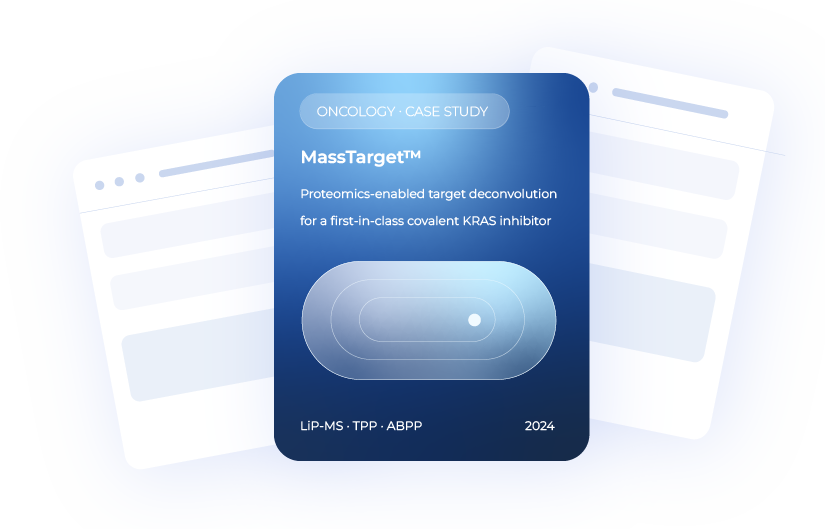
MassTarget™ chemoproteomics reveals novel target landscape for a covalent KRAS inhibitor

Working with a global oncology team, MassTarget™ combined LiP-MS, TPP, and competitive ABPP to map on- and off-target engagement directly in primary tumor samples, helping the sponsor interpret clinical safety signals and prioritize follow-up candidates.

Phase I KRAS G12C inhibitor program · Top 20 pharma partner MassTarget™ Chemoproteomics & Thermal Proteome Profiling Workflow

Resources

Whitepapers and application
notes for discovery teams

Downloadable resources designed to help you explain MS-based workflows to internal stakeholders and plan the right experiments for your project.

Get all resources as a pack

Featured whitepaper

A practical guide to combining ABPP, LiP-MS, TPP, and CETSA-MS in a single target ID program, from hit nomination through orthogonal validation.

Includes example study designs, sample considerations, and typical data outputs for small molecules, PROTACs, and molecular glues.

  • When to use chemoproteomics vs. conformation-based approaches
  • How to integrate thermal proteomics with engagement and selectivity
  • How to design follow-up validation and functional studies

Download PDF

Send to my inbox

MS-based PROTAC complex and degradation profiling

CETSA-MS, TPP, ubiquitinomics, and native MS workflows for degrader engagement and selectivity.

PDF

Molecular glue target identification by neo-interactome MS

APEX/BioID, CETSA-MS, and ubiquitinomics for glue-induced binding events and degradation profiles.

PDF

High-throughput MS assays for early hit triage

RapidFire, AEMS, and enzymatic panels for high-throughput hit evaluation beyond optical readouts.

PDF

MS imaging for tissue-level drug distribution and engagement

MALDI-MSI and DESI-MSI for mapping tissue penetration, exposure, and on-target biology in discovery.

PDF

Collaboration

How we work with discovery teams

From pilot studies to program-level support, we design MS workflows around your questions, assets, and internal decision points.

01

Project discussion

Clarify disease area, modality, questions, and available samples.

02

Study design

Assemble MS modules (chemoproteomics, thermal, imaging, HT-MS) into a tailored plan.

03

Experimental execution

Run MS workflows with QC and reference controls aligned with discovery needs.

04

Data interpretation

Translate spectra into targets, networks, and MoA stories suitable for internal review.

05

Follow-up & iteration

Plan orthogonal validation and next experiments with your team.

Start Your Project

Receive timelines, deliverables, and a tailored workflow proposal.

Resources

Deep dives, playbooks, and technical notes

Use these resources to align internal stakeholders and plan MS-enabled drug discovery campaigns.

Mass spectrometry-based strategies for Drug → Target deconvolution

A concise overview of ABPP, LiP-MS, TPP/PISA, CETSA-MS, and complementary methods, with decision trees for different chemotypes and target classes.

Download the whitepaper

Designing a PROTAC/MS package for early discovery

How to combine ternary complex analysis, ubiquitinomics, and degradation profiling in a staged way.

Download guide

Practical guide: integrating imaging MS in discovery

When to add MALDI / DESI imaging, what samples you need, and what decisions it can support.

Download guide

About MassTarget™

MS infrastructure built for discovery

Purpose-built labs, instruments, and informatics to keep complex MS projects on track.

MassTarget™ combines mass spectrometry, proteomics, structural biology, and chemoproteomics expertise into one platform.

Our teams bring together scientists with deep experience in proteomics, biophysics, enzymology, and drug discovery. We operate dedicated MS labs equipped with high-resolution LC-MS/MS systems, native MS, imaging MS, and high-throughput interfaces.

  • High-resolution LC-MS/MS and native MS systems
  • MALDI, DESI, and other imaging modalities
  • HT interfaces such as RapidFire-MS, AEMS/Echo-MS
  • Secure data infrastructure and reporting pipelines

FAQ

Questions discovery teams often ask

How early can we get involved?

Some partners bring us in with only a disease model and rough compound ideas; others already have hits, PROTACs, or glues and need deeper mechanistic support.

Either way, the first step is a short conversation about your biology, current data, and decision points. From there, we outline an MS plan and refine it together.

How much material do you typically need?

It depends on the technology module. For example, discovery-scale chemoproteomics and TPP/PISA can often start from millions of cells or small tissue amounts, while imaging MS requires appropriately prepared sections. During scoping we provide concrete input on sample numbers, controls, and replicates.

Can you support both exploratory and GLP-like workflows?

MassTarget™ is primarily designed for discovery and mechanism-focused work. Within that scope, we build robust SOPs, run QC, and deliver structured data and documentation suitable for internal governance and due diligence reviews.

What if we only know we have a phenotype but no clear targets?

That is exactly where the Disease → Target path applies. We can start with unbiased proteomics, phosphoproteomics, and interactome profiling, then converge on ranked target hypotheses and validation options.

Do you work with both in-house and external chemistry teams?

Yes. We frequently collaborate with organizations that have internal medicinal chemistry and with those who outsource chemistry. Our role is to provide the MS-based evidence that guides structure–activity relationships, triages hits, and supports mechanism discussions.