Chemoproteomics Services for Drug Discovery

Chemoproteomics helps us connect compounds to proteins, residues, and selectivity patterns in ways that conventional validation alone often cannot. We use chemoproteomics when your team needs stronger evidence for target identification, site mapping, off-target assessment, covalent chemistry programs, or project-level decision making.

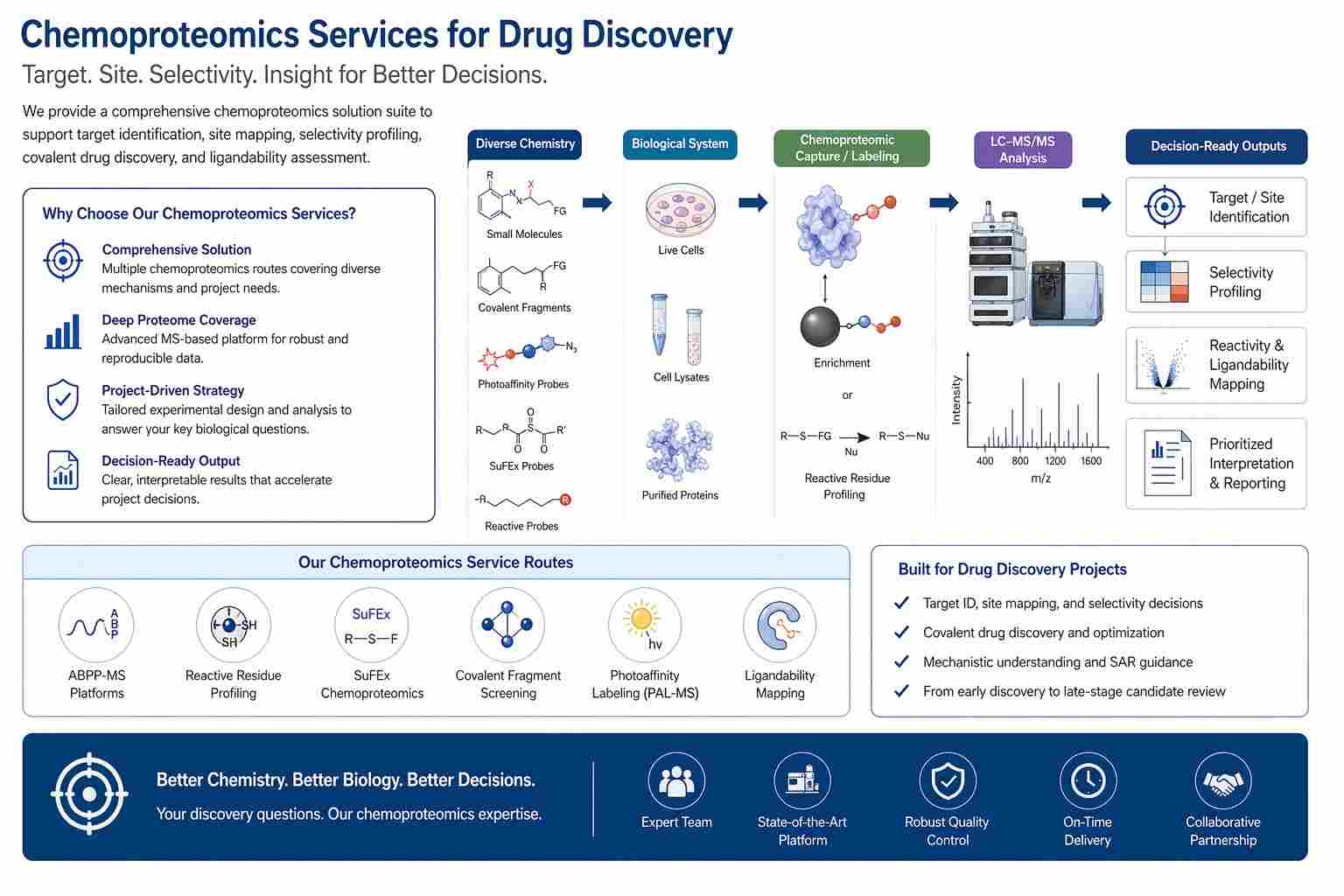
Our MassTarget platform brings together multiple chemoproteomics routes so we can match the method to the real question in front of you, rather than forcing every project into a single workflow.

  • Target, site, and selectivity support
  • Multiple chemoproteomics routes available
  • Built for drug discovery projects
  • Clear data for project decisions
Chemoproteomics services overview for drug discovery
What Chemoproteomics Solves Why It Matters Capabilities Method Selection Services We Offer Workflow Deliverables Sample Demo Case Study FAQ

What Chemoproteomics Can Help You Solve in Drug Discovery

Chemoproteomics is most useful when you need to move beyond indirect biology and into direct molecular evidence. In practical terms, it helps answer questions such as: Which protein is my compound engaging? Which residue is involved? How selective is this chemistry across the proteome? Are there ligandable or reactive sites worth pursuing in a difficult target class? For many discovery teams, those are exactly the questions that determine whether a program moves forward, changes direction, or expands into a broader profiling effort.

That makes chemoproteomics valuable across target identification, site-level mechanism work, selectivity assessment, and early covalent discovery. It is not one fixed assay. It is a family of mass spectrometry-based strategies that can be routed according to the project goal, from activity-state profiling to photoaffinity capture to residue-centric mapping.

The main advantage is not simply that chemoproteomics generates more data. The real advantage is that it generates the right kind of data for the next decision. Instead of staying at the level of phenotype, pathway change, or indirect target hypotheses, your team can work with target-level, site-level, and competition-aware outputs that are far easier to use in a drug discovery setting.

From target identification to site-level evidence

Some projects need to know which protein is engaged. Others need to know where the interaction occurs or whether one reactive chemotype behaves differently from another. Chemoproteomics gives us a route for both types of questions, which is why it is especially valuable for complex discovery programs.

Why chemoproteomics matters when functional data is not enough

A biological response does not automatically prove direct target engagement. At the same time, a weak phenotypic readout does not necessarily mean the chemistry is not worth pursuing. Chemoproteomics adds a direct molecular layer that helps separate those possibilities.

Where it fits in modern drug discovery

Chemoproteomics is especially relevant when you are working with covalent inhibitors, probes, fragment-derived chemotypes, target deconvolution problems, or projects where selectivity and ligandability matter as much as simple activity readouts.

Why Teams Use Chemoproteomics Instead of Relying on Conventional Validation Alone

Conventional validation methods still matter, but they often leave important gaps. Pull-down experiments, Western blot follow-up, and phenotype-led validation can all be informative, yet they may not show how broadly a chemistry behaves, which residues are involved, or whether the observed biology truly aligns with a direct engagement event.

We use chemoproteomics when those gaps begin to affect project decisions. If your team is asking whether a probe is truly selective, whether a covalent warhead is engaging the expected residue class, or whether a target deconvolution workflow can be grounded in proteome-scale evidence, chemoproteomics is often the most direct next step.

When pull-down or phenotype data leaves uncertainty

A captured protein is not always the most meaningful protein. A phenotypic change is not always the result of on-target engagement. Chemoproteomics helps place those observations into a more rigorous protein- and site-aware framework.

When selectivity and off-target questions become central

As programs mature, the question often shifts from "does this chemistry do something?" to "what exactly is it hitting, and how selectively?" Chemoproteomics is one of the most practical routes for answering that transition-stage question.

When a project needs a stronger evidence chain

If your team is building a target engagement, mechanism, or prioritization story for internal review, partner discussion, or scientific follow-up, chemoproteomic outputs are often much more persuasive than indirect biology alone.

How this connects to other MS evidence routes

Chemoproteomics can also complement related workflows such as Targeted Thermal Shift Assay and Thermal Proteome Profiling when your project needs a broader protein-state or target-engagement framework.

Our Chemoproteomics Capabilities Across Target, Site, and Selectivity Questions

We offer chemoproteomics as a route-matched platform rather than a single fixed workflow. That matters because the best method depends on the project question, the chemistry, the sample context, and the kind of evidence your team actually needs.

Our chemoproteomics scope currently covers multiple routes that can be aligned with target identification, site mapping, selectivity assessment, ligandability discovery, and covalent chemistry programs.

ROUTE 1

Probe-based and competitive chemoproteomics routes

When the key question is activity-state engagement, competitive binding, or target deconvolution through probe-enabled capture, we usually guide projects toward ABPP-style or PAL-style workflows.

ROUTE 2

Site-centric and ligandability-oriented routes

When the project needs residue-level evidence, reactive hotspot mapping, or a view of where chemistry may be expanded next, residue profiling and ligandability mapping become more useful.

ROUTE 3

Covalent chemistry-focused routes

For reactive warheads, covalent fragments, and chemistry-specific discovery questions, we can support project designs that prioritize early hit finding and interpretable selectivity logic.

ROUTE 4

Project design and data delivery support

We do not stop at assay execution. We help align the route, chemistry logic, sample plan, QC criteria, and deliverable structure with the decision your team needs to make.

How to Choose the Right Chemoproteomics Route for Your Project

The most important question on this page is not "What is chemoproteomics?" It is "Which chemoproteomics route actually fits my project?" Different methods solve different problems, and choosing the wrong one can slow a program down even when the experiment itself works technically.

MethodMain question answeredBest suited forKey strengthsMain limitations
ABPP-MSWhich active or probe-accessible proteins are engaged?Activity-state profiling, competitive engagement, enzyme-family questionsStrong for active-state and competitive profiling; useful when functional state mattersDepends on a suitable probe strategy and may not answer every site-level question alone
Reactive Residue ProfilingWhich residues or residue classes are engaged or perturbed?Site-level mapping across Cys, Lys, Tyr, or SerUseful for residue-centric selectivity and direct site evidenceRequires careful chemistry design and route-specific interpretation
SuFEx ChemoproteomicsHow does sulfur(VI) fluoride chemistry behave across proteins or sites?Reactive chemistry programs using SuFEx-enabled designWell suited to chemistry-specific discovery questionsMost valuable when the project already has the right chemistry hypothesis
Covalent Fragment ScreeningWhich reactive fragments show tractable engagement behavior?Early covalent hit discovery and triageSupports hit finding in covalent discovery programsNot a substitute for later, deeper selectivity studies
PAL-MSWhich targets are captured by a photoactivatable probe?Target deconvolution and interaction captureUseful when direct capture is needed in complex biological systemsProbe design quality strongly affects outcome and interpretation
Ligandability MappingWhich sites appear tractable or reactive across proteins?Site discovery, expansion planning, covalent opportunity mappingStrong for opportunity mapping and chemistry prioritizationBest interpreted together with broader project context

ABPP-MS for activity-state and competitive engagement questions

Choose ABPP-MS when the project centers on active-state proteins, competitive probe displacement, or enzyme-directed profiling.

Photoaffinity labelling for target deconvolution and interaction capture

Choose PAL-MS when target deconvolution or interaction capture in a biologically complex system is the main challenge.

Reactive residue profiling and ligandability mapping for site-level discovery

Choose Reactive Residue Profiling or Ligandability Mapping when the key output needs to be residue-aware rather than only target-aware.

Covalent fragment screening and SuFEx chemoproteomics in reactive chemistry programs

Choose Covalent Fragment Screening or SuFEx Chemoproteomics when the chemistry itself is central to the project design.

Chemoproteomics Services We Offer

Workflow from Project Intake to Decision-Ready Outputs

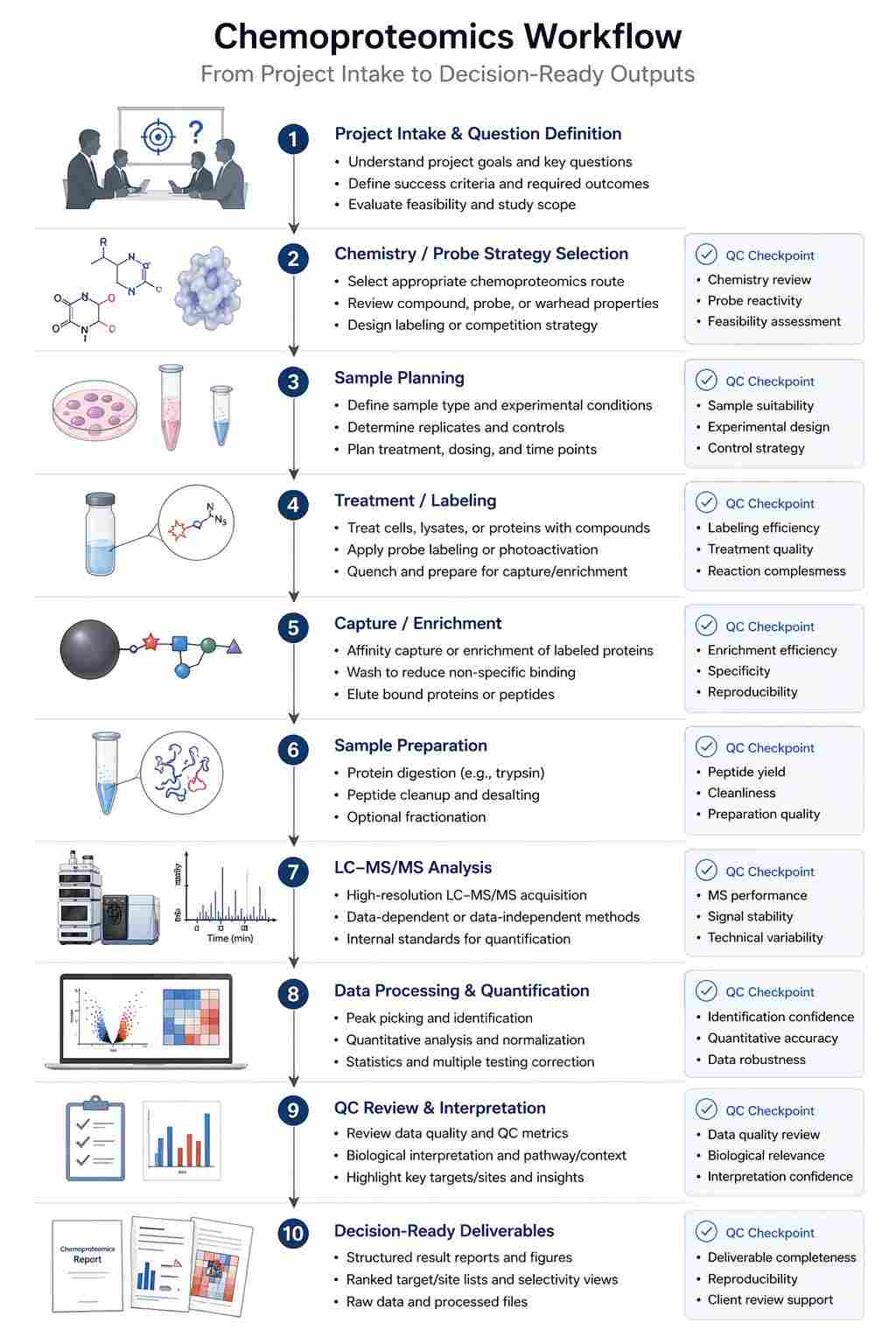
We build chemoproteomics projects from the question backward. That means we start with the project decision, then design the chemistry and analytical route that can generate the right evidence.

1

Study design, probe or chemistry review, and sample planning

We begin by reviewing your target question, chemistry type, sample context, and project goal. At this stage, we determine whether the strongest route is probe-based, competition-based, photoaffinity-driven, residue-centric, or ligandability-focused. We also review sample compatibility, chemistry logic, and the likely output format before the project begins.

2

Capture, enrichment, LC-MS/MS readout, and data processing

Once the route is set, the workflow proceeds through treatment or labeling, capture or enrichment where appropriate, proteomic sample preparation, LC-MS/MS analysis, and signal extraction. The exact technical sequence depends on the sub-method, but the logic is consistent: preserve the meaningful chemistry, capture the relevant proteins or sites, and generate interpretable quantitative outputs.

3

QC review, interpretation, and final deliverables

QC matters at every stage. We review sample quality, chemistry compatibility, enrichment behavior, MS signal quality, and interpretation thresholds before final reporting. The goal is not simply to generate a list. The goal is to generate a result package your team can actually use in project review.

Chemoproteomics workflow with QC checkpoints

What Data You Receive and How We Structure Deliverables

A chemoproteomics project should end with more than raw files and a spreadsheet of protein names. We structure deliverables to support project review, route comparison, and next-step decision making.

Target, site, and selectivity-oriented result outputs

Depending on the route, a typical output package may include identified targets, modified or competed sites, selectivity tables, ranked protein or residue lists, enrichment summaries, and project-level interpretation notes.

Raw and processed files for internal review

We support delivery of raw and processed outputs so your internal team can review, compare, and, when needed, reuse the data in later project stages.

How deliverables support next-step decisions

A good deliverable package should help you decide whether to advance a chemistry, redesign a probe, route the project into a child service, or connect the outcome to a broader MS evidence chain such as Thermal Proteome Profiling or Targeted Thermal Shift Assay.

Bioinformatics and data interpretation

Once signals are quantified, we organize the outputs into a form that helps your team distinguish strong target or site evidence from weak, ambiguous, or non-actionable observations. That may include ranked target lists, site-level prioritization, competition-aware views, selectivity summaries, and route-specific interpretation notes.

Sample Planning Considerations for Chemoproteomics Projects

Sample typeTypical inputChemistry or probe requirementPreparation notesQC focus
Intact cellsProject-dependent cell countProbe or compound information requiredKeep treatment conditions consistent and preserve viability where neededCell health, treatment quality, chemistry compatibility
LysatesDefined total protein inputChemistry compatibility requiredUse low-interference buffer conditionsProtein concentration, buffer suitability, background control
Purified protein or enriched fractionProject-dependentProbe, fragment, or warhead details requiredRoute-specific preparationPurity, compatibility, recoverability
Compound or probe submissionProject-specificExact structure, formulation, and handling details neededProvide stability and solvent informationChemistry integrity and feasibility for the chosen route

In some projects, chemistry design is just as important as sample type. That is why sample planning and route selection should be discussed together, not separately.

Demonstrated Results: Typical Chemoproteomics Output Types

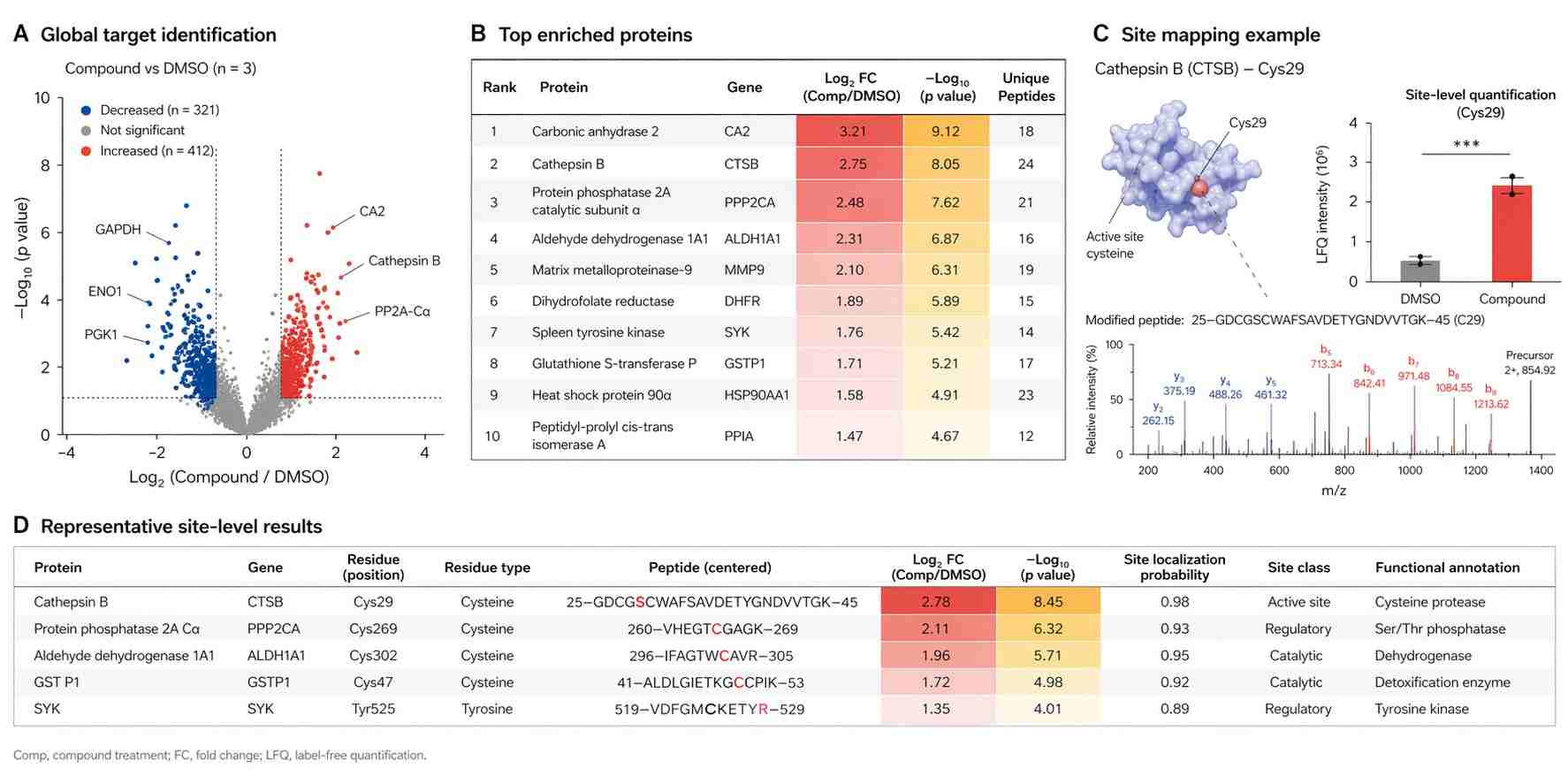
Typical chemoproteomics output types for drug discovery

Target or site identification outputs

These outputs typically appear as ranked target or residue panels, showing which proteins or sites are most strongly implicated in the study. In practice, teams use this type of result to decide whether the observed signal is strong enough to support target follow-up or whether the route should be refined.

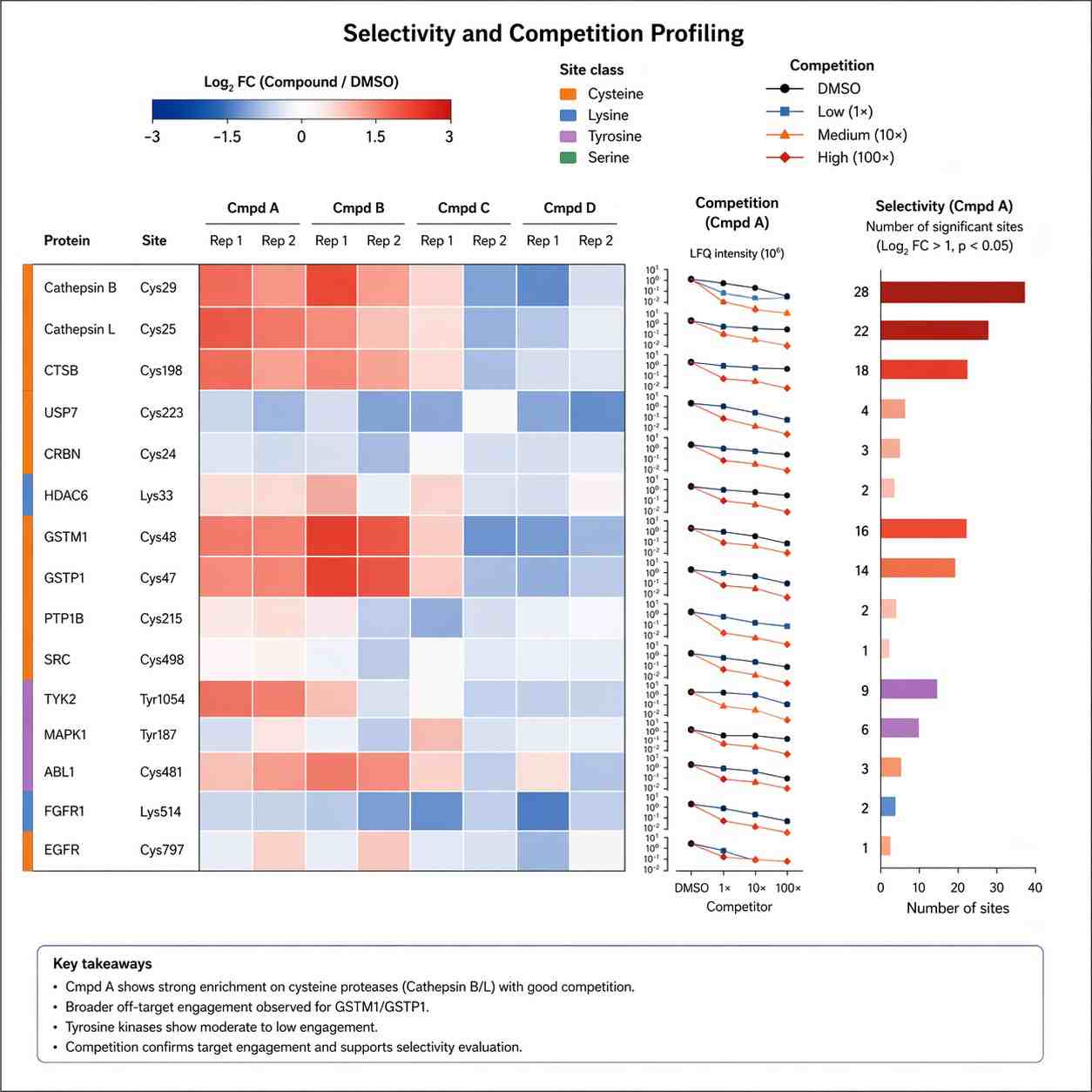
Selectivity and competition-style chemoproteomics result view

Selectivity and competition-style result views

These usually appear as comparative signal plots or heatmaps that show how chemistry behaves across proteins, sites, or conditions. In practice, this is the type of output teams use when they need to compare on-target behavior with broader proteome interaction patterns.

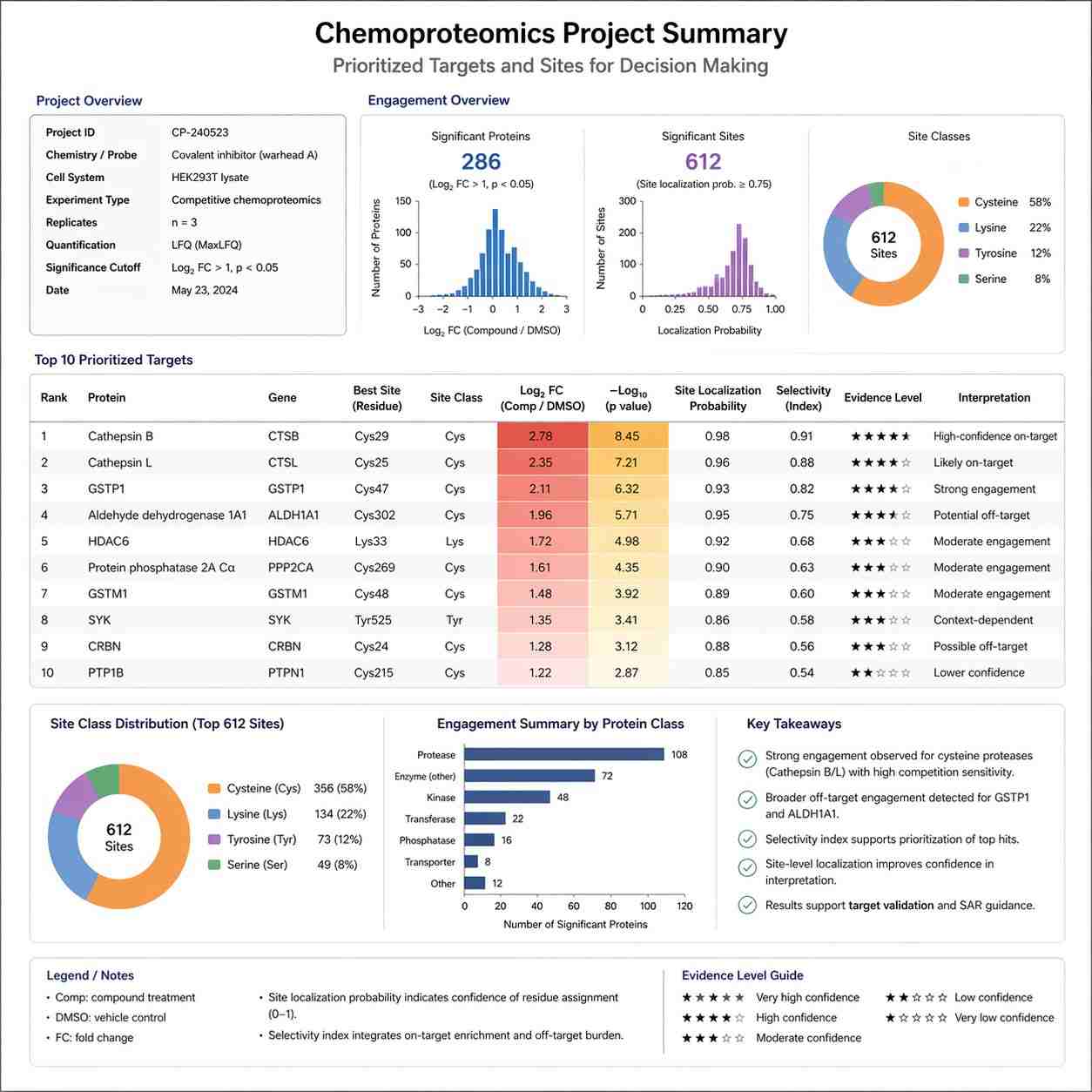
Prioritized interpretation summary for chemoproteomics results

Prioritized interpretation summaries

These are compact result summaries that convert technical findings into a clearer next-step view. In practice, they are the outputs most often used in internal project meetings because they help connect raw findings to go/no-go, prioritization, or route-expansion discussions.

Published Example: Ligandability Mapping in a Modern Chemoproteomics Workflow

Proteome-wide ligandability maps of drugs with diverse cysteine-reactive chemotypes

Background

Covalent drug discovery increasingly depends on understanding how reactive chemotypes engage cysteines across the proteome. A recent Nature Communications study addressed this by building proteome-wide ligandability maps for drugs with diverse cysteine-reactive chemotypes.

Methods

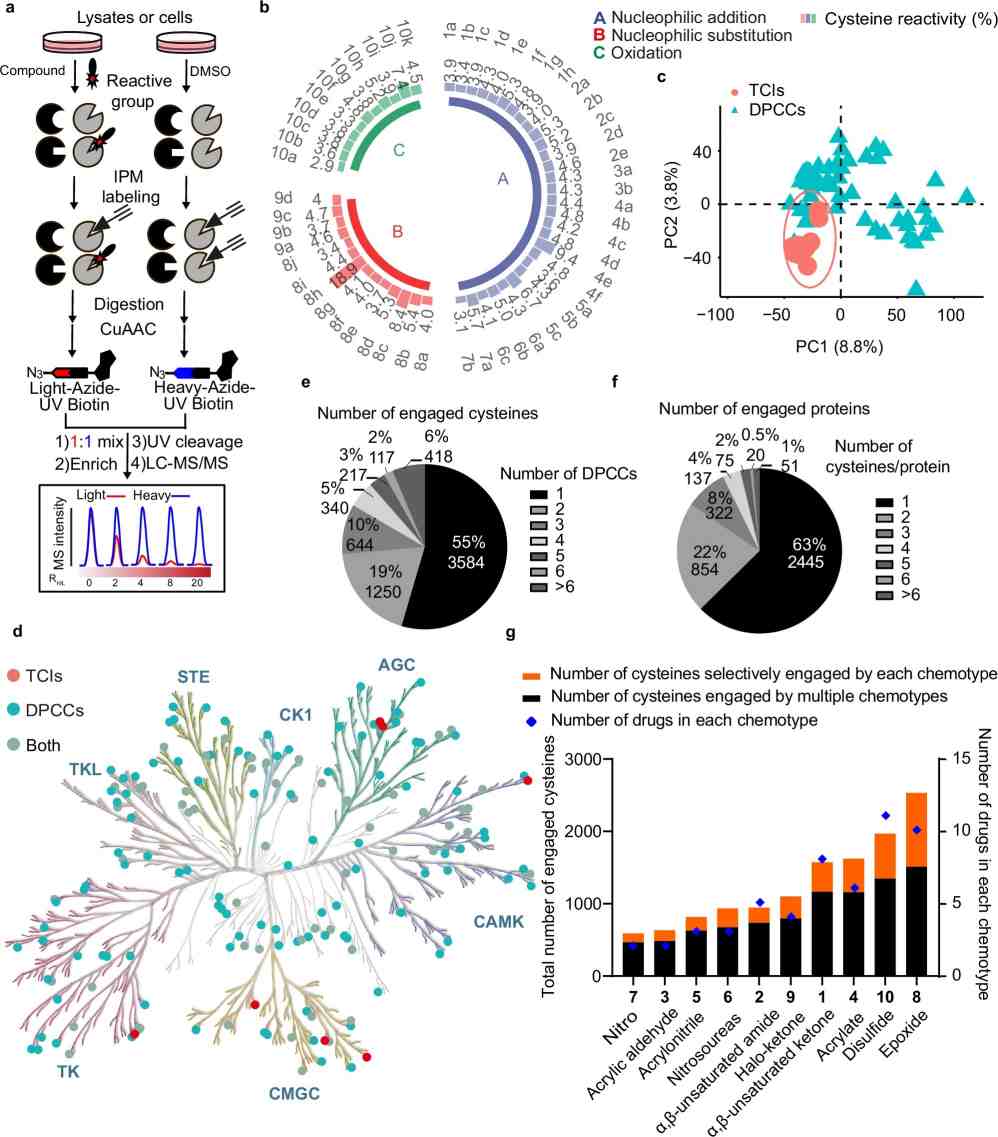
The authors used a quantitative residue-profiling chemoproteomics workflow to analyze 70 drugs, including 58 FDA-approved medicines, against more than 24,000 human cysteines in vitro and in cellular systems, combining probe competition, enrichment, and LC-MS/MS-based quantification.

Results

The most useful figure for this page is Fig. 2, which presents large-scale cysteinome reactivity screening across diverse cysteine-reactive drugs. The figure includes the study schematic and summary views that show how different chemotypes engage different parts of the reactive cysteine landscape. This is a strong fit for the page because it shows what ligandability-oriented chemoproteomics can produce at discovery scale and why those outputs matter for chemistry prioritization.

Conclusion

This case supports the main value proposition of this category page: chemoproteomics is not only useful for target identification, but also for understanding site-level opportunity, chemistry behavior, and selectivity in a way that directly supports covalent drug discovery decisions.

Fig. 2 from a 2025 chemoproteomics study showing cysteinome reactivity mapping of diverse cysteine-reactive drugs

Figure adapted from a 2025 open-access chemoproteomics study showing proteome-wide cysteine reactivity mapping across diverse cysteine-reactive drugs.

FAQ

Frequently Asked Questions

Q: What can chemoproteomics show that conventional target validation cannot?

It can provide target-level, site-level, and selectivity-oriented evidence that is often difficult to obtain from phenotype, pull-down, or single-target validation alone.

Q: How do I choose between ABPP-MS, PAL-MS, and reactive residue profiling?

That depends on whether your project needs activity-state profiling, target deconvolution, or residue-level evidence. We use the project question to guide route selection.

Q: When is ligandability mapping the better choice?

It is the better choice when you need to understand which sites across proteins appear tractable or reactive for future chemistry design.

Q: Can chemoproteomics support covalent drug discovery programs?

Yes. It is especially useful for covalent hit discovery, selectivity profiling, reactive residue analysis, and ligandability assessment.

Q: What kinds of samples and chemistries are usually compatible?

That depends on the route, but common starting points include intact cells, lysates, purified protein systems, and project-specific probes or reactive compounds.

Q: What deliverables should I expect from a chemoproteomics project?

Typical outputs include ranked target or residue lists, selectivity summaries, processed quantitative tables, and route-specific interpretation-ready result packages.

Q: Can this page help me route into the right child service?

Yes. That is one of its main purposes. This page is designed to help you decide which chemoproteomics route best fits your project.

Q: Can chemoproteomics data be combined with other MS evidence chains later?

Yes. In many programs, chemoproteomics is most valuable when connected to broader target engagement, structural, or proteome-wide follow-up work.

Plan your chemoproteomics study with the MassTarget team

Share your chemistry, sample type, and project question, and we will help you route the study toward the chemoproteomics workflow that best fits your next decision.


Disclaimer: All products and services provided by Creative Proteomics are for research use only. They are not intended for use in diagnostic, therapeutic, or clinical procedures.

Online Inquiry

Please submit a detailed description of your project. We will provide you with a customized project plan to meet your research requests. You can also send emails directly to for inquiries.

* Email
Phone
* Service & Products of Interest
Services Required and Project Description