UltraID Proximity Labeling Proteomics Service

Map proximal protein neighborhoods with compact biotin ligase–based proximity labeling and LC-MS/MS.

Creative Proteomics provides UltraID Proximity Labeling Proteomics Service for researchers who need compact biotin ligase–based protein-neighborhood mapping. We help you review UltraID fusion design, plan controls, enrich biotinylated proteins, acquire LC-MS/MS data, and interpret proximal candidates across bait-centered, membrane-associated, pathway, and perturbation studies.

UltraID is useful when you want to study proteins located near a bait, compartment, membrane-associated complex, or condition-dependent pathway state in living cells. Our service connects UltraID proximity labeling with enrichment proteomics, QC review, and bioinformatics interpretation, so you receive more than a protein list.

Service strengths:

  • Map proximal protein neighborhoods around bait proteins or local cellular regions.
  • Support compact UltraID fusion designs for proximity-dependent biotinylation.
  • Review localization, controls, labeling conditions, and background risk.
  • Analyze enriched biotinylated proteins by LC-MS/MS.
  • Deliver candidate ranking, QC summaries, and pathway interpretation.
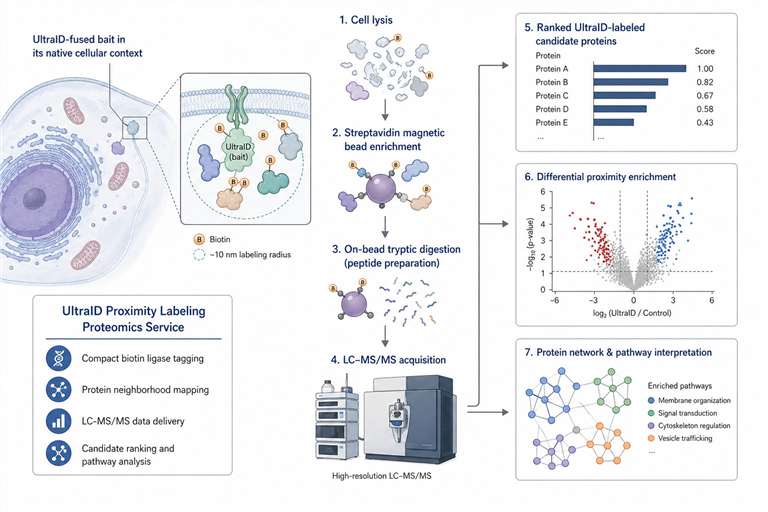
UltraID proximity labeling proteomics service overview showing bait fusion, biotinylation, streptavidin enrichment, LC-MS/MS, and candidate analysis.
UltraID Overview Capabilities Workflow Design & Controls Comparison Applications Sample Deliverables Demo Case Study FAQ

Map Proximal Protein Networks with UltraID Proximity Labeling

UltraID is an engineered biotin ligase used for proximity-dependent biotinylation. In a typical design, UltraID is fused to a bait protein or targeted cellular region. Proteins located near the UltraID fusion can become biotinylated, enriched with streptavidin-based capture, digested, and identified by LC-MS/MS.

This approach is useful when your research question depends on local protein context. Some interactions are weak, transient, membrane-associated, or difficult to preserve after cell lysis. UltraID-based proximity labeling can help capture proteins near a bait or local structure before enrichment and MS analysis.

UltraID results should be interpreted as proximity evidence. A proximal candidate may be enriched near the bait or local region, but that does not automatically prove direct physical binding. We help you design controls and analyze enrichment patterns so the results can support candidate prioritization and follow-up validation.

What UltraID Proximity Labeling Can Reveal

Proteins near a bait protein

UltraID can support bait-centered protein-neighborhood discovery when the bait fusion is localized and controlled appropriately.

Proximal interactome candidates

Enriched candidates can help prioritize proteins for follow-up validation, pathway review, or orthogonal interaction testing.

Membrane-associated protein neighborhoods

UltraID can be considered for membrane-associated or compartment-localized protein environments when fusion design and localization are confirmed.

Condition-dependent proximity changes

Drug-treated, stimulated, mutant, or control groups can be compared to evaluate shifts in bait-proximal proteins.

How to Interpret Proximity-Based Evidence

A strong UltraID candidate is usually supported by enrichment over control, reproducibility across replicates, and biological relevance to the bait, compartment, or treatment condition. Direct binding or functional conclusions should be tested with orthogonal approaches when needed.

Our UltraID Proteomics Service Capabilities

We support UltraID projects from design review to LC-MS/MS data delivery and bioinformatics analysis. If you already have UltraID constructs or labeled material, we can review your sample history and focus on enrichment proteomics and data interpretation. If your project is still in design, we can help evaluate whether UltraID is the right method.

MODE 1

Bait-Centered Proximal Interactome Mapping

For bait-centered studies, we help identify proteins enriched near a protein of interest.

  • Supports RNA-binding proteins, trafficking proteins, signaling proteins, and regulatory complexes.
  • Reviews bait name, fusion orientation, linker design, cell model, and localization evidence.
  • Helps determine whether the project can generate interpretable proximity data.
MODE 2

Membrane-Associated and Compartment-Localized Protein Neighborhoods

UltraID can support local proteome mapping around membrane-associated or compartment-localized proteins.

  • Useful for local cellular protein environments.
  • Requires careful fusion design and localization evidence.
  • Supports LC-MS/MS discovery from enriched biotinylated proteins.
MODE 3

Drug-, Mutation-, or Stimulus-Dependent Proximity Analysis

UltraID proteomics can compare proximal protein patterns across biological states.

  • Drug-treated vs control cells.
  • Stimulated vs baseline cells.
  • Mutant vs wild-type systems.
  • Bait fusion vs control fusion.
MODE 4

Client-Prepared UltraID Sample LC-MS/MS Analysis

Some teams already have UltraID-expressing cells, enriched proteins, lysates, or prepared samples.

  • We review construct design and labeling condition before LC-MS/MS.
  • We check control groups, replicate plan, enrichment status, and sample history.
  • We define what the data can support and where interpretation should remain cautious.
MODE 5

Feasibility Review for Fusion Design, Localization, and Controls

Before sample submission, we can review the biological question, fusion orientation, linker design, labeling condition, controls, and expected outputs.

  • Reduces design-related interpretation risk.
  • Supports background filtering and candidate confidence.
  • Helps align the UltraID workflow with the biological question.

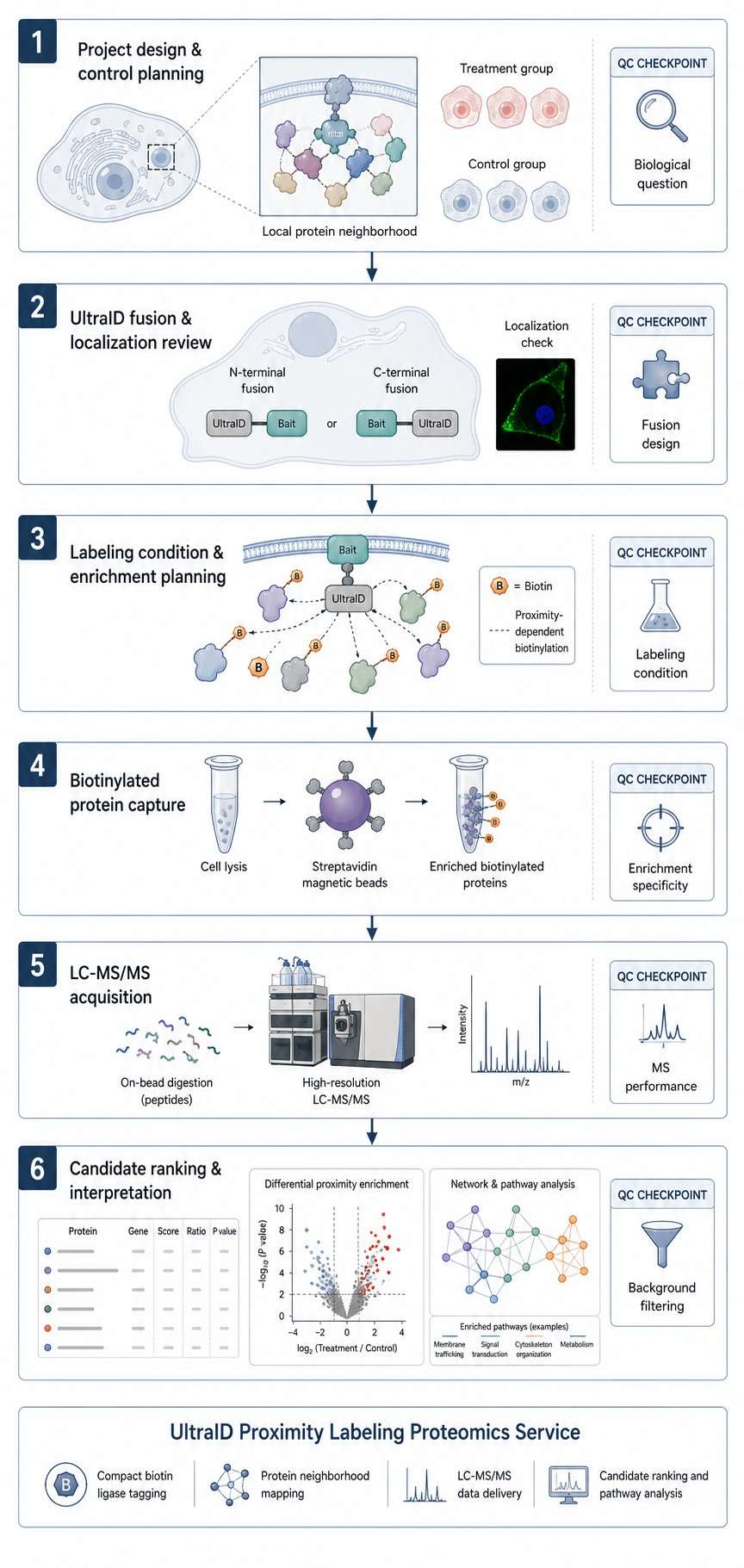
UltraID Workflow with QC Checkpoints

Our workflow combines the technical process with project-level QC, from feasibility review to final interpretation.

1

Project Design and Control Planning

We begin with the research question. Are you mapping a bait-centered interactome, a membrane-associated neighborhood, a pathway response, or a perturbation-dependent proximity change?

QC focus: Does the design separate bait-specific enrichment from background labeling?

2

UltraID Fusion and Localization Review

UltraID fusion design can affect localization, expression, and bait function. We review fusion orientation, tag placement, linker information, and localization evidence.

QC focus: Does the UltraID fusion reach the intended cellular context?

3

Labeling Condition and Enrichment Planning

UltraID labeling conditions should match the biological question and sample model. For perturbation studies, treatment and labeling timing should be planned together.

QC focus: Does the labeling plan support the intended comparison without avoidable background?

4

Biotinylated Protein Capture

After labeling, biotinylated proteins are enriched using streptavidin-based capture. Controls help distinguish bait-proximal candidates from nonspecific enrichment.

QC focus: Is enrichment strong and specific enough for LC-MS/MS?

5

LC-MS/MS Acquisition

Enriched proteins are digested into peptides and analyzed by LC-MS/MS. The acquisition strategy depends on sample type, comparison design, and depth needed.

QC focus: Are MS signal quality, sample consistency, and peptide recovery suitable for downstream analysis?

6

Candidate Ranking and Interpretation

We generate protein identification, quantification, enrichment results, and candidate ranking. When comparison groups are included, we can evaluate differential proximity enrichment.

QC focus: Are candidates supported by controls, replicate consistency, enrichment strength, and biological context?

Vertical UltraID proximity labeling proteomics workflow with QC checkpoints from fusion review to candidate interpretation.

Construct Design, Controls, and Background Filtering

UltraID projects depend strongly on construct design and control planning. A strong LC-MS/MS run cannot fix an unclear bait design, missing control, or poorly localized fusion.

Information to Prepare Before Starting

Design ItemWhy It Matters
Bait proteinDefines the protein neighborhood being studied.
Fusion orientationN- or C-terminal placement can affect bait function and localization.
Linker and tag designMay influence accessibility and protein behavior.
Cell modelDetermines labeling feasibility and interpretation limits.
Expression systemOverexpression can increase background or alter localization.
Localization evidenceHelps confirm the fusion reaches the intended site.
Labeling conditionAffects signal, background, and biological interpretation.
Control groupsSupport background filtering and candidate confidence.
ReplicatesImprove reproducibility and comparison strength.

Controls That Improve Interpretability

Control TypeWhat It Helps Test
Unrelated control baitHelps identify nonspecific biotinylation and enrichment.
Empty-vector or tag-only controlHelps detect vector- or tag-related background.
Untreated or vehicle controlSupports perturbation comparisons.
Mutant bait controlTests whether enrichment depends on bait function or localization.
Localization controlHelps separate local background from bait-specific candidates.
Biological replicatesSupport reproducibility and candidate ranking.
Enrichment QC controlHelps evaluate streptavidin capture consistency.

Design Risks That Can Affect UltraID Data

  • Fusion design that changes bait localization.
  • Expression level that increases nonspecific labeling.
  • Missing control fusion.
  • Uneven labeling or enrichment between groups.
  • Weak replicate consistency.
  • Overinterpreting proximal candidates as direct binders.

UltraID vs TurboID, BioID, APEX/APEX2, Co-IP-MS, and AP-MS

No proximity labeling enzyme is best for every project. UltraID should be selected when compact biotin ligase tagging and proximity-dependent biotinylation fit the biological question.

MethodWhat It MeasuresBest FitStrengthsKey Limitations
UltraIDProteins near an UltraID-fused bait or local region.Compact ligase-based protein-neighborhood mapping.Small tag; suitable for proximity-dependent biotinylation and LC-MS/MS discovery.Still requires controls, localization review, and background filtering.
TurboID / miniTurboProteins near a TurboID-fused bait or compartment.Fast biotin ligase proximity labeling.Well-established and broadly used.Background depends on design and conditions.
BioID / BioID2Proximity-dependent biotinylation over longer labeling windows.Established proximity mapping.Familiar method family.Slower labeling may not fit short events.
APEX / APEX2Peroxidase-based proximity labeling.Rapid local labeling and compartment studies.Fast activation and strong spatial applications.Requires substrate and activation planning.
Co-IP-MS / AP-MSProteins retained after extraction and purification.Stable protein complex recovery.Useful for stable complexes.Weak or transient associations may be lost.
Split proximity labelingLabeling driven by split-enzyme reconstitution.Pairwise or contact-dependent events.Adds interaction-dependent control.More construct-sensitive.

Selection Rules by Research Goal

Use UltraID when a compact biotin ligase fusion fits the bait design, when you need proximal interactome discovery by LC-MS/MS, or when the target context is bait-centered, membrane-associated, or pathway-localized.

Consider another method when you need peroxidase-based fast activation, pairwise interaction-triggered labeling, direct purification of a stable complex, or structural distance evidence.

Related workflows may include Proximity labeling proteomics, APEX Proximity Labeling Proteomics Service, Split Proximity Labeling Proteomics Service, or chemical cross-linking mass spectrometry.

Applications for UltraID Proximity Labeling Proteomics

UltraID is most useful when the project depends on local protein context and LC-MS/MS-based discovery.

Bait-Centered Proximal Interactome Discovery

UltraID can help identify proteins near a bait protein in living cells. This is useful when conventional purification may miss weak, transient, or local associations.

Membrane-Associated Protein Neighborhood Mapping

UltraID can support studies of membrane-associated complexes and trafficking-related protein environments. These projects benefit from control fusion design and perturbation logic.

Signaling Complex and Pathway Microenvironment Studies

Many signaling events depend on local protein recruitment. UltraID proteomics can help map proteins near a pathway component under defined conditions.

Drug-Treated vs Control Proximity Comparisons

For chemical biology and mechanism studies, UltraID can compare proximal protein patterns between treated and control groups. These results can be paired with photoaffinity labeling MS, Activity-based protein profiling, or Proteome-wide thermal stability profiling.

Organelle, Receptor, and Membrane Protein Studies

UltraID may be considered for local proteome mapping around organelle-associated, receptor-associated, or membrane-linked proteins when fusion design and localization can be reviewed.

Sample Requirements and Project Intake Checklist

UltraID projects depend on construct design, cell model, labeling condition, and whether the submitted material is cells, pellets, lysates, enriched proteins, or prepared peptides.

Sample / Material TypeRecommended Amount or InputStorage / ShippingKey Notes
Cultured cells for standard quantitative proteomics5 × 106 cells for label-free analysis; 1 × 10⁷ cells for DIA-style workflowsFrozen cell pellet; ship on dry iceKeep cell numbers consistent across groups.
Trace cell proteomics sample200–5,000 cellsFrozen low-bind tube where applicableFeasibility review required before submission.
Animal soft tissue100 mg for label-free; 200 mg for DIA-style workflowsFlash-freeze; ship on dry iceRecord tissue source and handling history.
Animal hard tissue200 mg for label-free; 300–500 mg for DIA-style workflowsFlash-freeze; ship on dry iceDiscuss homogenization needs before submission.
Plasma / serum / CSF without high-abundance protein depletion20 μLFreeze and ship on dry iceAvoid hemolysis and repeated freeze-thaw cycles.
Plasma / serum / CSF with high-abundance protein depletion50–100 μL for label-free; 100 μL for DIA-style workflowsFreeze and ship on dry iceEDTA plasma may be preferred for depletion workflows.
Pure protein or enriched protein material150 μg for label-free; 300 μg for DIA-style workflowsKeep frozen unless otherwise discussedProvide buffer and preparation details.
Cell culture supernatant10 mL for label-free; 20 mL for DIA-style workflowsFreeze and ship on dry iceSerum-containing medium may complicate interpretation.
FFPE material10 slices for label-free; 15–20 slices for DIA-style workflowsShip under agreed conditionsEach slice: about 10 μm thickness and 1.5 × 2 cm area.

What to Prepare Before Submission

  • Bait protein name.
  • UltraID fusion orientation.
  • Linker, tag, and vector information.
  • Cell type and expression system.
  • Localization evidence.
  • Labeling condition.
  • Control groups.
  • Treatment, mutation, or stimulation design.
  • Biological replicate plan.
  • Whether enrichment has already been performed.
  • Expected comparison groups and biological question.

LC-MS/MS Deliverables and Bioinformatics Analysis

A useful UltraID dataset should show which proteins are enriched near the bait, how consistent the enrichment is, and how candidates fit the biological question.

Minimum DeliverablesOptional Bioinformatics Add-OnsCandidate Prioritization Factors
  • Raw LC-MS/MS data files
  • Protein identification table
  • Protein quantification table
  • UltraID-labeled candidate protein list
  • Background-filtered enrichment table
  • Sample-level QC summary
  • Enrichment QC summary
  • Volcano plot or heatmap-ready result table
  • Methods and parameter summary
  • Differential proximity enrichment analysis
  • Bait vs control comparison
  • Drug-treated vs control comparison
  • Mutant vs wild-type comparison
  • GO enrichment analysis
  • KEGG / Reactome pathway enrichment
  • Protein interaction network visualization
  • Subcellular or membrane-associated marker review
  • Candidate prioritization for follow-up validation
  • Enrichment over control
  • Detection consistency across replicates
  • Condition-dependent proximity change
  • Known localization or pathway relevance
  • Background or contaminant risk
  • Biological fit with the bait or perturbation

This helps turn a long protein list into a focused candidate set.

Demo Results: What UltraID Proteomics Data Can Show

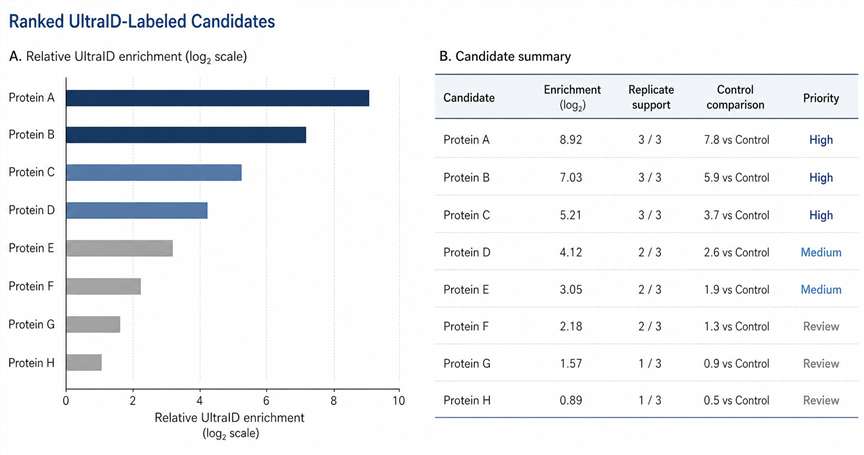
Representative UltraID proximity labeling proteomics result showing ranked candidate proteins.

Ranked UltraID-Labeled Candidate Proteins

A ranked candidate table or bar chart can show proteins enriched after background filtering.

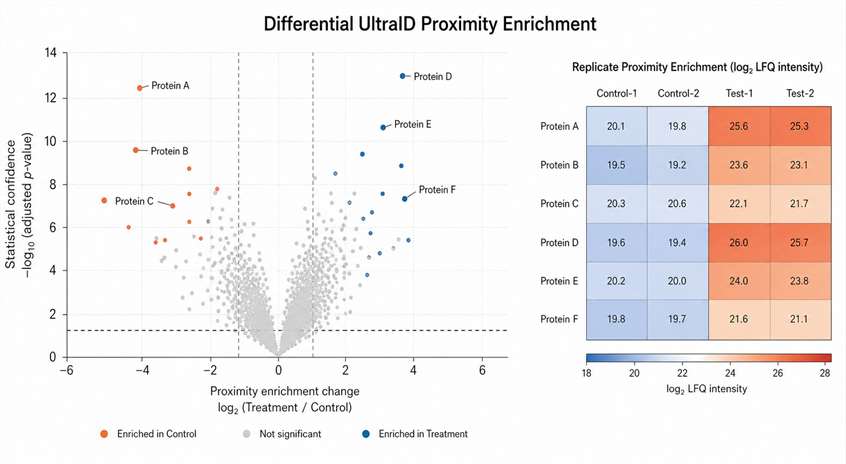
Representative UltraID proximity labeling proteomics result showing differential proximity enrichment.

Differential Proximity Enrichment Across Conditions

For bait vs control, treatment-control, stimulated-baseline, or mutant-wild-type designs, a volcano plot or heatmap can show condition-dependent enrichment.

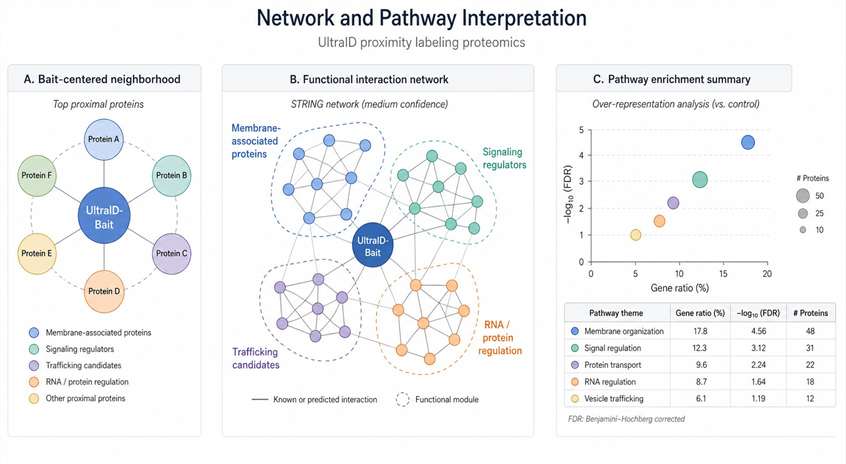
Representative UltraID proximity labeling proteomics result showing protein network and pathway interpretation.

Network and Pathway Interpretation

A bait-centered network can place enriched candidates into functional clusters. Pathway enrichment can help identify themes such as trafficking, membrane organization, RNA regulation, signaling, or protein transport.

Case Study: UltraID for Short-Pulse Interactome and Membrane-Associated Proxiome Mapping

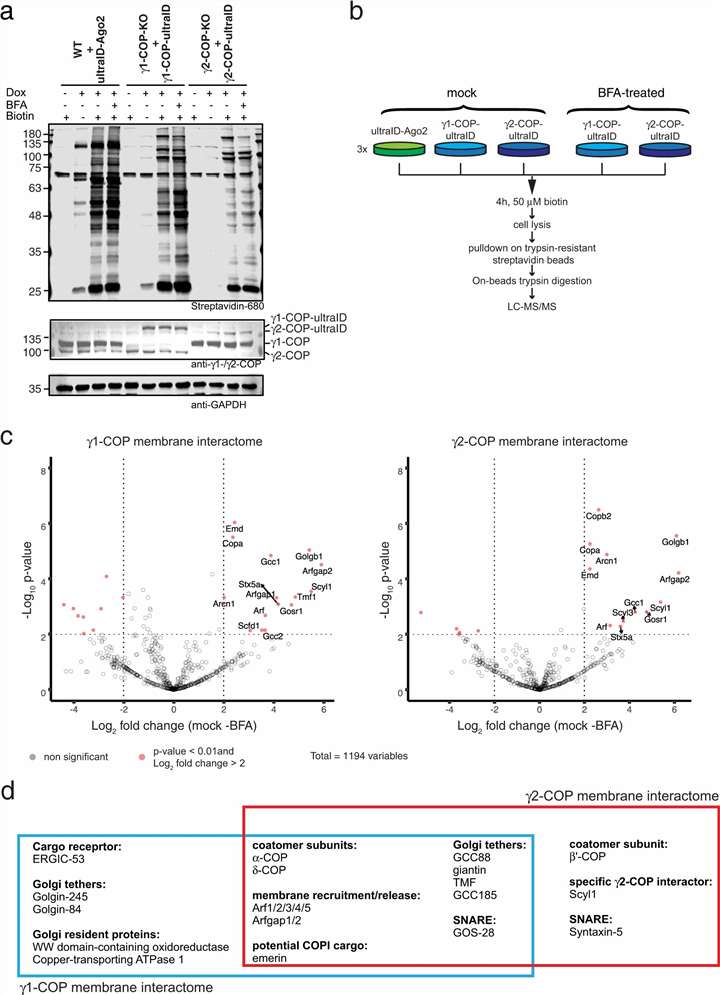
Kubitz, L., Bitsch, S., Zhao, X. et al. “Engineering of ultraID, a compact and hyperactive enzyme for proximity-dependent biotinylation in living cells.” Communications Biology 5, 657 (2022). https://www.nature.com/articles/s42003-022-03604-5

Background

Coatomer/COPI is a membrane-associated trafficking system whose active form transiently associates with endomembranes. This makes native-context interactome mapping challenging with conventional affinity purification. UltraID was developed as a compact engineered enzyme for proximity-dependent biotinylation in living cells, with applications in short-pulse interactome and membrane-associated proxiome mapping.

Methods

The study used UltraID fused to γ1-COP and γ2-COP in inducible rescue cell lines. Ago2-UltraID was used as a control fusion. The authors applied mock versus brefeldin A treatment to distinguish membrane-associated coatomer states, enriched biotinylated proteins, and analyzed the samples by LC-MS/MS.

Results

Figure 8 shows the experimental setup, LC-MS/MS volcano plots, and membrane-associated proximal protein outputs. The study identified 56 and 53 proximal proteins to γ1-COP and γ2-COP under mock conditions. After mock vs BFA filtering, the authors reported 21 and 17 membrane-associated proximal proteins. The paper also notes that all but one of the filtered hits were known Golgi proteins.

Conclusion

This case supports the value of UltraID for membrane-associated interactome mapping when construct design, control fusion selection, perturbation logic, enrichment, LC-MS/MS, and background filtering are planned together. It also shows why UltraID data should be interpreted as proximal candidate evidence rather than direct binding proof for every identified protein.

UltraID membrane-associated coatomer interactome mapping with LC-MS/MS volcano plots and proximal protein candidates.

Figure 8 from Kubitz et al. shows how UltraID can support membrane-associated interactome mapping through control fusion design, perturbation-based filtering, LC-MS/MS volcano plots, and proximal candidate interpretation.

FAQ

Frequently Asked Questions

Q: What is UltraID proximity labeling proteomics?

UltraID proximity labeling proteomics uses an engineered compact biotin ligase fused to a bait or local cellular region. Nearby proteins can be biotinylated, enriched, and identified by LC-MS/MS.

Q: How is UltraID different from TurboID?

UltraID and TurboID are both biotin ligase-based proximity labeling systems. UltraID is more compact, while TurboID is widely used and well established. The better choice depends on bait design, labeling condition, expression level, and background risk.

Q: How is UltraID different from BioID or BioID2?

BioID and BioID2 are established proximity labeling enzymes, but they often require longer labeling windows. UltraID was developed as a compact, active ligase option for proximity-dependent biotinylation.

Q: How is UltraID different from APEX/APEX2?

UltraID is a biotin ligase-based system. APEX/APEX2 is peroxidase-based and requires different activation chemistry. The right method depends on timing, cell model, labeling chemistry, and project goal.

Q: Does UltraID prove direct protein-protein interaction?

No. UltraID identifies proteins near the bait or local region under the selected condition. Direct interaction or functional dependency should be validated separately.

Q: What controls are recommended for UltraID proximity labeling?

Useful controls may include unrelated control bait, empty-vector or tag-only control, untreated or vehicle control, mutant bait control, localization control, enrichment QC control, and biological replicates.

Q: Can I submit samples if I already prepared UltraID constructs or labeled cells?

Yes. Please provide construct information, fusion orientation, cell model, labeling condition, enrichment status, controls, replicate design, and sample handling details.

Q: What LC-MS/MS deliverables will I receive?

Deliverables may include raw data files, protein identification and quantification tables, enriched candidate lists, background-filtered tables, QC summaries, and visualization-ready result tables.

Q: Can you provide pathway and network analysis?

Yes. Depending on project scope, we can provide GO, KEGG, or Reactome enrichment, protein interaction networks, membrane-associated marker review, and candidate prioritization.

Discuss an UltraID proximity labeling project with the MassTarget™ team

Share your bait design, cell model, labeling plan, and expected comparison groups. Our scientists will review feasibility and recommend an UltraID LC-MS/MS workflow aligned with your research question.

Disclaimer

This service is for Research Use Only and is not intended for clinical diagnosis, treatment selection, patient management, or medical decision-making.

Online Inquiry

Please submit a detailed description of your project. We will provide you with a customized project plan to meet your research requests. You can also send emails directly to for inquiries.

* Email
Phone
* Service & Products of Interest
Services Required and Project Description