APEX Proximity Labeling Proteomics Service

Creative Proteomics provides APEX Proximity Labeling Proteomics Service for researchers who need fast, location-aware protein-neighborhood mapping in living cell systems.

We help you review APEX/APEX2 feasibility, plan controls, enrich labeled proteins, acquire LC-MS/MS data, and interpret proximal candidates across bait-centered, organelle, membrane, receptor, and drug-response studies.

We built this service for projects where a standard protein list is not enough. Our team connects APEX/APEX2 labeling with enrichment proteomics, LC-MS/MS, QC review, and bioinformatics interpretation, so you can move from a local labeling experiment to a more usable candidate set for follow-up research.

Service strengths

  • Map rapid local protein neighborhoods
  • Support APEX and APEX2 proximity labeling workflows
  • Review localization, controls, and labeling conditions
  • Analyze enriched proteins by LC-MS/MS
  • Deliver candidate ranking, QC summaries, and pathway interpretation
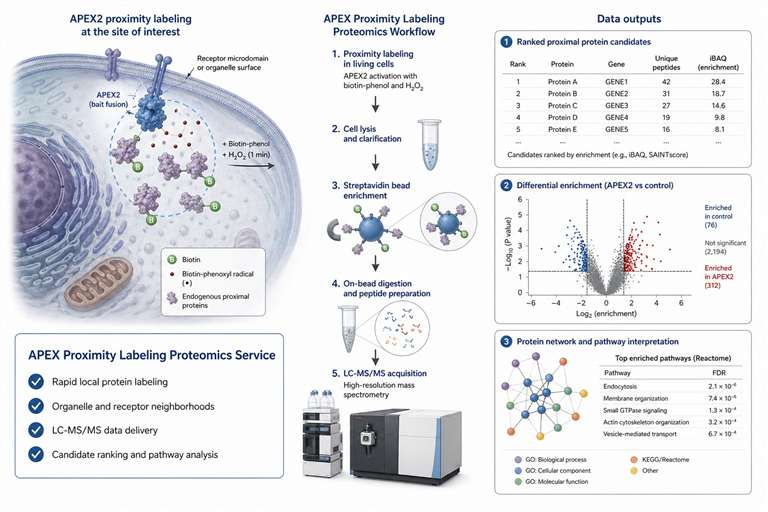
APEX proximity labeling proteomics service workflow showing local protein labeling, streptavidin enrichment, LC-MS/MS, and data outputs.
Local Environments Capabilities Workflow Comparison Applications Sample Deliverables Demo Case Study FAQ References Disclaimer

See Local Protein Environments with APEX Proximity Labeling

APEX proximity labeling is a peroxidase-based method for identifying proteins located near a bait protein, subcellular compartment, membrane region, receptor neighborhood, or signaling microdomain. In a typical workflow, APEX or APEX2 is fused to a protein or targeted to a defined cellular region. After labeling activation, nearby proteins are biotinylated, enriched, digested, and analyzed by LC-MS/MS.

This approach is most helpful when location and timing matter. Some protein associations are weak, transient, membrane-associated, or difficult to preserve after cell lysis. APEX-based labeling marks nearby proteins in the cellular environment before enrichment, giving researchers a local snapshot that conventional pull-down approaches may miss.

APEX proximity labeling should still be interpreted with care. It identifies proximal proteins under the selected labeling condition; it does not automatically prove direct physical binding. We help you plan controls and analyze enrichment patterns so the dataset can support candidate discovery, mechanism exploration, and follow-up validation decisions.

What APEX Proximity Labeling Detects

APEX/APEX2 proteomics can support detection of:

  • Proteins near a bait protein
  • Proteins enriched around an organelle or membrane region
  • Receptor-neighborhood proteins
  • Signaling microdomain-associated proteins
  • Local proteins that change after stimulation, mutation, or compound treatment
  • Candidate interactors that may be difficult to recover by extraction-based methods

When APEX Is More Useful Than Conventional Pull-Downs

APEX proximity labeling may be a strong fit when your project involves:

  • Fast local labeling windows
  • Subcellular or organelle-centered questions
  • Membrane, receptor, or signaling-complex neighborhoods
  • Weak or transient associations
  • Drug-treated vs control comparisons
  • Local protein environments that may not survive Co-IP or AP-MS workflows

How to Interpret Proximity-Based Evidence

APEX-based results are best treated as proximity evidence. A strong candidate is usually supported by enrichment over control, replicate consistency, and a biological connection to the bait, compartment, or treatment condition. For direct-binding or functional conclusions, top candidates should be validated with orthogonal approaches.

Our APEX/APEX2 Proteomics Service Capabilities

We support APEX/APEX2 projects from feasibility review through LC-MS/MS data delivery and bioinformatics analysis. If you already have a labeling system, we can focus on enrichment, proteomics, and data interpretation. If the project is still being designed, we can review the bait, localization strategy, controls, and sample plan before the work begins.

Bait-Centered Protein Neighborhood Mapping

For bait-centered studies, we help identify proteins enriched near a protein of interest. This can be useful for transcription factors, signaling proteins, receptor-associated proteins, scaffolds, organelle-localized proteins, and regulatory proteins with poorly defined local environments.

You can share the bait name, fusion orientation, tag design, cell model, and any known localization evidence. We use that information to judge whether the planned experiment can produce interpretable proximity data and to shape the downstream analysis plan.

Organelle, Membrane, and Receptor Microenvironment Profiling

APEX/APEX2 is often selected for compartment-aware proteomics because it can label proteins near a defined subcellular location. We support projects focused on mitochondria, ER, nucleus, plasma membrane, receptor neighborhoods, primary cilia, and other local protein environments.

For these studies, localization evidence is especially important. If the enzyme fusion does not reach the intended site, the final protein profile can shift away from the biological question. We therefore treat localization review as part of the project, not as a minor detail.

Drug-Treated vs Control Differential Proximity Analysis

APEX proteomics can compare local protein environments across biological states. For drug mechanism or pathway-response studies, this can help identify proteins that become more or less proximal after treatment.

  • Drug-treated vs control cells
  • Stimulated vs baseline cells
  • Mutant vs wild-type systems
  • Knockdown or perturbation models vs matched controls
  • Time-sensitive pathway activation studies

Client-Prepared APEX Sample LC-MS/MS Analysis

Some teams already perform APEX/APEX2 labeling and submit enriched proteins, lysates, pellets, or prepared samples for LC-MS/MS. In these cases, we review available information on labeling, enrichment, controls, and replicates before data acquisition.

This review helps us understand what the MS results can support. It also helps avoid overinterpreting data when the labeling history, control design, or sample handling is incomplete.

Feasibility Review for Localization, Controls, and Labeling Conditions

Before sample submission, we can review APEX or APEX2 construct design, bait or compartment targeting strategy, cell type and treatment conditions, labeling substrate and activation plan, negative and matched controls, biological replicate design, and expected deliverables.

A short feasibility review can prevent avoidable issues such as unclear localization, weak enrichment, excessive background, or missing controls.

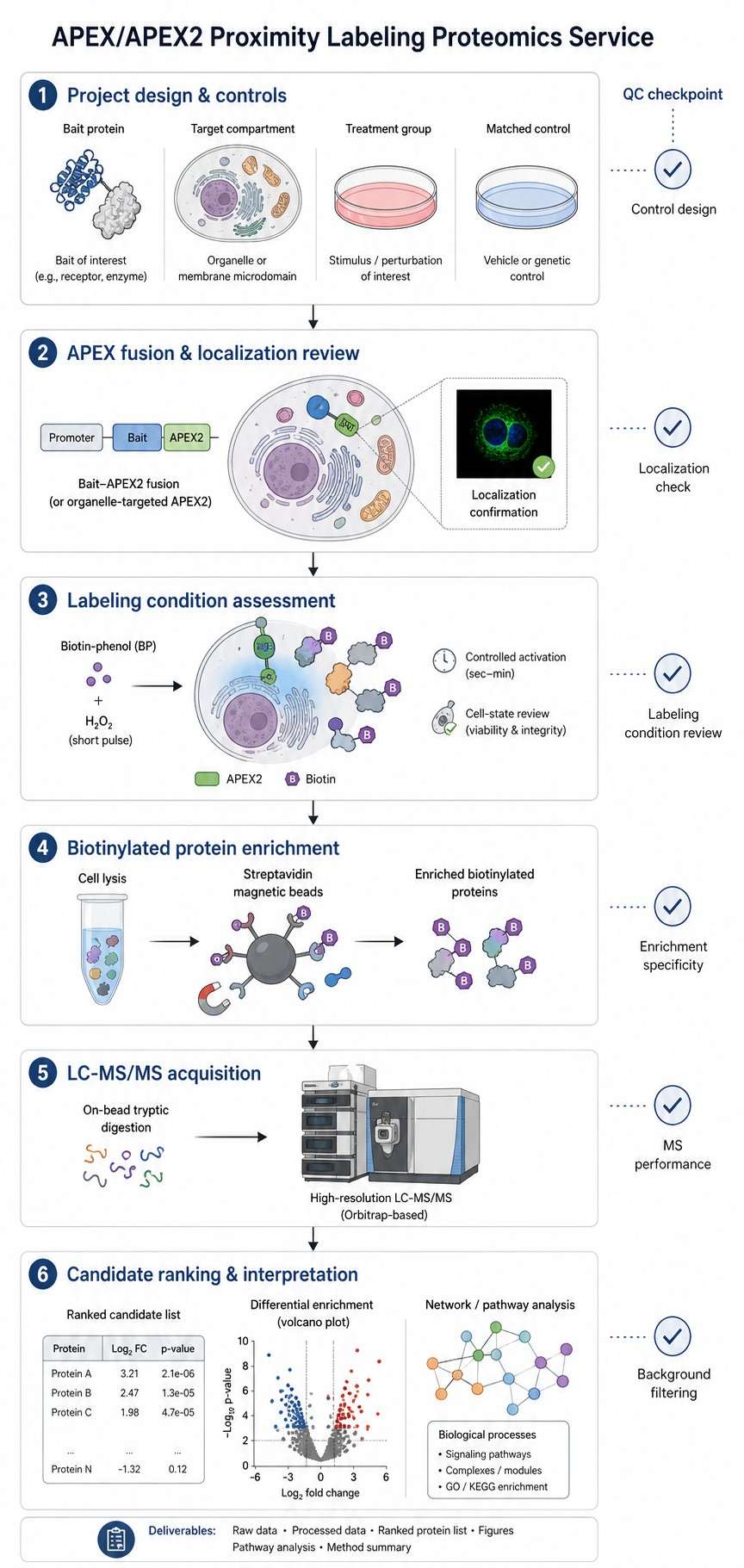
APEX/APEX2 Workflow with QC Checkpoints

Our workflow covers both the technical process and the service process, from project intake to final data delivery. At each step, we look at the same practical question: will this design produce proximity data that can be interpreted with confidence?

1

Project Design and Control Planning

We begin with the scientific question: What protein, compartment, receptor, or cellular region are you trying to study? We then review your cell model, perturbation design, control groups, replicate plan, and expected data outputs.

QC focus: Can the design separate true local enrichment from general background labeling?

2

APEX Fusion, Localization, or Client Model Review

If your project uses a bait-APEX or compartment-targeted APEX fusion, localization matters. We review the fusion orientation, tag position, targeting sequence, expression strategy, and available localization evidence.

For client-prepared models, we also review how the cells were generated, labeled, collected, and stored.

QC focus: Does the APEX/APEX2 system localize to the intended region?

3

Labeling Condition and Cell-State Assessment

APEX/APEX2 labeling depends on controlled activation. Labeling conditions should fit the cell model and the biological question. For drug-response or stimulation studies, the timing of treatment and labeling should be designed carefully.

QC focus: Does the labeling condition support local protein capture without creating avoidable stress or confusing background?

4

Biotinylated Protein Enrichment

After labeling, cells are collected and lysed. Biotinylated proteins are captured using streptavidin-based enrichment. Wash conditions are selected to reduce nonspecific material while preserving the enriched labeled-protein pool.

QC focus: Is enrichment strong enough for LC-MS/MS, and are background signals controlled?

5

LC-MS/MS Acquisition

The enriched proteins are digested into peptides and analyzed by LC-MS/MS. The acquisition method is selected based on project scope, sample type, and comparison design.

QC focus: Are peptide recovery, MS signal quality, and sample consistency suitable for downstream analysis?

6

Candidate Ranking and Interpretation

We process the proteomics data to generate protein identification, quantification, enrichment results, and candidate ranking. If the study includes multiple conditions, we can compare proximity enrichment across groups.

QC focus: Are the final candidates supported by enrichment, controls, reproducibility, and biological context?

Vertical APEX proximity labeling proteomics workflow with QC checkpoints.

Common control options include:

Enzyme-only controls

No-substrate or no-activation controls

Localization-matched controls

Untreated or vehicle controls

Mutant bait controls

Matched biological replicates

CTA: Share Your Bait and Cell Model Details

Choosing APEX vs TurboID, BioID, Co-IP-MS, AP-MS, and Spatial Proteomics

APEX/APEX2 is not automatically the best fit for every protein-interaction question. The right approach depends on the biology, timing, compartment, sample model, and type of evidence needed.

MethodWhat It MeasuresBest FitStrengthsKey LimitationsWhen We Would Consider It
APEX/APEX2 proximity labelingProteins near a bait or local cellular region after peroxidase-based labelingRapid, local, compartment-aware protein neighborhood mappingStrong spatial and temporal control; useful for organelles, membranes, receptors, and microdomainsRequires careful control of localization, substrate exposure, and backgroundWhen fast local labeling and LC-MS/MS candidate discovery are central
TurboID / miniTurboProximity-dependent biotin ligase labelingLiving-cell protein neighborhood mapping with biotin ligase chemistryEfficient labeling; broad use in bait-centered and compartment studiesMay produce a different profile than APEX/APEX2; background depends on designWhen biotin-ligase labeling better fits the model or time window
BioIDSlower biotin ligase-based proximity labelingLonger-window proximity mappingUseful when the biological question tolerates longer exposureLess suited for very fast eventsWhen slow labeling is acceptable and cell tolerance is favorable
Co-IP-MSProteins that remain associated with a bait after lysis and purificationStable protein complexesFamiliar validation method; direct bait-associated recoveryWeak or transient associations may be lost during extractionWhen stable complex recovery is the main goal
AP-MSAffinity-purified bait-associated proteinsStable interactome profilingUseful for well-behaved bait systemsLess suited for local or transient microenvironmentsWhen bait purification is robust and stable complexes are expected
Spatial proteomics / fractionation-MSProtein localization or compartment assignmentBroad compartment-level profilingUseful for global localization patternsLess bait-centered; may not resolve microdomain proximityWhen the question is broad localization rather than bait-centered proximity
Crosslinking MSCrosslinked protein contacts or distance-constrained informationStructural or complex-level interaction evidenceAdds structural distance supportMore complex analysis and lower coverageWhen proximity candidates need structural support

APEX/APEX2 vs TurboID and BioID

APEX/APEX2 uses peroxidase-based labeling, while TurboID, miniTurbo, and BioID use biotin ligase-based labeling. These systems can answer overlapping questions, but they are not identical. APEX/APEX2 may be preferred when rapid local labeling is important, while TurboID or BioID may be better suited to other cell models, time windows, or labeling conditions.

APEX/APEX2 vs Co-IP-MS and AP-MS

Co-IP-MS and AP-MS are valuable when stable protein complexes can be recovered after lysis. APEX/APEX2 is more useful when the target environment is local, transient, membrane-associated, or difficult to preserve during purification.

APEX/APEX2 vs Spatial Proteomics and Organelle Fractionation

Spatial proteomics and organelle fractionation can help assign proteins to compartments, but they are not always bait-centered. APEX/APEX2 can provide a more local view around a bait, receptor, organelle region, or microdomain.

Selection Rules by Research Goal

Use APEX/APEX2 when:

  • The question depends on rapid local labeling
  • The target is an organelle, membrane region, receptor, or microdomain
  • You need condition-dependent proximity comparison
  • Conventional pull-downs may lose weak or transient associations

Consider another approach when:

  • You need direct physical binding evidence
  • You expect a stable protein complex that can be purified
  • You need structural distance information
  • You need broad localization profiling rather than local proximity

For orthogonal follow-up, related MS approaches may include chemical cross-linking mass spectrometry, Proteome-wide thermal stability profiling, or HDX-MS epitope mapping.

Applications for APEX Proximity Labeling Proteomics

APEX/APEX2 proteomics is useful when local cellular context matters. We support projects where location, timing, and perturbation state shape the biological question.

Subcellular and Organelle Proteome Mapping

APEX/APEX2 can help identify proteins near a defined subcellular structure, including mitochondria, ER, nucleus, primary cilia, or other compartments. This is useful when whole-cell proteomics is too broad to answer a local-environment question.

Membrane and Receptor Neighborhood Profiling

For receptor biology, membrane signaling, and cell-surface regulation, APEX-based labeling can help reveal proteins enriched near a receptor or membrane microdomain. This can support candidate discovery for receptor-proximal signaling and local protein organization.

Signaling Microdomain and Pathway-Response Studies

Many signaling events happen quickly and locally. APEX/APEX2 can support studies of pathway components, scaffold proteins, transcription-factor neighborhoods, or compartment-specific signaling assemblies.

Drug Perturbation and Mechanism Exploration

For compound-treated models, APEX proteomics can help compare local protein environments before and after treatment. These results can support mechanism exploration when combined with other MS-based methods such as photoaffinity labeling MS, Activity-based protein profiling, or Competitive ABPP.

Genomic Locus or Chromatin-Associated Protein Mapping

APEX-based proximity labeling has also been adapted for targeted chromatin or genomic-locus proteomics. For these projects, the design is more specialized and should be reviewed carefully before sample submission.

Sample Requirements and Project Intake Checklist

APEX/APEX2 projects are highly dependent on cell model, labeling strategy, and whether you submit cells, pellets, lysates, enriched material, or prepared peptides. The table below provides practical starting points for project planning based on general proteomics sample submission guidance.

Sample / Material TypeRecommended Amount or InputStorage / ShippingKey Notes
Cultured cells for standard quantitative proteomics5 × 106 cells for label-free analysis; 1 × 10⁷ cells for DIA-style workflowsFrozen cell pellet; ship on dry iceKeep cell numbers consistent across groups
Trace cell proteomics sample200–5,000 cellsFrozen low-bind tube where applicableFeasibility review required before submission
Animal soft tissue100 mg for label-free; 200 mg for DIA-style workflowsFlash-freeze; ship on dry iceRecord tissue source and handling history
Animal hard tissue200 mg for label-free; 300–500 mg for DIA-style workflowsFlash-freeze; ship on dry iceDiscuss homogenization needs before submission
Plasma / serum / CSF without high-abundance protein depletion20 μLFreeze and ship on dry iceAvoid hemolysis and repeated freeze-thaw cycles
Plasma / serum / CSF with high-abundance protein depletion50–100 μL for label-free; 100 μL for DIA-style workflowsFreeze and ship on dry iceEDTA plasma may be preferred for depletion workflows
Pure protein or enriched protein material150 μg for label-free; 300 μg for DIA-style workflowsKeep frozen unless otherwise discussedProvide buffer and preparation details
Cell culture supernatant10 mL for label-free; 20 mL for DIA-style workflowsFreeze and ship on dry iceSerum-containing medium may complicate interpretation
FFPE material10 slices for label-free; 15–20 slices for DIA-style workflowsShip under agreed conditionsEach slice: about 10 μm thickness and 1.5 × 2 cm area

What to Prepare Before Submission

  • Bait protein or target compartment
  • APEX or APEX2 construct information
  • Fusion orientation and localization evidence
  • Cell type, culture condition, and treatment design
  • Labeling condition and sample handling history
  • Control groups and replicate plan
  • Whether enrichment has already been performed
  • Expected comparison groups and biological question

Control, Replicate, and Treatment Information

Strong APEX proteomics starts with control design. If your project includes treatment or stimulation, please provide timing, concentration, treatment order, and matched control conditions. If you are not sure which controls fit your design, our team can review the study plan before sample preparation.

LC-MS/MS Deliverables and Bioinformatics Analysis

A useful APEX dataset should show more than “which proteins were detected.” We help you evaluate which proteins are enriched, how consistent the enrichment is, whether differences appear across conditions, and how the candidates fit known pathways or compartments.

Minimum DeliverablesOptional Bioinformatics Add-OnsCandidate Prioritization Factors
  • Raw LC-MS/MS data files
  • Protein identification table
  • Protein quantification table
  • APEX-labeled candidate protein list
  • Background-filtered enrichment table
  • Sample-level QC summary
  • Enrichment QC summary
  • Volcano plot or heatmap-ready result table
  • Methods and parameter summary
  • Differential proximity enrichment analysis
  • GO enrichment analysis
  • KEGG / Reactome pathway enrichment
  • Protein interaction network visualization
  • Subcellular marker enrichment review
  • Treatment-control comparison
  • Bait-centered candidate prioritization
  • Custom visualization package
  • Enrichment over control
  • Detection consistency across replicates
  • Condition-dependent proximity change
  • Known localization or pathway relevance
  • Background or contaminant risk
  • Biological fit with the bait, compartment, or perturbation

This gives you a clearer short list for follow-up validation rather than an unfiltered protein table.

Demo Results: What APEX Proteomics Data Can Show

The examples below describe typical result types. They are representative output formats, not claims about a specific project result.

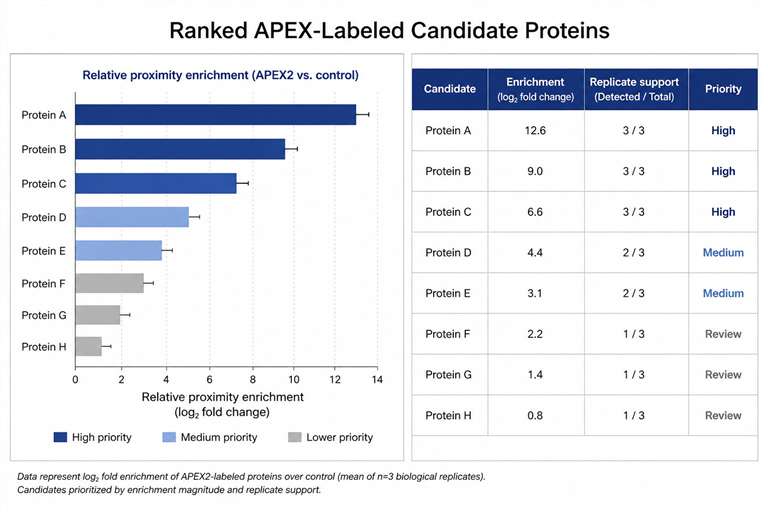
Representative APEX proteomics demo result showing ranked candidate proximal proteins.

Ranked APEX-Labeled Candidate Proteins

A ranked candidate table or bar chart can show which proteins are most enriched after background filtering.

  • Protein ID
  • Gene name
  • Enrichment value
  • Replicate support
  • Candidate priority group
  • Annotation notes
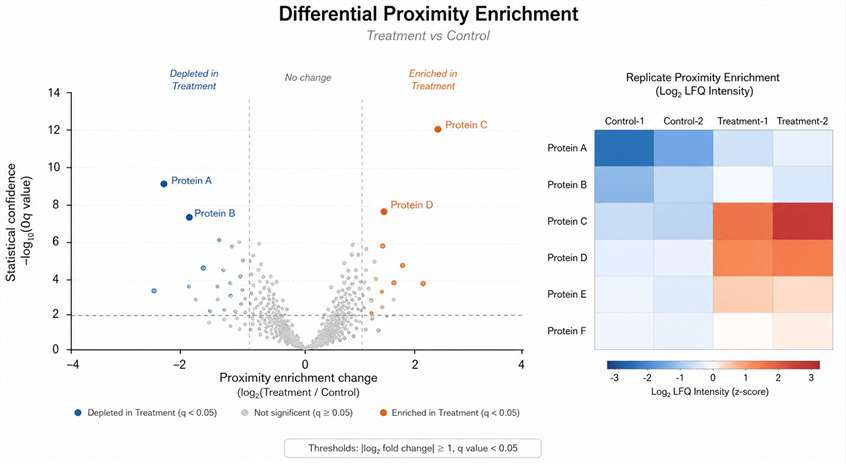
Representative APEX proteomics demo result showing differential proximity enrichment.

Differential Proximity Enrichment Across Conditions

For drug-treated vs control, stimulated vs baseline, or mutant vs wild-type designs, a volcano plot or heatmap can show proteins with condition-dependent proximity changes.

  • Group comparison table
  • Up-enriched and down-enriched candidates
  • Replicate-level consistency view
  • Statistical comparison where design allows
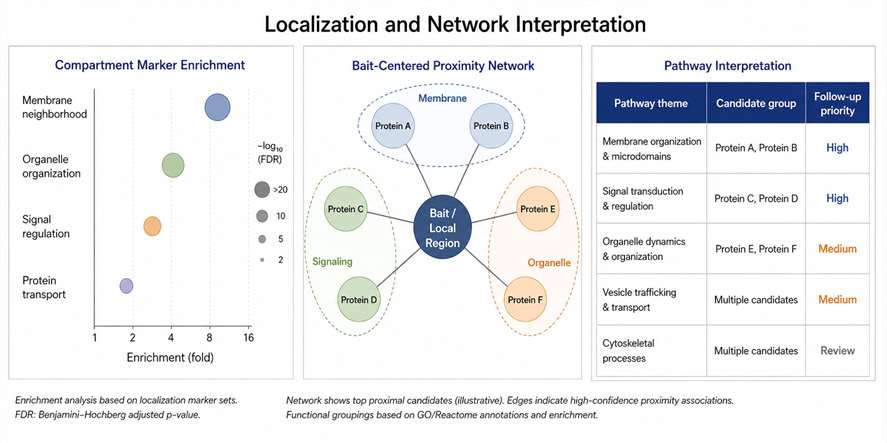
Representative APEX proteomics demo result showing protein network and pathway interpretation.

Localization-Informed Enrichment

For organelle or compartment studies, candidates can be grouped by known localization markers or functional annotation. This helps separate expected compartment proteins from unexpected candidates that may deserve follow-up.

Protein Network and Pathway Interpretation

A bait-centered or compartment-centered network can place enriched candidates into functional clusters. Pathway enrichment can help identify biological themes such as protein transport, signal regulation, organelle organization, or receptor-proximal pathways.

Case Study: Improving Specificity in APEX-Based Subcellular Proteomics

Source: An enzymatic cascade enables sensitive and specific proximity labeling proteomics in challenging biological systems

Background

APEX-based proximity labeling is valuable for subcellular proteomics because it can provide strong spatial and temporal control. However, conventional APEX2 activation can face background labeling and substrate-related concerns in some biological systems. This is especially important when the target compartment is small, difficult to isolate, or surrounded by proteins that can create nonspecific signal.

Sroka and colleagues addressed this challenge by developing iAPEX, an enzymatic cascade designed to locally generate hydrogen peroxide and improve specificity in APEX-based proximity labeling. The study tested this strategy across challenging biological contexts, including primary cilia proteomics.

Methods

The authors combined APEX2 with D-amino acid oxidase to activate labeling locally. In the primary cilia experiment, they applied the workflow in IMCD3 cells, enriched labeled proteins, digested proteins, labeled peptides with TMT, and analyzed samples using LC-MS-based quantitative proteomics.

The study compared iAPEX with conventional APEX2-based labeling under related experimental conditions. It also used downstream filtering and GO-based interpretation to evaluate specificity and enrichment quality.

Results

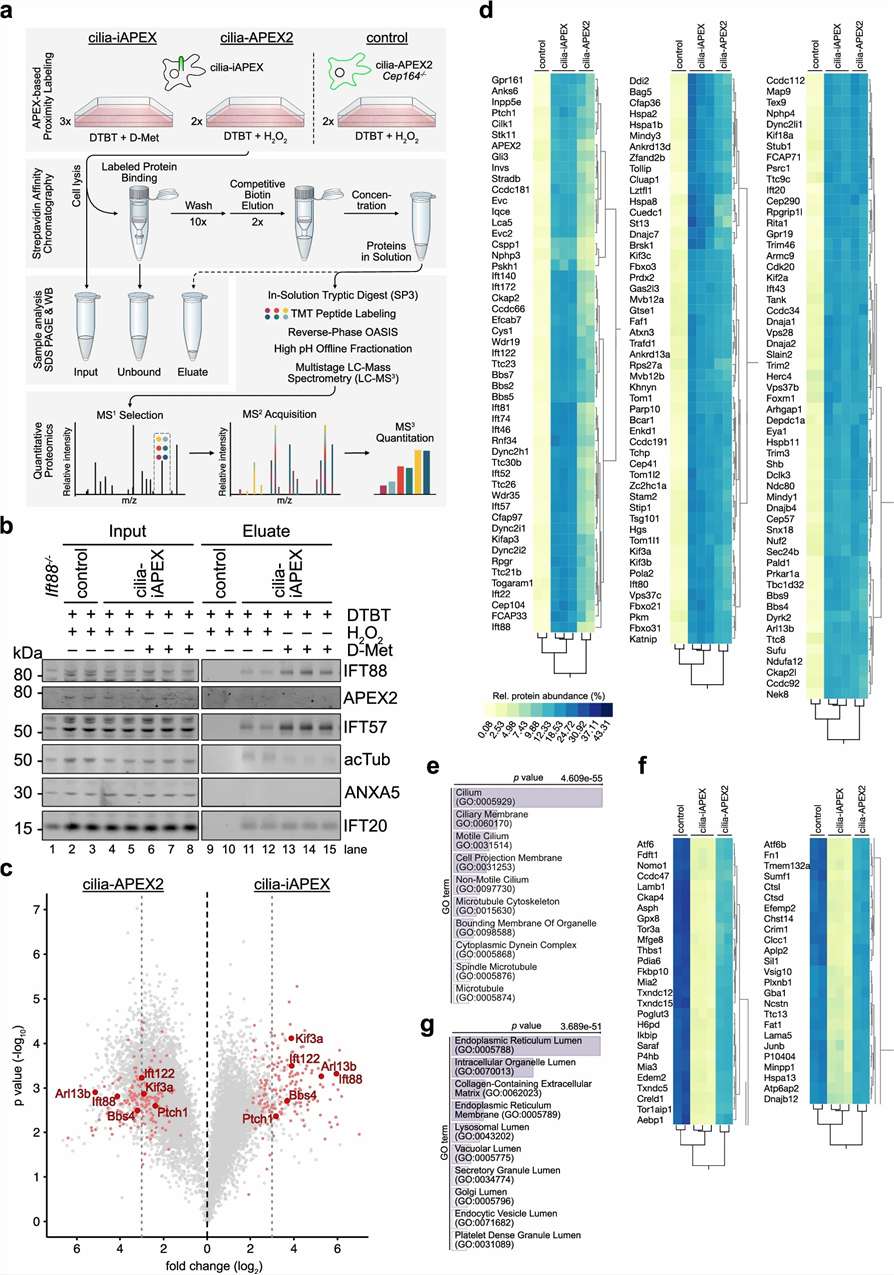
Figure 4 reports quantitative primary cilia proteomics using iAPEX compared with a conventional APEX2-based system in IMCD3 cells. The study quantified 5,982 proteins in this experiment. Under stringent enrichment filtering, iAPEX identified 175 high-confidence candidate cilia proteins, while the conventional APEX2-based system produced 799 putative cilia proteins under the same cutoff.

The authors showed that iAPEX separated known ciliary proteins from non-ciliary proteins more clearly than the conventional APEX2-based system. GO enrichment analysis also supported improved specificity for cilia-associated terms.

Conclusion

This case illustrates an important lesson for APEX proximity labeling projects: the labeling strategy, activation conditions, controls, and filtering logic strongly affect interpretability. For clients planning APEX/APEX2 proteomics, this supports the value of feasibility review, careful QC design, and bioinformatics filtering before drawing biological conclusions from candidate lists.

Quantitative APEX-based primary cilia proteomics showing candidate filtering and enrichment specificity.

Figure 4 from Sroka et al. shows how APEX-based proximity labeling can be evaluated through quantitative proteomics, candidate filtering, and specificity-focused enrichment analysis.

FAQ

Frequently Asked Questions

Q: What is APEX proximity labeling proteomics?

APEX proximity labeling proteomics uses an engineered peroxidase, usually APEX or APEX2, to label proteins located near a bait protein or target cellular region. The labeled proteins are enriched and identified by LC-MS/MS.

Q: How is APEX/APEX2 different from TurboID or BioID?

APEX/APEX2 uses peroxidase-based labeling, while TurboID, miniTurbo, and BioID use biotin ligase-based labeling. APEX/APEX2 is often selected when rapid, local, compartment-aware labeling is important. The best choice depends on the cell model, time window, target location, and background risk.

Q: Does APEX labeling prove direct protein-protein interaction?

No. APEX labeling shows that proteins were near the bait or target region under the chosen experimental condition. Direct interaction or functional dependency should be tested with follow-up methods when needed.

Q: What kinds of projects are best suited to APEX/APEX2?

APEX/APEX2 is well suited for local protein-neighborhood studies, organelle proteomics, receptor or membrane microenvironment profiling, signaling microdomain studies, and condition-dependent proximity comparisons.

Q: Can APEX proteomics compare drug-treated and control cells?

Yes. With matched controls and replicates, APEX proteomics can compare local protein environments between treated and control groups. This can support mechanism exploration and candidate prioritization.

Q: What controls are recommended for APEX proximity labeling?

Useful controls may include enzyme-only controls, no-substrate controls, no-activation controls, localization-matched controls, untreated controls, mutant bait controls, and biological replicates. The right control set depends on your system.

Q: Can I submit samples if I already performed APEX labeling?

Yes. If labeling has already been performed, please provide the cell model, construct information, labeling condition, enrichment status, controls, replicate design, and sample handling details. We can review whether the material is suitable for LC-MS/MS analysis.

Q: What LC-MS/MS deliverables will I receive?

Deliverables may include raw data files, protein identification and quantification tables, enriched candidate lists, background-filtered tables, QC summaries, and visualization-ready result tables.

Q: Can you provide pathway and network analysis?

Yes. Depending on project scope, we can provide GO, KEGG, or Reactome enrichment, protein interaction networks, subcellular marker review, and candidate prioritization.

Q: When should I choose Co-IP-MS, AP-MS, or crosslinking MS instead?

Choose Co-IP-MS or AP-MS when you expect stable protein complexes that can survive extraction. Choose crosslinking MS when structural distance information is needed. APEX/APEX2 is more useful when the main question is local, rapid, or compartment-aware proximity.

Disclaimer

This service is for Research Use Only and is not intended for clinical diagnosis, treatment selection, patient management, or medical decision-making.

Online Inquiry

Please submit a detailed description of your project. We will provide you with a customized project plan to meet your research requests. You can also send emails directly to for inquiries.

* Email
Phone
* Service & Products of Interest
Services Required and Project Description