Bioassay-Guided Fractionation + LC-MS Service

Accelerate bioactive hit identification from complex natural product extracts — integrated fractionation, high-resolution LC-MS/MS, and molecular networking under one CRO roof.

You have a crude extract that shows real promise in your assay — but which compound or compounds are driving that activity? That is the question bioassay-guided fractionation (BGF) was designed to answer. It is the classic strategy for natural product drug discovery: fractionate the extract chromatographically, test each fraction in a bioassay, and iteratively narrow down until the active compound(s) are pinned down.

At MassTarget™, we have taken this proven workflow and supercharged it with modern LC-MS-based metabolomics and molecular networking. Instead of tracking activity fraction by fraction in isolation, we overlay your bioactivity data directly onto molecular networks generated from high-resolution MS/MS data. The result is a visual map that shows you, at a glance, which molecular features correlate with activity — and which ones are just noise.

Key Advantages:

  • End-to-end workflow: From crude extract to prioritized bioactive hit list, with no handoffs between vendors
  • Advanced dereplication: GNPS molecular networking + feature-based metabolomics to eliminate knowns and spotlight novel compounds
  • Flexible scale: Analytical fractionation (96-well plate) to preparative isolation support
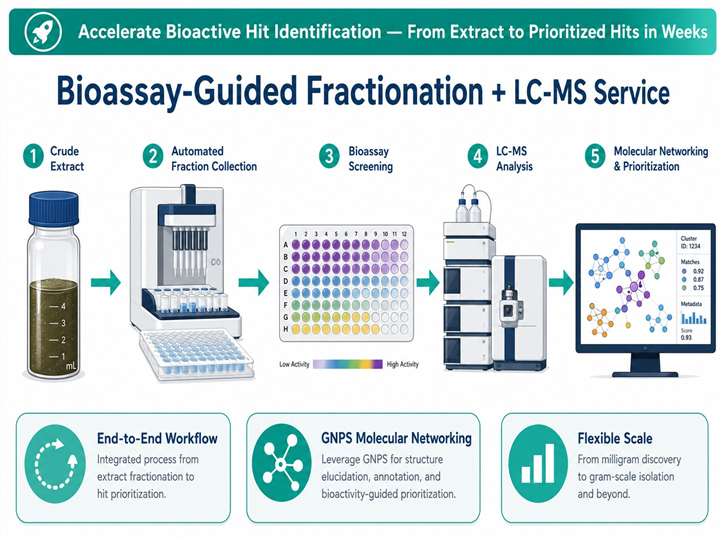
Bioassay-guided fractionation LC-MS service workflow overview showing extract fractionation, bioassay testing, LC-MS analysis, and molecular networking for natural product drug discovery.
What Is BGF + LC-MS Key Advantages When to Use Workflow Tech Comparison Sample Demo Case Study FAQ

What Is Bioassay-Guided Fractionation + LC-MS?

Bioassay-guided fractionation (BGF) combined with high-resolution LC-MS is a systematic workflow for identifying bioactive compounds from complex natural product extracts. The process begins with fractionating a crude extract — typically by flash chromatography — into discrete fractions, each of which is tested in a bioassay to locate activity. Active fractions are then analyzed by LC-HRMS/MS to identify the molecular features responsible.

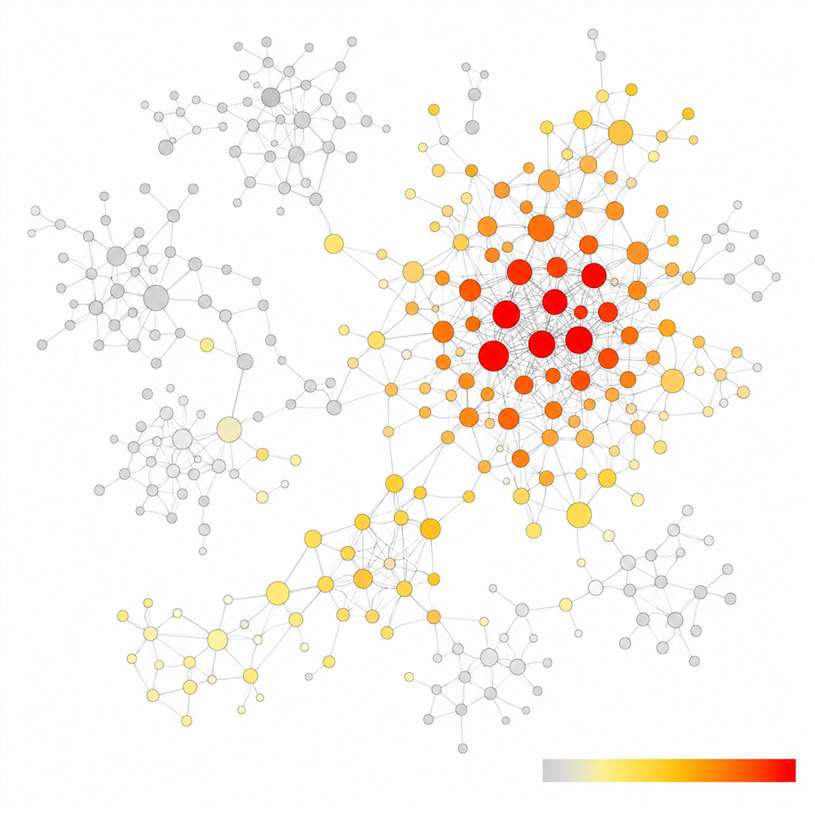
What sets the MassTarget™ approach apart is the integration of GNPS Molecular Networking and Feature-Based Molecular Networking (FBMN) directly into the fractionation pipeline. Instead of tracking activity blindly, we map every MS feature onto a molecular network and overlay bioactivity data as a heatmap. Active clusters stand out immediately, while inactive features fade into the background — giving you a data-driven shortcut to your most promising hits.

Why MassTarget for BGF + LC-MS?

ChallengeOur Solution
Time-consuming iterative fractionation cyclesIntegrated workflow with parallel bioassay + MS analysis
High rediscovery rate of known compoundsGNPS molecular networking + automated dereplication
Difficulty prioritizing active fractionsBioactivity heatmap overlaid on molecular network
Fragmented vendor handoffsSingle CRO managing fractionation, MS, and data analysis

For a broader overview of our capabilities in this area, see our Natural Product MS Discovery service.

Key Advantages of BGF + LC-MS at MassTarget

Integrated BGF + HRMS Workflow Under One Roof

Most labs handle fractionation in-house, then send fractions out for MS analysis, then hire a bioinformatician to make sense of the data. We skip that chain entirely. Your project moves from extraction to fractionation to LC-HRMS/MS acquisition to bioinformatics — all managed by one scientific team, with no handoffs and no data lost in translation.

Advanced Dereplication via GNPS Molecular Networking

The biggest time sink in natural product discovery is isolating a compound you already know. We avoid that by running every fraction's MS/MS spectra through the GNPS platform — the largest public repository of annotated mass spectra, with over 200,000 entries. Known compounds are flagged and set aside before you spend resources on isolation.

Bioactivity Correlation with Feature-Based Metabolomics

Feature-based molecular networking (FBMN) lets us connect each MS feature — each retention time, m/z value, and MS/MS spectrum — with its bioactivity readout across all fractions. The output is a bioactivity heatmap overlaid on the molecular network. Active clusters stand out in color; inactive ones fade into the background.

Flexible Fractionation Scale

Need a quick analytical-scale screen on 10 mg of extract? We will run it in 96-well plate format. Found a hit that needs gram-scale material for NMR? We scale up to preparative flash chromatography and prep HPLC. Same workflow, same team, different scale.

Rapid Turnaround — Active Hit Prioritization in Weeks

Parallel fraction processing and automated data analysis pipelines collapse the typical BGF timeline. Where traditional approaches take 6–12 months to reach hit prioritization, we deliver a prioritized hit list in 4–8 weeks.

Comprehensive Deliverable Package

You get more than fractionated samples and raw MS files. The final package includes interpreted molecular networks, bioactivity maps, dereplication results, and a ranked hit list with structural annotations — everything you need to decide which compounds to isolate next.

When to Use This Service

Bioassay-guided fractionation with LC-MS is most valuable when you have bioactivity data but lack compound-level resolution. Below are the research scenarios where this approach delivers the greatest impact.

Crude Extract Shows Bioactivity but Active Compound(s) Unknown

Your initial screening identified a promising extract — now you need to pinpoint which compounds are responsible. BGF + LC-MS systematically narrows the search space from hundreds of features to a handful of prioritized hits.

We solve: converting a "hit extract" into a "hit compound shortlist" with minimal wasted effort.

High Rediscovery Rate — Need Efficient Dereplication

You keep isolating known compounds that have already been reported in the literature. Our GNPS-based dereplication pipeline flags knowns early, so your isolation resources go toward genuinely novel chemistry.

We solve: breaking the rediscovery cycle with systematic MS/MS library matching and database cross-referencing.

Learn more about our LC-HRMS/MS Dereplication capabilities.

Multiple Bioactive Fractions Need Prioritization

Your fractionation produced several active pools, and you need a rational, data-driven way to decide which ones to pursue first. We rank fractions by bioactivity potency, chemical novelty, and abundance.

We solve: turning a list of active fractions into a ranked hit list with clear go/no-go criteria.

Need to Correlate Metabolomic Features with Bioassay Data

You want to move beyond fraction-level activity to compound-level assignment. FBMN maps every MS feature to its bioactivity readout, giving you molecular-level resolution of what is driving the signal.

We solve: connecting the dots between metabolomic profiles and functional activity.

Large Extract Library Requires Systematic HTS Fractionation

You have dozens or hundreds of extracts and need a standardized, high-throughput fractionation workflow that scales. Our 96-well plate format and automated flash chromatography handle batch processing efficiently.

We solve: scaling BGF from single-extract deep dives to library-wide screening campaigns.

BGF + LC-MS Workflow

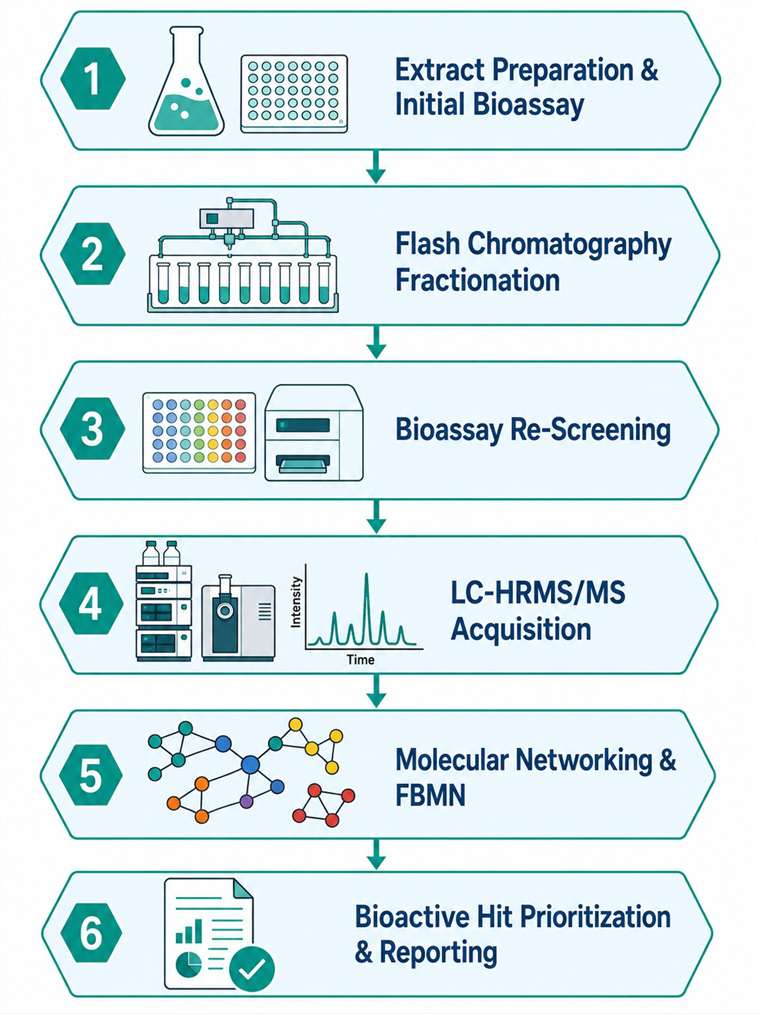
Our 6-step integrated workflow from crude extract to prioritized bioactive hit list:

1

Extract Preparation & Initial Bioassay

Your crude extract (or pre-fractionated sample) is received, logged, and subjected to initial bioassay confirmation. We work with your assay protocol or recommend appropriate assays based on your research goal.

2

Flash Chromatography Fractionation

The extract is fractionated using automated flash chromatography with a standardized gradient. Fractions are collected in 96-well plates (typically 48–96 fractions per extract), dried, and reconstituted for both bioassay and MS analysis.

3

Bioassay Re-Screening of Fractions

Each fraction is tested in your chosen bioassay (or we coordinate with your lab for testing). Active fractions are identified based on predefined activity thresholds.

4

LC-HRMS/MS Acquisition of Active Fractions

Active fractions are analyzed by ultra-high-performance liquid chromatography coupled with high-resolution tandem mass spectrometry (UHPLC-HRMS/MS) on Thermo Scientific™ Orbitrap or Q-TOF platforms. Data are acquired in both positive and negative ionization modes.

5

Molecular Networking & Feature-Based Metabolomics

Raw MS data are processed using MZmine 3 for feature detection, alignment, and gap-filling. Processed data are uploaded to GNPS for molecular networking and feature-based molecular networking (FBMN). Bioactivity data are overlaid onto the molecular network to generate a bioactivity heatmap.

6

Bioactive Hit Prioritization & Reporting

Compounds are prioritized based on a composite score combining bioactivity potency, novelty (dereplication status), abundance, and chemical class relevance. A final report includes the prioritized hit list, molecular network visualizations, and recommendations for downstream isolation.

Six-step bioassay-guided fractionation LC-MS workflow diagram showing extract preparation, flash chromatography fractionation, bioassay re-screening, LC-HRMS/MS acquisition, molecular networking with FBMN, and bioactive hit prioritization.

Key technologies integrated into this workflow:

Technology Comparison: BGF + LC-MS vs. Alternative Approaches

DimensionBGF + LC-MS (MassTarget)NMR-Only ApproachLC-MS Only (No BGF)HTS Fractionation Only
Dereplication CapabilityHigh (GNPS + FBMN)Low (requires pure compound)Moderate (MS/MS library match)None
Bioactivity CorrelationDirect (fraction-to-feature mapping)Indirect (requires prior isolation)NoneDirect (fraction-level only)
ThroughputHigh (96-well parallel)Low (one compound at a time)HighVery High
Structural InformationModerate (MS/MS annotation)High (full structure elucidation)ModerateNone
Cost EfficiencyHigh (eliminates dead-end isolations)Low (expensive per-compound)ModerateHigh
Time to Hit Prioritization4–8 weeks6–12 months2–4 weeks1–2 weeks

For a complementary approach that combines native mass spectrometry with metabolomics-based ligand discovery, see our Native Metabolomics for Ligand Discovery service.

Sample Requirements

Sample TypeRecommended AmountFormatBioassay RequirementTurnaround (Weeks)
Crude extract (plant)≥50 mg dry extractGlass vial or 96-well plateProvided by client or coordinated4–6
Crude extract (microbial)≥20 mg dry extractGlass vial or 96-well plateProvided by client or coordinated4–6
Pre-fractionated sample≥5 mg per fraction96-well plateProvided by client or coordinated3–4
Marine organism extract≥50 mg dry extractGlass vialProvided by client or coordinated4–6
Fungal culture broth extract≥20 mg dry extractGlass vialProvided by client or coordinated4–6

Deliverables

  • Fractionated extract library: 96-well plate or vial set containing all fractions
  • LC-HRMS/MS raw data files: Thermo .raw or Bruker .d format
  • Processed feature table: Retention time, m/z, MS/MS spectra, and relative abundance across fractions
  • GNPS molecular networking results: Interactive network visualization (Cytoscape-ready)
  • Bioactivity heatmap: Activity data overlaid on molecular network for visual hit prioritization
  • Prioritized hit list: Ranked compounds with dereplication status, proposed annotation, and bioactivity score
  • Final report: Comprehensive documentation of methods, results, and data interpretation

Representative Data

Molecular network with bioactivity heatmap overlay showing prioritized bioactive compound clusters from a BGF + LC-MS project.

Bioactivity-Guided Molecular Network

A representative molecular network from a BGF + LC-MS project. Nodes represent MS features (compounds), edges represent MS/MS spectral similarity. Node color intensity reflects bioactivity potency across fractions. The highlighted cluster (red) represents a group of bioactive compounds prioritized for isolation.

Case Study: Accelerated Bioactive Metabolite Discovery via nanoRAPIDS

Nuñez Santiago I, Machushynets NV, Mladic M, van Bergeijk DA, Elsayed SS, Hankemeier T, van Wezel GP. "nanoRAPIDS as an analytical pipeline for the discovery of novel bioactive metabolites in complex culture extracts at the nanoscale." Communications Chemistry. 2024;7:71. https://doi.org/10.1038/s42004-024-01153-y

Objective

To develop and validate a miniaturized analytical platform (nanoRAPIDS) that integrates nanofractionation, bioassay, LC-MS/MS, and feature-based molecular networking (FBMN) for rapid discovery of novel bioactive metabolites from microbial extracts using minimal sample amounts.

Methods

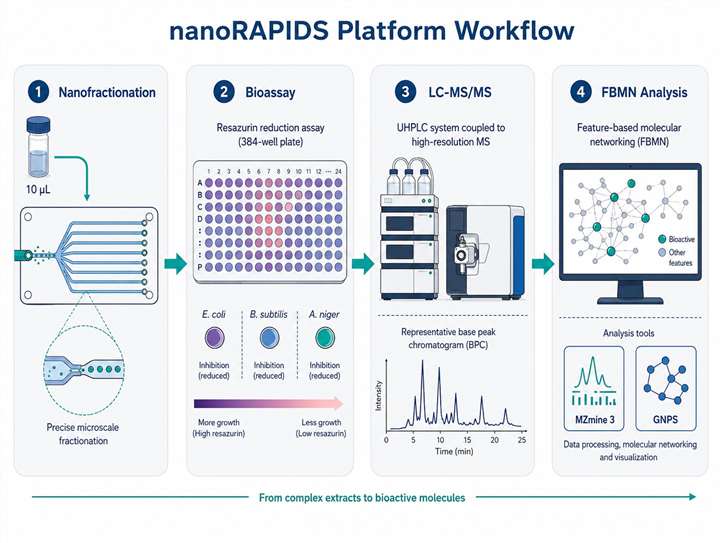
The nanoRAPIDS workflow combines:

  • At-line high-resolution nanofractionation of microbial extracts (requiring only ~10 μL of crude extract)
  • High-throughput bioassay (resazurin reduction assay against E. coli, B. subtilis, and A. niger)
  • Parallel LC-MS/MS acquisition for all fractions
  • Automated FBMN analysis via MZmine 3 + GNPS for dereplication and analog searching

Key Results

  • Validation phase: Applied to Bacillus sp. 90A-23 extract — successfully assigned antimicrobial activity to known iturin and surfactin lipopeptide families, confirming platform reliability
  • Discovery phase: Applied to Streptomyces sp. MBT84 extract (catechol-induced) — identified a low-abundance bioactive feature within a complex angucycline molecular network
  • Outcome: Large-scale fermentation and isolation yielded saquayamycin N — a novel angucycline derivative bearing an N-acetylcysteine moiety — alongside the known compound fridamycin A

Significance

This study demonstrates that integrated nanofractionation + LC-MS/MS + FBMN can identify novel bioactive metabolites from complex extracts at the nanogram scale, dramatically reducing sample requirements while maintaining discovery sensitivity. The approach is directly applicable to bioassay-guided fractionation programs in natural product drug discovery.

nanoRAPIDS workflow schematic showing nanofractionation, bioassay, LC-MS/MS acquisition, and FBMN analysis for bioactive metabolite discovery.

nanoRAPIDS workflow: nanofractionation → bioassay → LC-MS/MS → FBMN analysis (adapted from Nuñez Santiago et al., 2024).

FAQ

Frequently Asked Questions

Q: What types of samples can you process?

Pretty much any natural product extract you would work with in a discovery program: plant material (roots, leaves, bark, whole plant), microbial fermentation broths (actinomycetes, fungi, bacteria), marine organisms (sponges, tunicates, algae), and fungal cultures. We also take pre-fractionated samples if you have already done some initial separation.

Q: How much extract do you need?

For a standard analytical-scale project, send at least 50 mg of dry crude extract for plant or marine samples, or 20 mg for microbial extracts. If you are working with pre-fractionated material, 5 mg per fraction is usually enough. Got less than that? We can often work with smaller amounts using our nano-scale workflow — just ask.

Q: How long does a typical BGF + LC-MS project take?

From sample receipt to final report, expect 4–8 weeks for the initial hit prioritization phase. The actual timeline depends on how complex your extract is, how many fractions we generate, and how quickly the bioassay results come back. If you need follow-up isolation support, we scope that as a separate project.

Q: Do I need to provide bioassay data, or can you help?

Either works. If you have an established assay, we coordinate with your lab for fraction testing. If you do not have in-house bioassay capacity, we can recommend and connect you with partner CROs for standard assays — cytotoxicity, antimicrobial, enzyme inhibition, and similar. One thing we do not do in-house: bioassay development. That is best handled by specialists who focus on it.

Q: How do you handle dereplication of known compounds?

Three layers. First, GNPS molecular networking automatically compares every MS/MS spectrum against a spectral library of over 200,000 annotated compounds. Second, feature-based molecular networking (FBMN) catches retention time-aware analog patterns that pure spectral matching might miss. Third, our natural product chemists manually cross-check hits against the Dictionary of Natural Products and NPASS databases. Every known compound gets flagged with a confidence level in the final report.

Q: Can you scale up from analytical to preparative fractionation?

Yes — that is a common next step. Once analytical-scale BGF identifies your prioritized hits, we move to preparative flash chromatography and prep HPLC to accumulate enough material for NMR analysis and full structure elucidation. Same platform, just scaled up.

References

  1. Nuñez Santiago I, Machushynets NV, Mladic M, van Bergeijk DA, Elsayed SS, Hankemeier T, van Wezel GP. nanoRAPIDS as an analytical pipeline for the discovery of novel bioactive metabolites in complex culture extracts at the nanoscale. Communications Chemistry. 2024;7:71.
  2. Nothias LF, Nothias-Esposito M, da Silva R, et al. Bioactivity-Based Molecular Networking for the Discovery of Drug Leads in Natural Product Bioassay-Guided Fractionation. Journal of Natural Products. 2018;81(4):758-770.
  3. Mani J, Johnson J, Hosking H, et al. Bioassay-Guided Fractionation of Pittosporum angustifolium and Terminalia ferdinandiana with Liquid Chromatography Mass Spectroscopy and Gas Chromatography Mass Spectroscopy Exploratory Study. Plants. 2024;13(6):807.

Ready to accelerate your natural product discovery program?

Send us a brief description of your extract, the bioassay you are using, and your project timeline. We will review it and get back to you within two business days with a project outline and cost estimate.

Online Inquiry

Please submit a detailed description of your project. We will provide you with a customized project plan to meet your research requests. You can also send emails directly to for inquiries.

* Email
Phone
* Service & Products of Interest
Services Required and Project Description