Stability-Shift MS Screening Services

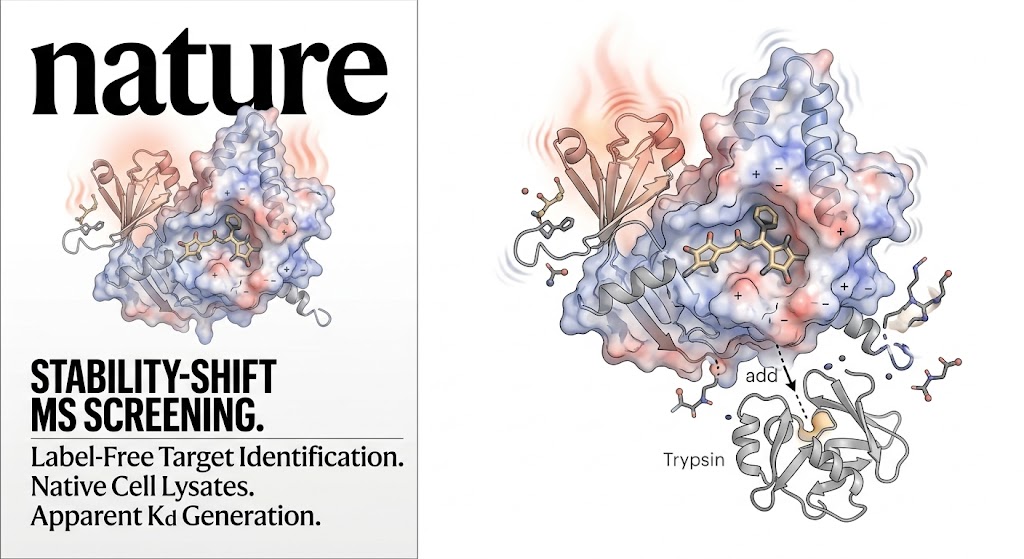
Accelerate your phenotypic drug discovery with our completely label-free Stability-Shift MS Screening services. By combining Thermal Proteome Profiling (TPP) and Limited Proteolysis (LiP-MS) into a single orthogonal platform, we identify direct binding targets, calculate apparent binding affinities, and map proteome-wide off-target liabilities directly in complex cell lysates—with absolutely no destructive chemical tagging required.

  • 100% label-free target deconvolution in native cell lysates
  • Dual-engine platform (TPP & LiP-MS) minimizes false negatives
  • Generate precise Apparent Kd dose-response curves
Stability-Shift MS Screening Services
What is Stability-Shift MS?Dual-Engine PlatformService CapabilitiesWorkflowTechnology ComparisonDemo ResultsSample RequirementsBioinformaticsCase StudyFAQ

What is Stability-Shift MS Screening? (Label-Free Target Discovery)

Stability-Shift Mass Spectrometry (MS) Screening is an advanced chemoproteomic strategy used to discover and validate the specific protein targets of small molecule drugs directly within complex biological mixtures. Instead of relying on artificial chemical tags, this technology measures the natural biophysical changes that occur when a drug physically binds to a protein.

The traditional approach to finding a drug's target is incredibly frustrating. Typically, you must alter your perfectly optimized small molecule by attaching a bulky biotin tag or a photo-crosslinker so you can physically "pull down" the target from a cell lysate. Unfortunately, adding these chemical tags frequently destroys the drug's ability to enter cells or fit into its intended binding pocket, resulting in failed experiments and wasted months of medicinal chemistry effort.

Stability-Shift MS completely eliminates this problem. It relies on a fundamental principle of thermodynamics: when a drug binds to a protein, it inherently alters that protein's structural stability. The bound protein will either become more resistant to heat-induced unfolding or more resistant to being cut by digestive enzymes. By utilizing high-resolution mass spectrometry to monitor these stability shifts across the entire proteome simultaneously, our platform allows you to test your unmodified, biologically active drug exactly as it exists in nature. We find the targets hiding in your cell lysates without ever altering your molecule.

Our Dual-Engine Platform: TPP & LiP-MS Orthogonal Validation

Not all proteins behave the same way when a drug binds to them. If you rely on just one type of stability assay, you risk missing your target entirely. To provide you with the highest possible confidence and minimize the risk of false negatives, we have built a "Dual-Engine" orthogonal screening platform. We interrogate your samples using two fundamentally different physical principles.

First, we utilize Thermal Proteome Profiling (TPP). Also known as MS-based Proteome-wide Thermal Stability Profiling coupled to MS, this approach applies a gradient of heat to the cell lysate. Proteins naturally unfold and precipitate as the temperature rises. When your drug binds to its target, it acts like a structural anchor, significantly shifting the temperature at which that specific protein melts. We use multiplexed mass spectrometry to track the melting curves of thousands of proteins simultaneously, flagging the ones that stabilize in the presence of your drug.

Second, we utilize Limited Proteolysis–MS (LiP-MS). Some highly flexible proteins, or proteins binding allosteric modulators, may not show a noticeable shift in their overall melting temperature. For these challenging targets, LiP-MS is the perfect solution. Instead of heat, we use a broad-specificity protease to gently probe the protein's surface. When your drug binds, it physically covers the binding pocket or induces a conformational change that hides specific digestion sites. By measuring these precise proteolytic protection patterns, we can identify targets that thermal methods miss, while also providing valuable clues about the exact location of the binding site.

Service Capabilities & Boundaries (Phenotypic Hits & PROTACs)

Our mass spectrometry platform is specifically engineered to bridge the gap between a successful biological screen and a confirmed molecular mechanism. We process highly complex natural mixtures to give you clear, actionable data that drives your drug development pipeline forward.

Projects We Excel At:

Phenotypic Screen Deconvolution

You have a compound that brilliantly kills cancer cells or stops viral replication, but you have no idea how it works. We take your unmodified hit compound, incubate it with the relevant disease cell lysate, and scan the entire proteome to find the specific receptor, kinase, or enzyme driving the therapeutic effect.

Proteome-Wide Off-Target Profiling

Before moving a promising lead candidate into expensive animal toxicity studies, you need to know exactly what else it binds to. This is especially critical for covalent inhibitors and Targeted Protein Degradation (TPD) agents like PROTACs. We screen your molecule against thousands of background proteins to map its safety profile and identify potential off-target liabilities early.

Allosteric and Cryptic Pocket Discovery

Because our stability-shift platform monitors the structural integrity of the entire protein, we can easily detect drugs that bind outside of the traditional active site. We frequently identify novel allosteric modulators that traditional enzymatic assays or active-site competitive probes completely fail to detect.

Native Environment Validation

Sometimes a drug binds perfectly to a purified recombinant protein in a test tube, but fails to show activity in a living cell. We use our platform to validate that your drug is actually achieving target engagement in the complex, crowded, physiological environment of a true cell lysate.

End-to-End Workflow: From Lysate to High-Confidence Targets

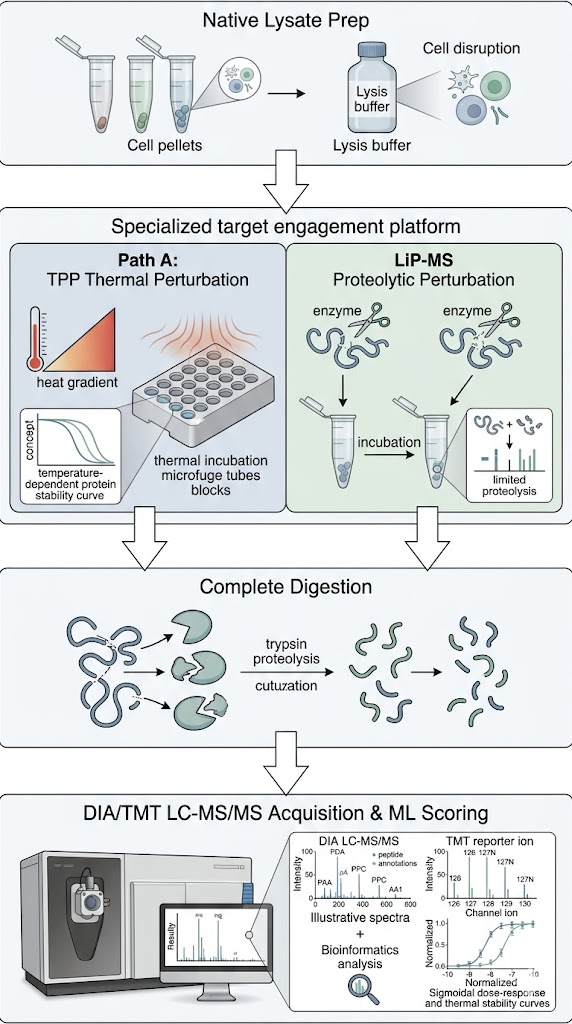
Executing a whole-proteome stability assay requires flawless laboratory technique. We have refined our workflow to ensure the native protein interactions in your lysate are perfectly preserved right up until the moment of measurement.

1

Native Lysate Preparation & Incubation

We carefully lyse your chosen cell line or tissue under strict, non-denaturing conditions to extract the proteins in their natural folded states. The lysate is divided into aliquots and incubated with your unmodified drug across a precise concentration gradient, allowing the drug to naturally seek out and bind its targets.

2

Precise Structural Perturbation

This is the critical biophysical step. Depending on the chosen strategy, we subject the aliquots to either a strict thermal gradient (for TPP) or a highly controlled pulse of digestive enzymes (for LiP-MS). We use highly calibrated thermocyclers and automated liquid handlers to ensure absolute reproducibility across all replicates.

3

Denaturation and Complete Digestion

Once the stability shift is captured, the reaction is immediately halted. The samples are then fully denatured, reduced, alkylated, and completely digested into small peptides using standard trypsin protocols, preparing them for mass spectrometry.

4

High-Resolution MS Acquisition

The complex peptide mixtures are analyzed on our advanced Orbitrap or TIMS-TOF mass spectrometers. We typically utilize sophisticated Data-Independent Acquisition (DIA) or multi-channel TMT multiplexing to maximize our detection depth, ensuring we capture low-abundance transcription factors and membrane receptors alongside the highly abundant housekeeping proteins.

5

Machine Learning & ML Scoring

The raw mass spectrometry data is fed into our proprietary bioinformatics pipeline. We use advanced statistical modeling to filter out background noise, calculate dose-dependent stability shifts, and output a highly confident, ranked list of your true biological targets.

Stability-Shift MS Dual-Engine Workflow combining TPP and LiP-MS.

Technology Comparison: Stability-Shift MS vs. Pull-Down vs. SPR

Choosing the right target identification technique is a strategic decision that can save you months of wasted effort. We want you to understand exactly why our platform excels compared to older, traditional methods.

FeatureStability-Shift MS PlatformAffinity Pull-Down (ABPP)Surface Plasmon Resonance (SPR)
Compound Tagging Required?No. 100% Label-Free.Yes. Requires biotin or photo-crosslinkers.Sometimes. Target often needs immobilization.
Physiological RelevanceVery High. Done in native lysates or intact cells.Medium. Tagging can alter natural binding.Low. Uses isolated, purified recombinant proteins.
Throughput & ScopeProteome-wide. Screens thousands of targets simultaneously.Proteome-wide.Single Target. Tests one specific protein at a time.
Measures Allosteric Binding?Yes. Highly sensitive to global structural shifts.Yes. If the tag doesn't block the site.Yes.

Our Solution Selection Strategy:

  • Choose SPR or BLI when you already know your exact target, you possess highly purified recombinant protein, and you need to calculate precise, real-time kinetic on/off rates (Kon/Koff) for lead optimization.
  • Choose Affinity Pull-Down (ABPP) if your drug molecule has a well-understood structure with a clear, synthetically accessible location where you can easily attach a biotin tag without destroying its pharmacological activity.
  • Choose Stability-Shift MS Screening when you have a phenotypic hit and chemical tagging destroys its activity, when you need to map the proteome-wide off-target safety profile of a compound, or when your target is a complex membrane protein that cannot be easily purified for traditional biophysical assays.

Demo Results: Volcano Plots & Apparent Kd Curves

We do not just hand you a massive, unreadable spreadsheet of raw data. We deliver beautiful, publication-ready visualizations that clearly prove target engagement and guide your next medicinal chemistry decisions.

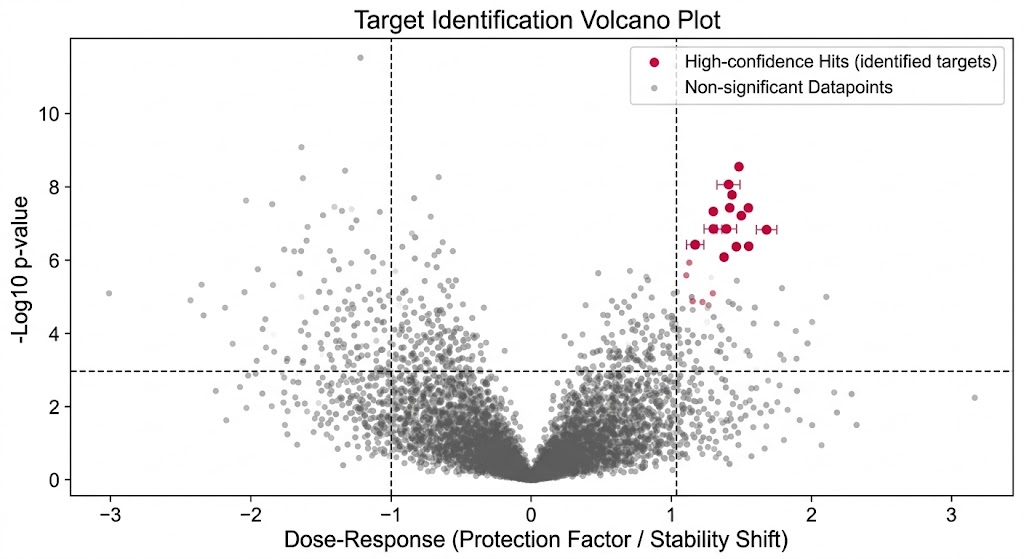
Target Identification Volcano Plot showing significant hits

Target Identification Volcano Plots

We provide rigorous statistical scatter plots to show exactly how your target was discovered. The thousands of unaffected background proteins cluster harmlessly at the bottom of the graph. Meanwhile, your true targets rise sharply into the upper quadrants, displaying massive stability shifts and extremely low statistical p-values, making the "hits" immediately obvious to your entire team.

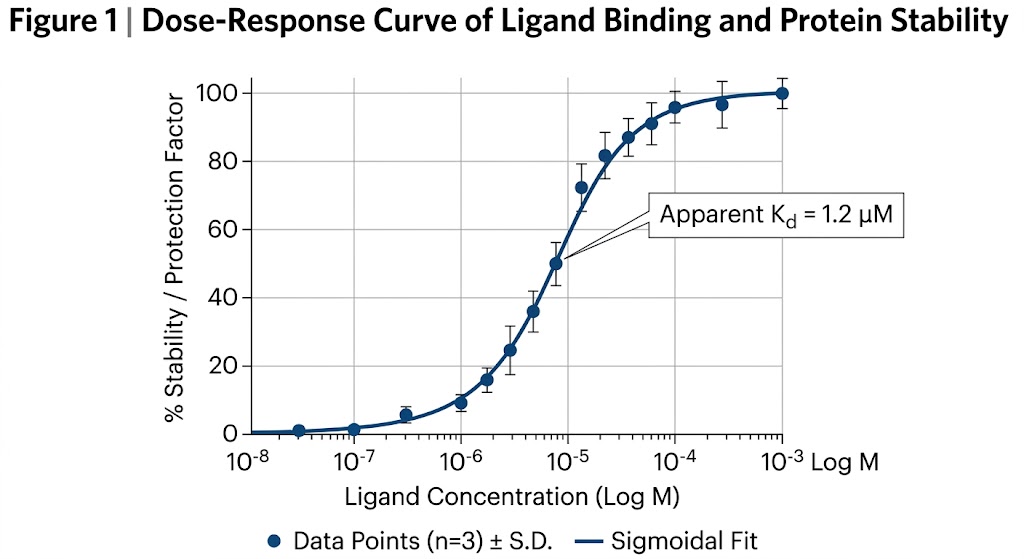
Apparent Kd Dose-Response Curve demonstrating specific binding

Apparent Kd Dose-Response Curves

Discovery is only the first step; we also provide quantitative confirmation. For your top hits, we plot the stability shift across a full range of drug concentrations. This generates a smooth, classic sigmoidal dose-response curve directly from the lysate data. This allows us to calculate an Apparent Kd (binding affinity), proving that the interaction is specific, saturable, and biologically highly relevant.

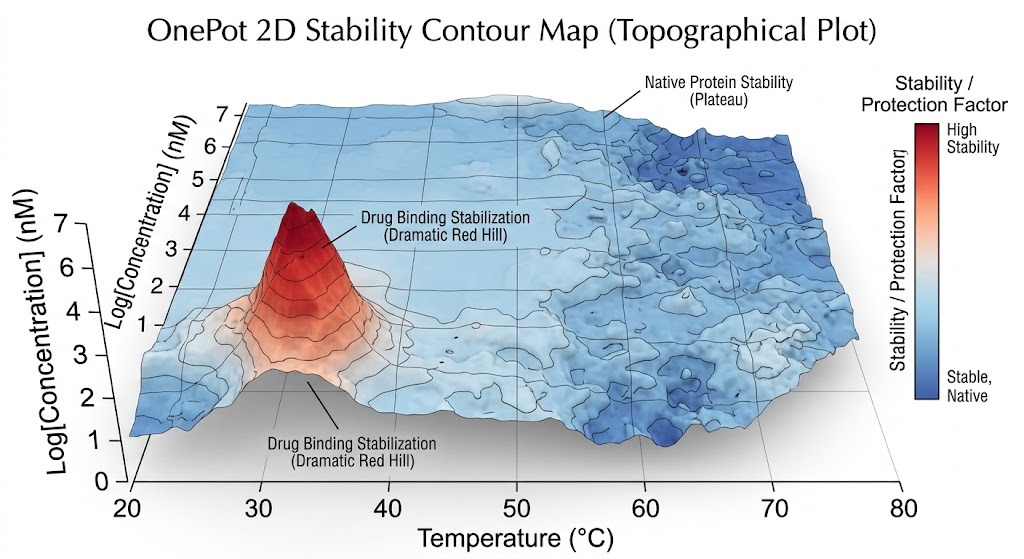
OnePot 2D Contour Maps displaying combined thermal and concentration shifts

OnePot 2D Contour Maps

For advanced experimental designs, we provide 2D thermal and concentration contour maps. These stunning visuals display exactly how the protein's melting temperature shifts in direct proportion to increasing drug dosage, providing the ultimate proof of specific target engagement in a complex mixture.

Sample Requirements & Compound Guidelines

To ensure the success of your screening campaign, the input materials must meet strict quality standards. Careful sample preparation is the absolute foundation of reliable target deconvolution.

Sample TypeMinimum AmountStrict Buffer RestrictionsPreparation Notes
Cell Pellets> 5 x 10^7 cells per conditionWash thoroughly with cold PBS. Strictly NO protease inhibitors if utilizing the LiP-MS workflow.Snap-freeze immediately in liquid nitrogen to preserve the native state. Do not use strong denaturants like SDS or Urea.
Small Molecule Compounds> 2 mg dry powderKeep DMSO concentrations as low as possible (<1% final).Purity must be >95% via HPLC/NMR. Please provide known solubility limits.

Note: Please ship all biological samples overnight on ample dry ice. If you are submitting proprietary compounds, we are fully equipped to execute standard Non-Disclosure Agreements (NDAs) prior to receiving chemical structures or physical materials.

Bioinformatics: False Discovery Control & Dose-Response Fitting

The true magic of Stability-Shift MS does not just happen in the mass spectrometer; it happens in our data analysis pipeline. The biggest challenge in any whole-lysate assay is the overwhelming background noise generated by highly abundant housekeeping proteins.

Our proprietary bioinformatics algorithms are specifically designed to filter out this noise. We do not just look for proteins that randomly change stability at a single temperature. Instead, we utilize advanced non-parametric statistical testing to analyze the entire melting curve or the full proteolytic profile. We apply strict False Discovery Rate (FDR) controls to ensure that random biological fluctuations are not incorrectly labeled as targets.

Furthermore, by integrating multi-concentration dose-response data into our statistical models, we force the algorithm to look for a very specific signature. A true target must show a smooth, predictable increase in stability as the drug concentration increases. This rigorous mathematical fitting process actively aggressively eliminates false positives, leaving you with a highly confident, prioritized list of targets ready for immediate biological validation.

Case Study: Advances in Thermal Proteome Profiling

Experimental and data analysis advances in thermal proteome profiling. https://www.cell.com/cell-reports-methods/fulltext/S2667-2375(24)00032-8

Background

Target deconvolution in complex cellular lysates using thermal stability methods is historically challenging. While the concept is sound, early iterations of the technology were frequently plagued by background noise and reproducibility issues. Identifying true targets amidst the melting profiles of thousands of background proteins requires highly optimized experimental pipelines and rigorous, mathematically sound statistical modeling to prevent costly false positives.

Methods

Researchers have continuously refined the methodologies for Thermal Proteome Profiling (TPP). In advanced workflows, scientists have integrated highly optimized multiplexing strategies, utilizing isobaric mass tags (like TMT) to simultaneously analyze multiple temperature points and drug concentrations within a single mass spectrometry run. Crucially, the workflow incorporates advanced data analysis frameworks designed specifically to handle the complex, non-linear nature of thermal melting curves derived from whole-cell extracts.

Results

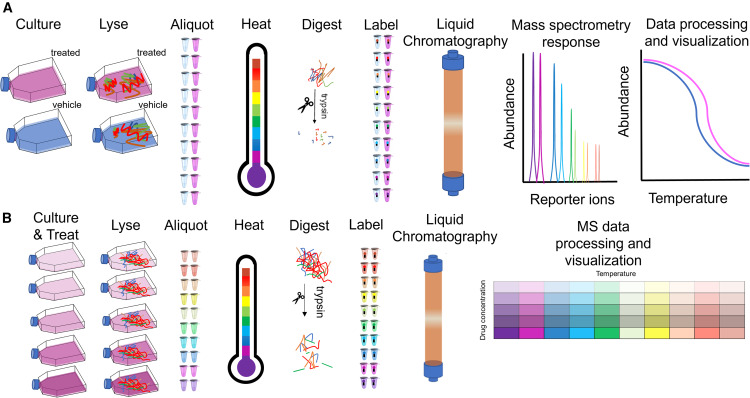
As detailed in the methodological framework and workflow overviews of the referenced comprehensive study (such as the data analysis pipelines illustrated in Figure 1 of the publication), these advanced TPP approaches significantly enhance the detection and confirmation of true protein-ligand interactions. The optimized statistical models effectively distinguish the subtle, true target melting shifts from the massive background biological variance. This computational rigor enables high-confidence target identification, even for relatively low-abundance proteins that would previously have been lost in the noise of a whole-cell extract.

Conclusion

Implementing these advanced experimental multiplexing and rigorous data analysis workflows in TPP provides a highly robust, sensitive platform for completely label-free target discovery. By effectively managing background noise and calculating reliable shifts, this advanced platform provides pharmaceutical researchers with accurate proteome-wide off-target profiling, significantly reducing the risk of pursuing false positives in early-stage drug development pipelines.

Advanced Thermal Proteome Profiling data analysis workflow

Advanced statistical modeling successfully filters out massive false-positive background noise to identify true targets.

FAQ

Frequently Asked Questions

Q: Why do you recommend using both TPP and LiP-MS together?

We utilize this dual-engine approach to drastically reduce your risk of false negatives. Different proteins react differently to drug binding. A highly rigid protein might not show a significant shift in its thermal melting point (meaning TPP would miss it), but the drug might still physically block a specific enzyme cleavage site on the surface (meaning LiP-MS will easily catch it). By utilizing both orthogonal techniques, we ensure the broadest possible coverage of your target's structural biology.

Q: Do I need to modify my compound with a tag or linker before sending it?

Absolutely not. This is the primary advantage of our Stability-Shift MS platform. We require only the pure, unmodified, biologically active parent compound. You do not need to spend months synthesizing biotinylated probes or worrying if the chemical linker has destroyed your drug's ability to cross the cell membrane or enter the binding pocket.

Q: How do you handle background noise and false positives in such complex cell lysates?

We overcome background noise through rigorous experimental design and advanced bioinformatics. We rarely rely on single-point measurements. Instead, we track protein stability across multiple temperatures and multiple drug concentrations. Our algorithms actively look for specific, smooth, dose-dependent mathematical curve shifts. Highly abundant background proteins that randomly fluctuate in the mass spectrometer will fail this strict statistical curve-fitting test and are automatically filtered out as false positives.

References

  1. Experimental and data analysis advances in thermal proteome profiling.
  2. Decoding protein dynamics with limited proteolysis coupled to mass spectrometry.
  3. A Comparison of Two Stability Proteomics Methods for Drug Target Identification in OnePot 2D Format.

Disclaimer: All services and products provided by Creative Proteomics are for Research Use Only (RUO) and are not intended for use in diagnostic procedures or clinical treatments.

Identify your targets without chemical tags

Submit your compound library and phenotypic background to schedule an expert assessment on the optimal TPP vs. LiP-MS screening strategy.

Online Inquiry

Please submit a detailed description of your project. We will provide you with a customized project plan to meet your research requests. You can also send emails directly to for inquiries.

* Email
Phone
* Service & Products of Interest
Services Required and Project Description