Organoid Metabolomics by LC-MS

Profiling drug-induced metabolic changes in 3D organoid models with validated low-input LC-MS workflows.

Organoid Metabolomics by LC-MS is a specialized service that combines 3D organoid culture with high-resolution LC-MS metabolomics and lipidomics to profile the metabolic state of patient-derived or stem cell-derived organoids. Unlike conventional 2D cell metabolomics, our service captures the full metabolic response of organoids to drug treatment, disease modeling, or genetic perturbation in a physiologically relevant, three-dimensional context that more faithfully recapitulates in vivo tissue architecture.

At Creative Proteomics, our MassTarget™ platform applies optimized, low-input LC-QTOF-MS workflows to organoid samples — including those embedded in extracellular matrix (ECM) — with validated protocols for background signal filtering and data quality control. Whether you are profiling drug-induced metabolic changes in patient-derived tumor organoids (PDOs), characterizing metabolic phenotypes in disease-model organoids, or integrating metabolomics with lipidomics and proteomics from the same 3D culture, our service delivers publication-ready data from as few as 500 cells per injection.

Key Capabilities:

  • Low-input LC-QTOF-MS metabolomics and lipidomics from organoid samples (≥500 cells per injection).
  • ECM-compatible sample preparation with validated background filtering protocol (p-value + fold-change threshold).
  • Untargeted metabolomics covering polar metabolites, amino acids, nucleotides, and central carbon metabolites.
  • Untargeted lipidomics covering phospholipids, sphingolipids, glycerolipids, and fatty acids.
  • Comprehensive pathway enrichment analysis with KEGG and HMDB mapping.
  • Flexible service model: accepts pre-cultured organoids or provides culture guidance.
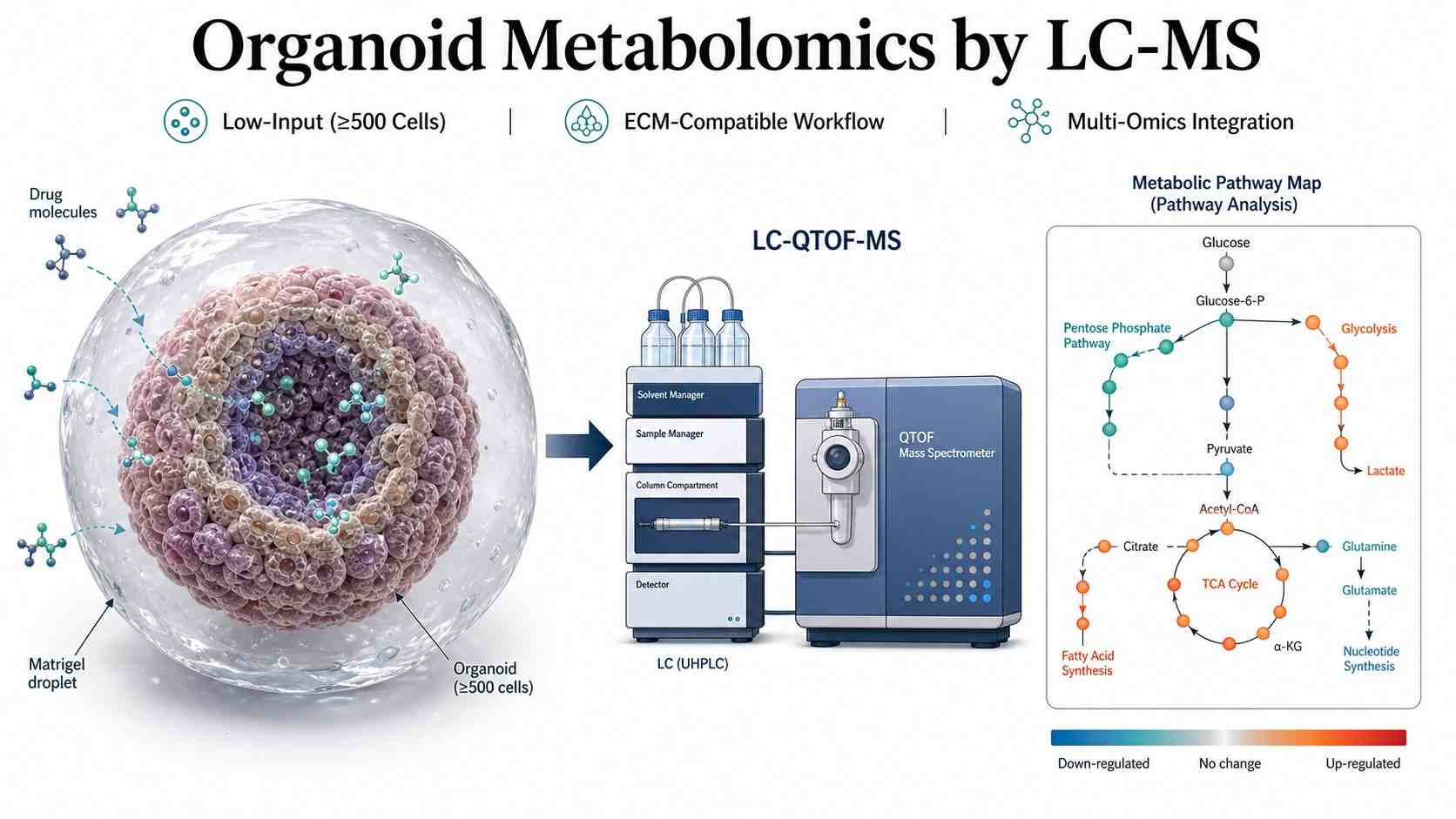
Organoid Metabolomics platform diagram featuring 3D organoid structure, LC-MS analysis, and metabolic pathway map with drug-response readout.
Overview Why Organoid Metabolomics Workflow Capabilities Sample Data Outputs Applications Case Study FAQ

What Is Organoid Metabolomics?

Organoid Metabolomics by LC-MS is a specialized service that combines 3D organoid culture with high-resolution LC-MS metabolomics and lipidomics to profile the metabolic state of patient-derived or stem cell-derived organoids. Unlike conventional 2D cell metabolomics, our service captures the full metabolic response of organoids to drug treatment, disease modeling, or genetic perturbation in a physiologically relevant, three-dimensional context that more faithfully recapitulates in vivo tissue architecture.

At Creative Proteomics, our MassTarget™ platform applies optimized, low-input LC-QTOF-MS workflows to organoid samples — including those embedded in extracellular matrix (ECM) — with validated protocols for background signal filtering and data quality control. Whether you are profiling drug-induced metabolic changes in patient-derived tumor organoids (PDOs), characterizing metabolic phenotypes in disease-model organoids, or integrating metabolomics with lipidomics and proteomics from the same 3D culture, our service delivers publication-ready data from as few as 500 cells per injection.

Key Capabilities:

  • Low-input LC-QTOF-MS metabolomics and lipidomics from organoid samples (≥500 cells per injection).
  • ECM-compatible sample preparation with validated background filtering protocol (p-value + fold-change threshold).
  • Untargeted metabolomics covering polar metabolites, amino acids, nucleotides, and central carbon metabolites.
  • Untargeted lipidomics covering phospholipids, sphingolipids, glycerolipids, and fatty acids.
  • Comprehensive pathway enrichment analysis with KEGG and HMDB mapping.
  • Flexible service model: accepts pre-cultured organoids or provides culture guidance.
Why Organoid Metabolomics for Drug Discovery

Conventional 2D cell culture metabolomics provides valuable data but lacks the three-dimensional architecture, cell-cell interactions, and metabolic gradients that characterize in vivo tissue. Animal models offer physiological relevance but are costly, time-intensive, and face increasing regulatory pressure to reduce use (3Rs principles). Organoid metabolomics occupies the optimal middle ground — combining human-relevant biology with scalable, reproducible LC-MS analysis.

Improved translational predictivity

Organoids better recapitulate patient tissue metabolism than 2D cultures, making drug-response metabolomics data more predictive of clinical outcomes.

Low-input feasibility

Our validated protocols enable metabolomics from the limited cell numbers typical of organoid cultures (<500 cells per injection), removing a key technical barrier.

ECM background control

We apply a published, validated two-step filtering strategy (fold-change > 1.2, p < 0.05) to eliminate Matrigel/ECM background signals, ensuring that reported metabolites reflect genuine biological changes.

Multi-omics from the same sample

Metabolomics, lipidomics, and proteomics can be integrated from the same organoid preparation, providing a systems-level view of drug mechanism.

Precision medicine enablement

Patient-derived organoids enable personalized drug-response profiling, where metabolomics readouts can identify metabolic vulnerabilities unique to individual tumors.

Service Workflow

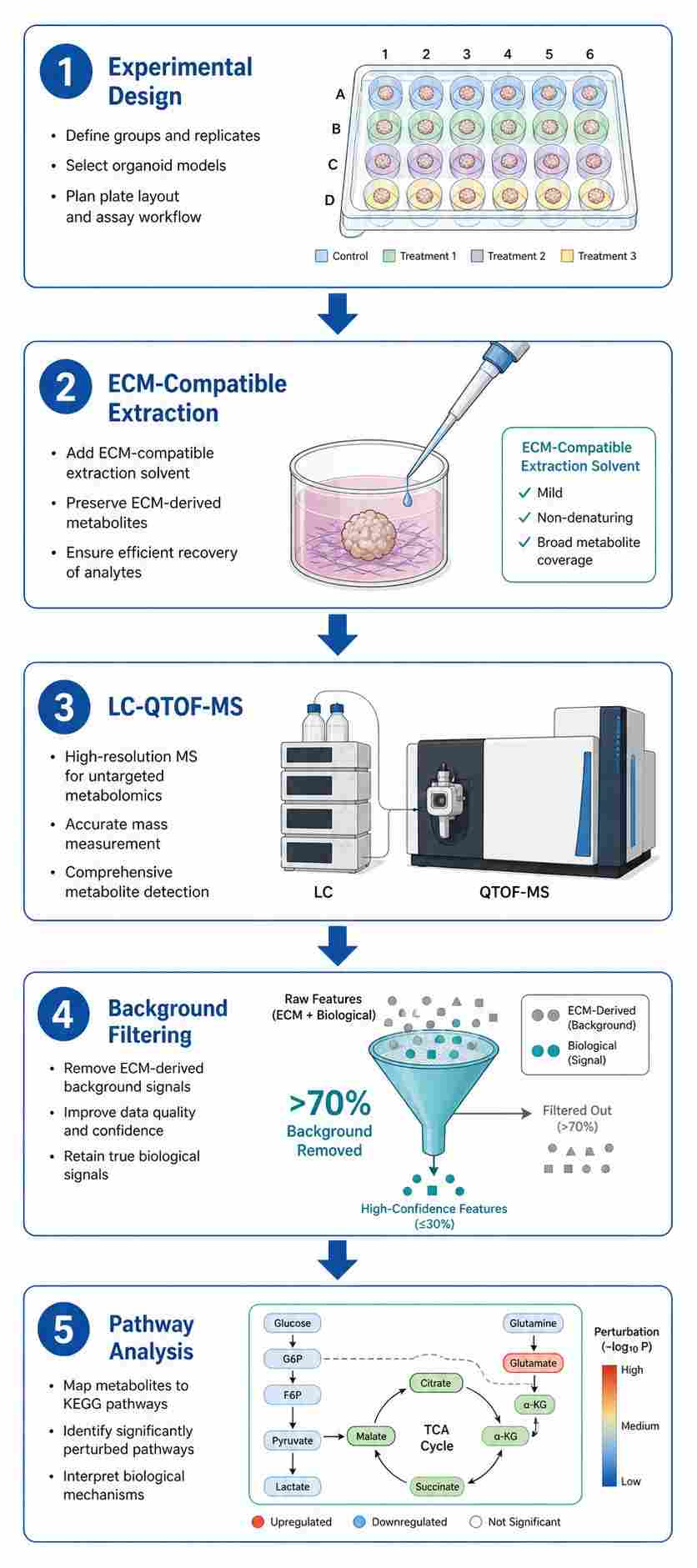
Our Organoid Metabolomics service follows a five-stage workflow optimized for the unique challenges of 3D culture metabolomics.

1

Experimental Design Consultation

We work with your team to define the optimal study design: drug concentrations, time points, number of biological replicates, and appropriate controls (including ECM/Matrigel blanks).

2

Sample Preparation

Organoid samples are washed with PBS at 37 °C, then extracted directly in the culture well using ice-cold acetonitrile/methanol/water (2:2:1, v/v/v) with ultrasonication — less than 2 hours for 30 samples.

3

LC-QTOF-MS Acquisition

Extracts are analyzed by reversed-phase LC-QTOF-MS in positive and negative ionization modes, covering polar metabolites and lipid species with high-resolution accurate-mass data.

4

Data Processing & Background Filtering

Raw data undergo peak picking, alignment, and normalization. A two-step filtering strategy removes >70% of ECM-derived background features, retaining only biologically relevant signals.

5

Pathway Analysis & Report

Significantly altered metabolites are mapped onto metabolic pathways using KEGG and HMDB databases. Deliverables include annotated metabolite lists, PCA/PLS-DA plots, volcano plots, and a comprehensive project report.

Key Capabilities & Platform

CapabilityDetails
LC-MS PlatformLC-QTOF-MS (high-resolution, accurate-mass)
Ionization modesPositive and negative electrospray ionization (ESI)
Metabolite coveragePolar metabolites, amino acids, nucleotides, central carbon metabolites, organic acids
Lipid coveragePhospholipids (PC, PE, PS, PI), sphingolipids, glycerolipids, fatty acids, acyl carnitines
Minimum input≥500 cells per injection
Background controlTwo-step filtering: FC > 1.2 vs ECM blank + p < 0.05
Data analysisPCA, PLS-DA, volcano plots, heatmaps, KEGG/HMDB pathway enrichment
Multi-omics integrationMetabolomics + lipidomics + proteomics from same organoid preparation

Study Design & Sample Requirements

Sample TypeRecommended AmountPreparationStorage & Shipping
Organoid lysates (PDO)≥500 cells per injection; ≥3 biological replicates per conditionWash with PBS at 37 °C; extract with acetonitrile/methanol/water (2:2:1, v/v/v); sonicate-80 °C storage; dry ice shipping
Intact organoids (in Matrigel)≥1 × 10⁴ cells per conditionRemove excess Matrigel by gentle washing; snap-freeze in liquid N₂-80 °C storage; dry ice shipping
Conditioned media≥100 µL per replicateCentrifuge at 13,000 g, 4 °C, 10 min; collect supernatant-80 °C storage; dry ice shipping
ECM/Matrigel blank controlsSame volume as sampleInclude Matrigel-only controls for background subtractionSame conditions as samples
Replicates≥5 biological replicates per group (recommended)Randomized block designN/A
Turnaround4–6 weeks (standard project)Depending on study size and sample complexityN/A

Study Design Options: Dose-response (3–5 concentrations + vehicle control), time-course (multiple time points with matched controls), comparator studies (Drug A vs Drug B vs combination), patient cohort (multiple PDO lines for precision medicine profiling).

Data Outputs & Interpretation

DeliverableDescriptionFormat
Raw LC-MS dataFull-scan MS files in vendor format.raw or .d files
Processed feature tableAligned peak list with m/z, retention time, intensity across all samples.csv
Background-filtered datasetFeatures passing FC > 1.2 vs ECM blank and p < 0.05 thresholds.csv
PCA/PLS-DA score plotMultivariate analysis showing group separationFigure (.png/.pdf)
Volcano plotFold-change vs p-value visualization of significantly altered metabolitesFigure (.png/.pdf)
Pathway enrichment mapKEGG/HMDB pathway analysis with enrichment scoresFigure (.png/.pdf)
Annotated metabolite listIdentified metabolites with HMDB IDs, fold-change, p-value, and pathway assignments.csv
Project reportComprehensive report including methods, QC metrics, and results.pdf

Applications

Organoid metabolomics by LC-MS is applicable across multiple stages of drug discovery and translational research.

Drug MoA Elucidation

Identify metabolic pathways modulated by novel compounds in a physiologically relevant 3D context using patient-derived tumor organoids or iPSC-derived organoids.

Related service: metabolic pathway drug-response mapping

Precision Oncology Profiling

Profile drug-response metabolomics across patient-derived organoid panels to identify metabolic vulnerabilities unique to individual tumors.

Related service: cellular metabolomics screening

Metabolic Toxicity Screening

Detect off-target metabolic effects of drug candidates in liver or kidney organoids before advancing to costly in vivo studies.

Multi-Omics Integration

Combine metabolomics with lipidomics and proteomics from the same organoid samples for a systems-level view of drug mechanism.

Related service: cellular lipidomics profiling

Drug Resistance Mechanisms

Investigate metabolic rewiring associated with drug resistance using organoid models that retain tumor heterogeneity.

Related service: drug resistance mechanism MS analysis

Live-Cell Metabolic Profiling

Complement organoid metabolomics with live-cell MS approaches for real-time metabolic monitoring.

Related service: live-cell MS profiling

Case Study: Metabolic Drug-Response Phenotyping in Colorectal Cancer Organoids by LC-QTOF-MS

Neef S.K., Janssen N., Winter S., Wallisch S.K., Hofmann U., Dahlke M.H., Schwab M., Mürdter T.E., Haag M. “Metabolic Drug Response Phenotyping in Colorectal Cancer Organoids by LC-QTOF-MS.” Metabolites 10(12):494 (2020). https://doi.org/10.3390/metabo10120494 (CC BY 4.0)

Background

Colorectal cancer (CRC) is the third most common cancer worldwide, yet response rates to standard chemotherapy (5-fluorouracil, 5-FU) remain only 17–36%. Patient-derived organoids (PDOs) offer a more physiologically relevant model than 2D cell lines for studying drug response, but metabolomics analysis of organoids is challenged by low cell numbers and ECM background interference. This study aimed to establish and validate an optimized LC-QTOF-MS workflow for untargeted metabolomics and lipidomics profiling of CRC organoids.

Methods

The authors compared three extraction protocols and selected an in-well extraction using ice-cold acetonitrile/methanol/water (2:2:1, v/v/v) with ultrasonication — a method that does not require removal of Matrigel ECM. A two-step filtering strategy (fold-change > 1.2 vs ECM blank, p < 0.05) was applied to remove background signals. As proof of concept, CRC organoids were treated with 5-FU at 1, 10, and 100 µM for 24 hours, and metabolic changes were assessed in three independent experiments.

Results

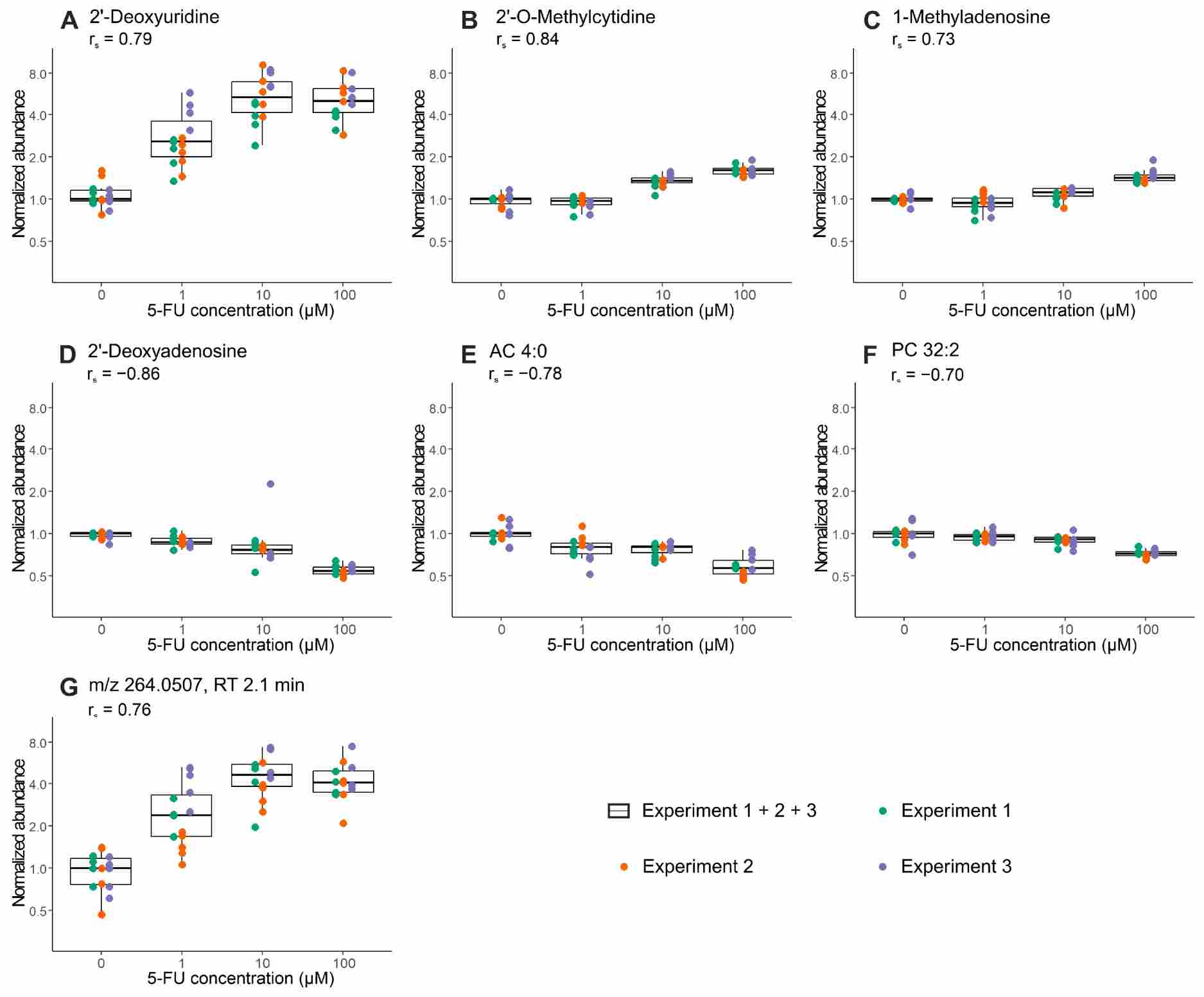
The optimized protocol enabled reproducible metabolomics and lipidomics data from fewer than 500 cells per injection. ECM background filtering removed >70% of detected features, retaining only biologically relevant signals. 5-FU treatment induced dose-dependent metabolic changes consistent with its mechanism of action: 2′-deoxyuridine levels increased, 2′-deoxyadenosine levels decreased, and RNA modification markers (2′-O-methylcytidine, 1-methyladenosine) showed elevated abundance. Lipid species including acyl carnitine AC 4:0 and phosphatidylcholine PC 32:2 decreased with increasing drug concentration. These changes mapped primarily to purine and pyrimidine metabolism pathways (see Figure 3).

Conclusions

This study demonstrated that LC-QTOF-MS metabolomics and lipidomics can reliably capture drug-induced metabolic changes in CRC organoids, providing a foundation for larger-scale drug-response phenotyping and biomarker discovery studies using patient-derived organoid models.

Figure 3 from Neef et al. 2020 — Tukey box plots showing dose-dependent metabolite changes in 5-FU-treated colorectal cancer organoids.

Figure 3: Tukey box plots of dose-dependent changes in metabolite abundance after 24 h treatment with 5-FU at increasing concentrations. Adapted from Neef et al. (2020), CC BY 4.0.

FAQ

Frequently Asked Questions

Q: What is organoid metabolomics and how is it different from standard cell metabolomics?

Organoid metabolomics analyzes the metabolic profile of 3D organoid cultures — miniature tissue-like structures derived from stem cells or patient tissue. Unlike 2D cell metabolomics, organoid metabolomics captures metabolic activity in a three-dimensional context that better mimics in vivo tissue architecture, cell-cell interactions, and metabolic gradients.

Q: What types of organoids can be analyzed?

Our service is compatible with a wide range of organoid types, including tumor organoids (colorectal, pancreatic, breast, lung, gastric), iPSC-derived organoids (brain, liver, kidney, intestinal), and stem cell-derived organoids for disease modeling. We provide consultation to optimize sample preparation for each organoid type.

Q: How do you handle Matrigel/ECM background signals in metabolomics data?

We apply a validated two-step filtering strategy: (1) features must show signal intensity > 120% of ECM blank control, and (2) features must pass statistical filtering (p < 0.05, FC > 1.2). This approach, published by Neef et al. (2020), removes >70% of ECM-derived background features while retaining biologically relevant signals.

Q: What is the minimum number of organoid cells needed for LC-MS analysis?

Our validated protocol requires ≥500 cells per injection for reliable metabolomics and lipidomics data. We recommend ≥3 biological replicates per condition, with ≥5 replicates per group for optimal statistical power.

Q: Can you analyze organoids that we culture ourselves?

Yes. We offer a flexible service model: you can send pre-cultured organoid samples (lysates, intact organoids, or conditioned media) for metabolomics analysis. We also provide guidance on culture conditions compatible with downstream LC-MS analysis if needed.

Q: What metabolites and lipids can you detect from organoid samples?

Our untargeted LC-QTOF-MS platform covers polar metabolites (amino acids, nucleotides, central carbon intermediates, organic acids) and lipid species (phospholipids, glycerolipids, sphingolipids, fatty acids, acyl carnitines). Targeted analysis of specific metabolite classes is also available upon request.

Q: How many biological replicates do you recommend for organoid metabolomics studies?

We recommend a minimum of 5 biological replicates per group for adequate statistical power. Organoid cultures can show higher variability than 2D cell lines due to their 3D architecture, so adequate replication is essential for reliable results.

Q: Can metabolomics and lipidomics be performed from the same organoid samples?

Yes. Our extraction protocol (acetonitrile/methanol/water, 2:2:1, v/v/v) is compatible with both metabolomics and lipidomics analysis from the same sample. We can acquire data in both positive and negative ionization modes to maximize coverage.

Q: How do you ensure data quality and reproducibility?

We implement rigorous QC measures including pooled QC samples injected at regular intervals, internal standards for retention time and intensity normalization, randomized injection order, ECM blank controls for background subtraction, and batch correction for large studies.

Q: How long does a typical organoid metabolomics project take?

Standard projects are completed within 4–6 weeks from sample receipt. Timelines depend on study size (number of samples, conditions, replicates) and complexity (untargeted vs targeted, single-omics vs multi-omics).

Plan an Organoid Metabolomics Study with the MassTarget™ Team

Share your organoid model and study goals — our scientists will design a tailored metabolomics strategy for your drug discovery program.

Online Inquiry

Please submit a detailed description of your project. We will provide you with a customized project plan to meet your research requests. You can also send emails directly to for inquiries.

* Email
Phone
* Service & Products of Interest
Services Required and Project Description