Disease to Target Discovery by Mass Spectrometry

An integrated mass spectrometry platform connecting disease biology to validated drug targets through 13 coordinated sub-services — from mechanism analysis and pathway mapping to target identification, engagement profiling, and functional validation.

The gap between understanding a disease mechanism and having a validated drug target is where most discovery programs lose momentum. Our Disease → Target Discovery platform provides that connection through 13 integrated sub-services designed so data from each stage feeds directly into the next, with consistent analytical standards and coordinated project management across all modules.

Key Advantages:

  • End-to-end pipeline from disease biology to validated targets
  • 13 integrated sub-services covering the full discovery spectrum
  • Modular entry at any stage of the discovery process
  • Consistent data standards across all service modules
  • Single point of project management across all phases
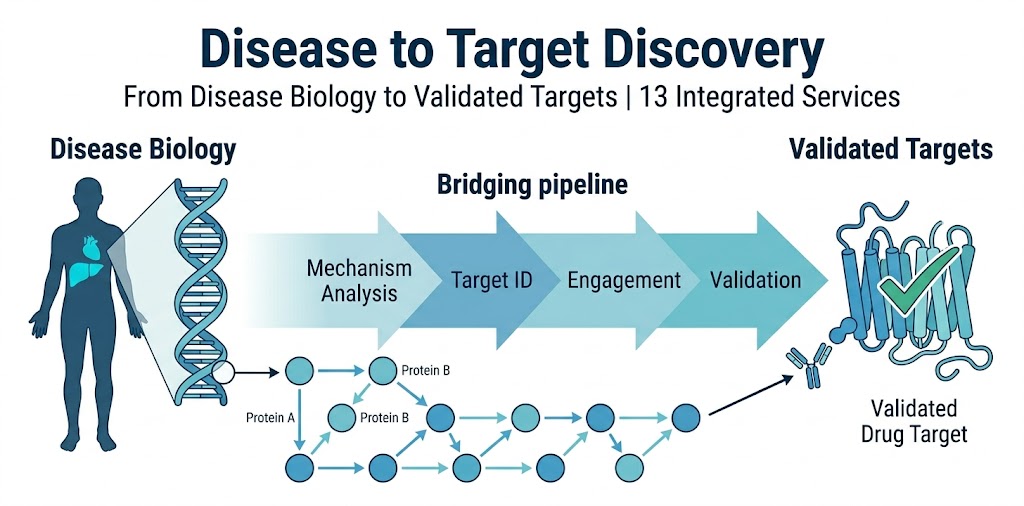
Disease to target discovery workflow showing the integrated pipeline from disease mechanism analysis through target identification, engagement, and validation.
Overview Solution Modules Pipeline Why Choose FAQ

From Disease Biology to Validated Targets — A Unified Workflow

The gap between understanding a disease mechanism and having a validated drug target is where most discovery programs lose momentum. Disease biology research generates hypotheses — differentially expressed proteins, altered pathways, candidate biomarkers — but translating those findings into a high-confidence target list requires an integrated experimental workflow that connects each step from mechanism to validation.

Our Disease → Target Discovery platform provides that connection. We offer 13 integrated sub-services that span the entire target discovery pipeline: from disease mechanism analysis and pathway mapping through proteomics-based target identification, interactome and network analysis, target engagement profiling, and functional validation. The pipeline is designed so that data from each stage feeds directly into the next, with consistent analytical standards, unified bioinformatics pipelines, and coordinated project management across all modules. Whether your compound is a conventional small molecule, a PROTAC degrader, a molecular glue, or a biologic, the platform accommodates the specific characterization requirements of each modality at every stage of the workflow.

Whether your program starts with a clinical observation that needs mechanistic explanation, a phenotypic screen that needs target deconvolution, or a known pathway that needs expanded target discovery, our platform adapts to your entry point. The modular structure means you can engage a single sub-service for a specific question or deploy the full pipeline for comprehensive end-to-end target discovery.

Each of the 13 sub-services is staffed by scientists with domain expertise in the relevant techniques — proteomics, chemical biology, biophysics, cell biology — and supported by a centralized bioinformatics team that ensures data harmonization across modules. This structure means that a project starting with disease pathway analysis can flow seamlessly into target identification, engagement profiling, and validation without re-negotiating data formats, quality standards, or deliverable expectations at each transition point.

Our Target Discovery Solution Modules

CATEGORY A

Disease Biology and Mechanism Analysis

Understanding the molecular foundation of a disease is the essential first step in rational target selection. Our disease mechanism analysis services combine multi-omics profiling, pathway mapping, and network biology to identify the proteins, pathways, and interactions that drive disease pathology.

ServiceDescription
Disease Mechanism & Pathway AnalysisMulti-omics profiling of disease vs normal samples to identify dysregulated pathways.
Proteomics-Based Target DiscoveryQuantitative proteomics to identify differentially expressed or modified proteins.
Interactome & Network Target IDPPI mapping and network analysis for druggable node identification.
CATEGORY B

Translational Target Identification

Once disease-relevant candidates are identified, the next stage is translating those candidates into directly targetable proteins. These services bridge the gap between disease association and pharmacological tractability.

ServiceDescription
Biomarker to Target TranslationConverting biomarker findings into candidate target lists.
Global Drug Target IdentificationUnbiased proteome-wide target deconvolution.
Small-Molecule Target IDDedicated target ID for small molecules.
CATEGORY C

Target Engagement and Selectivity

Identifying a target is not enough — you need to know how your compound engages it, how selectively, and what other proteins it hits. These services characterize the compound-target interaction in detail.

ServiceDescription
Target Engagement & Selectivity ProfilingQuantitative compound-target binding measurement.
Off-target ProfilingProteome-wide off-target identification.
Mechanism-of-Action (MoA) AnalysisMulti-omics MoA elucidation.
CATEGORY D

Validation and Next-Generation Modalities

The final stage confirms that the target is functionally relevant and expands into modern drug modalities beyond conventional small molecules.

ServiceDescription
Drug–Target Interaction ValidationOrthogonal binding validation using multiple methods.
PROTAC Complex ProfilingTernary complex and degradation characterization.
Molecular Glue Target IdentificationNeosubstrate and E3 ligase engagement analysis.
Target Function ValidationFunctional assessment of target relevance.

How the Disease → Target Pipeline Works

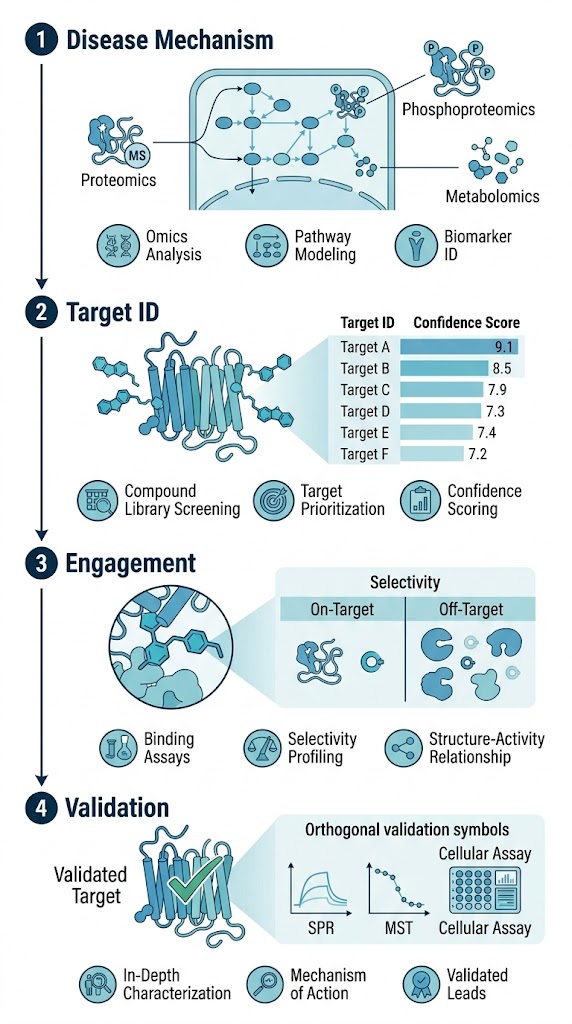
The platform operates as a four-stage pipeline, with each stage building on the data generated by the previous one. The entire pipeline is supported by a unified bioinformatics infrastructure that tracks samples, results, and quality metrics from intake through final reporting.

1

Disease Mechanism Discovery

Starting with disease vs normal samples, we perform quantitative proteomics, phosphoproteomics, and metabolomics to identify differentially regulated proteins and pathways. Network analysis maps these changes onto PPI networks and signaling pathways to prioritize candidate nodes for target identification.

2

Target Identification

Prioritized candidates enter the target ID workflow. For compounds with known bioactivity, chemical proteomics (affinity pulldown or thermal profiling) identifies all bound proteins. For phenotypic hits, unbiased target deconvolution connects the observed cellular effect to specific protein targets. Output is a ranked candidate list with confidence scores.

3

Target Engagement and Selectivity

Confirmed targets are characterized for engagement — does the compound bind in a cellular context? How potently? What is the selectivity profile across the proteome? These data inform medicinal chemistry optimization and early de-risking before committing to full development.

4

Validation and Mechanistic Confirmation

The final stage confirms that target engagement translates to functional effects. Orthogonal validation methods — SPR, MST, cellular thermal shift assays, and functional readouts — confirm binding from multiple independent angles. PROTAC projects receive ternary complex and degradation analysis. Molecular glue projects identify neosubstrates and E3 ligase engagement. The output is a fully validated target with orthogonal evidence from at least two independent methods.

Four-stage vertical workflow for disease to target discovery: disease mechanism, target identification, engagement profiling, and validation.

Why Choose Our Integrated Target Discovery Platform

CriterionSiloed Point SolutionsOur Integrated Platform
Pipeline connectivityDisconnected handoffs between vendorsSingle coordinated workflow
Data standardsInconsistent across methodsUnified QC and data formats
Project managementMultiple contacts per projectSingle project lead
Turnaround efficiencyCumulative vendor timelinesOptimized parallel workflows
Cost efficiencyRedundant sample preparationConsolidated processing
Target confidenceVariable across methodsCross-validated by design

What sets us apart: End-to-end integration from disease biology to validated targets; 13 sub-services covering the full discovery spectrum; modular entry at any stage of the pipeline; consistent data standards, QC metrics, and bioinformatics pipelines across all modules so results from different stages are directly comparable; single point of project management across all phases, eliminating the coordination overhead of managing multiple vendor relationships for a single target discovery campaign. This integrated approach reduces end-to-end project timelines by eliminating the delays associated with data reformatting, method re-validation, and knowledge transfer between disconnected service providers.

FAQ

Frequently Asked Questions

Q: At what stage of the drug discovery process should we engage your target discovery platform?

At any stage. Some clients start with disease mechanism analysis and progress through the full pipeline. Others have a candidate compound already and need target deconvolution or engagement profiling. The platform is modular by design.

Q: How do the different sub-services work together in a single project?

A project manager coordinates all active services, ensuring samples are processed efficiently and data flows between stages. Bioinformatics pipelines are harmonized so results from target identification can be directly compared with engagement and selectivity data.

Q: Can we use only one or two services without committing to the full pipeline?

Yes. Each service can be engaged independently. Many clients start with a single service and add additional modules as the project progresses.

Q: How long does a complete disease-to-target discovery project take?

A focused target ID project typically completes in 6-10 weeks. A full pipeline from disease mechanism through target validation may require 12-20 weeks depending on the number of conditions and validation complexity.

References

  1. Schenone M, Dančík V, Wagner BK, Clemons PA. "Target identification and mechanism of action in chemical biology and drug discovery." Nature Chemical Biology, 2013, 9(4), 232–240. DOI: 10.1038/nchembio.1199
  2. Savitski MM, et al. "Tracking cancer drugs in living cells by thermal profiling of the proteome." Science, 2014, 346(6205), 1255784. DOI: 10.1126/science.1255784
  3. Meissner F, et al. "The emerging role of mass spectrometry-based proteomics in drug discovery." Nature Reviews Drug Discovery, 2022, 21(9), 637–654. DOI: 10.1038/s41573-022-00409-3

Ready to move from disease biology to validated targets?

Contact our team to discuss your project and design the optimal workflow.

Disclaimer: All products and services provided by Creative Proteomics are for research use only (RUO). They are not intended for use in diagnostic, therapeutic, or clinical procedures.

Online Inquiry

Please submit a detailed description of your project. We will provide you with a customized project plan to meet your research requests. You can also send emails directly to for inquiries.

* Email
Phone
* Service & Products of Interest
Services Required and Project Description