Nanodisc Reconstitution & MS Binding Assays for Membrane Protein Drug Discovery

We combine nanodisc reconstitution with affinity selection mass spectrometry (ASMS) to deliver label-free, native-state binding data for membrane protein targets — GPCRs, ion channels, and transporters — without detergent denaturation or target immobilisation.

Key Advantages:

  • Native lipid bilayer environment — Nanodiscs keep membrane proteins in a near-physiological state, avoiding the denaturation risks that come with detergent micelles.
  • Label-free MS detection — Direct binding readout. No fluorescent tags, no immobilisation, no reporter assays.
  • Sensitive to weak and transient interactions — Our high-resolution MS captures low-affinity binding events that fragment-based and early-stage discovery campaigns depend on.
  • Pooled library throughput — Screen up to 1,000 compounds per run in a single ASMS experiment, cutting assay development time and consumable costs.
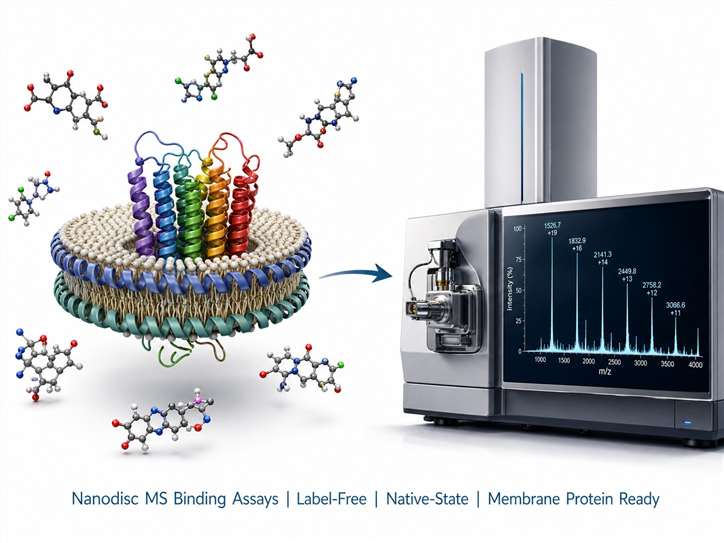
Nanodisc MS binding assay overview: membrane protein in nanodisc with compound pool, LC-HRMS detection, and binding readout.
What Is Nanodisc MS Binding Key Advantages Service Overview Workflow Technology Comparison Sample Demo Case Study FAQ

What Are Nanodisc Reconstitution MS Binding Assays?

Membrane proteins — GPCRs, ion channels, transporters — account for roughly 60% of current drug targets. Yet they remain among the hardest classes to study with biophysical binding assays. Their hydrophobic transmembrane regions need a lipid-like environment to stay structurally intact, and conventional detergent micelles often compromise native conformation, producing unreliable binding data.

Nanodisc reconstitution MS binding assays solve this by combining two well-established technologies. First, we reconstitute the target membrane protein into a nanodisc — a nanoscale lipid bilayer held together by two membrane scaffold protein (MSP) belts. This creates a near-native phospholipid environment that preserves the protein's structure, dynamics, and accessibility. Next, we incubate the nanodisc-embedded target with a pooled compound library and use affinity selection mass spectrometry (ASMS) to identify bound ligands directly — no immobilisation, no functional readout required.

The result is a label-free, solution-phase binding assay that delivers reliable hit identification for membrane protein targets in their native-like state.

Key Advantages of Nanodisc MS Binding Assays

Native-State Membrane Environment

Detergent micelles can strip lipids from the protein surface and alter its conformation. Nanodiscs avoid this by providing a controlled lipid bilayer that keeps the target in a near-physiological state. This matters especially for GPCRs and transporters, whose ligand-binding pockets often depend on specific lipid interactions.

Label-Free, Immobilisation-Free Detection

ASMS detects binding events directly by mass. No fluorescent labels, no surface immobilisation, no enzymatic activity readouts. This sidesteps common artefacts from tag interference or surface-induced conformational changes.

Detection of Weak and Transient Binders

High-resolution mass spectrometry picks up low-affinity interactions — fragment hits with millimolar KD values included — that functional assays routinely miss. This makes nanodisc MS binding a strong fit for fragment-based lead discovery against membrane proteins.

Pooled Library Screening

We screen compounds in pools of 100–1,000, boosting throughput while cutting protein consumption and assay cost. Hit deconvolution uses accurate-mass identification and isotopic pattern matching.

Service Overview — Creative Proteomics Nanodisc MS Binding Capabilities

Our nanodisc MS binding service supports discovery-stage research across a range of membrane protein targets and library formats. Every workflow is label-free, solution-phase, and optimised for native-state binding detection.

MODE 1

GPCR Nanodisc MS Binding Screening

Built for orphan GPCRs, peptide receptors, and class B/C GPCRs where functional assays are hard to come by.

  • Full-length GPCR reconstitution in defined lipid compositions.
  • Pooled small-molecule screening (100–1,000 compounds per run).
  • Compatible with orthosteric and allosteric ligand detection.
MODE 2

Ion Channel and Transporter MS Binding

For voltage-gated and ligand-gated ion channels, plus SLC transporters.

  • Nanodisc reconstitution preserves channel gating and transport conformations.
  • Direct binding readout — no electrophysiology or transport assays needed.
  • Suitable for fragment and focused library screening.
MODE 3

Membrane Protein Fragment-Based Screening

Optimised for fragment libraries (MW < 300 Da) against membrane protein targets.

  • High-sensitivity MS detects weak fragment binding events.
  • Lower protein consumption than SPR or NMR.
  • Rapid triage of fragment hits for follow-up validation.
MODE 4

Custom Nanodisc Reconstitution & Method Development

For specialised targets or non-standard lipid compositions.

  • Lipid composition optimisation (POPC, POPG, DMPC, brain lipid extracts, and more).
  • MSP scaffold selection (MSP1D1, MSP1E3D1, MSP2N2, and others).
  • Buffer and stability optimisation for challenging targets.
MODE 5

Orthogonal Validation & Hit Follow-Up

Combine nanodisc MS binding with our native ESI-MS for noncovalent complexes or ligand-observed ESI-MS binding assays for orthogonal hit validation.

  • Cross-platform confirmation of binding events.
  • Reduces false-positive rates in hit progression.

Nanodisc Reconstitution & MS Binding Workflow

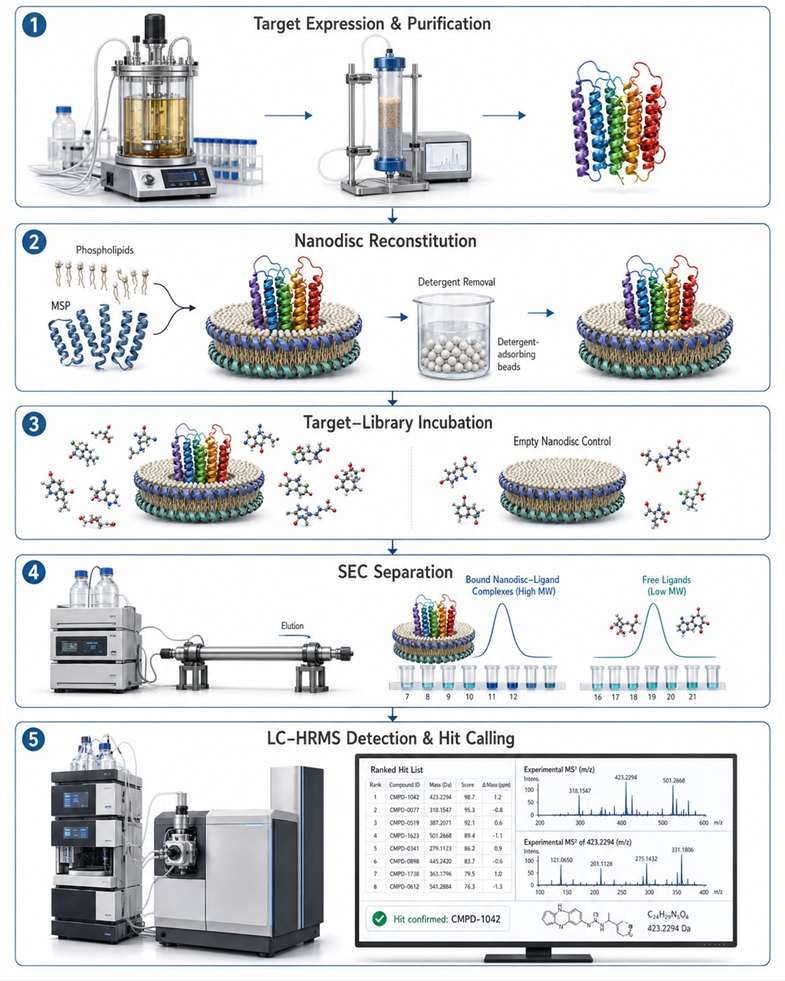
Our standard workflow runs through five stages:

1

Target Expression and Purification

We express the membrane protein target (mammalian, insect, or bacterial system) and purify it in detergent. Quality control covers SEC profile, SDS-PAGE, and an activity assay where feasible.

2

Nanodisc Reconstitution

Purified target is mixed with MSP and selected lipids at optimised molar ratios. Detergent is removed via Bio-Beads or dialysis, driving self-assembly of target-embedded nanodiscs. QC includes SEC profile, native MS, and negative-stain EM if needed.

3

Target–Library Incubation

Nanodisc-embedded target is incubated with the pooled compound library under optimised native conditions (temperature, buffer, incubation time). Control incubations — empty nanodisc plus library — run in parallel to flag non-specific binders.

4

SEC Separation of Bound vs. Unbound Compounds

Size-exclusion chromatography separates target–ligand complexes from free small molecules. The bound fraction is collected, and retained ligands are released by denaturation.

5

LC-HRMS Detection and Hit Calling

Released ligands are analysed by reversed-phase UPLC coupled with high-resolution QToF mass spectrometry. Data processing includes accurate-mass alignment, isotopic pattern matching, and library database searching to produce a ranked hit list with enrichment scores.

Five-step nanodisc MS binding workflow diagram: expression, nanodisc reconstitution, incubation, SEC separation, LC-HRMS detection.

Technology Comparison: Nanodisc MS Binding vs. Alternative Techniques

TechniqueMembrane EnvironmentLabel-FreeThroughputWeak Binding DetectionKinetic DataProtein Consumption
Nanodisc MS Binding (Creative Proteomics)Native lipid bilayerYesHigh (pooled)YesNoLow (μg)
Detergent-Based ASMSDetergent micelleYesHigh (pooled)LimitedNoLow (μg)
SPR (Surface Plasmon Resonance)Immobilised (detergent or nanodisc)No (immobilisation)Low–MediumYesYesMedium (μg)
ITC (Isothermal Titration Calorimetry)Solution (detergent or nanodisc)YesLowYesNo (thermodynamics)High (mg)
MST (MicroScale Thermophoresis)Solution/capillaryOptional labelMediumYesOptionalLow (μg)

Selection Strategy: We recommend nanodisc MS binding as the primary screening tool for membrane protein targets where native conformation is critical — especially early-stage hit discovery with pooled libraries. For kinetic follow-up on prioritised hits, SPR works well as a complementary technique. For a broader view of our affinity-based MS platform, see our affinity selection mass spectrometry (ASMS) service and native ESI-MS for noncovalent complexes.

Platform Instrumentation

Our nanodisc MS binding platform integrates advanced chromatography, high-resolution mass spectrometry, and optimised nanodisc reconstitution systems to support sensitive and reproducible drug screening for membrane protein targets.

Module CategoryInstrument / SystemCore CapabilityWhy It Matters
ChromatographyACQUITY UPLC 2DSEC + RP dual-mode separationPreserves native-state complexes and removes free ligands
Mass SpectrometryXevo G3 QTofHigh-resolution, accurate-mass detectionSensitive to low-affinity or weak binders
Informaticswaters_connectAutomated hit calling + database supportScales for pooled library analysis
Nanodisc ReconstitutionOptimised MSP + lipid systemControlled bilayer assemblyConsistent, reproducible nanodisc preparation
Stability ControlsTemp-controlled modules4 °C sample stabilityIdeal for membrane proteins and fragile targets

Sample Requirements

Sample TypeRequired AmountConcentrationPurityBuffer ConditionsNotes
Membrane Protein (purified in detergent)200–1,000 µg1–10 µM≥85%MS-compatible (low detergent)Provide sequence, tags, and known ligands
Membrane Protein (expression construct)ConsultationWe can handle expression and purification
Small-Molecule Library1–5 mg or 10 mM stock≥90%DMSOPooled screening format (100–1,000 cmpds/run)
Fragment Library1–5 mg≥95%DMSOProvide SDF if available
Lipids (if custom composition)ConsultationStandard lipids provided by default
Empty Nanodisc ControlPrepared in parallel for background subtraction

Note: Sample requirements may vary depending on target characteristics and library size. We recommend a preliminary consultation to determine optimal conditions for your specific project.

Deliverables

  • Ranked hit list with accurate-mass identification and enrichment scores
  • SEC chromatograms (target–library incubation and bound fraction)
  • RP-UPLC-MS chromatograms of eluted ligands
  • High-resolution MS spectra with isotopic pattern confirmation
  • Control experiment data (empty nanodisc background binding)
  • Summary report with hit prioritisation recommendations

Representative Demo Data

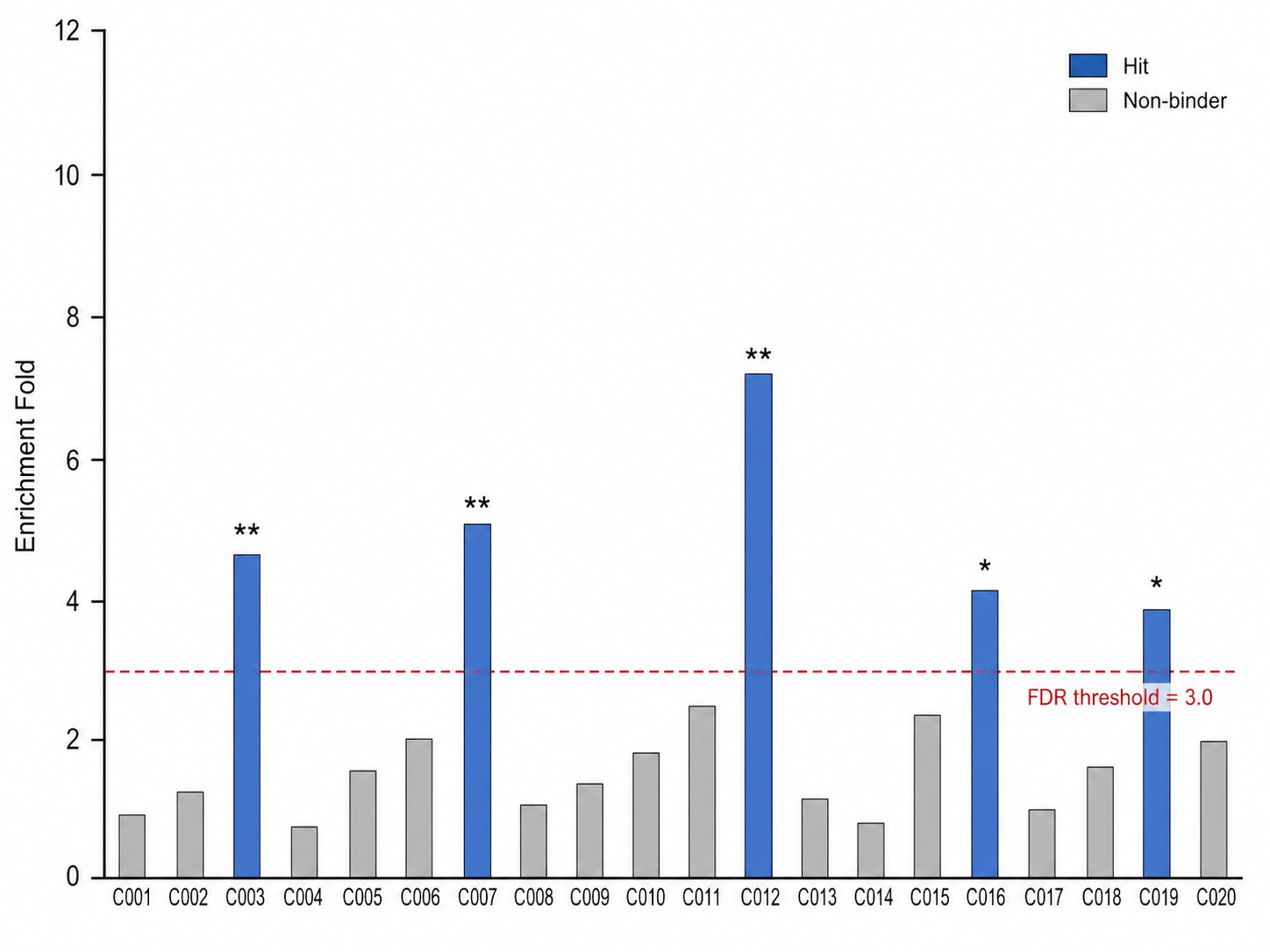
Example: Binding Enrichment Plot from a Nanodisc MS Binding Screen

A representative pooled library screen against a GPCR target reconstituted in nanodiscs. Compounds are ranked by MS signal intensity (enrichment fold). Hits above the FDR threshold (dashed line) are flagged as candidate binders and carried forward for confirmation.

Binding enrichment bar chart from a nanodisc MS binding screen: X-axis compound IDs, Y-axis enrichment fold, FDR threshold line, hits highlighted.

Example nanodisc MS binding enrichment plot

Case Study: AS-MS Ligand Identification for Nanodisc-Reconstituted Adenosine A2A Receptor

Ligand identification of the adenosine A2A receptor in self-assembled nanodiscs by affinity mass spectrometry

Background

The adenosine A2A receptor (A2AR) is a class A GPCR and a widely studied membrane-protein drug target. Because GPCR ligand screening can be affected by detergent conditions, receptor instability, labeling requirements, or surface immobilisation, Ma et al. evaluated whether nanodisc reconstitution could provide a more native-like environment for affinity mass spectrometry-based ligand identification.

Methods

In this study, A2AR was incorporated into self-assembled nanodiscs designed to maintain the receptor in a native-like phospholipid environment. The nanodisc-reconstituted receptor was then incubated with a set of eight known A2AR ligands. Affinity mass spectrometry was used to identify ligands retained by the receptor-containing nanodiscs, enabling direct, label-free detection of receptor–ligand interactions in a detergent-free buffer system.

Results

The affinity MS workflow identified the known A2AR ligands tested in the nanodisc format, and the results were consistent with previously reported binding-affinity data. The study also showed that nanodiscs improved the receptor's thermostability and homogeneity compared with detergent micelles, supporting their value as a membrane-mimetic platform for GPCR ligand screening.

Conclusions

This publication provides a real experimental example showing that nanodisc-reconstituted GPCRs can be paired with affinity mass spectrometry for label-free ligand identification. For membrane-protein drug discovery, the study supports the feasibility of combining nanodisc-based receptor stabilization with MS-based binding readouts, especially when preserving a native-like receptor environment is important for reliable hit detection.

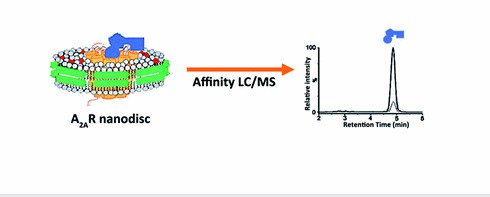
A2A receptor nanodisc affinity MS workflow showing nanodisc reconstitution, ligand incubation, affinity selection, and LC-MS detection.

Schematic representation of an A2AR nanodisc affinity MS workflow for label-free ligand identification.

FAQ

Frequently Asked Questions

Q: What types of membrane proteins are compatible with nanodisc MS binding assays?

Our service covers GPCRs (class A, B, and C), ion channels (voltage-gated and ligand-gated), SLC transporters, receptor tyrosine kinases, and membrane-embedded enzymes. We also offer feasibility assessments for novel or challenging targets.

Q: How much protein do I need to provide for a nanodisc reconstitution and MS binding experiment?

For a standard pooled library screen, we recommend 200–1,000 µg of purified membrane protein. Smaller amounts may work for pilot or feasibility studies. If purified protein isn't available, we can handle expression and purification from your construct.

Q: Can you screen my existing compound library, or do I need to prepare it specifically?

We can screen most compound libraries directly, as long as they're soluble in DMSO at the required concentration. A brief buffer compatibility check and library annotation help us optimise the pooling strategy and minimise false positives.

Q: How does nanodisc MS binding compare with traditional SPR for membrane protein targets?

Nanodisc MS binding offers higher throughput (pooled vs. serial screening) and doesn't require target immobilisation, avoiding potential conformational artefacts. SPR gives real-time kinetic data (kon, koff) and is better suited for detailed characterisation of prioritised hits. The two techniques are complementary — we typically recommend ASMS for primary screening and SPR for hit validation.

Q: What data will I receive at the end of a nanodisc MS binding project?

You'll get a ranked hit list with accurate-mass identification and enrichment scores, SEC and LC-MS chromatograms, high-resolution mass spectra, and a summary report with hit prioritisation recommendations. Control experiment data (empty nanodisc background) is included for confidence assessment.

Q: Can nanodisc MS binding detect weak or transient fragment binding?

Yes. High-resolution mass spectrometry is inherently sensitive to low-abundance species, making it well suited for detecting weak fragment–target interactions. This is a key advantage over functional assays that need a measurable biological response.

Reference

  1. Prudent, R., Annis, D.A., Dandliker, P.J. et al. Exploring new targets and chemical space with affinity selection-mass spectrometry. Nat Rev Chem 5, 62–71 (2021).
  2. Marty, M.T. Nanodiscs and mass spectrometry: Making membranes fly. Int J Mass Spectrom 458, 116436 (2020).
  3. Padayatti, P.S., et al. Nanodiscs: A Controlled Bilayer Surface for the Study of Membrane Proteins. Acc Chem Res 52, 557–565 (2019).
  4. Ma, J., Lu, Y., Wu, D., Peng, Y., Loa-Kum-Cheung, W., Peng, C., Quinn, R.J., Shui, W., Liu, Z.-J.Ligand identification of the adenosine A2A receptor in self-assembled nanodiscs by affinity mass spectrometry. Analytical Methods 9, 5851–5858 (2017).
  5. Muchiri, R.N., van Breemen, R.B. Drug discovery from natural products using affinity selection-mass spectrometry. Drug Discov Today Technol 40, 59–63 (2021).

Plan a nanodisc MS binding campaign with the MassTarget™ team

Share your target and library details and our scientists will design a tailored nanodisc MS binding strategy for your discovery program.

Online Inquiry

Please submit a detailed description of your project. We will provide you with a customized project plan to meet your research requests. You can also send emails directly to for inquiries.

* Email
Phone
* Service & Products of Interest
Services Required and Project Description