Integrated LiP-MS + TPP for Orthogonal Drug Target Deconvolution

Two orthogonal chemoproteomic readouts — conformational dynamics and thermal stability — from a single biological sample.

Every label-free chemoproteomic method has blind spots. TPP detects drug-induced thermal stability shifts but cannot report conformational dynamics. LiP-MS detects changes in protease accessibility but may miss targets where binding does not alter local structure. Relying on either method alone risks false negatives.

The solution is not to choose one method over the other — it is to run them together. LiP-MS and TPP are orthogonal by design. LiP-MS reads out structural dynamics at peptide-level resolution; TPP reads out global stability changes at protein-level resolution. When a candidate target is flagged by both methods, the confidence in direct engagement rises dramatically. When flagged by only one, the result still provides valuable mechanistic information — a conformational change without stability shift, or a thermal stabilization without detectable structural rearrangement.

We offer LiP-MS and TPP as an integrated, coordinated workflow — not two separate assays run independently. From a single compound-treated sample, we generate two independent lines of evidence, cross-correlate them through a unified bioinformatics pipeline, and deliver a confidence-ranked target list. This approach has been validated in published studies: a 2024 study in Nature Chemical Biology showed >60% concordance between LiP-MS and TPP across the E. coli and human proteomes, demonstrating that the two methods provide complementary target identification data.

Our service is part of the broader multi-omics integration platform at Creative Proteomics, and complements our standalone LiP-MS service and standalone TPP service by adding the orthogonal validation that single-method approaches cannot provide.
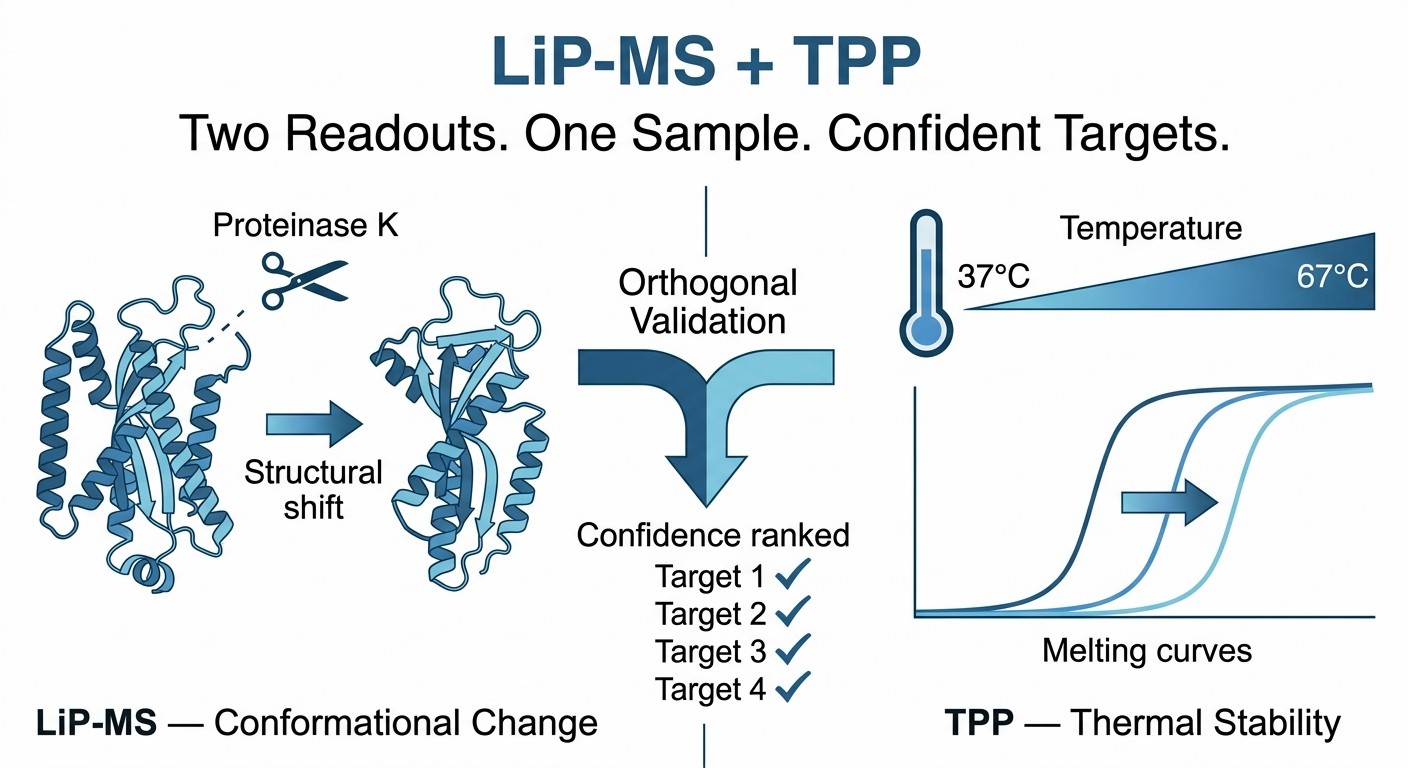
Integrated LiP-MS TPP orthogonal drug target deconvolution workflow combining conformational detection with thermal stability profiling
Why Combine How It Works What It Reveals Applications Comparison Sample Case Study

Why Orthogonal Chemoproteomic Readouts Are Essential for Confident Target Identification

Every label-free chemoproteomic method has blind spots. TPP detects drug-induced thermal stability shifts but cannot report conformational dynamics. LiP-MS detects changes in protease accessibility but may miss targets where binding does not alter local structure. Relying on either method alone risks false negatives.

The solution is not to choose one method over the other — it is to run them together. LiP-MS and TPP are orthogonal by design. LiP-MS reads out structural dynamics at peptide-level resolution; TPP reads out global stability changes at protein-level resolution. When a candidate target is flagged by both methods, the confidence in direct engagement rises dramatically. When flagged by only one, the result still provides valuable mechanistic information — a conformational change without stability shift, or a thermal stabilization without detectable structural rearrangement.

We offer LiP-MS and TPP as an integrated, coordinated workflow — not two separate assays run independently. From a single compound-treated sample, we generate two independent lines of evidence, cross-correlate them through a unified bioinformatics pipeline, and deliver a confidence-ranked target list. This approach has been validated in published studies: a 2024 study in Nature Chemical Biology showed >60% concordance between LiP-MS and TPP across the E. coli and human proteomes, demonstrating that the two methods provide complementary target identification data.

For drug discovery teams facing phenotypic hits with unknown targets, low-affinity binders that evade affinity capture, or membrane proteins that resist pull-down approaches, the combined LiP-MS + TPP workflow offers the most comprehensive label-free target deconvolution strategy available today.

This service is part of our broader multi-omics integration platform, which connects orthogonal chemoproteomic readouts with complementary omics data for complete drug mechanism characterization.

How the Integrated LiP-MS + TPP Workflow Delivers Two Readouts from One Sample

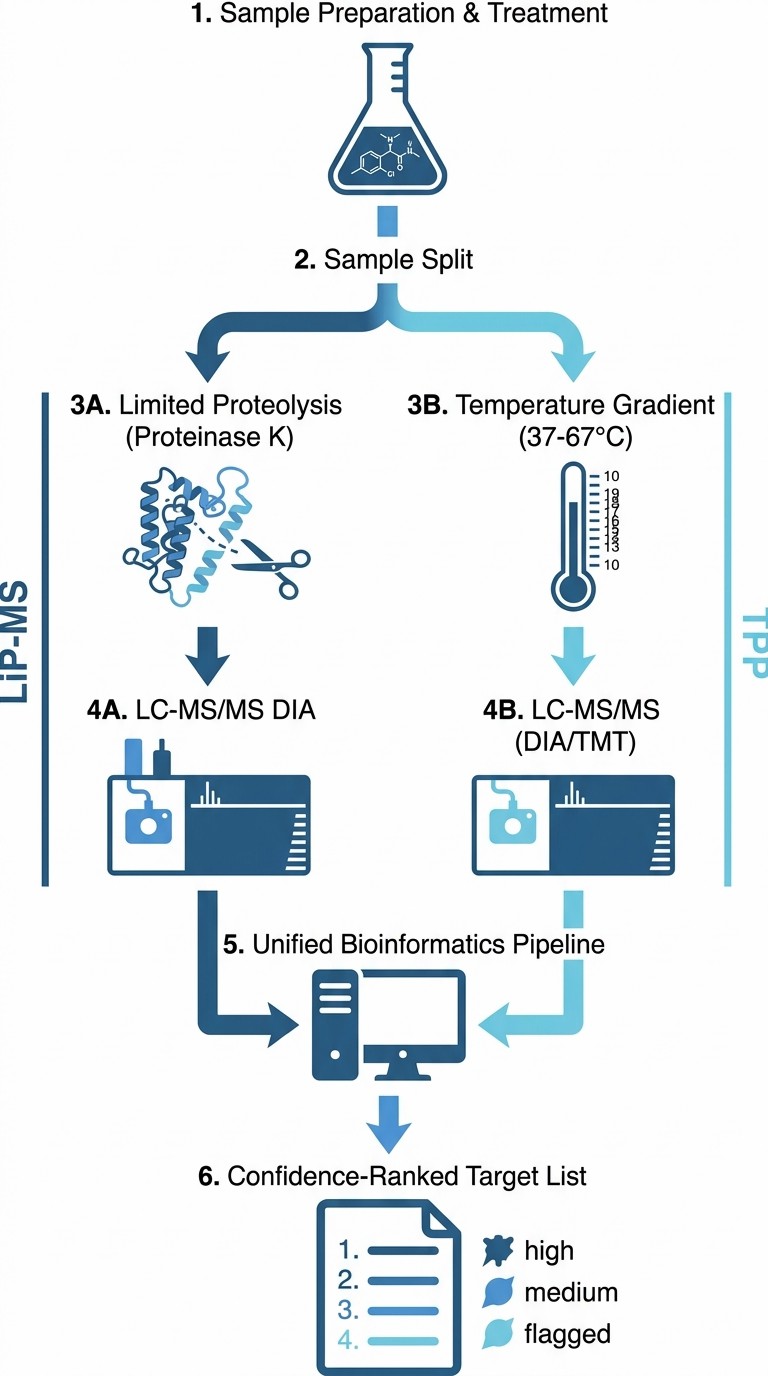
The key advantage of our combined service is that both LiP-MS and TPP analyses run from the same compound-treated biological sample. This eliminates the need to scale up culture or split precious limited material into two separate experiments. The workflow proceeds as follows:

Step 1 — Sample Preparation and Treatment

Cells or lysates are treated with the compound of interest at the desired concentration and incubation time. A matched vehicle control is prepared in parallel. After treatment, the sample is divided into two aliquots — one for LiP-MS and one for TPP.

Step 2 — LiP-MS Workflow

The LiP-MS aliquot undergoes limited proteolysis with proteinase K under tightly controlled conditions (enzyme-to-substrate ratio, temperature, and time). Drug-bound proteins exhibit altered protease accessibility patterns compared to the control — regions that become protected or exposed upon compound binding generate differential peptide-level fingerprints. After proteolysis quenching, samples undergo denaturation, reduction, alkylation, and full tryptic digestion. Peptides are analyzed by LC-MS/MS using data-independent acquisition (DIA) for deep proteome coverage.

Step 3 — TPP Workflow

The TPP aliquot is distributed across a temperature gradient (typically 37–67°C in 10 increments). After heating, soluble protein fractions are separated from aggregates by centrifugation. Each temperature point is digested and analyzed by LC-MS/MS (DIA or TMT-based). Drug-bound proteins show shifted melting curves — stabilized (higher Tm) or destabilized (lower Tm) — compared to the vehicle control.

Step 4 — Parallel Data Acquisition

Both workflows run simultaneously, not sequentially. This parallel design reduces total project time to 8–10 weeks — comparable to running a single-method study.

Step 5 — Unified Bioinformatics Pipeline

LiP-MS and TPP datasets are processed through a single bioinformatics pipeline that: identifies significantly altered peptides (LiP-MS) and shifted proteins (TPP) using statistical cutoffs; cross-correlates hits — a protein flagged by both methods receives "high confidence" status; maps structural annotations (LiP-MS peptide-level data) onto thermal stability profiles (TPP); and generates a confidence-ranked target list with functional annotation and pathway enrichment.

Step 6 — Integrated Report

The final deliverable includes both method-specific datasets and the cross-correlation analysis, providing a complete picture of compound-induced proteome perturbations.

For researchers who also need quantitative binding affinity, our LiP-Quant target deconvolution workflow can be layered onto the same LiP-MS data.

Complementary Insights: Conformational Dynamics Meets Thermal Stability

The power of combining LiP-MS and TPP lies in what each method reveals — and what the combination reveals that neither can alone.

What LiP-MS Provides

LiP-MS detects peptide-level changes in protease accessibility. When a compound binds to a protein, it can sterically shield a protease cleavage site, or it can induce a conformational change that alters the local structure. Both effects produce a differential peptide signal. This means LiP-MS can: identify the approximate binding region on a target protein; distinguish between direct binding and downstream structural effects; and detect transient or low-affinity interactions that stabilize specific conformations.

What TPP Provides

TPP measures protein-level thermal stability shifts. Compound binding typically stabilizes a protein, shifting its melting curve to higher temperatures. TPP can: identify targets and off-targets across the entire proteome without any prior knowledge; work in live cells (thermal stabilization assay format) or lysates; and provide dose-response information when run in 2D-TPP mode.

The Combined Readout Matrix

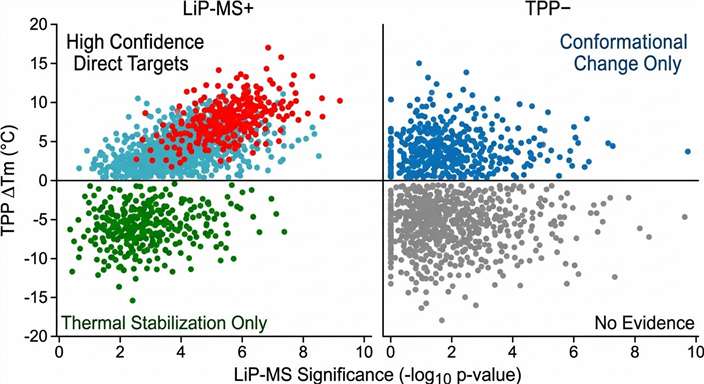
When both methods are applied to the same sample, each protein falls into one of four categories: LiP-MS+/TPP+ = direct target engagement with both conformational and thermal effects (high confidence); LiP-MS+/TPP- = conformational change without thermal stabilization — possible transient binding or local effect (medium confidence); LiP-MS-/TPP+ = thermal stabilization without detectable structural change — possible allosteric or indirect effect (medium confidence); LiP-MS-/TPP- = no evidence of engagement (low).

From Data to Decision

This matrix is the core analytical framework of our combined service. It transforms two independent datasets into a single, interpretable decision tool. High-confidence hits can proceed directly to medicinal chemistry or functional validation. Medium-confidence hits provide mechanistic clues for further investigation. The orthogonal design ensures that even when methods disagree, the result is informative rather than ambiguous.

When to Choose Combined LiP-MS + TPP Over Single-Method Approaches

SCENARIO 1

Phenotypic Hits with Completely Unknown Targets

When a phenotypic screen yields a hit but the target is unknown, maximum confidence is essential. The combined approach provides two independent lines of evidence, reducing the risk of false positives that could misdirect medicinal chemistry efforts. Both LiP-MS and TPP are unbiased and proteome-wide, covering targets that affinity-based methods would miss.

SCENARIO 2

Low-Affinity or Transient Binders

Compounds with weak binding affinity (μM range or higher) often fail in affinity pulldown experiments. LiP-MS can detect transient conformational changes, and TPP can detect subtle thermal stabilization — together they capture interactions that single methods might miss. This makes the combined approach particularly valuable for fragment screening follow-up and natural product target ID.

SCENARIO 3

Membrane Protein Targets

Membrane proteins are notoriously difficult to study by affinity-based methods due to solubilization requirements. Both LiP-MS and TPP can be performed in native membrane environments, making them suitable for GPCRs, ion channels, and transporters. The combined approach maximizes the chance of detecting engagement for these challenging target classes.

SCENARIO 4

Lead Optimization Requiring Comparative Target Engagement

When comparing a series of analogs, the combined readout provides richer information than either method alone. Differences in conformational fingerprints (LiP-MS) and thermal stabilization magnitudes (TPP) can guide structure-activity relationship decisions, helping prioritize compounds with the most favorable target engagement profiles.

SCENARIO 5

Off-Target Profiling for Safety Assessment

Comprehensive off-target identification requires unbiased proteome-wide coverage. The combined approach maximizes the chance of detecting off-targets that might cause toxicity, while the orthogonal validation reduces the risk of pursuing false off-target leads. This is especially important for compounds advancing toward preclinical development.

For routine target confirmation where the target is already suspected, or for very early-stage screening where sample is extremely limited, a single-method approach (LiP-MS or TPP alone) may be sufficient. Our thermal proteomics for MoA service provides an alternative approach for mechanism-of-action studies. We can help you decide which strategy fits your project stage.

LiP-MS + TPP vs. Alternative Target Identification Strategies

DimensionLiP-MS + TPP (Combined)TPP AloneLiP-MS AloneAffinity Pulldown-MSABPPDARTS
Label-free✗ (requires modification)✗ (requires probe)
Proteome coverageHighHighHighMedium (depends on affinity resin)Medium (probe-dependent)Medium
Conformational information✓ (peptide-level)✓ (peptide-level)Partial
Binding site inference✓ (from LiP-MS)✓ (competitive)Partial
Thermal stability data
Membrane protein compatibleLimitedLimited
Low-affinity binder detection
Live-cell compatible✓ (thermal stabilization assay)Limited
ThroughputMediumMedium-HighMediumHighHighMedium
Sample requirementModerateLowLowModerateLowLow

Selection guidance. If you need the highest confidence in target identification and have sufficient sample, the combined LiP-MS + TPP approach is the strongest option. If sample is very limited or throughput is the priority, TPP alone offers excellent proteome coverage with lower sample demand. If binding site information is critical, LiP-MS (especially LiP-Quant) provides peptide-level resolution that TPP cannot match.

For teams already using thermal proteomics for MoA, the combined LiP-MS + TPP approach provides an orthogonal and complementary line of evidence.

Project Workflow and Timeline

From sample receipt to integrated report in 8–10 weeks.

1

Study Design Consultation

We review your compound properties, sample type, experimental goals, and recommend the optimal treatment conditions, concentration range, and number of replicates.

2

Sample Preparation and QC

Your sample is received, logged, and quality-checked. Compound treatment is performed, and the sample is split for parallel LiP-MS and TPP processing.

3

Parallel Data Acquisition

LiP-MS (limited proteolysis + LC-MS/MS DIA) and TPP (thermal gradient + LC-MS/MS) run simultaneously. Each workflow includes its own QC checkpoints.

4

Unified Bioinformatics Analysis

LiP-MS peptide-level data and TPP protein-level data are processed through the integrated pipeline. Cross-correlation analysis generates the confidence-ranked target list.

5

Cross-Correlation and Target Ranking

The 2×2 matrix analysis is completed. High-confidence hits (positive by both methods) are prioritized. Medium-confidence hits are annotated with mechanistic notes.

6

Integrated Report Delivery

You receive the complete deliverable package including raw data, processed datasets, interactive visualizations, and the written interpretation.

LiP-MS TPP 6-step integrated workflow diagram showing parallel processing of LiP-MS and TPP from a single sample

Sample Requirements for Combined LiP-MS + TPP Studies

Sample TypeMinimum AmountRecommended AmountReplicatesNotes
Cultured cells (suspension)2 × 10⁷ cells5 × 10⁷ cells3 biologicalSingle treatment, split for both assays
Cultured cells (adherent)2 × 10⁷ cells5 × 10⁷ cells3 biologicalHarvest and wash before splitting
Tissue (soft)100 mg200–300 mg3 biologicalHomogenize before splitting
Tissue (hard)200 mg400–500 mg3 biologicalRequires additional processing
Cell lysate / protein extract2 mg protein5 mg protein3 technicalProvide in compatible buffer
Microbial pellet100 μL pellet200–300 μL pellet3 biologicalLyse before splitting

Important notes: Both LiP-MS and TPP run from the same compound-treated sample — no need to scale up culture. We recommend 3 biological replicates for statistical rigor; 2 is the minimum. Compound concentration and incubation time should be optimized in a pilot study. Buffer conditions: avoid high glycerol (>5%), detergents (>0.1% SDS), or reducing agents that interfere with proteolysis or thermal stability. Contact us for sample-specific compatibility if your sample type is not listed.

Integrated Deliverables: What You Receive

  • LiP-MS differential peptide table with fold-change, significance (adjusted p-value), and structural annotation (protein domain, predicted secondary structure)
  • TPP melting curve dataset with fitted Tm values, ΔTm, and significance for each quantified protein
  • Cross-correlation report mapping LiP-MS conformational changes to TPP thermal stability shifts, with the 2×2 confidence matrix
  • Confidence-ranked target list: high confidence (positive by both LiP-MS and TPP), medium confidence (positive by one method only, with mechanistic annotation), and flagged (borderline significance, recommended for orthogonal follow-up)
  • Pathway enrichment and functional annotation for the target list, including GO terms, KEGG pathways, and protein class analysis
  • Interactive visualizations: volcano plots (LiP-MS), melting curves (TPP), correlation scatter plots, and the confidence matrix heatmap
  • Raw data files: LC-MS/MS raw files, database search results, quantification tables — suitable for publication and regulatory submission
  • Methods section ready for manuscript preparation, describing the integrated workflow in publication-standard detail

Representative Data: Orthogonal Confidence Matrix

LiP-MS TPP 2x2 confidence matrix heatmap showing orthogonal validation categories for drug target identification

Orthogonal confidence matrix: LiP-MS conformational changes vs. TPP thermal stability shifts

Case Study: In Situ Analysis of Osmolyte Mechanisms Using Combined LiP-MS and TPP

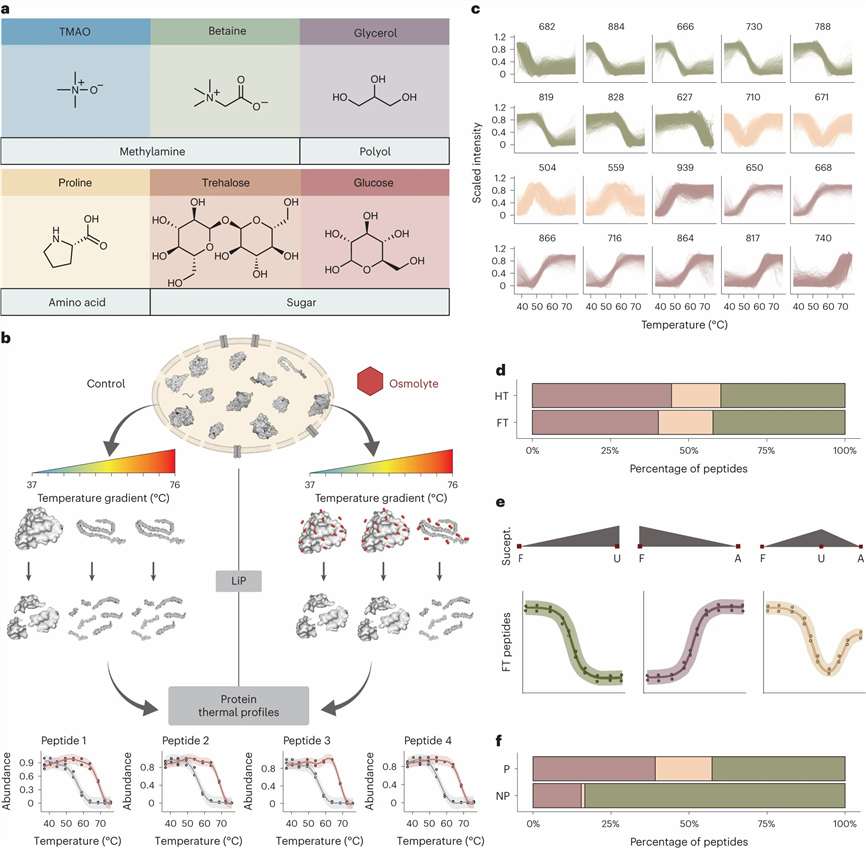
Pepelnjak M, Velten B, Näpflin N, et al. "In situ analysis of osmolyte mechanisms of proteome thermal stabilization." Nature Chemical Biology 20, 1053–1065 (2024). https://doi.org/10.1038/s41589-024-01568-7

Background

Osmolytes are small organic compounds that cells use to protect proteins under stress conditions. While their stabilizing effects were known from in vitro studies, the mechanisms at proteome scale — and the interplay between conformational stabilization and aggregation prevention — remained poorly understood. The Picotti lab at ETH Zurich designed a study using both LiP-MS and TPP to systematically dissect osmolyte mechanisms in E. coli and human HEK293T cell lysates.

Methods

The team treated cell lysates with five osmolytes (sucrose, trehalose, sorbitol, TMAO, and proline) at physiological concentrations. Samples were subjected to a 10-point temperature gradient (37–76°C). For LiP-MS, proteinase K was added at each temperature point under controlled conditions, followed by LC-MS/MS DIA analysis. For TPP, the soluble protein fraction was recovered after heating and quantified by LC-MS/MS. The two datasets were analyzed independently and then cross-correlated.

Results

LiP-MS revealed that osmolytes induce widespread but protein-specific conformational stabilization patterns. Over 60% of E. coli proteins showed measurable stabilization by at least one osmolyte. The LiP-MS data identified distinct structural mechanisms — some proteins showed protection of specific surface regions, while others exhibited global rigidification. TPP confirmed the thermal stabilization and additionally revealed that osmolytes delay protein aggregation at high temperatures. Critically, LiP-MS and TPP showed >60% concordance in identifying stabilized proteins, providing orthogonal validation of the findings. The combined analysis also uncovered osmolyte-specific effects: TMAO preferentially stabilized proteins with charged surface patches, while sucrose showed broader, less selective stabilization.

Conclusion

This study demonstrated that LiP-MS and TPP provide complementary, concordant readouts of proteome-wide stabilization effects. The >60% concordance rate validates the orthogonal approach: proteins flagged by both methods represent high-confidence hits, while those detected by only one method still provide valuable mechanistic insight. The study established a framework for combined LiP-MS + TPP analysis that is directly transferable to drug target deconvolution projects.

LiP-MS TPP combined analysis data from Pepelnjak et al. 2024 showing osmolyte-induced proteome stabilization

Fig. 1 from Pepelnjak et al. (2024): LiP-MS thermal profiling workflow and representative stabilization data.

FAQ

Frequently Asked Questions

Q: How is combined LiP-MS + TPP different from running LiP-MS and TPP as separate projects?

When run separately, LiP-MS and TPP are independent experiments with separate sample preparations, separate data analyses, and separate reports. Our combined service integrates both workflows from a single sample preparation through a unified bioinformatics pipeline, delivering a single cross-correlated report with confidence-ranked targets.

Q: What types of compounds are compatible with this combined approach?

Small molecules, natural products, metabolites, peptides, and biologics are all compatible. The key requirement is that the compound can be added to the biological sample (cells or lysates) and that it induces a detectable change in protein conformation (LiP-MS) or thermal stability (TPP). No compound modification or labeling is needed.

Q: Can I use the same biological sample for both LiP-MS and TPP analyses?

Yes — this is a core feature of our combined service. The compound-treated sample is split into two aliquots after treatment, one for each workflow. This eliminates the need for separate culture scale-up and ensures both datasets come from the same biological context.

Q: How do you integrate the two data types into a unified target list?

Our bioinformatics pipeline first processes each dataset independently using method-specific statistical cutoffs. It then cross-correlates the results: proteins significant in both datasets are assigned "high confidence"; proteins significant in one dataset are assigned "medium confidence" with mechanistic annotation. The final output is a single ranked list with the 2×2 confidence matrix.

Q: What is the typical turnaround time for a combined LiP-MS + TPP project?

8–10 weeks from sample receipt to final report. This is comparable to a single-method project because the LiP-MS and TPP workflows run in parallel.

Q: How does this approach compare with thermal stabilization assay (PISA-based) or affinity pulldown for target identification?

Thermal stabilization assay is a cellular format of thermal stability profiling and is conceptually similar to TPP. Affinity pulldown requires compound modification and may miss low-affinity or membrane protein targets. The combined LiP-MS + TPP approach is label-free, works for any compound type, and provides orthogonal evidence that single-method approaches cannot match.

Q: What happens if LiP-MS and TPP results disagree for a particular protein?

Disagreement is informative, not problematic. A protein positive by LiP-MS but not TPP may undergo a conformational change without measurable thermal stabilization — this could indicate transient or local binding. A protein positive by TPP but not LiP-MS may be stabilized through indirect or allosteric mechanisms. Both scenarios provide valuable mechanistic information and are annotated as such in the report.

References

  1. Pepelnjak M, Velten B, Näpflin N, et al. In situ analysis of osmolyte mechanisms of proteome thermal stabilization. Nat Chem Biol 20, 1053–1065 (2024).
  2. Piazza I, Beaton N, Bruderer R, et al. A machine learning-based chemoproteomic approach to identify drug targets and binding sites in complex proteomes. Nat Commun 11, 4200 (2020).
  3. Schopper S, Kahraman A, Leuenberger P, et al. Measuring protein structural changes on a proteome-wide scale using limited proteolysis-coupled mass spectrometry. Nat Protoc 12, 2391–2410 (2017).
  4. Franken H, Mathieson T, Childs D, et al. Thermal proteome profiling for unbiased identification of direct and indirect drug targets using multiplexed quantitative mass spectrometry. Nat Protoc 10, 1567–1593 (2015).
  5. Mateus A, Määttä TA, Savitski MM. Thermal proteome profiling: unbiased assessment of protein state through heat-induced stability changes. Proteome Sci 15, 13 (2017).

Design Your Orthogonal Target ID Study

Share your project details and our scientists will design an integrated LiP-MS + TPP strategy for your drug discovery program, delivering confidence-ranked targets with orthogonal validation.

For Research Use Only. Not for use in diagnostic procedures.

Online Inquiry

Please submit a detailed description of your project. We will provide you with a customized project plan to meet your research requests. You can also send emails directly to for inquiries.

* Email
Phone
* Service & Products of Interest
Services Required and Project Description