Charge Detection Mass Spectrometry Service for Large Complexes

Single-particle mass analysis for heterogeneous viral particles and large biomolecular assemblies.

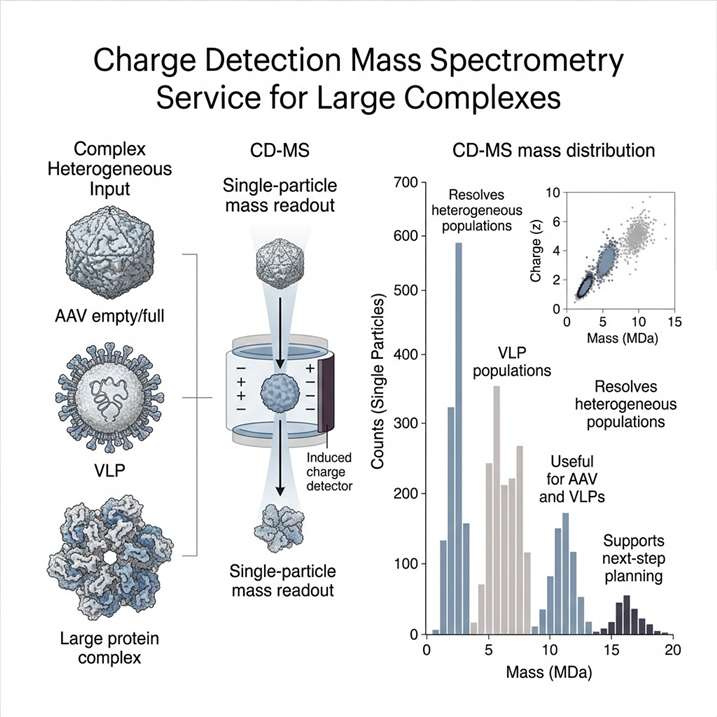
Charge Detection Mass Spectrometry Service for Large Complexes helps us characterize large and heterogeneous complexes through direct single-ion mass measurement. We use CD-MS to resolve mass distributions, distinguish subpopulations, and support project decisions when bulk methods or conventional MS readouts do not fully explain complex sample behavior. CD-MS is especially valuable for very large biomolecules, including viral particles, VLPs, RNA-containing assemblies, and high-mass protein complexes.

Key Advantages:

  • Single-particle mass readout.
  • Resolves heterogeneous populations.
  • Useful for AAV and VLPs.
  • Supports formulation review.
  • Built for next-step planning.
Charge detection mass spectrometry overview for large complexes, showing single-particle mass readout, heterogeneous population resolution, and viral particle characterization.
What CD-MS RevealsCapabilitiesProject FitWorkflowInterpretationResultsSampleComparisonCase StudyFAQReferences

What CD-MS Can Reveal in Large and Heterogeneous Complexes

Large complexes rarely behave like simple, uniform analytes. Once heterogeneity increases, ensemble-style measurements can hide important differences between particle populations. CD-MS addresses that problem by measuring the charge and mass-to-charge ratio of individual ions, allowing direct mass determination at the single-particle level. That makes it well suited to very large and heterogeneous biomolecules that are difficult to resolve by conventional high-mass MS alone.

For viral capsids and related particles, this matters because the project question is often distribution-based rather than binary. You may need to know whether the sample contains empty, partial, full, or overfilled populations, whether formulation changes have shifted the balance of those populations, or whether a purification step has improved sample quality in a meaningful way. CD-MS is increasingly used in these settings because it can directly read out particle-level mass distributions across complex sample populations.

The same logic applies to large protein assemblies and supramolecular complexes. When size, adduction, and heterogeneity blur conventional charge-state resolution, CD-MS can provide a more usable mass-distribution view. Recent application work on native protein complexes highlights this advantage specifically in samples where broad peaks and unresolved charge states limit interpretation by traditional high-mass ToF workflows.

Our CD-MS Capabilities for Large Complexes and Viral Particles

AAV, viral capsids, and VLPs

We support particle-level mass characterization for viral particles and related assemblies where subpopulation resolution matters.

Large protein complexes

We can support high-mass protein complexes and supramolecular assemblies when conventional ensemble MS interpretation becomes difficult.

Heterogeneous samples

We work with samples affected by formulation, process history, or multimodal population structure that require direct distribution analysis.

Process and condition comparisons

We can compare purification stages, lots, or formulation conditions to show how population structure changes across the study.

QC-aware result interpretation

We organize outputs around population structure, reproducibility, and sample behavior rather than leaving you with a plot alone.

Follow-up planning support

We structure reporting so your team can decide whether to continue with CD-MS, add another method, or refine sample conditions.

For many clients, the value of CD-MS is not simply that a large particle can be detected. The value is that complex populations can be separated into interpretable groups and then linked back to the analytical question that matters most to the project. That may be payload-related heterogeneity, aggregate-like populations, process-stage comparison, or confirmation that a formulation change has altered the sample state in a meaningful way. Published CD-MS application work has shown this clearly in both AAV and large native protein-complex settings.

When CD-MS Is a Good Fit for Your Sample and Study Goal

Viral capsids and payload heterogeneity

CD-MS is especially useful when you need to distinguish empty, partially filled, full, or overfilled populations across complex viral particle samples.

Large complexes with high heterogeneity

It is a strong fit when unresolved charge-state behavior or broad mass ranges limit interpretation by conventional high-mass MS.

Process, formulation, and orthogonal support

It is useful when the project depends on comparing populations across conditions, stages, or analytical paths rather than generating a single endpoint readout.

Workflow From Sample Review to Final Distribution Analysis

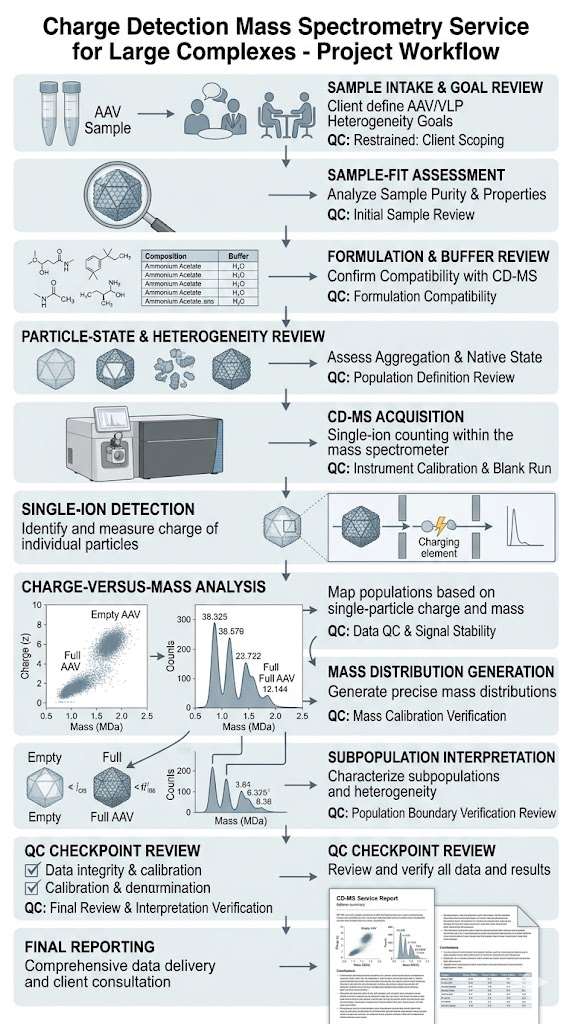
STEP 1

Project intake, sample-fit review, and formulation assessment

We begin by reviewing the sample class, the main analytical question, the expected heterogeneity, and the comparison you want the study to support. For large-complex projects, the sample type alone is not enough. We need to understand whether the priority is subpopulation resolution, process comparison, formulation review, or orthogonal support for another structural or biophysical method.

STEP 2

CD-MS acquisition, single-ion measurement, and QC checkpoints

Once the project is judged suitable, we review formulation and matrix details, including salts, additives, stabilizers, surfactants, and handling history. This is an important QC stage because these factors can strongly influence high-mass ion behavior and distribution interpretability. After sample readiness is established, the material proceeds into CD-MS acquisition, where the core technical readout is based on individual-ion measurement rather than ensemble-only signal behavior.

STEP 3

Distribution analysis, subpopulation interpretation, and reporting

After acquisition, we process the data into interpretable distribution views. That includes identifying dominant and minor populations, reading subpopulation boundaries, comparing conditions or stages, and organizing the result into a report that can support the next analytical decision. For CD-MS projects, the most useful interpretation is usually not a simple mass call, but which populations are present, how they differ, and what that means for the next step.

Typical QC checkpoints include sample identity and comparison design review, buffer or formulation compatibility review, concentration and distribution context, handling history including freeze-thaw or stress notes when relevant, and signal stability plus population-boundary review during analysis.

How We Interpret Heterogeneity and Subpopulation Patterns

1

Distinguishing major and minor mass populations

A distribution plot often contains more than one analytically relevant population. Major peaks may define the dominant particle class, while lower-abundance populations may reflect partial filling, aggregation-like behavior, non-target components, or process-associated impurity material.

2

Reading empty, partial, full, and overfilled patterns

For viral vector work, this is one of the most practical outputs. The distinction between empty, intermediate, full, and overfilled populations is central to sample assessment, and multiple recent studies show that CD-MS can support that kind of particle-level classification.

3

Connecting mass distributions to practical project decisions

Our reporting is built around what the distribution means for the project, including purification assessment, formulation review, method selection, and follow-up planning.

4

Data analysis and reporting

For this service, the analysis layer is centered on mass-distribution interpretation rather than a separate bioinformatics workflow. Reporting can include mass histograms, charge-versus-mass plots, subpopulation assignments, comparative condition views, QC observations, and concise interpretation notes.

Vertical CD-MS workflow showing project intake, formulation review, single-ion measurement, and mass-distribution interpretation for large complexes.

Representative CD-MS Results You Can Receive

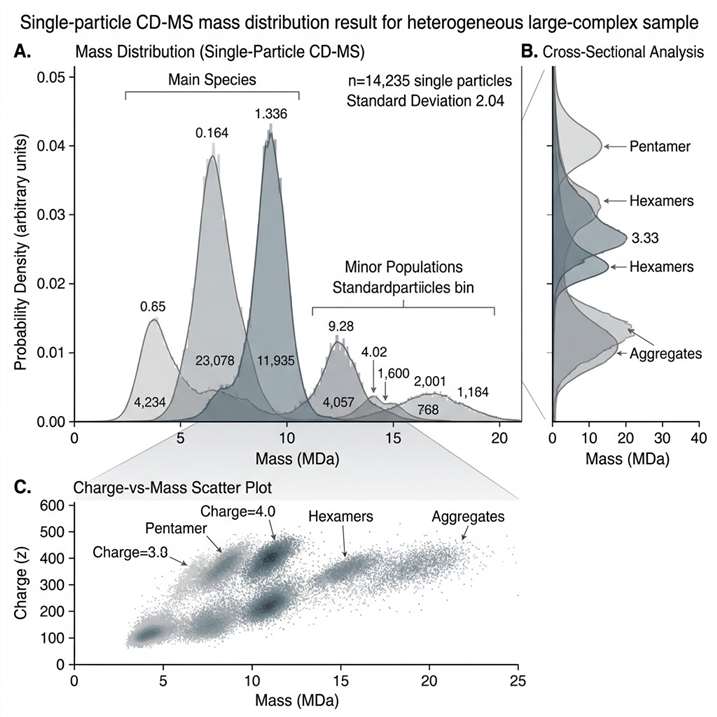
Single-particle CD-MS mass distribution view for a heterogeneous large-complex sample.

Single-particle mass distribution view

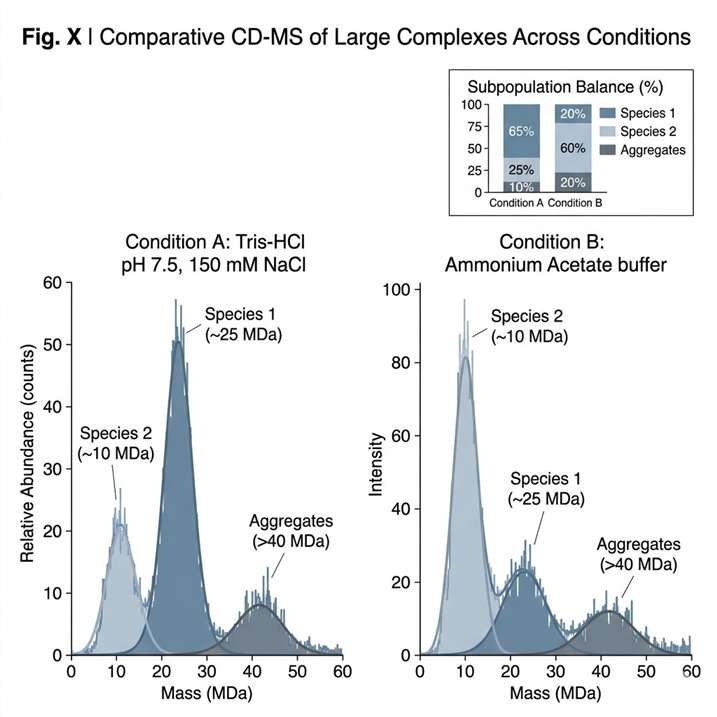
CD-MS subpopulation comparison across purification stage, formulation, or sample condition.

Subpopulation comparison across conditions or stages

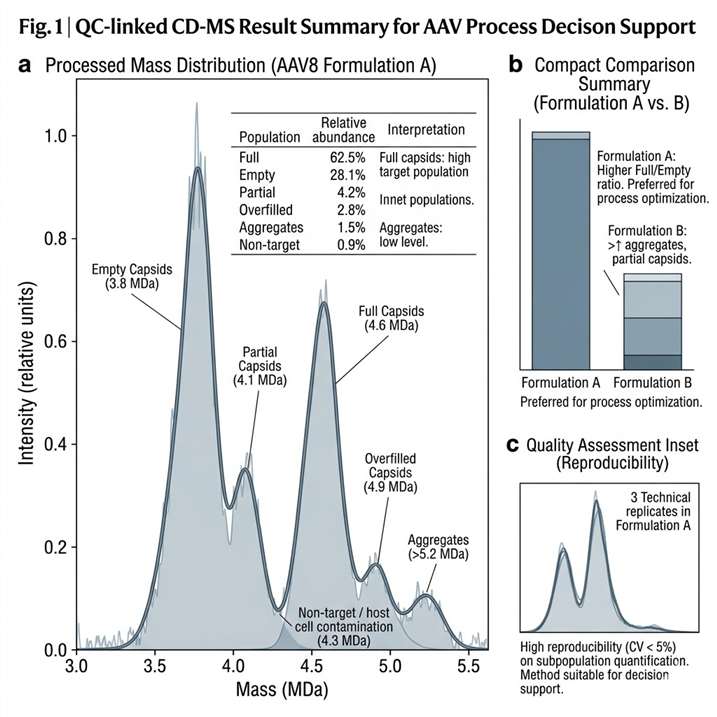
QC-linked CD-MS summary showing annotated subpopulations for formulation or process decisions.

QC-linked summary for formulation or process decisions

A useful CD-MS result should help your team decide what to do next. This may include an overall mass profile across the sample population, a comparison across process or formulation conditions, or a QC-linked summary that helps determine whether the sample should move to another analytical step.

Sample Requirements and Submission Planning

Sample categoryPractical quantity guideHandlingSubmission notes
Purified protein target150 µg recommended; 300 µg optimizedFreeze promptly, store at -80°C, ship on dry iceSuitable for large-complex feasibility review and high-mass assay planning
Cultured cell pellets5 × 106 recommended; 1 × 10⁷ optimizedPre-chilled PBS wash, quick-freeze, ship on dry iceUseful when upstream preparation or complex-expression context matters
Plasma / serum20 µL without depletion; 50-100 µL with depletion; >100 µL in metabolomics guidanceFreeze promptly, store at -80°C, ship on dry iceUsually relevant for upstream exploratory or orthogonal sample workflows
Culture supernatant / medium10 mL recommended; 20 mL optimized; >2 mL in metabolomics guidanceQuick-freeze, store at -80°C, ship on dry iceUseful for upstream enrichment, process-related review, or special sample contexts
Urine200-500 µLTransfer clear supernatant, quick-freeze, store at -80°C, ship on dry icePrimarily relevant for exploratory sample contexts rather than direct CD-MS large-complex readout

CD-MS vs Other Large-Complex Characterization Methods

MethodMain question it answersTypical outputStrengthLimitationBest use stage
CD-MSWhat particle-level mass distributions and subpopulations are present in a large, heterogeneous sample?Single-particle mass distributions, charge-versus-mass plots, subpopulation viewsStrong for very large, heterogeneous biomolecules and mixed particle populationsNot a structural imaging methodSample assessment, heterogeneity analysis, process comparison, orthogonal support
Native ESI-MS for noncovalent complexesHow does an intact complex behave under native-like ionization conditions?Intact-complex mass readout, charge-state distributionsStrong for many complex assemblies when conventional native MS remains interpretableHigh heterogeneity can blur conventional ensemble interpretationComplex behavior and intact-mass follow-up
Cryo-EM / TEMWhat does the particle look like structurally?Image-based structural viewsStrong for structural visualization and morphologyDoes not replace particle-level mass distribution analysisStructural follow-up and morphology-focused work
AUC / SEC-MALS / DLSHow does size or bulk distribution behave across the sample?Bulk distribution or size-related readoutsUseful orthogonal bulk characterizationLess direct for particle-level mass distributionsBulk comparison and orthogonal characterization
Ion Mobility MS (IM-MS / TIMS-MS)Does the sample contain separable shape-state or conformational distributions alongside mass information?Mobility-separated distributionsUseful when shape-state separation mattersDifferent analytical priority from direct particle-mass profilingConformation-aware follow-up

If your main need is direct single-particle mass distribution with strong visibility into heterogeneous subpopulations, CD-MS is often the strongest starting point. If your main goal is higher-resolution structure, broader bulk distribution, or shape-state separation, another method may be more appropriate for the next step.

Case Study

End-to-end characterization of AAV manufacturing process using charge detection mass spectrometry

Background

AAV manufacturing and purification workflows generate samples that can contain multiple particle populations, including target capsids, aggregates, and non-target material. For development-stage characterization, the key question is often not simply whether AAV is present, but whether the particle population is clean, reproducible, and analytically distinguishable across runs and conditions.

Methods

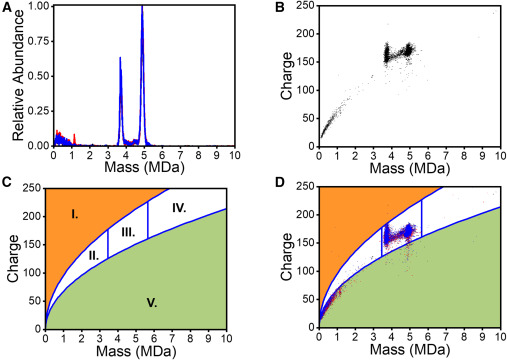
In the study, purified AAV9-1 material was analyzed by CD-MS in triplicate. The workflow included mass histograms and charge-versus-mass scatterplots so that individual ions could be evaluated across the characteristic charging regions observed in native electrospray. This approach allowed the authors to assess reproducibility and to distinguish typical AAV particle signals from lower-mass material, aggregates, and other non-target populations.

Results

In Figure 1, the case is presented through four linked views. Figure 1A shows triplicate mass histograms for purified AAV9-1, demonstrating reproducible distribution patterns across replicate measurements. Figure 1B shows a charge-versus-mass scatterplot in which each dot represents a single AAV ion from one run. Figure 1C defines the typical charging regions observed in native electrospray, separating DNA and denatured proteins, low-molecular-weight species, AAV particles, AAV aggregates, and surfactant micelles or high-density aggregates. Figure 1D overlays triplicate charge-versus-mass scatterplots and shows that typical AAV ions fall within the defined blue-line boundaries. Together, these views show that CD-MS can provide both reproducible mass distributions and clear contextual separation between target AAV populations and non-target signal regions.

Conclusion

This figure is highly relevant for a CD-MS service page because it shows exactly the kind of result clients need to interpret: reproducibility across runs, direct single-ion distribution readout, and visually defined boundaries between intended particle populations and non-target material. For large-complex and viral-particle characterization projects, that kind of output supports sample assessment, subpopulation review, and more confident decisions about what to do next.

Source for verification: End-to-end characterization of AAV manufacturing process using charge detection mass spectrometry

Figure showing triplicate mass histograms and charge-versus-mass scatterplots from CD-MS analysis of purified AAV9-1, including typical AAV, aggregate, low-mass, and non-target signal regions.
FAQ

Frequently Asked Questions

Q: What types of large complexes are best suited to CD-MS?

CD-MS is especially useful for very large and heterogeneous biomolecular assemblies, including viral capsids, VLPs, RNA-containing particles, and high-mass protein complexes.

Q: Can CD-MS distinguish empty, partial, full, and overfilled populations?

Yes. That is one of the strongest practical reasons teams use CD-MS in AAV-related work, because particle-level mass distributions can separate these populations directly.

Q: How much does formulation or buffer composition affect CD-MS results?

It can matter substantially, especially for high-mass and formulation-sensitive samples. That is why sample-fit and formulation review are part of the project path before acquisition.

Q: Is CD-MS mainly for AAV, or can it also support large protein complexes and VLPs?

It is useful well beyond AAV. Recent application work also highlights large protein complexes and VLP-like systems as strong CD-MS use cases.

Q: What kinds of outputs are typically included in the final report?

A final report can include mass histograms, charge-versus-mass plots, subpopulation interpretation, comparative condition views, QC observations, and concise notes linked to the next analytical step.

Q: When is CD-MS a better choice than native MS, cryo-EM, or AUC?

CD-MS is often the better choice when unresolved heterogeneity and particle-level mass distribution are the main analytical problem. Native MS, cryo-EM, and AUC each answer different questions and may be more useful once the project shifts toward intact-complex behavior, structural imaging, or bulk distribution.

Discuss Your CD-MS Project

Share your sample type, formulation details, and comparison goals, and we will help you evaluate project fit, distribution interpretability, and the most useful next-step characterization path.

Disclaimer: This service and all related deliverables are for research use only. They are not intended for diagnostic procedures, clinical decision-making, or patient management.

Online Inquiry

Please submit a detailed description of your project. We will provide you with a customized project plan to meet your research requests. You can also send emails directly to for inquiries.

* Email
Phone
* Service & Products of Interest
Services Required and Project Description