Enzyme-Ligand Residence Time MS

Kinetics-driven drug discovery — directly measure how long your drug stays bound, not just how tightly.

Drug-target residence time — the duration a ligand remains bound to its biological target — is increasingly recognized as a better predictor of in vivo efficacy than equilibrium binding affinity (KD) alone. Two compounds can have identical KD values yet exhibit dramatically different dissociation rates, leading to vastly different pharmacodynamic profiles.

At Creative Proteomics, our MassTarget™ Residence Time MS service uses label-free mass spectrometry to directly monitor dissociation kinetics of enzyme-ligand complexes under native conditions. By combining our RapidFire MS, SEC-MS, and pulsed ultrafiltration platforms with validated jump-dilution and competition binding protocols, we provide robust koff and t½ measurements without radioactive labels, fluorophores, or target immobilization.

Core Capabilities:

  • Label-free dissociation kinetics — direct MS readout of free ligand reappearance
  • No target immobilization — native-state binding, no surface artifacts
  • Broad kinetic range — t½ from seconds to hours
  • Multiple assay formats — jump-dilution MS, competition binding MS, pulsed ultrafiltration
  • Low sample consumption — micrograms of target protein per determination
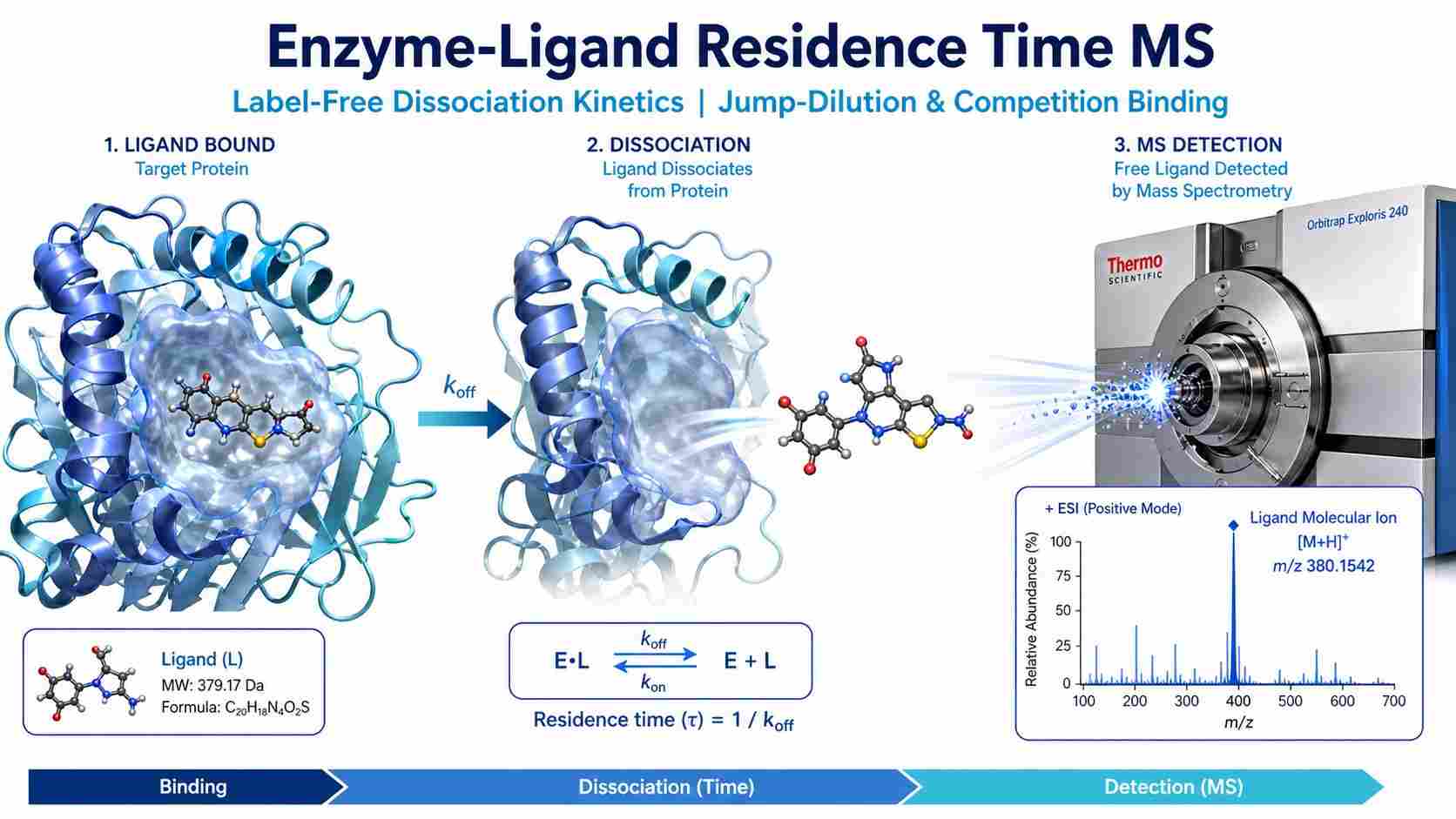
Enzyme-ligand residence time MS platform showing dissociation kinetic measurement workflow with mass spectrometry detection.
Why Residence Time Matters The MS Advantage Our Methods Case Study Method Comparison Sample FAQ

Why Residence Time Matters: Affinity vs. Kinetics

The interaction between a drug and its target is fundamentally a kinetic process. Binding affinity (KD = koff / kon) describes the equilibrium position, but it is the individual rate constants — particularly the dissociation rate constant koff — that determine how long the drug occupies its target in vivo. Drug-target residence time, defined as the reciprocal of koff (t½ = ln2 / koff), directly reflects the duration of pharmacological effect.

Two ligands can have identical KD values yet differ by orders of magnitude in residence time. A slow-dissociation ligand (long residence time) can provide sustained target occupancy even after the free drug concentration falls below KD, translating into longer dosing intervals, improved efficacy, and potentially reduced side effects. This concept has been experimentally validated: longer drug-target residence time correlates with superior in vivo target occupancy and duration of action across multiple therapeutic areas.

The practical implications are clear. For medicinal chemistry programs, optimizing residence time in parallel with affinity can differentiate lead compounds that would otherwise appear equivalent in equilibrium binding assays. For screening cascades, incorporating kinetic profiling at the hit-to-lead stage provides an additional dimension for compound prioritization that equilibrium measurements alone cannot deliver.

The MS Advantage for Residence Time Measurement

Mass spectrometry offers distinct advantages over established techniques for measuring drug-target dissociation kinetics.

Label-Free Detection

MS directly detects the ligand molecule by its mass-to-charge ratio. No radioactive label, fluorophore, or antibody is required. This eliminates labeling artifacts and allows measurement of native compounds, including fragments, natural products, and unmodified peptides.

No Target Immobilization

Unlike SPR or BLI, MS-based residence time measurement is performed in free solution. The target protein remains in its native state without surface coupling, orientation bias, or mass transport limitations that can confound kinetic measurements.

Direct Free Ligand Quantification

MS measures the reappearance of free ligand into solution as it dissociates from the target complex. This provides a direct, unambiguous kinetic trace — no reporter system, no signal amplification, no secondary detection step.

Compatible with Multiple Formats

Our platform supports jump-dilution, competition binding, and pulsed ultrafiltration protocols, each optimized for different kinetic regimes (t½ from seconds to hours) and target classes (soluble proteins, membrane proteins, protein complexes).

Our Residence Time Measurement Methods

We deploy three complementary MS-based approaches, selected based on the kinetic regime and target characteristics.

Jump-Dilution MS (RapidFire)

The target-ligand complex is pre-formed at high concentration, then rapidly diluted into a large volume of buffer containing excess unlabeled tracer or competitor. Dissociation is monitored by quantifying the reappearance of free ligand at multiple time points using our RapidFire MS platform. Each time point is analyzed in under 15 seconds, enabling dense kinetic sampling. Best suited for t½ of 1–60 min.

Competition Binding MS

The target is incubated with a labeled or unlabeled probe ligand to equilibrium. A test compound is added at varying concentrations, and the displacement of the probe is monitored by MS over time. This format allows simultaneous measurement of both binding affinity and dissociation rate for the test compound without requiring direct labeling. Particularly useful for fragment screening and lead optimization.

Pulsed Ultrafiltration MS

The target-ligand complex is separated from free ligand by ultrafiltration. Dissociation is triggered by buffer flow, and the eluting free ligand is captured on a trap column for periodic MS analysis. This method provides continuous monitoring of dissociation over extended time frames (t½ up to several hours) and is compatible with membrane proteins solubilized in detergent or nanodisc systems.

Integrated Kinetic Analysis

Raw dissociation traces are fitted to single- or multi-exponential decay models using nonlinear regression. Apparent koff, t½, and fractional binding amplitudes are reported with 95% confidence intervals. Where applicable, global fitting of competition binding data yields both kinetic (koff, kon) and equilibrium (KD) parameters from a single experiment.

Case Study: Label-Free Biosensing for Extreme Binding Kinetics

Quinn JG. "A rebinding-assay for measuring extreme kinetics using label-free biosensors." Scientific Reports 11:8301 (2021). https://doi.org/10.1038/s41598-021-87880-x

Background

Measuring drug-target binding kinetics faces a critical challenge: the methods available cannot reliably measure very fast or very slow dissociation events. Transient complexes with t½ < 1 second and ultra-high-affinity complexes with t½ > 10 hours fall outside the measurable range of conventional SPR, BLI, and fluorescence-based techniques. The author, from Genentech, aimed to develop a generalizable assay design capable of measuring binding kinetics across the full spectrum of drug-target interaction stabilities.

Methods

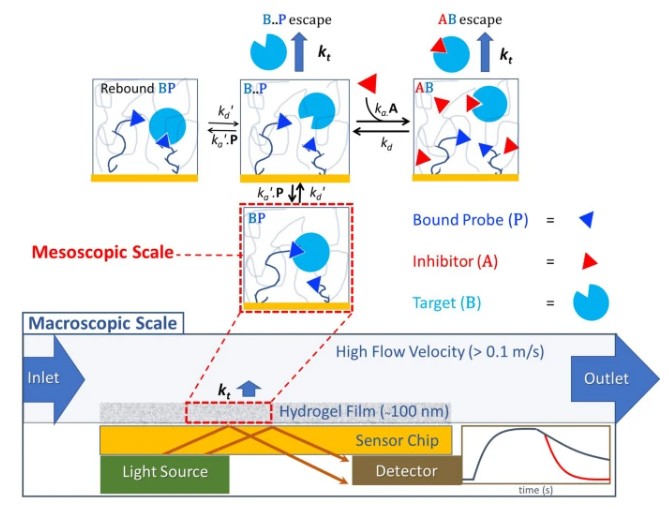
The approach leverages the "rebinding" phenomenon — traditionally considered a measurement artifact — within a crowded hydrogel sensor surface. By controlling the density of immobilized target and the flow rate, the rebinding probability becomes predictable and mathematically tractable. A finite element analysis (FEA) model was first built to simulate the virtual instrument, then used to derive a simplified algebraic model linking the observed kinetics to the intrinsic rate constants. The model was validated experimentally using a Biacore SPR instrument with well-characterized protein-ligand pairs.

Results

The rebinding assay successfully measured transient binding interactions with dissociation t½ below 500 ms — events that conventional SPR methods cannot resolve. It also quantified the kinetics of slowly dissociating complexes previously considered irreversible. The model was shown to be independent of the association rate limit that constrains traditional kinetic analysis, extending the measurable kon range beyond 5 × 10⁷ M⁻¹s⁻¹. For a model irreversible inhibitor, the method separated the reversible binding step from the subsequent inactivation step, providing individual rate constants that a single exponential fit could not distinguish.

Conclusions

This study demonstrated that label-free biosensing, combined with appropriate assay design and mathematical modeling, can provide accurate kinetic measurements across a much wider dynamic range than previously achievable. The principle — using a controlled environment to extract intrinsic kinetics from observed binding traces — is directly applicable to MS-based residence time measurements. At Creative Proteomics, we apply analogous dilution and competition strategies with direct MS readout, achieving label-free kinetic characterization across a broad range of dissociation rates.

Schematic representation of the rebinding assay principle for measuring extreme binding kinetics using label-free biosensors.

Schematic of the rebinding assay: target-bound ligand dissociates and either escapes or rebinds within the hydrogel sensor layer, enabling measurement of fast and slow kinetics.

Residence Time Measurement: MS vs. Established Techniques

ParameterResidence Time MSSPR / BLIRadioligand BindingFluorescence Polarization
DetectionDirect MS of free ligandRefractive index changeRadioactive scintillationPolarized fluorescence
Label requiredNoNoYes (radioisotope)Yes (fluorophore)
ImmobilizationNo (solution-phase)Yes (surface-coupled)NoNo
Kinetic range (t½)Seconds to hoursSeconds to hoursMinutes to daysSeconds to hours
ThroughputMedium (RapidFire: high)Low-mediumLowHigh (plate format)
Mass informationYes — confirms identityNoNoNo
Artifact riskLow — mass-resolvedMedium — mass transport, avidityMedium — nonspecific bindingMedium — fluorophore interference

Our MS-based residence time service is complementary to our broader kinetic characterization offerings, including continuous-flow MS kinetics (for steady-state kinetic parameters) and enzyme activity and mechanism studies (for detailed mechanistic enzymology).

Sample Requirements

Sample TypeRequired AmountConcentrationBufferNotes
Target Protein50–500 µg1–50 µM stockMS-compatible (ammonium acetate/bicarbonate, ≤50 mM)Provide purity, stability data; membrane proteins in nanodisc/detergent accepted
Ligand (test compound)100–500 µL per condition0.1–10 mM stockDMSO or MS-compatible bufferExact mass required; solubility confirmed at assay concentration
Known binder (control)50 µL1–10 mM stockDMSO or MS-compatibleRecommended for assay validation; provide KD if known
Competitor/probe (optional)50–100 µL1–10 mM stockMS-compatible bufferRequired for competition binding format

General Guidelines:

  • Target-ligand complex stability should be confirmed before initiating dissociation measurements
  • For jump-dilution: provide estimated KD to guide pre-incubation concentration
  • Controls: target-only, ligand-only, and known slow-dissociation control compound
  • Buffer exchange to MS-compatible conditions can be performed by our team

For detailed guidance on assay design and sample preparation, consult our team or refer to our HT-MS screening service for general submission guidelines.

Deliverables

  • Dissociation kinetic trace (free ligand concentration vs. time)
  • Fitted dissociation rate constant (koff) with 95% CI
  • Residence time (t½) calculated as ln2 / koff
  • Dissociation model (single- or multi-exponential) with model selection criteria
  • Mass spectra confirming ligand identity at each measured time point
  • Optional: KD determination from competition binding data (koff/kon)

Representative Residence Time Data

Representative dissociation kinetic plot showing free ligand concentration versus time with fitted exponential decay curve for drug-target residence time determination.

Example dissociation kinetic trace from jump-dilution MS data

FAQ

Frequently Asked Questions

Q: What is drug-target residence time and why does it matter?

Residence time (t½) is the duration a ligand remains bound to its target, determined by the dissociation rate constant (koff). It matters because a compound with long residence time can maintain target occupancy even after the free drug concentration drops below KD, leading to sustained pharmacodynamic effect. Two compounds with identical KD can have vastly different residence times.

Q: How does mass spectrometry measure residence time?

We pre-form the target-ligand complex, then trigger dissociation (by dilution or competition) and monitor the reappearance of free ligand into solution by MS at multiple time points. The resulting dissociation curve is fitted to an exponential decay model to determine koff and t½. MS provides direct, unambiguous identification of the dissociating ligand by its mass.

Q: How does MS-based residence time measurement compare with SPR?

Unlike SPR, MS does not require target immobilization, eliminating surface artifacts and mass transport limitations. MS also provides direct mass confirmation of the ligand identity. However, SPR provides continuous real-time traces whereas MS-based methods sample at discrete time points. The two techniques are complementary — SPR for rapid kinetic screening, MS for confirmation with native-state targets.

Q: What kinetic range can your residence time MS service cover?

Our platform covers dissociation t½ from approximately 30 seconds to several hours. The specific range depends on the method selected: jump-dilution RapidFire MS for fast-to-intermediate kinetics (t½ 1–60 min), pulsed ultrafiltration for slower dissociation (t½ up to several hours).

Q: What types of targets are compatible?

Soluble proteins, protein complexes, and membrane proteins (in nanodiscs, detergent micelles, or liposomes) are all compatible. The primary requirement is that the target-ligand complex can be separated from free ligand for detection — whether by SEC, ultrafiltration, or SPE-based RapidFire.

Q: Can you measure residence time for covalent or very slowly dissociating inhibitors?

Yes. For slowly dissociating complexes, we use extended incubation and sampling protocols with our pulsed ultrafiltration platform. For covalent inhibitors, we can distinguish the initial reversible binding step from the subsequent inactivation step, providing kinetic parameters for each phase of the interaction.

References

  1. Quinn JG. A rebinding-assay for measuring extreme kinetics using label-free biosensors. Sci Rep. 2021;11:8301. doi:10.1038/s41598-021-87880-x. https://doi.org/10.1038/s41598-021-87880-x
  2. Kordylewski SK, Bugno R, Podlewska S. Residence time in drug discovery: current insights and future perspectives. Pharmacol Rep. 2025;77(4):851-873. doi:10.1007/s43440-025-00748-z. https://doi.org/10.1007/s43440-025-00748-z
  3. Copeland RA, Pompliano DL, Meek TD. Drug-target residence time and its implications for lead optimization. Nat Rev Drug Discov. 2006;5:730-739. doi:10.1038/nrd2082. https://doi.org/10.1038/nrd2082
  4. Prudent R, Annis DA, Dandliker PJ, et al. Exploring new targets and chemical space with affinity selection-mass spectrometry. Nat Rev Chem. 2021;5:62-71. doi:10.1038/s41570-020-00229-2. https://www.nature.com/articles/s41570-020-00229-2

Plan a residence time study with the MassTarget™ team

Share your target-ligand system and research questions — our scientists will design a tailored dissociation kinetics strategy for your discovery program.


For research use only. Not for use in diagnostic procedures. Creative Proteomics provides residence time MS services exclusively for research and development purposes. Results are not intended for clinical diagnosis or medical decision-making.

Online Inquiry

Please submit a detailed description of your project. We will provide you with a customized project plan to meet your research requests. You can also send emails directly to for inquiries.

* Email
Phone
* Service & Products of Interest
Services Required and Project Description