Fragment-Based Lead Discovery by Native MS — Label-Free Fragment Screening and Hit Validation

From fragment to lead: native mass spectrometry reads the protein-fragment complex directly, without labels, immobilisation, or chromogenic substrates.

Fragment-based lead discovery (FBLD) identifies low-molecular-weight (typically <300 Da) compounds that bind to a target protein with weak but efficient binding, then elaborates them into potent leads through iterative medicinal chemistry. The central analytical challenge at the heart of every FBLD campaign is detection — fragment binding is typically weak (Kd from high µM to low mM), and the small molecular weight of fragments provides minimal spectroscopic signal for conventional biochemical assays. Native mass spectrometry addresses this challenge by detecting the intact protein-fragment complex directly: the mass of the complex is measured precisely enough to confirm binding, and the fraction of protein in the bound state is quantified to determine binding affinity. Our FBLD service by native MS covers the full fragment-to-lead trajectory — primary fragment library screening, hit validation by dose-response Kd determination, SAR-by-MS for fragment elaboration, and covalent fragment profiling.

Key Advantages:

  • No assay development required — the masses of the target and fragments are the only information needed to start screening.
  • Direct binding stoichiometry from every measurement — distinguishes specific 1:1 engagement from higher-order or non-specific aggregation.
  • Kd determination by native MS titration across nM to mM affinity range, without surface immobilisation artefacts.
  • SAR-by-MS competition binding for rapid analogue ranking during fragment elaboration without assay redevelopment.
  • Compatible with challenging targets — membrane proteins, protein-protein interaction interfaces, intrinsically disordered proteins, and multi-protein complexes.
  • Low protein consumption — 50–200 µg per 1,000–5,000 fragment set, comparable to or less than SPR and substantially less than NMR.
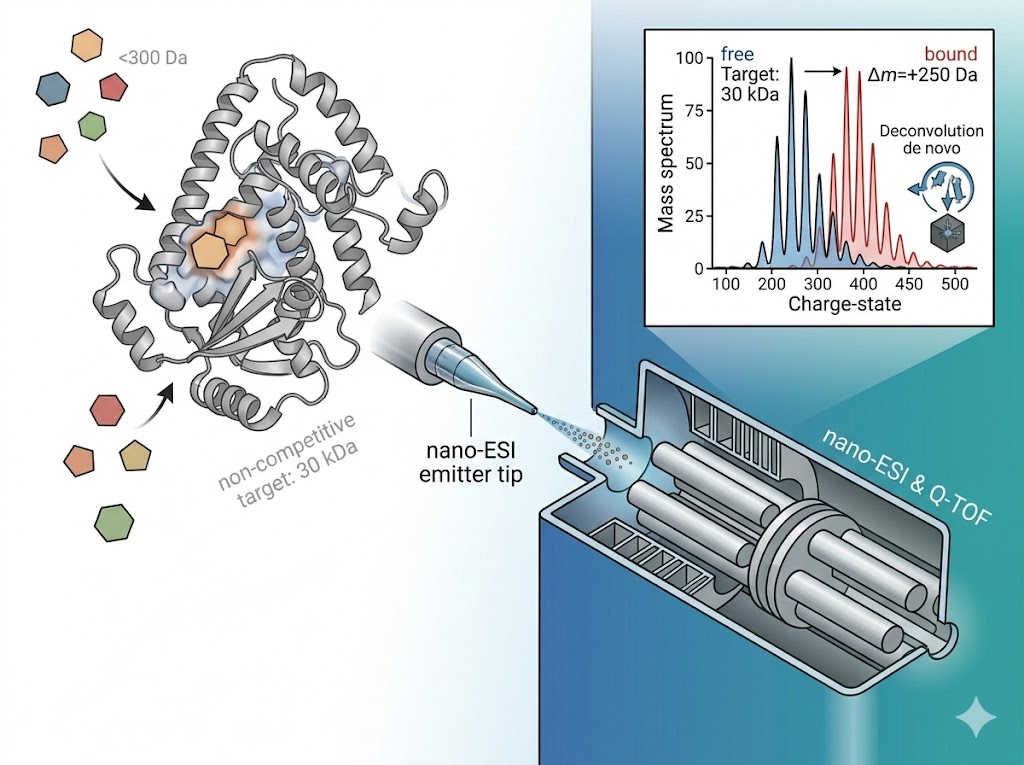
Fragment-based lead discovery by native MS overview: a purified target protein is incubated with a fragment library, and the intact protein-fragment complex is detected by nano-ESI native mass spectrometry — label-free, immobilisation-free binding readout.
What Is FBLD Service Modes Tech Comparison Sample Demo Case Study FAQ

What Is Native MS Fragment-Based Lead Discovery?

Native MS fragment-based lead discovery combines two established methodologies: fragment-based drug discovery — the systematic screening of low-molecular-weight compound libraries to identify weak but efficient starting points for medicinal chemistry — and native mass spectrometry — the analysis of intact, non-covalently bound protein complexes under conditions that preserve solution-phase structure. The target protein is prepared in a volatile ammonium acetate buffer, incubated with fragment compounds individually or in defined pools, and introduced into the mass spectrometer via nano-electrospray ionisation (nano-ESI) under conditions that preserve non-covalent interactions. The mass spectrum reveals both free protein and any protein-fragment complexes — binding is detected as an additional peak series shifted by the exact mass of the bound fragment.

The fraction of protein in the bound state, measured from the relative intensities of free and bound peak series, provides a direct readout of the binding equilibrium. Repeating the measurement across a concentration series yields a binding isotherm from which Kd is determined. Modern high-resolution mass spectrometers operating under native conditions routinely achieve mass accuracy sufficient to distinguish fragments differing by as little as 1 Da and can resolve complex mixtures of 5–15 fragments per pool, enabling screening of thousands of fragments while consuming 50–200 µg of target protein. This label-free, immobilisation-free, assignment-free detection principle makes native MS uniquely suited to fragments that are poor spectroscopic reporters, targets that are difficult to functionalise or crystallise, and weak interactions at the edge of detection for other biophysical methods.

Native MS is a core component of our integrated Target → Drug Discovery platform, where it serves as the primary readout for fragment-based hit identification within a broader pipeline spanning covalent screening, HT-MS, ligand discovery, biophysical hit validation, and enzyme activity profiling.

Why Native MS for Fragment Screening

Direct detection of weak binding without immobilisation

Fragment hits typically bind with Kd values of 10 µM to 10 mM — affinities that challenge most biophysical methods. Native MS operates at protein concentrations of 1–20 µM, well above the Kd for all but the weakest fragments. Because the measurement is equilibrium-based and requires no wash steps, surface regeneration, or immobilisation, the binding equilibrium is captured as it exists in solution, free from mass transport, avidity, or orientational artefacts.

Binding stoichiometry from every measurement

Every native mass spectrum reports the distribution of binding states: free protein, protein bound to one fragment molecule, protein bound to two, and so on. This direct stoichiometry readout is unique among fragment screening methods. SPR, NMR, and MST report a signal change that indicates binding but does not reveal how many molecules are bound. Native MS resolves the exact number of ligands per protein, distinguishing specific 1:1 binding from non-stoichiometric aggregation.

SAR-by-MS: competition binding without assay redevelopment

During fragment elaboration, each round of analogue evaluation typically requires re-running a full binding assay. SAR-by-MS uses a competition binding format: the target is saturated with a reporter ligand, and the elaborated analogue is titrated in. Displacement of the reporter is detected as a decrease in the reporter-protein complex peak and the appearance of the analogue-protein complex peak — providing direct, label-free ranking of relative binding affinities across an analogue series without any assay redevelopment.

Compatibility with challenging target classes

Membrane proteins solubilised in detergent micelles can be analysed provided the detergent is electrospray-compatible. Protein-protein interaction interfaces — large, flat, devoid of deep binding pockets — are a rich source of fragment screening targets accessible by native MS. Intrinsically disordered proteins, lacking the stable tertiary structure required for X-ray crystallography, can be analysed if fragment binding induces or stabilises a folded state. Multi-protein complexes can be screened directly.

Minimal protein consumption

A typical native MS fragment screen consumes 50–200 µg of purified target protein per 1,000–5,000 fragment set — substantially less than NMR (which requires isotopically labelled protein at mg quantities) and comparable to or less than SPR. For targets where protein production is the programme bottleneck, this economy enables broader screening coverage from the same material investment.

Intrinsic chemical identity confirmation

A fluorescence signal tells you that something happened in the well. A native MS readout tells you exactly what happened: the exact mass of the fragment bound, the number of fragments bound, and the presence or absence of adducts or modifications. This intrinsic chemical confirmation eliminates false positives from fluorescent compound interference, aggregation, and assay artefacts. For covalent fragment screening, the mass shift of the target upon bond formation provides unequivocal confirmation of covalent engagement.

Service Modes — FBLD Screening and Hit Validation by Native MS

We offer four operational modes within our native MS FBLD service, each addressing a distinct stage of the fragment-to-lead discovery pipeline. All modes share the same core technology — nano-ESI native MS on high-resolution mass spectrometers — but differ in experimental design, throughput, and data output.

MODE 1

Fragment Library Screening by Native MS

Primary screening of a fragment library against a purified target protein by direct infusion nano-ESI native MS. Fragments are screened in defined pools (typically 5–15 per pool, mass-resolved to avoid isobaric overlap) to maximise throughput while maintaining unambiguous hit identification by accurate mass.

  • Format: Fragment pools in ammonium acetate buffer; 5–15 min nano-ESI acquisition per pool on Q-TOF or Orbitrap MS.
  • Output: Per-pool mass spectra with fragment hit assignments; hit list identified by exact mass; fraction bound for each hit; binding stoichiometry annotation (1:1 vs 1:2 vs higher-order).
  • Throughput: 1,000–5,000 fragments screened in 2–4 weeks, depending on library size and pool composition.
MODE 2

Fragment Hit Validation and Dose-Response Kd Determination

Primary hits from Mode 1 are advanced to individual dose-response confirmation. Each hit is titrated across 6–10 concentrations; the fraction of protein bound at each concentration is measured by native MS to generate a binding isotherm. Kd is determined by non-linear least-squares fitting to a 1:1 binding model.

  • Format: Individual compound dose-response; 6–10 concentrations; replicate measurements (n=2–3) per concentration.
  • Output: Binding isotherm with fitted Kd and 95% confidence interval; binding stoichiometry confirmation; competition experiment with known ligand (if available) for binding site classification.
  • Also applicable to customer-nominated fragments from virtual screening, literature, or prior experimental campaigns.
MODE 3

SAR-by-MS for Fragment Elaboration

Competition binding native MS for ranking elaborated fragment analogues during medicinal chemistry optimisation. The target protein is pre-incubated with a fixed concentration of a reporter ligand, and each elaborated analogue is titrated in. Reporter displacement is monitored by the decrease in reporter-protein complex peak relative to the analogue-protein complex peak.

  • Format: Competition binding; 6–8 concentrations per analogue; reporter ligand at fixed saturating concentration.
  • Output: Competition binding isotherms; relative affinity ranking across analogue series; IC₅₀ values from competition curves.
  • Throughput: 20–100 elaborated analogues per week. For deeper SAR support requiring binding site information, see our SAR-MS service for integrated MS-based structure-activity relationship workflows.
MODE 4

Covalent Fragment Screening and Warhead Profiling

Screening of covalent fragment libraries containing electrophilic warheads (acrylamides, chloroacetamides, cyanoacrylates, Michael acceptors) against target proteins. Covalent adduction is detected by the characteristic mass shift of the target protein upon bond formation — an unequivocal signal distinguishing on-target covalent engagement from reversible binding.

  • Format: Time-course incubation of target with covalent fragments; intact protein MS at defined time points; peptide-level LC-MS/MS for residue-level adduction site mapping.
  • Output: Covalent adduction mass shift (intact protein); time-dependent adduction progress curves; relative reactivity ranking; adduction site identification.
  • For larger covalent screening campaigns requiring proteome-wide selectivity profiling, our covalent drug discovery service provides integrated workflows combining target engagement with off-target reactivity assessment.

Analytical Workflow

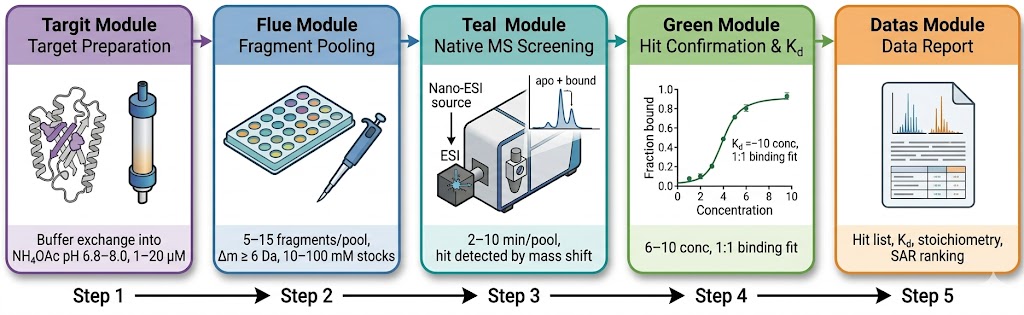
Five stages from target preparation to ranked fragment output:

1

Target preparation and buffer exchange

The purified target protein is buffer-exchanged into volatile ammonium acetate buffer (typically 50–200 mM, pH 6.8–8.0) by centrifugal filtration or size-exclusion chromatography. Buffer conditions are optimised for protein stability and MS compatibility: detergents (for membrane proteins) are tested for MS compatibility; non-volatile salts and glycerol are removed or minimised. The protein concentration is adjusted to 1–20 µM for native MS analysis, and the charge-state envelope of the apo protein is recorded as a reference spectrum.

2

Fragment library pooling and plate preparation

The fragment library is formatted in 96- or 384-well plates at stock concentrations (typically 10–100 mM in DMSO). Fragments are assigned to screening pools of 5–15 compounds each, ensuring that no two fragments in a pool have overlapping isotope envelopes (Δm ≥ 6 Da recommended for unambiguous assignment). Pool compositions are documented in a plate map linking each well position to fragment identities and molecular weights.

3

Primary screening by nano-ESI native MS

Each pool is mixed with the target protein at a defined protein-to-ligand ratio (typically 1:5 to 1:20 molar ratio of protein to each fragment), incubated briefly (5–30 min at room temperature), and infused into the mass spectrometer via nano-ESI. Spectra are acquired for 2–10 minutes per pool. Automated spectral processing identifies the masses of all detected complexes and matches them to the fragment molecular weights in the pool map. Hits are defined as pools in which an additional peak series is observed at a mass corresponding to protein + fragment mass. Deconvolution of multi-fragment binding is performed by iterative subtraction or by binary deconvolution screens for pools yielding hits.

4

Hit confirmation and dose-response binding

Individual fragments from hit pools are re-tested as single compounds against the target to confirm binding. Fragments that confirm by single-compound native MS are advanced to dose-response titration: the fragment is titrated across 6–10 concentrations, with native MS spectra acquired at each concentration. The fraction of protein in the bound state is plotted against free fragment concentration, and the binding isotherm is fitted to determine Kd. Competition experiments with a known active-site ligand are performed where available to classify binding as orthosteric or allosteric.

5

Data analysis and deliverable preparation

Processed data are compiled into a comprehensive report: per-pool screening spectra with hit annotations; individual fragment binding spectra with stoichiometry and Kd; competition binding data and target class assessment; SAR-by-MS competition rankings (if applicable); covalent adduction time courses and adduction site mapping (Mode 4); written interpretation with hit triage recommendations and recommended follow-up strategy including biophysical hit validation by orthogonal methods if required for programme advancement.

FBLD by native MS analytical workflow: target buffer exchange and reference spectrum acquisition, fragment library pooling in 96-well plates, nano-ESI native MS primary screening, hit confirmation by dose-response Kd titration, and deliverable compilation with hit list, binding curves, and interpretation report.

Applications by Drug Discovery Stage

Native MS FBLD is most impactful where conventional screening methods cannot deliver reliable binding data — challenging targets, weak interactions, and label-dependent assays.

Primary fragment screening against novel targets

For targets with no known ligands — newly identified proteins from genomic or proteomic discovery programmes, orphan receptors, under-explored enzyme families — native MS fragment screening provides the most direct route to chemical matter. No prior binding information, assay development, or probe design is required; the only prerequisites are a purified target and a fragment library. This makes native MS FBLD an ideal entry point for targets emerging from upstream target discovery.

Output: Fragment hit list with Kd values, stoichiometry, and binding site classification by competition experiments.

Hit expansion and fragment-to-lead optimisation

Once a fragment hit with validated binding is identified, SAR-by-MS guides the first round of medicinal chemistry iteration. Elaborated analogues — incorporating chemical vectors identified from the fragment binding pose — are ranked by competition binding affinity. This iterative cycle of compound design, synthesis, and MS ranking identifies productive elaboration vectors and selects optimal fragment-derived lead series for progression.

Output: SAR-by-MS competition ranking table; elaborated leads with improved Kd; guidance for next-round compound design.

Covalent fragment-based drug discovery

For targets where covalent inhibition is the desired therapeutic modality — persistent target occupancy, high selectivity from targeted covalent modification, or pharmacodynamic durability — covalent fragment screening by intact protein MS provides simultaneous detection of binding and bond formation. The mass shift of the target upon covalent adduction is unequivocal confirmation of on-target engagement.

Output: Covalent adduction confirmed by intact mass shift; time-dependent adduction kinetics; adduction site mapped by peptide-level LC-MS/MS.

Orthogonal biophysical validation of fragment hits

Fragments identified by virtual screening, NMR fragment screening, or thermal stabilisation assays can be validated by native MS as orthogonal confirmation. Native MS provides binding stoichiometry, affinity, and competition data that complement other screening methods. This orthogonal validation step — recommended in all FBLD best-practice guidelines — is critical before committing medicinal chemistry resources to a fragment hit.

Output: Orthogonal confirmation of fragment binding; Kd by native MS titration; stoichiometry assessment; binding site classification by competition.

Technology Comparison: Native MS vs Other Fragment Screening Platforms

PlatformDetection PrincipleLabel Required?Kd RangeStoichiometry?Protein ConsumptionKey Limitation
Native MS (this service)Intact protein-fragment complex mass detectionNonenM–mM✅ Yes — direct from spectrum50–200 µg per screenRequires purified protein; buffer must be MS-compatible
SPRRefractive index change at sensor surfaceNone (immobilisation required)nM–mM❌ No — signal-averaging50–500 µgSurface immobilisation may alter binding geometry; mass transport artefacts
NMR (HSQC)¹⁵N/¹³C chemical shift perturbationRequired — isotopic labellingµM–mM❌ No1–5 mg labelled proteinLabelling requirement; size limit ~40 kDa
MSTFluorescence or thermophoretic mobility changeRequired — fluorescent label or Trp fluorescencenM–mM❌ No10–50 µgLabel-dependent; aggregation interference
X-ray CrystallographyElectron density of bound fragmentNone (crystals required)Not affinity-based⚠️ Partial if resolvable>5 mg for crystallisationCrystallisation bottleneck; may not reflect solution binding
ITCHeat released/absorbed upon bindingNonenM–mM✅ Yes (n-value)0.5–2 mgVery low throughput; high protein consumption

Sample Requirements

ComponentFormat OptionsRecommended InputMinimum InputKey Notes
Target ProteinPurified in MS-compatible buffer (ammonium acetate, pH 6.8–8.0)50–200 µg total for full screening set20 µg for limited panel (100–500 fragments)Provide purity (>90% recommended), buffer composition, concentration, and known activity data
Fragment Library96- or 384-well plate, 10–100 mM in DMSO5–10 µL per well at 10–100 mM2 µL at 10 mMProvide SDF or compound list with molecular weights
Covalent FragmentsIndividual vials or plate format, DMSO stocks10 µL at 50–100 mM5 µL at 10 mMProvide warhead class and known reactivity
Elaborated Analogues (SAR-by-MS)96-well plate, 10–100 mM in DMSO5 µL per well at 10 mM2 µL per well at 10 mMInclude parent fragment as reference for competition ranking
Reference LigandAqueous or DMSO stock10 µL at 10 mM5 µL at 1 mMKnown Kd strongly recommended for assay validation and competition experiments

Typical total protein requirement for a full FBLD campaign (Mode 1 + Mode 2): 200–500 µg. For membrane protein targets, discuss detergent compatibility with our team before sample submission. All samples should be shipped on dry ice in labelled, sealed tubes or plates. For targets with limited material, we optimise miniaturised formats to minimise consumption.

Deliverables

  • Per-pool screening mass spectra annotated with fragment hit assignments; complete well-level binding assignment table linking each fragment to its detection status and fraction bound in the primary screen.
  • Ranked hit list prioritised by binding affinity, with stoichiometry annotation (1:1 vs higher-order binding) and competition data.
  • Dose-response binding curves (fraction bound vs compound concentration) for each confirmed hit, with fitted Kd values, 95% confidence intervals, and goodness-of-fit statistics.
  • SAR-by-MS competition binding ranking table (Mode 3) with relative IC₅₀ values across analogue series and competition binding isotherms.
  • Covalent adduction time-course data (Mode 4): intact protein mass spectra at each time point, adduction progress curves, residue-level modification site maps by peptide LC-MS/MS.
  • Written interpretation report: hit triage recommendations, binding mode assessment, target-specific considerations, and recommended follow-up strategy (HDX-MS binding epitope mapping, crosslinking MS for binding site identification, crystallography for structural guidance).
  • Raw MS data files in standard formats (mzXML, raw) for customer re-processing if desired.

Representative Results

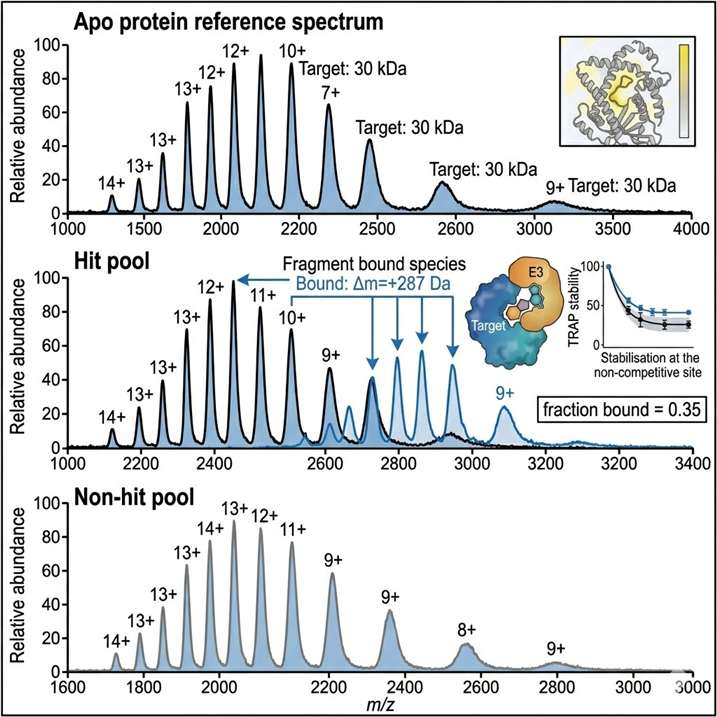
Native MS screening mass spectra showing three pools of fragments screened against a target protein: the top spectrum shows the apo protein charge-state envelope, the middle spectrum shows a hit pool with an additional peak series at protein + 287 Da, and the bottom spectrum shows a non-hit pool with only the apo protein peaks.

Native MS fragment pool screening: hit vs non-hit spectra

Representative nano-ESI native mass spectra from a fragment library screening campaign. Top: apo protein reference spectrum (30 kDa target, charge-state series 14+ to 9+). Middle: hit pool — an additional charge-state envelope appears at +287 Da corresponding to a fragment-bound species (fraction bound = 0.35 at 100 µM fragment). Bottom: non-hit pool — only the apo protein envelope is observed, indicating no binding for any fragment in this pool.

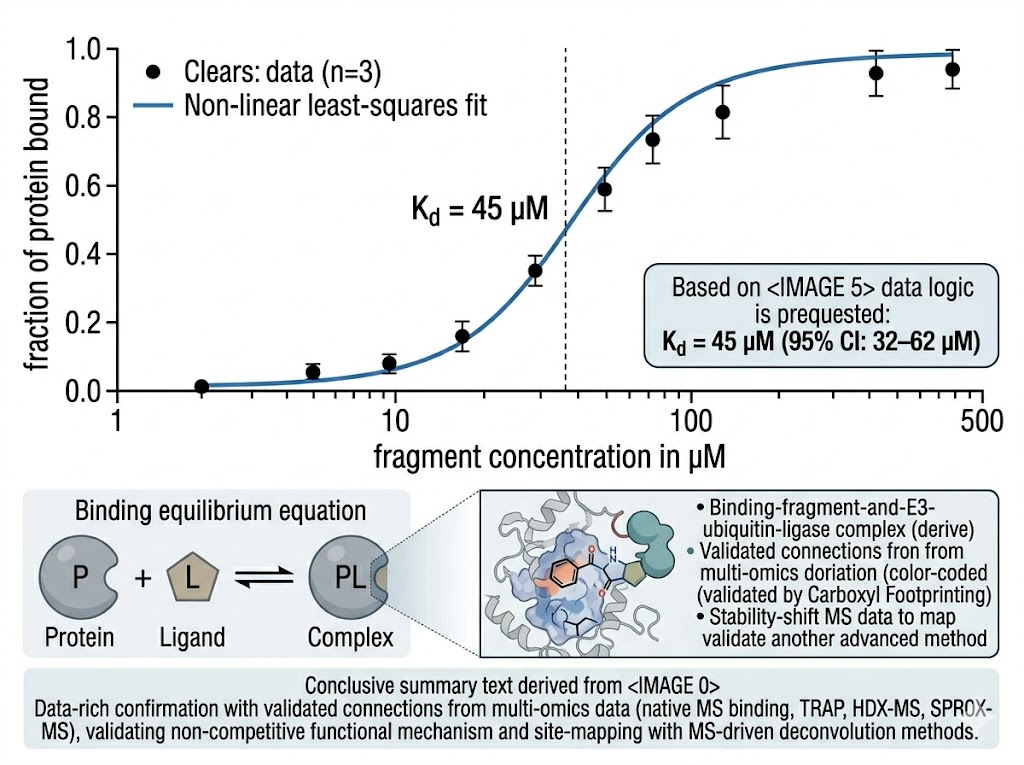
Dose-response binding isotherm from native MS titration: fraction of protein bound (y-axis) plotted against fragment concentration in µM (x-axis, log scale), showing a sigmoidal curve fitted to a 1:1 binding model with Kd = 45 µM annotated, with error bars from triplicate measurements.

Dose-response binding isotherm: native MS Kd determination

Binding isotherm for a confirmed fragment hit titrated across 8 concentrations (1–500 µM). Fraction bound measured by native MS at each concentration point (n=3). Non-linear least-squares fit to a 1:1 binding model yields Kd = 45 µM (95% CI: 32–62 µM). The saturable, concentration-dependent binding confirms specific target engagement rather than non-specific aggregation.

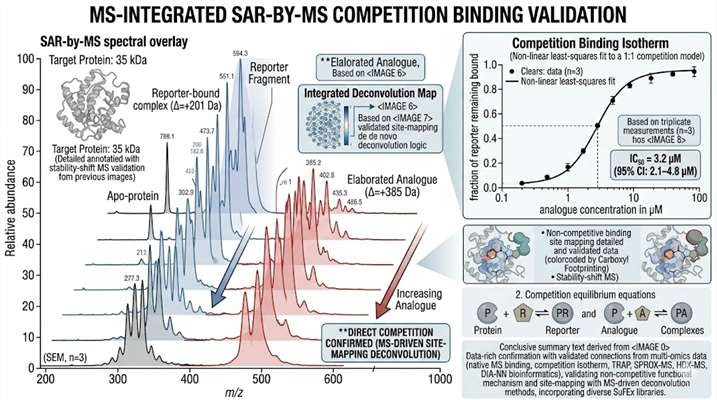
SAR-by-MS competition binding data: overlay of native mass spectra showing the target protein pre-incubated with a reporter fragment (blue-shaded peaks), and the progressive displacement of the reporter by an elaborated analogue (red-shaded peaks appearing at a higher mass) across increasing analogue concentrations.

SAR-by-MS competition binding for fragment elaboration ranking

Competition binding native MS data from a fragment elaboration campaign. The target protein (35 kDa) is pre-incubated with reporter fragment (Δ = +201 Da, blue-shaded peaks). An elaborated analogue (Δ = +385 Da, red-shaded peaks) is titrated in across 6 concentrations. The progressive decrease in reporter-bound species and corresponding increase in analogue-bound species demonstrates direct competition, enabling relative affinity ranking without redeveloping any binding assay.

Case Study: Native MS-Guided Fragment Screening Identifies Hits for HOP-HSP90 Protein-Protein Interaction Inhibition

Vaaltyn M.C., Mateos-Jimenez M., Muller R., Mackay C.L., Edkins A.L., Clarke D.J., Veale C.G.L. "Native Mass Spectrometry-Guided Screening Identifies Hit Fragments for HOP-HSP90 PPI Inhibition." ChemBioChem. 2022;23(21):e202200322. https://doi.org/10.1002/cbic.202200322 Open Access (PMC9826382).

Background

The HOP-HSP90 protein-protein interaction (PPI) is a validated therapeutic target in cancer biology. HOP (HSP70-HSP90 Organizing Protein) facilitates client protein transfer between HSP70 and HSP90 through its TPR2AB domain, which binds to the C-terminal MEEVD motif of HSP90. Disruption of this PPI modulates multiple oncogenic signalling pathways that depend on HSP90 chaperone cycling. However, the TPR2AB-MEEVD interface — a large, shallow protein-protein interaction surface with predominantly electrostatic character — is a challenging target for conventional fragment screening due to the absence of deep binding pockets and the lack of a readily screenable biochemical activity.

Methods

The authors applied nano-electrospray ionisation native mass spectrometry as the primary screening technology. The purified TPR2AB domain of HOP (17.5 kDa) was buffer-exchanged into 200 mM ammonium acetate (pH 6.8) at a final protein concentration of 10 µM. A focused 88-fragment library was screened in pools of 5–8 fragments per mass spectrum at 100 µM each (~10-fold molar excess over protein). Binding was assessed by the appearance of additional charge-state peak series shifted by the exact mass of each fragment. Hit confirmation was performed by dose-response native MS titration (Kd determination), and hits were advanced to orthogonal validation by SPR and ITC. Functional PPI inhibition was assessed by a fluorescence polarisation competition assay.

Results

Native MS primary screening identified 22 fragments that bound to the TPR2AB domain with unambiguous mass-shift confirmation — a 25% hit rate reflecting the shallow binding surface typical of PPI targets. Fragment hits showed fraction bound values from 0.13 to 0.74 at the screening concentration. Dose-response native MS titration yielded Kd values from 40 to 300 µM, confirming concentration-dependent binding. Fragment Zen-10 displayed a second lower-abundance binding event at 1:2 stoichiometry — detected by native MS as a second peak series — an observation that would not have been captured by any signal-averaging technique. Four priority fragments were validated by SPR (Kd concordant with native MS) and ITC (enthalpy-driven binding, consistent with electrostatic interactions at the charged TPR2AB surface). Fragment Zen-15 showed 32% inhibition of the HOP-HSP90 PPI at 1 mM in a functional competition assay, confirming that the fragment binds at the functional interface.

Significance for FBLD by Native MS

This study demonstrates the complete native MS-driven FBLD workflow: primary fragment screening by native MS, binding affinity quantification by dose-response titration, orthogonal biophysical validation, functional PPI inhibition confirmation, and in silico SAR hypothesis generation. The detection of 1:2 binding stoichiometry for one fragment — uniquely enabled by native MS — illustrates the value of the direct stoichiometry readout. The successful translation of a native MS-identified fragment into measurable PPI inhibition confirms that native MS screening identifies functionally relevant hits against challenging PPI targets, providing the validation evidence required before committing to a fragment elaboration programme.

Figure from Vaaltyn et al. 2022, ChemBioChem, showing native mass spectrometry screening results for fragments binding to the TPR2AB domain of HOP: representative mass spectra of hit and non-hit pools, dose-response binding curve for fragment Zen-15 with Kd determination, and SPR sensorgram confirming orthogonal binding to the TPR2A domain.

Figure adapted from Vaaltyn et al. 2022 (ChemBioChem, DOI: 10.1002/cbic.202200322, PMC9826382). Native MS-guided fragment screening against the HOP TPR2AB domain — direct protein-fragment complex detection by nano-ESI MS with orthogonal SPR/ITC validation. CC BY 4.0.

FAQ

Frequently Asked Questions

Q: What size of fragment library is optimal for native MS screening?

Native MS FBLD is most effective with libraries of 1,000–5,000 fragments, screened in pools of 5–15 compounds per MS experiment. This provides broad chemical space coverage while maintaining unambiguous hit identification by accurate mass. For targets with limited protein availability, scaled-down screens of 500–1,000 fragments are feasible. Libraries larger than 10,000 fragments are better addressed by HT-MS screening platforms with higher throughput. We can advise on library composition and pooling strategy during project design.

Q: What is the smallest fragment mass change that can be resolved by native MS?

On a high-resolution Q-TOF or Orbitrap mass spectrometer operating under native conditions, mass differences of 1–2 Da between the free and bound protein are routinely resolvable for fragments of 150–350 Da. The practical minimum mass difference depends on the protein mass and charge state: for a 30 kDa protein, a fragment of approximately 100 Da (Δm ~0.3% of protein mass) is typically resolvable. We assess the mass resolution and fragment mass distribution before each screening campaign to confirm pool assignments and ensure unambiguous hit identification.

Q: Can native MS distinguish between a specifically bound fragment and non-specific aggregation?

Yes — this is one of the most valuable features of native MS. Specific binding produces a discrete, mass-resolved peak series at the exact mass of the protein-fragment complex. Non-specific aggregation produces a broad, unresolved mass distribution or multiple binding events with poorly defined stoichiometry. Binding stoichiometry from the spectrum (1:1 vs 1:2 vs higher-order) provides additional discrimination. Dose-response titration further distinguishes specific binding (saturable, fitted by a 1:1 binding isotherm) from non-specific adherence (linear, non-saturable across the concentration range).

Q: Is the FBLD service compatible with membrane protein targets?

Yes, for detergent-solubilised membrane proteins. The detergent must be compatible with electrospray ionisation — low-CMC detergents such as n-dodecyl-β-D-maltoside or lauryl maltose neopentyl glycol at ≤2× CMC are typically compatible. The detergent micelle contributes a mass distribution above the protein mass, and fragment binding is detected as a further mass shift of the protein-micelle complex. We assess detergent compatibility during the assay design phase and optimise buffer exchange conditions for each membrane protein target. For membrane proteins that are not amenable to native MS, our HT-MS screening or ASMS platforms may offer alternative label-free screening formats.

Q: How does native MS Kd determination compare with SPR or ITC for fragment affinity measurement?

Native MS, SPR, and ITC show good concordance across the µM–mM affinity range most relevant for fragment binding. Native MS offers the advantages of solution-phase measurement (no immobilisation), direct stoichiometry readout, and lower protein consumption. SPR provides real-time association and dissociation kinetics; ITC provides thermodynamic parameters (ΔH, ΔS) that are not available from MS alone. For fragment hit validation, we recommend native MS as the primary affinity method, with SPR or ITC as orthogonal confirmation for priority hits advancing to lead optimisation.

Q: What hit rates should I expect from a native MS fragment screen?

Hit rates depend on the target class and fragment library composition. Typical rates range from 1–5% for conventional enzyme targets with well-defined binding pockets, up to 5–25% for PPI targets or shallow binding surfaces where binding is weaker and less selective. Covalent fragment screens typically show lower hit rates (0.5–3%) due to the additional requirement of reactive warhead complementarity. These ranges are consistent with published native MS fragment screening studies across diverse target classes. Our team provides a project-specific feasibility assessment during the consultation phase.

References

  1. Pedro L., Quinn R.J. Native mass spectrometry in fragment-based drug discovery. Molecules. 2016;21(8):984.
  2. Goth M., Badock V., Weiske J., Pagel K., Kuropka B. Critical evaluation of native electrospray ionization mass spectrometry for fragment-based screening. ChemMedChem. 2017;12(15):1201–1211.
  3. Gavriilidou A.F.M., Holding F.P., Coyle J.E., Zenobi R. Application of native ESI-MS to characterize interactions between compounds derived from fragment-based discovery campaigns and two pharmaceutically relevant proteins. SLAS Discovery. 2018;23(9):951–959.

Design Your Fragment-Based Lead Discovery Campaign with the MassTarget Team

Tell us your target, fragment library, and programme stage — our scientists will design an optimal screening strategy, confirm MS feasibility, and propose a throughput-matched campaign plan for your drug discovery programme.

For Research Use Only (RUO). Not intended for diagnostic, therapeutic, or clinical decision-making purposes. Creative Proteomics services are designed to support preclinical research, drug discovery, and mechanism of action studies only.

Online Inquiry

Please submit a detailed description of your project. We will provide you with a customized project plan to meet your research requests. You can also send emails directly to for inquiries.

* Email
Phone
* Service & Products of Interest
Services Required and Project Description