Network Pharmacology + Mass Spectrometry Service

Bridge the gap between computational network pharmacology predictions and experimental validation. Our integrated MS-based platform combines chemoproteomics, thermal profiling, and multi-omics analysis to transform predicted targets into verified, publication-ready results.

You have a list of predicted targets from your network pharmacology analysis. Now you need to know which ones are real. Our service closes that gap — combining computational network analysis with proteomics- and metabolomics-based validation to deliver verified target lists you can publish, patent, or advance into follow-up studies.

Key Advantages:

  • Proteome-wide target identification without compound modification
  • Integrated proteomics + metabolomics network analysis
  • Validated for natural products, single compounds, and drug mixtures
  • From computational prediction to verified target list in weeks
  • Publication-ready data with confidence scoring
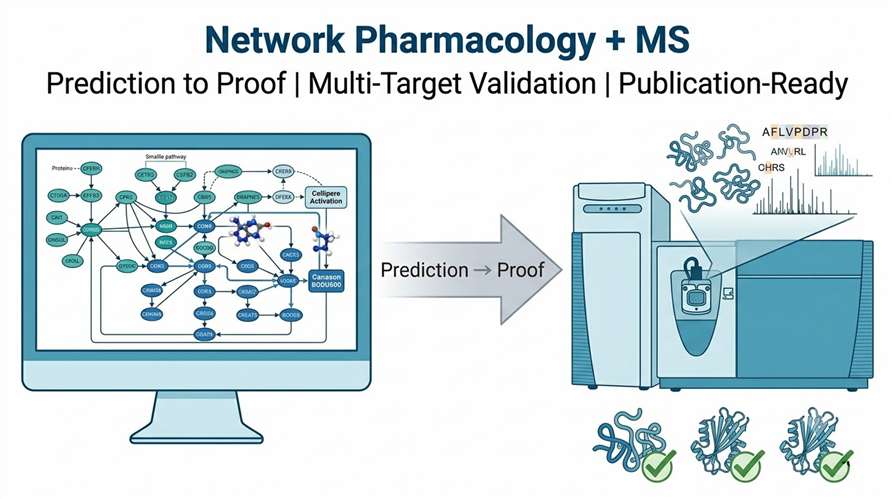
Network pharmacology and mass spectrometry integration showing computational network prediction connecting to MS-based target validation.
Overview Why MS Workflow Applications Case Study Sample Bioinformatics FAQ

From Computational Prediction to Experimentally Validated Targets

You have a list of predicted targets from your network pharmacology analysis. Now you need to know which ones are real. That gap — between computational prediction and experimental proof — is where most drug discovery projects stall. Our network pharmacology mass spectrometry service closes it, combining computational network analysis with proteomics- and metabolomics-based validation to deliver verified target lists you can publish, patent, or advance into follow-up studies.

For related capabilities, see our chemoproteomics service for affinity-based target identification approaches.

How it works:

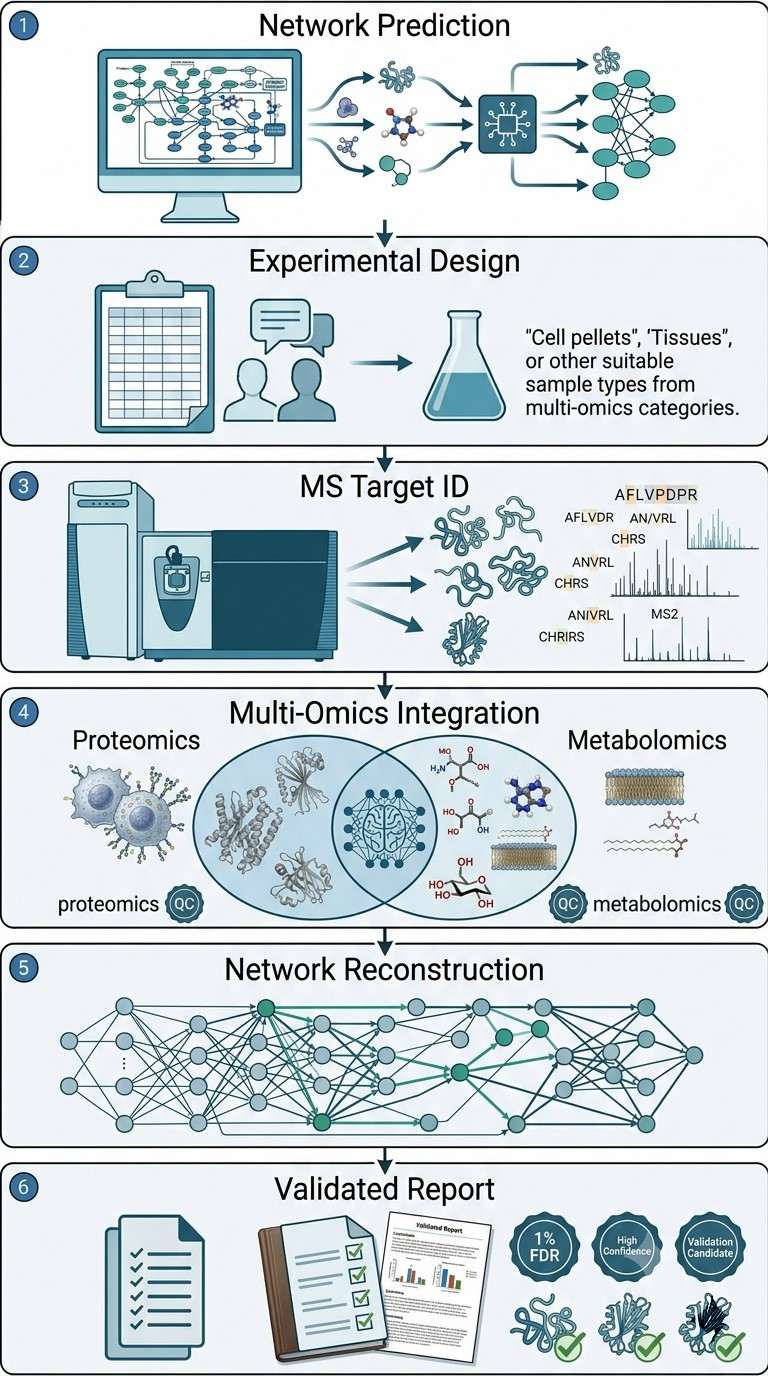
  1. Computational network analysis — We start with your existing network pharmacology data or build one from scratch using STRING, STITCH, and DisGeNET, applying network propagation algorithms to prioritize the most likely targets.
  2. Experimental design consultation — Your compound type, sample availability, and research question determine the best MS strategy: chemoproteomics, thermal shift profiling, or affinity-based approaches.
  3. MS-based target identification — We run the selected method on Orbitrap or timsTOF platforms to capture proteins that bind your compound or show compound-dependent stability shifts.
  4. Multi-omics data integration — When the question calls for it, we layer untargeted metabolomics on top of proteomics to capture both protein-level and metabolite-level effects from the same experiment.
  5. Network reconstruction and pathway analysis — Identified targets go back onto biological networks for enrichment analysis, PPI construction, and pathway mapping in your disease context.
  6. Validated target report — You get a ranked target list with confidence scores, raw MS data, network visualizations, and a written interpretation ready for manuscripts or grant applications.

Why Mass Spectrometry for Network Pharmacology Validation

Single-target biochemical assays were never designed to capture the polypharmacology that network pharmacology aims to characterize. Mass spectrometry changes that.

Proteome-Wide Coverage

A single LC-MS/MS run quantifies 5,000–8,000 proteins. That means we detect both the targets you predicted and the ones you didn't — essential for polypharmacology profiling where a compound engages multiple proteins across different pathways simultaneously.

No Compound Modification Needed

MS works without fluorescent tags, radioactive labels, or chemical handles. The compound behaves as it would in a biological system, which matters especially for natural products and complex mixtures where a tag could alter binding specificity.

One Platform, Two Readouts

The same instrumentation can be configured for proteomics and metabolomics, so we can measure protein targets and their downstream metabolic consequences from the same biological sample.

Which Method Fits Your Project

ApproachHow It WorksBest ForWhat You Need
Chemoproteomics (CCCP)Immobilize compound on beads, pull down binding proteins, ID by MSSingle compounds with known structure≥1 mg purified compound with immobilization handle
Thermal shift profiling (PISA/TPP)Drug binding changes protein melting temperatureComplex mixtures, natural products, phenotypic screensNo modification needed; works with extracts and lysates
DARTSDrug binding protects target from proteolysisQuick validation of predicted targetsMicrogram-scale compound; label-free
Affinity selection MS (AS-MS)Size-exclusion separates protein-ligand complexesFragment screening, weak bindersCompound library or mixture; no immobilization
Activity-based probes (ABPP)Probe labels active-site residuesEnzyme family targeting, covalent inhibitorsProbe design based on compound scaffold

For a deeper look at label-free thermal profiling approaches, see our thermal shift proteomics service.

Integrated Workflow — Prediction to Proof

Our end-to-end workflow moves from computational prediction through experimental validation to a verified target list, all within a single coordinated project.

1

Computational Network Analysis

We start with your existing network pharmacology data or build one from scratch using STRING, STITCH, and DisGeNET. Network propagation algorithms prioritize the most likely targets from the predicted network, reducing the list to a manageable set for experimental validation.

2

Experimental Design Consultation

Your compound type, sample availability, and research question determine the best MS strategy. We recommend the optimal approach — chemoproteomics for single compounds with handles, thermal profiling for label-free detection, or DARTS for quick validation — and plan the control conditions, replicates, and orthogonal confirmation strategy.

3

MS-Based Target Identification

We run the selected method on Orbitrap or timsTOF platforms. For thermal profiling, samples are heated across a temperature gradient and soluble fractions analyzed by LC-MS/MS. For chemoproteomics, compound-bound beads capture interacting proteins for digestion and identification. Each experiment quantifies 5,000–8,000 proteins.

4

Multi-Omics Data Integration

When the question calls for it, we layer untargeted metabolomics on top of proteomics to capture both protein-level and metabolite-level effects from the same experiment. This dual-readout approach reveals not just which proteins are bound, but what metabolic consequences follow — essential for understanding functional impact.

5

Network Reconstruction and Pathway Analysis

Identified targets go back onto biological networks for enrichment analysis, PPI construction, and pathway mapping in your disease context. We build compound-target-pathway networks in Cytoscape, with node attributes encoding confidence scores, differential expression, and pathway membership.

6

Validated Target Report

You receive a ranked target list with confidence scores (high/medium/putative), raw MS data, network visualizations, cross-comparison tables of predicted vs experimentally identified targets, and a written interpretation with recommendations for follow-up validation — ready for manuscripts or grant applications.

Six-step vertical workflow for network pharmacology MS: network prediction, design, MS target ID, multi-omics integration, network reconstruction, and validated report.

For label-free target identification, see our PISA service for thermal stabilization-based profiling.

Applications in Drug Discovery Research

APPLICATION 1

Natural Product Mechanism of Action

An extract with hundreds of constituents. Which ones are bioactive? What proteins do they hit? Our approach combines computational prediction (compound library matching, target similarity searching) with chemical proteomics and metabolomics to deconvolute multi-constituent mechanisms. We've applied this to botanical extracts, microbial fermentation broths, and marine natural products.

APPLICATION 2

Drug Repurposing Target Identification

Repositioning an approved drug means understanding its full target profile in the new disease context. We identify both the intended target and off-target interactions that could contribute to — or undermine — therapeutic activity in the repurposed indication.

APPLICATION 3

Polypharmacology Profiling for Multi-Target Drugs

More programs are deliberately pursuing multi-target profiles for complex diseases like cancer, neurodegeneration, and metabolic disorders. We provide the experimental evidence that a compound engages its intended targets simultaneously, backing the polypharmacology hypothesis with proteome-wide data.

For related multi-omics capabilities, see our drug-target network analysis service.

Case Study — NP-VIP Strategy for Natural Product Target Characterization

Xu R, Yu H, Wang Y, et al. "Natural product virtual-interact-phenotypic target characterization: A novel approach demonstrated with Salvia miltiorrhiza extract." Journal of Pharmaceutical Analysis, 2024. DOI: 10.1016/j.jpha.2024.101101

Background

Natural product target identification has two hard problems: extracts contain hundreds of constituents, and there is no standard workflow to connect computational predictions to experimental proof. Xu et al. (2024) addressed this with the Natural Product Virtual-Interact-Phenotypic (NP-VIP) strategy, which integrates virtual screening, chemical proteomics, and metabolomics to characterize targets of Salvia miltiorrhiza extract — a botanical drug used for ischemic stroke.

Methods

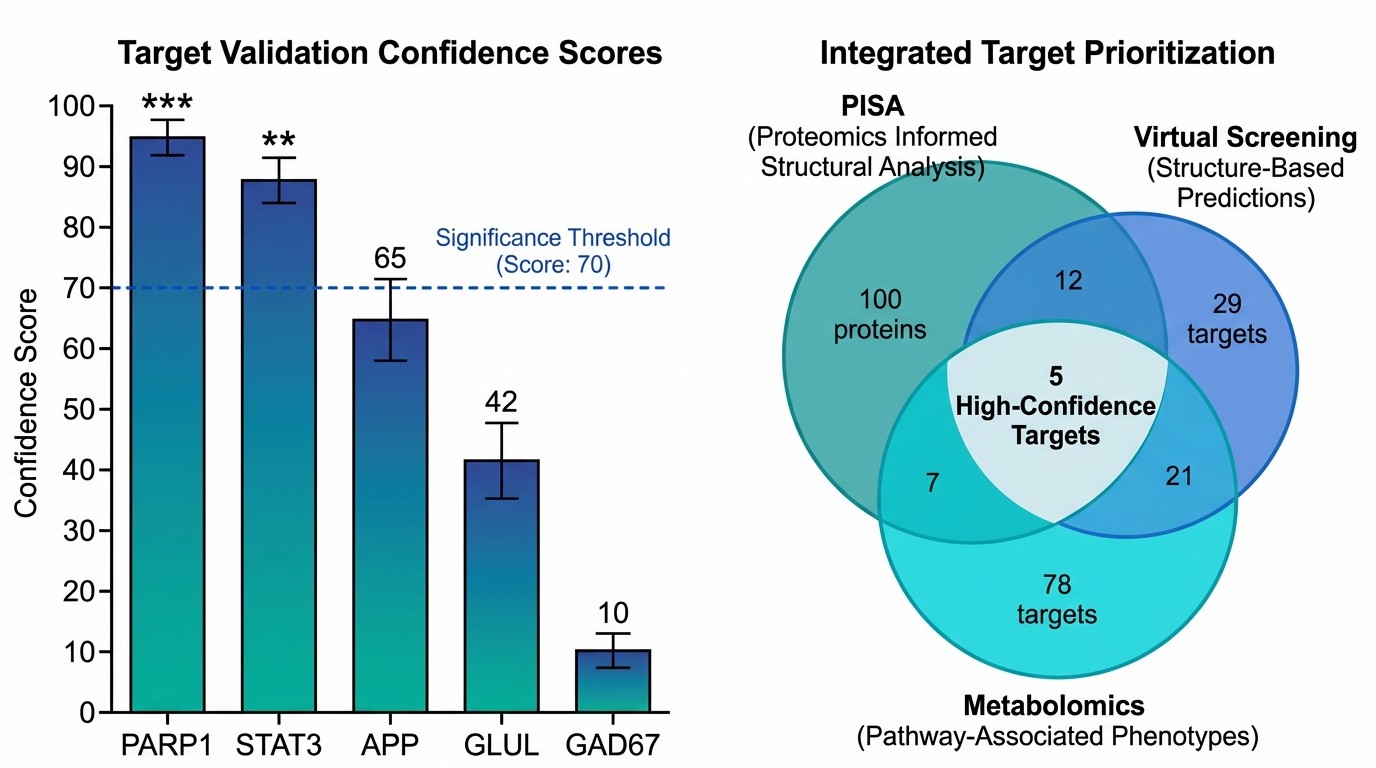
The team used a three-pronged design. First, 75% ethanol extraction followed by silica gel column chromatography and MS-based profiling identified 151 compounds in the extract. Second, computational target prediction using structural and bioactivity similarity tools, cross-referenced against DisGeNET, produced 29 high-confidence predicted targets. Third, two orthogonal MS approaches ran in parallel: PISA (thermal stabilization assay) for unbiased proteome-wide binding detection (100 differential proteins) and untargeted metabolomics for dose-dependent metabolite profiling (82 metabolites linked to 78 metabolic enzyme targets).

Results

Cross-comparison of the three datasets converged on five high-confidence targets: PARP1, STAT3, APP, GLUL, and GAD67. These span cell death signaling (PARP1), inflammatory response (STAT3), amyloid processing (APP), and glutamate metabolism (GLUL, GAD67) — all relevant to ischemic stroke pathology. DARTS combined with Western blot independently confirmed that the extract directly binds all five proteins.

Conclusion

The NP-VIP strategy showed that integrating computational network pharmacology with orthogonal MS approaches can systematically resolve the multi-target mechanism of a complex natural product extract. The same workflow applies broadly to natural product and multi-target drug discovery projects.

NP-VIP case study showing target validation results for Salvia miltiorrhiza extract with five confirmed targets.

Figure 7 from Xu et al. (2024): Target validation by DARTS and Western blot confirming five high-confidence targets (PARP1, STAT3, APP, GLUL, GAD67). Reproduced under CC BY 4.0 license.

Sample Requirements and Project Planning

Project TypeSample FormRecommended AmountControl RequiredTimeline
Single compound target IDPurified compound, ≥95% purity1–5 mgVehicle-only (DMSO/PBS)4–6 weeks
Natural product extractDried extract or fraction10–50 mg (or equivalent)Vehicle-only + blank matrix6–8 weeks
Drug repurposing profilingPurified drug substance1–5 mgVehicle-only + known target control4–6 weeks
Polypharmacology screeningCompound set (≤20)0.5 mg eachPooled vehicle control6–10 weeks

Important planning considerations:

  • Cell or tissue requirements: For cell-based experiments, 1×10⁷ cells per condition (minimum 3 conditions: control, low-dose, high-dose). For tissue samples, 50–100 mg per condition.
  • Controls: Include vehicle-only control (DMSO or appropriate solvent) and a positive control compound with known targets where applicable.
  • Replicates: Minimum 3 biological replicates per condition; 2–3 technical replicates per sample.
  • Bioinformatics: All projects include standard network analysis (PPI construction, pathway enrichment, GO analysis). Advanced options — multi-omics integration, network propagation, machine learning-based target prioritization — are available on request.

Bioinformatics and Data Interpretation

Our bioinformatics pipeline turns raw MS data into target insights you can act on:

Protein Identification and Quantification

MaxQuant or DIA-NN processes raw data for peptide identification and label-free quantification. Proteins are filtered at 1% FDR with a minimum of 2 unique peptides.

Network Construction

Identified targets map onto STRING PPI networks. We build compound-target-pathway networks in Cytoscape, with node attributes encoding confidence scores, differential expression, and pathway membership.

Pathway Enrichment

Over-representation analysis and gene set enrichment analysis against KEGG, Reactome, and GO databases identify the biological processes and signaling pathways most affected by your compound.

Multi-Omics Integration

When both proteomics and metabolomics data are generated, we run correlation-based integration to link protein-level changes with metabolite-level perturbations, identifying enzyme-substrate pairs and pathway-level coordination.

What you receive:

  • Ranked target list with confidence scores (high/medium/putative)
  • PPI network visualization with annotated target nodes
  • Pathway enrichment bar charts and network maps
  • Cross-comparison table: predicted vs experimentally identified targets
  • Written interpretation with recommendations for follow-up validation

For complementary approaches, see our native metabolomics for ligand discovery service.

Why Choose Our Network Pharmacology + MS Platform

CriterionComputational-Only PlatformsGeneral Proteomics CROsOur Integrated Service
Target prediction✓ Yes (in silico only)✗ No✓ Yes + experimental validation
Experimental validation✗ No✓ Yes (generic)✓ Yes (network pharmacology-optimized)
Multi-omics integration✗ Limited✓ Optional✓ Proteomics + metabolomics standard
Natural product expertise✗ Generic databases✗ Variable✓ Dedicated workflow for extracts
Network interpretation✓ Automated reports✗ Raw data only✓ Curated with biological context
Publication-ready output✓ Standard figures✗ Requires in-house analysis✓ Manuscript-ready tables and figures

What sets us apart:

  • End-to-end integration — We handle both the computational prediction and experimental validation, so you don't have to manage the handoff between a bioinformatics vendor and a proteomics lab.
  • Method flexibility — We pick the MS approach that fits your compound and question, rather than forcing everything through one workflow.
  • Natural product specialization — Our team works routinely with complex mixtures: extract fractionation, compound identification, and multi-constituent target deconvolution.
  • Publication support — Results are formatted for journal submission, including methods sections, figure preparation, and supplementary data tables.

Frequently Asked Questions

Can this service validate targets for natural product extracts with hundreds of constituents?

Yes. Our workflow was built for complex mixtures. We combine PISA-based thermal profiling for unbiased binding detection with metabolomics for downstream effect profiling, cross-referenced against computational predictions. This three-pronged approach works even when the active constituents are unknown.

What if my compound's predicted targets are not detected by MS?

That happens, and it tells you something. Low-abundance proteins, membrane proteins, and very weak binders may fall below detection thresholds. We report the detection limits, suggest orthogonal approaches like targeted PRM assays, and help you decide whether the negative result reflects true absence of binding or a technical limitation.

How do you distinguish true targets from background binding?

We use several strategies: dose-response experiments to separate specific from nonspecific binding, competition experiments with excess free compound, statistical filtering with FDR control, and cross-validation across orthogonal MS methods like PISA and DARTS on the same compound.

Can you integrate my existing transcriptomics or proteomics data?

Yes. We routinely merge customer-provided omics data with our experimental results for multi-layer network analysis that connects transcriptional regulation to protein-level changes and metabolic consequences.

What is the minimum sample amount required for a target validation project?

For single compounds, 1 mg of purified compound (≥95% purity) is typically sufficient. For natural product extracts, 10–50 mg of dried extract. Smaller amounts may work with method optimization — contact us to discuss your specific sample.

References

  1. Xu R, Yu H, Wang Y, et al. "Natural product virtual-interact-phenotypic target characterization: A novel approach demonstrated with Salvia miltiorrhiza extract." Journal of Pharmaceutical Analysis, 2024. DOI: 10.1016/j.jpha.2024.101101
  2. Meissner F, et al. "The emerging role of mass spectrometry-based proteomics in drug discovery." Nature Reviews Drug Discovery, 2022. DOI: 10.1038/s41573-022-00409-3
  3. Savitski MM, et al. "Tracking cancer drugs in living cells by thermal profiling of the proteome." Science, 2014. DOI: 10.1126/science.1255784
  4. Mateus A, et al. "Thermal proteome profiling for interrogating protein interactions." Molecular Systems Biology, 2020. DOI: 10.15252/msb.20199232

Ready to turn your network pharmacology predictions into experimentally validated targets?

Contact our team to discuss your project and receive a detailed quotation.

Disclaimer: All products and services provided by Creative Proteomics are for research use only (RUO). They are not intended for use in diagnostic, therapeutic, or clinical procedures.

Online Inquiry

Please submit a detailed description of your project. We will provide you with a customized project plan to meet your research requests. You can also send emails directly to for inquiries.

* Email
Phone
* Service & Products of Interest
Services Required and Project Description