Electrosonic Spray Ionization Mass Spectrometry Service

Pneumatically assisted electrospray ionization with supersonic nebulizer gas for soft, efficient ion generation. Our ESSI-MS service delivers improved desolvation, reduced adduct formation, and preserved non-covalent interactions for proteins, peptides, metabolites, and lipids.

Conventional electrospray works well for most polar analytes, but proteins, non-covalent complexes, and labile molecules often suffer from in-source fragmentation, adduct formation, and incomplete desolvation. Our electrosonic spray ionization mass spectrometry (ESSI-MS) service addresses these limitations by coupling a supersonic nebulizer gas flow with the electrospray process, generating finer primary droplets and accelerating solvent evaporation for softer, more efficient ionization.

Key Advantages:

  • Supersonic nebulizer gas for finer primary droplets and faster desolvation
  • Softer ionization — preserves non-covalent protein-ligand and protein-protein interactions
  • Reduced alkali metal adduct formation for cleaner spectra
  • Improved signal-to-noise in complex matrices due to lower ion suppression
  • Compatible with standard ESI mass spectrometers with minor source modifications
  • Flow rate flexibility from 1–20 µL/min for sample conservation or throughput
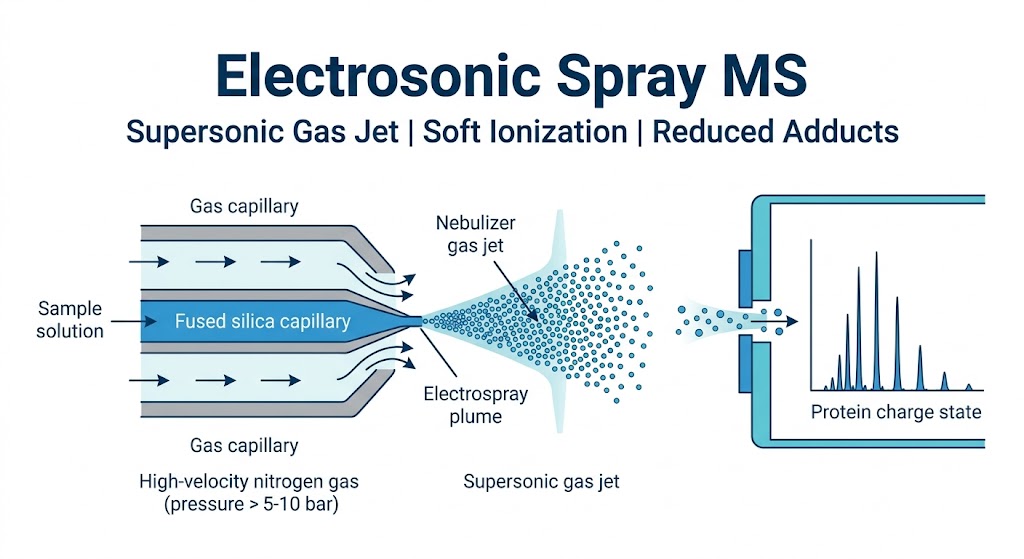
Electrosonic spray ionization mass spectrometry showing supersonic nebulizer gas jet coupled with electrospray for soft ionization of proteins and complexes.
Overview Applications Workflow Demo Sample Data & Analysis Why Choose FAQ

Pneumatically Assisted Electrospray for Soft, Efficient Ionization

Conventional electrospray works well for most polar analytes, but proteins, non-covalent complexes, and labile molecules often suffer from in-source fragmentation, adduct formation, and incomplete desolvation — each degrading spectral quality and limiting what you can extract from a single acquisition. Our electrosonic spray ionization mass spectrometry (ESSI-MS) service addresses these limitations by coupling a supersonic nebulizer gas flow with the electrospray process. The high-velocity gas stream collides with the electrospray plume, generating finer primary droplets and accelerating solvent evaporation. The result is a softer, more efficient ionization that preserves non-covalent interactions, reduces alkali metal adducts, and produces cleaner mass spectra across a wide analyte range.

The ESSI source operates at atmospheric pressure. Sample solution is infused through a fused silica capillary (50–100 µm ID) at 1–20 µL/min. A coaxial sheath gas (nitrogen, heated to 50–150°C) passes through an outer capillary at 5–10 bar, creating a supersonic gas jet at the spray tip. High voltage (2–5 kV) is applied to the solution, and the combined action of the electric field and the gas jet generates a fine aerosol of charged droplets. The supersonic gas provides two advantages over conventional ESI: it reduces initial droplet size, decreasing the number of droplet fission events needed to produce gas-phase ions, and the high-velocity gas impact at the droplet surface accelerates solvent evaporation, reducing reliance on heated drying gas or elevated source temperatures.

This combination of smaller initial droplets and more efficient desolvation means ESSI produces ions with fewer attached solvent molecules and fewer alkali metal adducts than conventional ESI under the same solution conditions. For protein analysis, this translates to narrower charge state distributions shifted toward lower charge states — characteristic of more compact, native-like conformations — and reduced adduct peak widths that improve mass measurement accuracy.

Applications in Drug Discovery and Protein Characterization

APPLICATION 1

Non-Covalent Protein-Ligand Complex Analysis

ESSI's gentle ionization makes it particularly suited for detecting non-covalent complexes that dissociate under conventional ESI conditions. For drug discovery programs targeting protein-protein interactions or allosteric binding sites, ESSI-MS provides direct evidence of complex formation with stoichiometric information from the intact complex mass. The technique is compatible with titration experiments for binding affinity estimation, and the reduced adduct formation improves mass assignment accuracy for large complexes. For related capabilities, see our native ESI-MS service.

APPLICATION 2

Intact Protein Mass Measurement and Conformational Analysis

The softer ionization and improved desolvation of ESSI produce narrower, better-resolved charge state distributions for intact proteins compared to conventional ESI. This is particularly valuable for biotherapeutics (monoclonal antibodies, fusion proteins, ADCs) where adduct heterogeneity can obscure the primary mass distribution. The shift toward lower charge states in ESSI also provides information about protein conformation — more compact, folded states carry fewer charges than unfolded states — enabling conformational profiling under different solution conditions.

APPLICATION 3

Metabolite and Lipid Profiling in Complex Mixtures

Reduced ion suppression in ESSI compared to conventional ESI translates to broader metabolome coverage from the same sample. In plasma, urine, or tissue extract analysis, the supersonic gas jet improves desolvation of matrix components and reduces the competitive ionization that suppresses low-abundance metabolites. For targeted lipidomics, the cleaner spectra reduce isobaric interference and improve confidence of lipid class assignments. For high-throughput spray-based approaches, see our nanoESI HT-MS and paper spray MS services.

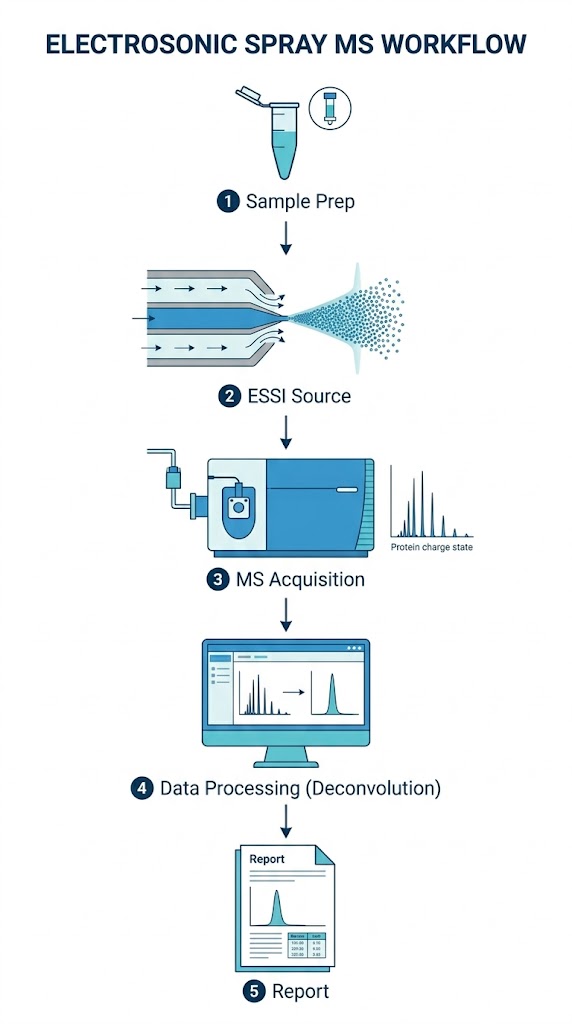
Our ESSI-MS Workflow

Five steps from sample to interpreted results.

1

Sample Preparation and Optimization

Your sample is prepared in an ESI-compatible buffer (ammonium acetate for native conditions, formic acid for denaturing). We optimize concentration, solvent composition, and modifiers during a brief method development phase.

2

ESSI Source Setup and Tuning

The sample is infused at 1–20 µL/min. We set nebulizer gas pressure (5–10 bar), source temperature (50–150°C), and spray voltage (2–5 kV). Source geometry is adjusted to maximize signal stability and intensity.

3

MS Acquisition

We acquire data on Q-TOF or Orbitrap platforms. For intact proteins, m/z 500–5000. For metabolites and lipids, full-scan MS at high resolution (70,000 on Orbitrap). For quantitative work, targeted MS/MS methods are developed.

4

Data Processing and Interpretation

Raw spectra are processed using UniDec for protein deconvolution or Xcalibur/MZmine for small molecules. Protein mass deconvolution uses maximum entropy algorithms. Small molecule data uses extracted ion chromatogram integration against calibration standards.

5

Report Delivery

You receive processed mass spectra with charge state assignments, deconvoluted mass spectra with measured and theoretical masses, adduct analysis, and a written interpretation of results with experimental conditions.

Five-step vertical workflow for electrosonic spray MS: sample prep, source setup, MS acquisition, data processing, and report delivery.

Representative Data — ESSI Performance

Protein Mass Accuracy and Resolution

For a 150 kDa monoclonal antibody under native ESSI conditions, the charge state distribution spans m/z 4000–6000 (25–35 charge states). Deconvolution yields a zero-charge mass of 148,234 ± 12 Da, consistent with the theoretical mass. Glycoform resolution is achievable with well-resolved glycan populations, with mass differences of approximately 162 Da (hexose) resolved in the deconvoluted spectrum.

Signal Improvement over Conventional ESI

In side-by-side comparisons using the same protein sample (myoglobin, 10 µM in 10 mM ammonium acetate) on the same mass spectrometer, ESSI produced 2–4 fold higher signal intensity, with a 30–50% reduction in sodium adduct intensity and a 15–25% improvement in signal-to-noise ratio.

Linearity and Dynamic Range

Calibration curves for small molecule analytes in ESSI mode show linear response (R² ≥ 0.99) over 3–4 orders of magnitude, comparable to conventional ESI, with the advantage of reduced matrix effects in complex samples.

Sample Requirements and Project Planning

Sample TypeConcentrationVolume RequiredBuffer CompatibilityReplicates
Purified protein (intact mass)1–50 µM20–100 µLAmmonium acetate 5–50 mM, pH 6.8–7.53
Protein complex (non-covalent)5–50 µM each30–100 µLAmmonium acetate 5–50 mM3
Peptide digest0.1–1 µg/µL10–50 µL≤0.1% FA, 5% ACN3
Metabolite extractVariable20–100 µL50% ACN/H₂O, ≤0.1% FA3
Lipid extractVariable20–100 µL50:50 MeOH/CHCl₃ + 5 mM NH₄OAc3
Biotherapeutic formulation0.1–10 mg/mL20–100 µLFormulation buffer (may require dilution)3

Planning notes:

  • High salt concentrations (>50 mM) and non-volatile buffers (PBS, Tris) cause signal suppression. Buffer-exchange samples before analysis.
  • Detergents (>0.01%) and glycerol (>1%) interfere with droplet formation. Minimize or remove before submission.
  • Method development for a new analyte class typically requires 1–2 days.
  • Turnaround: most projects complete in 2–4 weeks from sample receipt.

Data Processing and Interpretation

Protein Mass Deconvolution

Raw spectra with charge state envelopes are processed using maximum entropy deconvolution (UniDec or Intact Mass) to produce zero-charge mass spectra. Output includes measured mass, theoretical mass when available, mass accuracy (ppm), and a list of detected adducts.

Charge State Analysis

The charge state distribution itself reports structural information. Narrow distributions at low charge suggest compact, folded conformations. Broad distributions extending to higher charges indicate partially unfolded populations. For ligand binding studies, shifts upon ligand addition can report on conformational changes.

Quantitative Analysis

For small molecules, extracted ion chromatograms are integrated using consistent detection parameters. Calibration curves use linear or quadratic regression. QC samples at low, mid, and high concentrations are included in every batch for accuracy assessment.

Deliverables Package

Processed spectra with annotations, deconvoluted mass spectra for proteins, charge state distribution plots, a data table with measured masses and adduct assignments, and a written methods summary with experimental conditions.

Why Choose Our ESSI-MS Platform

CriterionConventional ESI-MSElectrosonic Spray (ESSI-MS)
Nebulizer gasOptional / sheath gasSupersonic (5–10 bar coaxial)
Initial droplet size1–5 µm0.1–1 µm (gas jet)
Desolvation efficiencyModerateHigh
Adduct formationModerate (Na⁺, K⁺)Reduced (30–50% less)
In-source fragmentationModerateLow
Non-covalent preservationVariableImproved
Signal suppressionModerate-to-highReduced
Protein charge statesBroader distributionNarrower, lower charge
Flow rate range1–1000 µL/min1–20 µL/min

What sets us apart:

  • Dedicated ESSI source expertise — Optimized configurations for protein intact mass, non-covalent complexes, and small molecule analysis, with gas pressure, temperature, and capillary positioning specific to each application.
  • Orthogonal confirmation — When needed, we compare ESSI results with conventional ESI and nanoESI data from the same sample on the same instrument.
  • Method development support — If your analyte or matrix is new to ESSI, we optimize conditions before beginning characterization work.
  • Flexible platform compatibility — Our ESSI source interfaces with Orbitrap, Q-TOF, and ion trap mass spectrometers.
FAQ

Frequently Asked Questions

Q: How does ESSI differ from conventional electrospray ionization?

ESSI uses a supersonic nebulizer gas (5–10 bar, coaxial) to generate finer primary droplets than conventional ESI. This means more efficient desolvation, reduced adduct formation, and softer ionization that better preserves non-covalent interactions and labile modifications.

Q: What types of samples benefit most from ESSI over conventional ESI?

Samples where gentle ionization is critical: non-covalent protein complexes, labile post-translational modifications, intact biotherapeutics where adduct heterogeneity complicates mass assignment, and complex mixtures where ion suppression limits coverage.

Q: Can ESSI be used for quantitative analysis?

Yes. ESSI shows comparable linearity and dynamic range to conventional ESI for small molecule quantification. Reduced matrix effects can improve accuracy in complex samples. Stable isotope internal standards are used where available.

Q: What sample preparation is needed for ESSI-MS?

Samples should be in volatile buffers (ammonium acetate, ammonium bicarbonate) or acidified water/organic mixtures. Non-volatile salts, detergents, and glycerol should be minimized or removed before analysis.

References

  1. Takáts Z, Wiseman JM, Gologan B, Cooks RG. "Electrosonic spray ionization. A gentle technique for generating folded proteins and protein complexes in the gas phase and for studying ion-molecule reactions at atmospheric pressure." Analytical Chemistry, 2004, 76(14), 4050–4058. DOI: 10.1021/ac049848m
  2. Schmidt A, Karas M, Dülcks T. "Effect of different solution flow rates on analyte ion signals in nano-ESI MS, or: when does ESI turn into nano-ESI?" Journal of the American Society for Mass Spectrometry, 2003, 14(5), 492–500. DOI: 10.1016/S1044-0305(03)00128-4
  3. Hilton GR, Benesch JLP. "Two decades of studying non-covalent biomolecular assemblies by means of electrospray ionization mass spectrometry." Journal of the Royal Society Interface, 2012, 9(70), 801–816. DOI: 10.1098/rsif.2011.0823

Ready to characterize your samples with softer, more efficient ESSI-MS ionization?

Contact our team to discuss your project and receive a detailed quotation.

Disclaimer: All products and services provided by Creative Proteomics are for research use only (RUO). They are not intended for use in diagnostic, therapeutic, or clinical procedures.

Online Inquiry

Please submit a detailed description of your project. We will provide you with a customized project plan to meet your research requests. You can also send emails directly to for inquiries.

* Email
Phone
* Service & Products of Interest
Services Required and Project Description