LC-MS/MS Bioanalysis Service | PK Assay Development & Sample Analysis

Reliable LC-MS/MS bioanalysis for your PK program — from discovery through preclinical development.

Our team delivers validated methods, multi-matrix analysis, and ICH M10-aligned documentation to keep your drug development milestones on track.

Whether you are advancing a small molecule through lead optimisation or preparing preclinical data for an IND submission, the quality of your bioanalytical data directly determines whether your program meets its milestones — or stalls. Our LC-MS/MS bioanalysis service is built to solve the challenges that discovery and development teams face every day: limited internal MS capacity, unpredictable assay development timelines, and the need for reproducible data across multiple matrices.

Key Advantages:

  • Validated LC-MS/MS methods for plasma, tissue, CSF, and more
  • Rapid method development — typically 5–7 business days
  • ICH M10-aligned documentation for regulatory confidence
  • Integrated PK parameter reporting (Cmax, AUC, t1/2, CL, Vd)
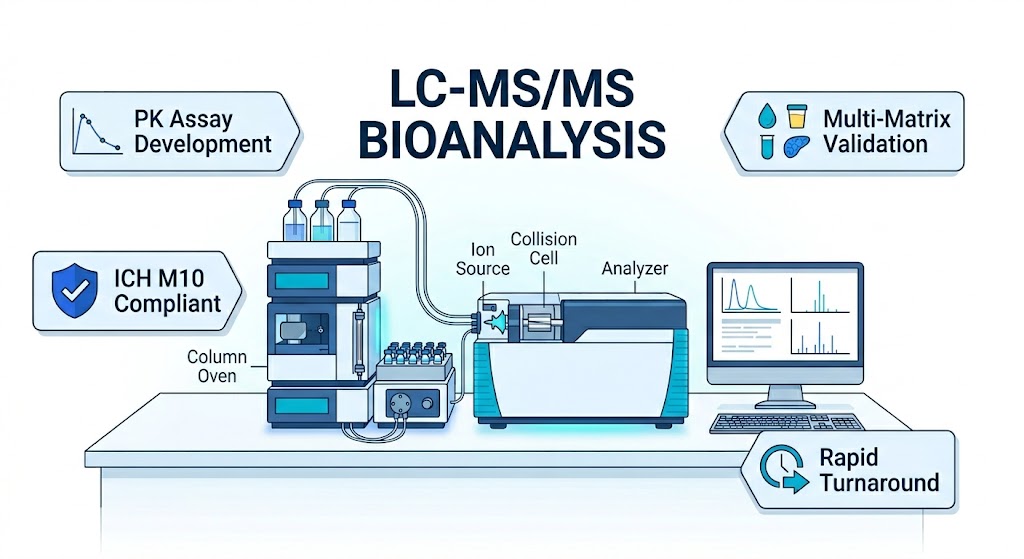
LC-MS/MS bioanalysis service overview featuring LC-MS/MS instrument, plasma and tissue sample workflow, and four key advantage tags
Why Matters Matrices Key Advantages When to Use Workflow Platform Comparison Sample Deliverables Demo Case Study FAQ

Why High-Quality LC-MS/MS Bioanalysis Matters for Your PK Program

Reliable PK data is what separates a program that moves forward from one that stalls. Every decision you make — dose escalation, lead candidate selection, IND-enabling study design — depends on the accuracy and reproducibility of your bioanalytical data.

We've seen too many programs hit unexpected delays because of poorly validated methods, inconsistent data across matrices, or documentation that does not hold up to regulatory scrutiny. That is why our LC-MS/MS bioanalysis service focuses on three things from day one: method rigour, matrix versatility, and documentation that works for your submission package.

Every method we develop follows ICH M10-aligned practices. Every study we run includes full calibration curves, QC samples at three levels, and incurred sample reanalysis. The result is PK data you can trust — whether you are in early discovery or preparing for preclinical development.

For a complete overview of our drug metabolism and PK capabilities, visit our ADME/DMPK/PK-PD Research Platforms page.

Bioanalytical Matrices We Support

Plasma is the default matrix for most PK studies, but it is rarely the only one you need. Tissue distribution tells you where your drug goes. CSF levels tell you about CNS penetration. Urine and bile data tell you about clearance routes. Each matrix comes with its own analytical challenges — different recovery profiles, different matrix effects, different stability considerations.

We have validated LC-MS/MS methods across the full range of matrices you are likely to encounter in preclinical development:

  • Plasma (K₂EDTA, heparin, citrate) — Standard PK matrix; protein precipitation, SPE, and LLE workflows available
  • Serum — Biomarker quantification and clinical bioanalysis
  • Whole blood — Blood-to-plasma ratio and haemolysis-sensitive analytes
  • Tissue homogenate (brain, liver, kidney, lung, heart, spleen) — Tissue distribution and retention studies
  • CSF — CNS drug penetration assessment
  • Urine — Renal clearance and excretion profiling
  • Bile — Hepatobiliary elimination studies
  • Faecal homogenate — Mass balance and metabolite profiling
  • Dried blood spots (DBS) — Microsampling for paediatric and preclinical studies

For plasma protein binding assessment, see our plasma protein binding MS service. For comprehensive tissue distribution analysis, our tissue binding MS services provide complementary data.

Key Advantages of Our LC-MS/MS Bioanalysis Service

Rapid Method Development

We develop and qualify fit-for-purpose LC-MS/MS methods in 5–7 business days for standard small molecules. For novel or challenging compound classes — peptides, oligonucleotides, prodrugs — we apply systematic optimisation of chromatography, ionisation, and sample preparation to deliver robust methods within 10–14 days.

Multi-Matrix Validated Methods

We do not stop at plasma. Where your study requires it, we develop parallel methods across multiple matrices — plasma, tissue, CSF, urine — so your PK data is comparable across compartments from the same study.

ICH M10-Aligned Documentation

Every method validation follows ICH M10 framework principles: full accuracy and precision assessment, selectivity, matrix effect evaluation, carryover testing, dilution integrity, and stability profiling. Our documentation is structured for regulatory submission support.

Dedicated Scientific Point of Contact

Each bioanalysis project is assigned a senior scientist who serves as your single point of contact — from study design consultation through final report delivery. No account manager handoffs, no lost context.

Integrated PK Parameter Reporting

Raw concentration data is just the starting point. We calculate and report full PK parameters — Cmax, Tmax, AUC0–t, AUC0–∞, t1/2, CL, Vd, MRT — using validated pharmacokinetic software (Phoenix WinNonlin).

Flexible Study Design

From single-dose mouse PK with sparse sampling to multi-dose rat toxicokinetic studies, we adapt our analytical strategy to your study design — not the other way around.

When to Engage Our LC-MS/MS Bioanalysis Team

When Your Internal MS Capacity Is Saturated

When your in-house bioanalytical team cannot keep pace with the volume of PK studies across multiple programs, outsourcing provides immediate relief without compromising data quality.

When Your Compound Class Requires Bespoke Method Development

Novel chemical entities, peptides, oligonucleotides, and prodrugs often need custom LC-MS/MS method development. Our team has experience across diverse chemotypes and can rapidly establish optimal conditions.

When You Have Limited Sample Volume

Mouse PK studies with sparse sampling generate as little as 10–25 µL of plasma per time point. Our optimised microflow LC-MS/MS methods achieve sub-ng/mL sensitivity from these minimal volumes.

When You Need ICH M10-Compliant Documentation

As your program transitions from discovery to preclinical development, the bioanalytical data package must meet regulatory standards. Our methods are developed and documented with ICH M10 principles from day one.

When You Are Moving from Discovery to Preclinical Development

The leap from non-GLP discovery bioanalysis to GLP-compliant preclinical studies requires method bridging, extended validation, and rigorous documentation. We manage this transition seamlessly.

For complementary services, explore our metabolic stability assays and metabolite identification (MetID) capabilities.

Our LC-MS/MS Bioanalysis Workflow

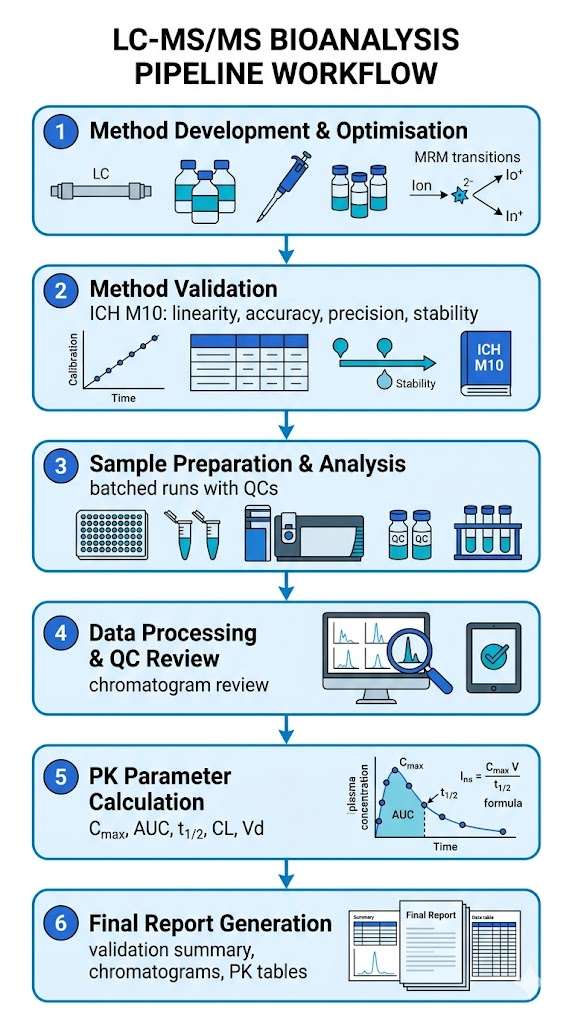
Our workflow covers the full bioanalysis lifecycle, from method development through final report generation.

1

Method Development & Optimisation

We select the optimal LC column, mobile phase, ionisation mode (ESI+/ESI−), and MRM transitions for your compound. Sample preparation — protein precipitation, SPE, or LLE — is optimised for recovery and matrix effect minimisation.

2

Method Validation

Full validation per ICH M10 framework: calibration curve linearity (R² ≥ 0.99), accuracy (85–115%), precision (CV ≤ 15%), selectivity, matrix effect, carryover, dilution integrity, and stability (bench-top, freeze-thaw, long-term, autosampler).

3

Sample Preparation & Analysis

Study samples are processed in batched runs with calibration standards and QCs at three concentration levels. Incurred sample reanalysis (ISR) is performed per regulatory expectations.

4

Data Processing & QC Review

Raw chromatographic data is processed using validated software. Each analytical run is reviewed for system suitability, calibration curve performance, and QC accuracy before acceptance.

5

PK Parameter Calculation

Non-compartmental or compartmental PK analysis is performed using Phoenix WinNonlin or equivalent. Parameters reported: Cmax, Tmax, AUC0–t, AUC0–∞, t1/2, CL, Vd, MRT.

6

Final Report Generation

A comprehensive study report is delivered, including method validation summary, raw chromatograms, calibration curve data, QC results, PK parameter tables, and concentration-time plots.

LC-MS/MS bioanalysis workflow showing six steps from method development through final report generation

LC-MS/MS Platforms & Technology

Our laboratory is equipped with multiple LC-MS/MS platforms to match the sensitivity and throughput requirements of your study.

ParameterSciex Triple Quad 7500Waters Xevo TQ-XSAgilent 6495 Triple Quad
Sensitivity (LLOQ)0.1 pg/mL (on-column)0.5 pg/mL (on-column)0.2 pg/mL (on-column)
Linear Dynamic Range>5 orders of magnitude>4 orders of magnitude>5 orders of magnitude
Scan SpeedUp to 800 MRM transitions/sUp to 500 MRM transitions/sUp to 600 MRM transitions/s
Mass Accuracy<5 ppm<5 ppm<5 ppm
Ionisation OptionsESI, APCI, UniSprayESI, APCI, ASAPESI, APCI, MMI, AJS
Typical ApplicationUltra-sensitive quantification for low-dose PK studiesVersatile multi-analyte bioanalysisRobust high-throughput routine analysis

Platform Selection Strategy: The choice of LC-MS/MS platform depends on your study requirements. For projects requiring the highest sensitivity — low-dose PK, peptide quantification — we deploy the Sciex Triple Quad 7500. For multi-analyte bioanalysis with broad compound coverage, the Waters Xevo TQ-XS provides excellent versatility. For high-throughput routine PK analysis, the Agilent 6495 delivers robust, reproducible performance.

Sample Submission Guidelines

Sample TypeMinimum VolumeContainerStorage ConditionShipping ConditionNotes
Plasma (K₂EDTA)50 µLEppendorf tube−80 °CDry iceAvoid freeze-thaw cycles
Serum50 µLEppendorf tube−80 °CDry iceAllow clotting before centrifugation
Whole Blood100 µLK₂EDTA tube−80 °CDry iceHomogenise before aliquoting
Tissue Homogenate100 µL (or 50 mg tissue)Eppendorf tube−80 °CDry iceProvide tissue weight for normalisation
CSF20 µLLow-bind tube−80 °CDry iceMinimal dilution preferred
Urine200 µLEppendorf tube−80 °CDry iceRecord collection interval

Note: For sample volumes below the stated minimum, contact our team to discuss microflow LC-MS/MS options. We can achieve reliable quantification from as little as 10 µL of plasma using optimised microflow methods.

Bioanalysis Deliverables

  • Validated Method Report: Full method development and validation documentation, including calibration curve data, accuracy and precision tables, selectivity chromatograms, matrix effect evaluation, and stability data
  • Raw Chromatograms: Representative MRM chromatograms for all analytes and internal standards at LLOQ, mid, and high QC levels
  • Calibration Curves: Weighted linear regression curves with back-calculated concentrations and residuals
  • QC Data: Intra- and inter-run accuracy and precision for LQC, MQC, HQC, and ULOQ levels
  • PK Parameters: Cmax, Tmax, AUC0–t, AUC0–∞, t1/2, CL, Vd, MRT, and %extrapolated
  • Concentration-Time Plots: Individual and mean PK curves for each dosing group and matrix
  • Final Study Report: Comprehensive, audit-ready report suitable for internal review and regulatory submission support

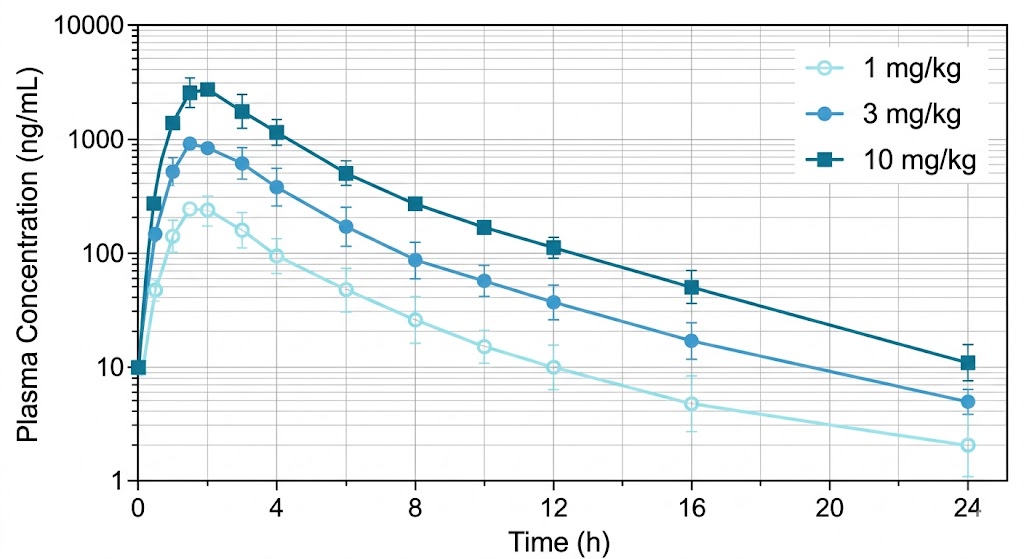
Representative Bioanalysis Data

Representative plasma concentration-time curves showing PK profiles for multiple dose groups with error bars

Example PK concentration-time curves from a rat oral PK study

Case Study: LC-MS/MS PK and Tissue Distribution of Ropivacaine After Plane Block Anesthesia

Butiulca M, Farczadi L, Imre S, Vari CE, Vlase L, Cordos B, Azamfirei L, Lazar AE. "LC-MS/MS assisted pharmacokinetic and tissue distribution study of ropivacaine and 3-OH-ropivacaine on rats after plane block anesthesia." Frontiers in Pharmacology. 2025;15:1494646. https://doi.org/10.3389/fphar.2024.1494646

Background

Understanding the pharmacokinetics and tissue distribution of local anaesthetics is essential for optimising regional anaesthesia protocols. Butiulca et al. (2025) investigated the PK profile and tissue distribution of ropivacaine and its major metabolite 3-OH-ropivacaine in rats following ultrasound-guided plane block anaesthesia, using a validated LC-MS/MS method.

Methods

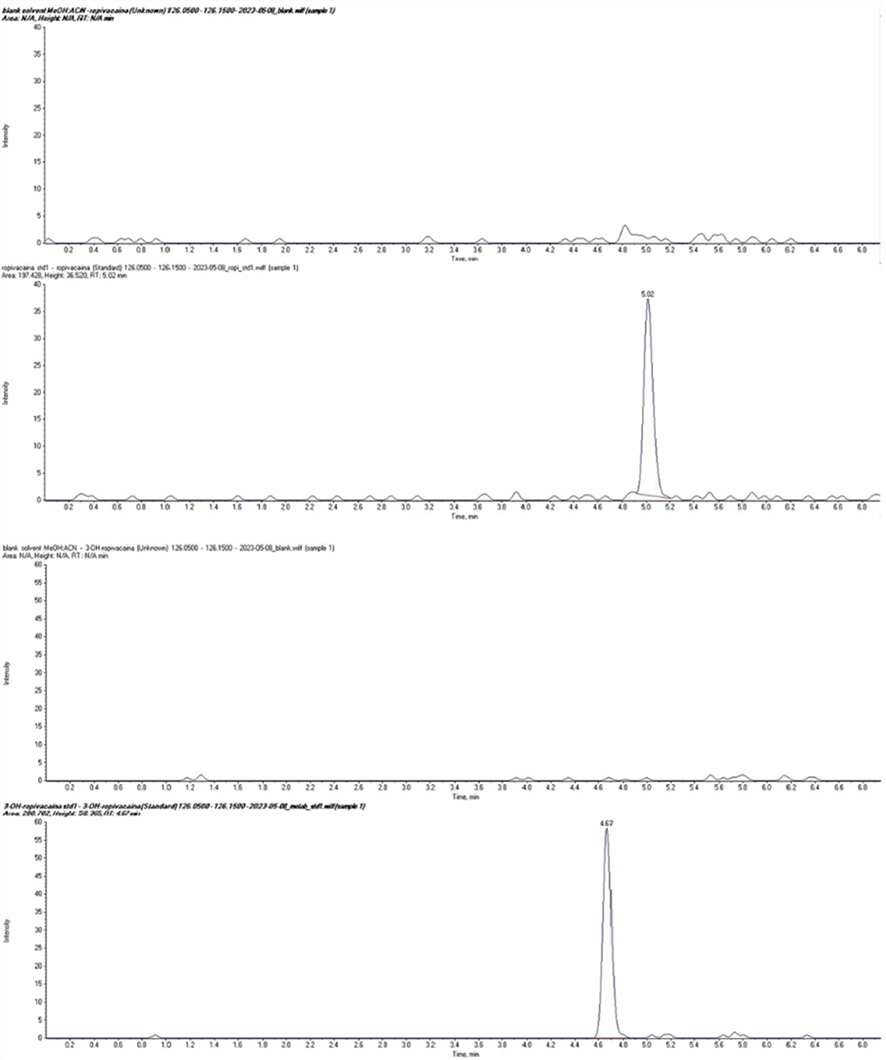
A sensitive LC-MS/MS method was developed and validated for the simultaneous quantification of ropivacaine and 3-OH-ropivacaine in rat plasma and multiple tissues — liver, kidney, muscle, brain, heart, and lung. Sample preparation used protein precipitation with acetonitrile. Chromatographic separation was achieved on a C18 column with a gradient of ammonium formate buffer and acetonitrile. Detection was performed using positive electrospray ionisation in MRM mode. The method was validated for selectivity, linearity, accuracy, precision, matrix effect, recovery, and stability.

Results

The method showed excellent linearity (R² > 0.99) over the range 1–500 ng/mL for both analytes in plasma and tissue homogenates. Accuracy ranged from 92.3% to 107.8%, and precision (CV) was below 11.2% at all QC levels. The method was successfully applied to characterise the PK profile of ropivacaine after plane block administration. Peak plasma concentrations were observed at 15–30 minutes post-administration, with a terminal half-life of approximately 2.5 hours. Tissue distribution analysis revealed highest drug concentrations in liver and kidney, with measurable levels in brain tissue indicating blood-brain barrier penetration.

Conclusions

The validated LC-MS/MS method provided robust, reproducible quantification of ropivacaine and its metabolite across plasma and multiple tissues. The PK and tissue distribution data support the clinical optimisation of plane block anaesthesia protocols. This study demonstrates how rigorous LC-MS/MS bioanalysis delivers the high-quality PK data needed to inform both preclinical and clinical decision-making.

FAQ

Frequently Asked Questions

Q: How quickly can you develop and validate an LC-MS/MS bioanalysis method for my compound?

For standard small molecules, we typically complete method development and fit-for-purpose validation within 5–7 business days. For novel or complex compound classes — peptides, oligonucleotides, prodrugs — the timeline is 10–14 business days, depending on the extent of method optimisation required.

Q: What biological matrices can you handle for PK bioanalysis?

We routinely handle plasma (K₂EDTA, heparin, citrate), serum, whole blood, tissue homogenate (brain, liver, kidney, lung, heart, spleen), CSF, urine, bile, faecal homogenate, and dried blood spots. For specialised matrices, discuss with our team during study design.

Q: What is the minimum sample volume required for LC-MS/MS analysis?

Standard methods require 50 µL of plasma or serum. With our optimised microflow LC-MS/MS methods, we can achieve reliable quantification from as little as 10 µL. For CSF, we can work with 20 µL. Contact us to discuss low-volume options for your study.

Q: Do your bioanalysis methods comply with regulatory guidelines?

All our methods are developed and validated in alignment with ICH M10 bioanalytical method validation guidelines. Our documentation includes full accuracy, precision, selectivity, matrix effect, carryover, dilution integrity, and stability assessments, suitable for regulatory submission support.

Q: What is the typical turnaround time from sample receipt to final PK report?

For standard discovery PK studies (up to 200 samples), the typical turnaround is 10–15 business days from sample receipt. This includes sample analysis, data processing, PK parameter calculation, and final report generation. Expedited timelines are available upon request.

Q: Can you handle novel compound classes such as peptides, oligonucleotides, or prodrugs?

Yes. Our team has extensive experience with diverse chemotypes, including small molecules, peptides, oligonucleotides, antibody-drug conjugates (via hybrid LBA-LC-MS/MS), prodrugs, and natural products. Each compound class requires specific method development considerations, which we address systematically.

Q: What PK parameters do you include in your final report?

Standard PK parameters include Cmax, Tmax, AUC0–t, AUC0–∞, t1/2, CL, Vd, MRT, and %extrapolated. For multi-dose studies, we also report accumulation ratios and steady-state parameters. Non-compartmental analysis is standard; compartmental modelling is available upon request.

Q: How do you ensure data integrity and reproducibility across studies?

We follow a multi-layered data integrity framework: validated software with audit trails, independent peer review of all analytical runs, incurred sample reanalysis (ISR) per regulatory expectations, and strict chain-of-custody documentation for all study samples.

References

  1. Butiulca M, Farczadi L, Imre S, Vari CE, Vlase L, Cordos B, Azamfirei L, Lazar AE. LC-MS/MS assisted pharmacokinetic and tissue distribution study of ropivacaine and 3-OH-ropivacaine on rats after plane block anesthesia. Frontiers in Pharmacology. 2025;15:1494646. https://doi.org/10.3389/fphar.2024.1494646
  2. Lu G, Pan Y, Zhang Y, et al. An LC-MS/MS method for the simultaneous determination of 18 antibacterial drugs in human plasma and its application to therapeutic drug monitoring. Frontiers in Pharmacology. 2022;13:1044234. https://doi.org/10.3389/fphar.2022.1044234
  3. ICH M10 Bioanalytical Method Validation and Study Sample Analysis. International Council for Harmonisation of Technical Requirements for Pharmaceuticals for Human Use. 2022. https://www.ema.europa.eu/en/documents/scientific-guideline/ich-guideline-m10-bioanalytical-method-validation-step-5_en.pdf

Plan your LC-MS/MS bioanalysis study with the MassTarget™ team

Share your compound and study details and our scientists will design a tailored bioanalysis strategy for your PK program.

For Research Use Only. Not for use in diagnostic procedures.

Online Inquiry

Please submit a detailed description of your project. We will provide you with a customized project plan to meet your research requests. You can also send emails directly to for inquiries.

* Email
Phone
* Service & Products of Interest
Services Required and Project Description