Native Metabolomics for Ligand Discovery — Identify Protein-Bound Metabolites Directly from Complex Mixtures

Screen your entire metabolome against a protein target in a single 10-minute LC-MS run — no pre-purification, no immobilization, no labeling.

You have a protein target and a complex biological extract. Somewhere in that mixture, a metabolite binds to your protein — but finding it using traditional methods could take months of iterative fractionation. Native metabolomics changes that. We combine untargeted LC-MS/MS metabolomics with native electrospray ionization mass spectrometry to directly detect non-covalent protein-ligand complexes from crude extracts. A single 10-minute LC-MS run screens your entire metabolome against your protein target, identifying bound metabolites by their mass shift and charge state distribution. The result: hit discovery accelerated 10–100× compared to traditional bioassay-guided fractionation, with unambiguous binding evidence.

Key Advantages:

  • Screens entire metabolome in a single LC-MS run
  • Direct detection of non-covalent protein-ligand complexes
  • No target immobilization, labeling, or pre-purification required
  • Works with crude extracts, complex mixtures, and diverse protein targets
  • Seamless integration with downstream structure elucidation
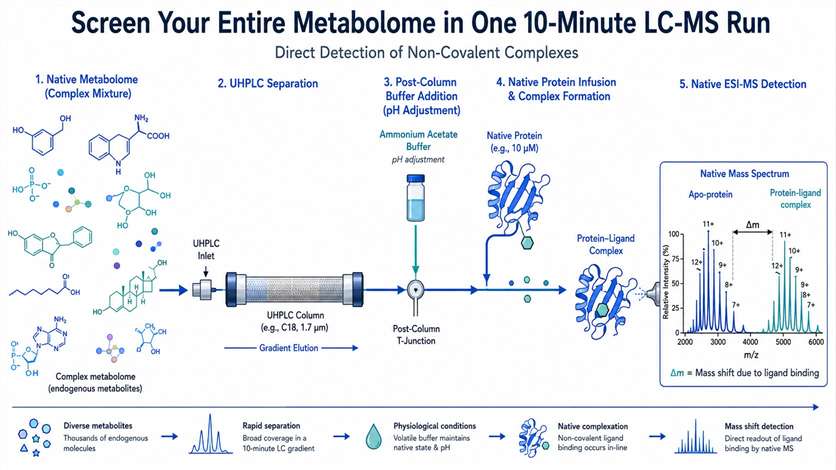
Native metabolomics workflow for ligand discovery with LC-MS and native ESI-MS detection
What Is Native Metabolomics How It Accelerates Discovery Our Workflow Key Advantages When to Choose Tech Comparison Sample Deliverables Case Study Demo FAQ

What Is Native Metabolomics for Ligand Discovery?

Native metabolomics for ligand discovery is an integrated approach we developed that combines untargeted metabolomics with native mass spectrometry to directly identify protein-bound metabolites from complex biological mixtures. The method — first demonstrated as a scalable, top-down strategy termed "nativeomics" (Reher et al., Nature Communications, 2022) — unifies untargeted metabolomics with native MS detection of non-covalent protein-ligand complexes.

The core innovation is post-column pH adjustment. After UHPLC separation of a crude extract, we mix the eluent with a volatile ammonium acetate buffer to shift the pH to near-physiological conditions (pH 6.8–7.5) compatible with native electrospray ionization (ESI). Your protein target is then infused into the post-column flow. Any metabolites that bind to it form non-covalent complexes that survive the gentle native ESI conditions, and we detect these complexes in the mass spectrometer as a mass shift relative to the apo-protein — providing direct, unambiguous evidence of binding.

This approach differs fundamentally from traditional ligand discovery methods:

  • vs. Bioassay-guided fractionation: We screen all metabolites simultaneously rather than testing fractions one at a time, eliminating weeks to months of iterative fractionation.
  • vs. Affinity Selection MS (ASMS): We detect the intact protein-ligand complex directly, rather than relying on SEC-based separation of bound vs. unbound ligands.
  • vs. SPR: No target immobilization is required, preserving the native conformation and avoiding surface artifacts.

The method is particularly powerful for natural product discovery, where crude extracts contain hundreds to thousands of metabolites at varying concentrations. By coupling untargeted metabolomics acquisition (data-dependent MS/MS) with native MS binding detection, we evaluate every feature detected in the metabolomics run for protein binding simultaneously — a capability no other single technique provides.

How Native Metabolomics Accelerates Ligand Discovery

The biggest bottleneck in traditional ligand discovery from complex mixtures is the iterative nature of bioassay-guided fractionation. Each round requires collecting fractions, drying and reconstituting them, running a bioassay, analyzing results, and deciding which fractions to pursue. A typical campaign takes 5–10 rounds — weeks to months — to progress from crude extract to purified active compound.

We eliminate that bottleneck entirely.

Single-run metabolome-wide screening: In a single 10-minute LC-MS run, we evaluate every detectable metabolite in your crude extract for binding to your protein target. The result is a comprehensive hit list — often 20–50 candidate ligands — ranked by binding signal, without any fractionation steps.

Direct binding evidence vs. indirect activity: Traditional bioassays report an activity endpoint (enzyme inhibition, cell viability) that can arise from non-specific effects, assay interference, or off-target activity. We provide direct mass spectrometric evidence of the physical interaction between a metabolite and the protein, eliminating false leads from assay artifacts.

Parallel vs. serial screening: Bioassay-guided fractionation tests one fraction at a time. We test all metabolites in parallel. For a crude extract containing 1,000 detectable metabolites, we complete the screening in ~10 minutes — a task that would require weeks of iterative fractionation using traditional methods.

Prioritization for downstream isolation: Our hit list directly informs which features to prioritize for targeted isolation. Instead of blindly fractionating and testing every fraction, you go directly to the retention time and m/z values of confirmed binders, dramatically reducing the number of isolation steps required.

The speed advantage has been demonstrated in multiple peer-reviewed studies. Reher et al. (2022) identified 30 chymotrypsin-binding cyclodepsipeptides from a cyanobacterial extract in a single native metabolomics run. Naimi et al. (2026) identified 30 trypsin-binding compounds from cyanobacterial extracts, yielding five suomilide analogs with IC50 values in the low micromolar range after targeted isolation.

Our Native Metabolomics Workflow

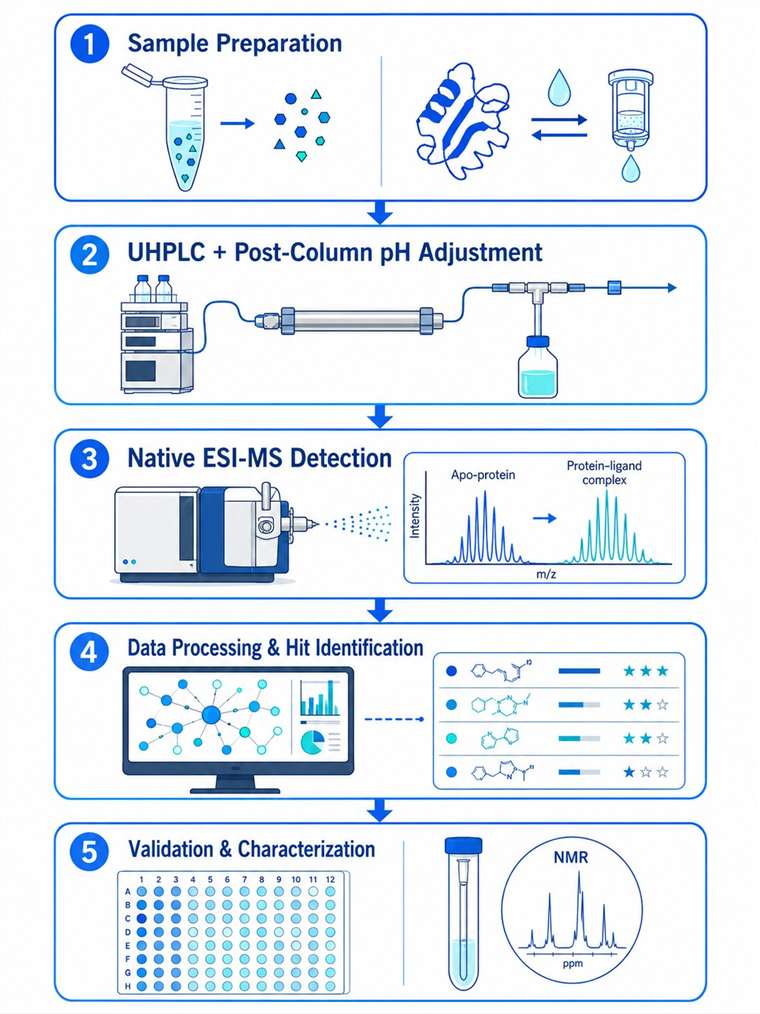
We provide an end-to-end native metabolomics service encompassing sample preparation, LC-MS analysis, native MS detection, data processing, and hit validation. Our workflow is designed to transition seamlessly from crude extract to validated ligand-target interaction.

STEP 1

Sample Preparation and Metabolomics Extraction

We prepare your metabolite extract (or crude biological sample) using a standardized extraction protocol optimized for broad metabolome coverage. Your protein target is buffer-exchanged into a volatile MS-compatible buffer (typically ammonium acetate, pH 6.8–7.5) at a concentration of 1–10 µM.

STEP 2

UHPLC Separation with Post-Column pH Adjustment

We separate your metabolite extract on a reversed-phase UHPLC column using a water–acetonitrile gradient. Post-column, we mix the eluent with a concentrated ammonium acetate buffer via a T-junction, adjusting the pH to native ESI-compatible conditions. This post-column pH adjustment is the key innovation that enables native MS detection of protein-ligand complexes from LC-separated metabolomes.

STEP 3

Native ESI-MS Detection of Protein-Ligand Complexes

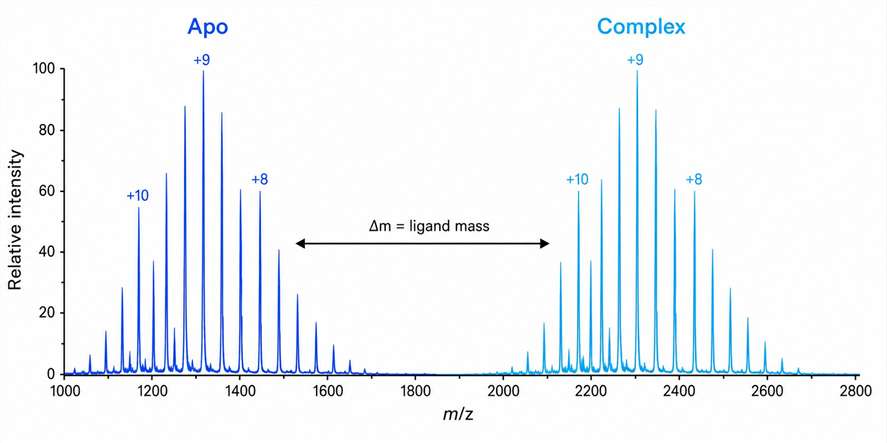
Your protein target is infused into the post-column flow via a second infusion line. Under gentle native ESI conditions (low declustering potential, low source temperature), non-covalent protein-ligand complexes remain intact and are detected in the mass spectrometer. The mass spectrum shows the charge state envelope of the apo-protein alongside one or more shifted envelopes corresponding to protein-ligand complexes. For more on the detection principle, see our native ESI-MS for noncovalent complexes service.

STEP 4

Data Processing and Hit Identification

We process raw MS data to extract binding events. Features are aligned across the chromatographic time axis, and mass spectra at each time point are searched for protein charge state envelopes. When a mass shift consistent with a known metabolite feature is detected, it is flagged as a candidate binding event. The hit list is cross-referenced with your untargeted metabolomics data (MS/MS spectra) for putative identification via feature-based molecular networking and database matching (GNPS).

STEP 5

Hit Validation and Structural Characterization

We validate candidate hits through control experiments: (1) denatured protein control to exclude non-specific binding, (2) competition with known ligands, and (3) titration to assess binding stoichiometry. Confirmed hits proceed to targeted isolation (if from a natural product extract) or direct structural characterization by MS/MS, NMR, or chemical derivatization as needed.

Native Metabolomics Workflow Diagram

1

Sample preparation

Metabolite extraction and protein buffer exchange to volatile MS-compatible conditions.

2

UHPLC + post-column pH adjustment

LC separation with inline pH shift to native ESI conditions.

3

Native ESI-MS detection

Protein infused post-column; non-covalent complexes detected by mass shift.

4

Data processing

Binding event extraction, hit list generation, and molecular networking.

5

Validation & characterization

Control experiments, targeted isolation, and structural elucidation.

Native metabolomics workflow diagram with five steps from sample to validated hits

Key Advantages of Native Metabolomics for Ligand Discovery

Screens Entire Metabolome in One Run

Unlike bioassay-guided fractionation that tests fractions sequentially, we evaluate every detectable metabolite in your crude extract simultaneously. A single 10-minute LC-MS run provides a comprehensive binding profile of the entire metabolome against your protein target.

No Target Immobilization or Labeling

Your protein target remains in solution, in its native conformation, without any surface immobilization, chemical labeling, or genetic tagging. This eliminates artifacts associated with immobilization and preserves the protein's native binding properties.

Direct Binding Evidence

We provide unambiguous mass spectrometric evidence of the physical interaction between a metabolite and your protein. The observed mass shift directly reports the mass of the bound ligand, and the charge state distribution provides information about complex stability. This is fundamentally different from indirect readouts that can produce false positives from assay interference.

Works with Crude Extracts and Complex Mixtures

The method is specifically designed for complex mixtures. UHPLC separation resolves individual metabolites before the native MS detection step, and post-column pH adjustment ensures that native MS conditions are maintained regardless of the LC mobile phase composition. Crude extracts, fermentation broths, and biological fluids are all compatible. Integration with GNPS molecular networking further enhances chemical annotation of complex samples.

Compatible with Diverse Protein Targets

We have successfully analyzed soluble proteins, protein complexes, and membrane proteins (in detergent micelles or nanodiscs). The key requirement is that the protein remains folded and functional in volatile buffers at near-physiological pH. Proteins from ~10 kDa to several hundred kDa are compatible.

Integration with Downstream Characterization

Our hit list directly informs downstream isolation and characterization. Because every hit is associated with a specific retention time and m/z value, targeted isolation can be performed with minimal additional effort. We can further characterize identified ligands by MS/MS, NMR, or orthogonal binding assays as part of a comprehensive service package. For dereplication of known compounds from complex mixtures, see our LC-HRMS/MS dereplication service.

When to Choose Native Metabolomics for Your Ligand Discovery Project

Native metabolomics is most impactful when researchers encounter challenges that traditional screening approaches cannot easily solve. Below are representative scenarios where native metabolomics provides a clear technical advantage.

Orphan Proteins with Unknown Endogenous Ligands

Working with a protein of unknown function or a newly discovered protein with no known ligands? We provide an unbiased survey of the endogenous metabolome. By screening the protein against a relevant biological extract (cell lysate, tissue extract, serum), we identify natural binding partners that may reveal the protein's biological function.

Native metabolomics solves: discovering natural binding partners without any prior knowledge of the protein's function.

Natural Product Library Screening

Natural product extracts are chemically complex, containing hundreds to thousands of metabolites across a wide concentration range. We screen all metabolites simultaneously and provide a direct readout of which compounds bind to your target protein. For related approaches, see our natural product MS discovery service.

Native metabolomics solves: rapid hit identification from complex natural product mixtures without pre-purification.

Targets Requiring Native Conformation

For targets that lose activity upon immobilization, labeling, or purification into non-native buffers — such as membrane proteins, protein complexes, or conformationally sensitive enzymes — we offer a solution. Your protein remains in solution under gentle conditions, and we detect binding without any modification to the target.

Native metabolomics solves: screening under gentle, native-state conditions that preserve target functionality.

Rapid Hit Prioritization for Large-Scale Discovery Campaigns

When screening multiple protein targets against multiple extract libraries, we provide a rapid triage tool. A single 10-minute run per target–extract combination generates a prioritized hit list, enabling you to focus isolation and characterization resources on the most promising combinations.

Native metabolomics solves: fast triage of target–extract combinations and efficient resource allocation.

Validation of Computational or Virtual Screening Hits

Computational predictions of protein-ligand interactions require experimental validation. We can rapidly confirm or refute predicted binding events by testing the predicted ligand (or a close analog) against your target protein in a native MS binding experiment. The direct binding evidence provides higher-confidence validation than activity-based assays alone.

Native metabolomics solves: rapid orthogonal validation of in silico predictions with direct binding evidence.

Native Metabolomics vs. Alternative Ligand Discovery Methods

DimensionNative MetabolomicsAffinity Selection MS (ASMS)Surface Plasmon Resonance (SPR)Bioassay-Guided Fractionation
ThroughputScreens entire metabolome in one 10-min runScreens pooled libraries (100–1,000 compounds/run)Low throughput; one compound at a timeVery low; weeks to months per extract
Sample Complexity ToleranceHigh — designed for crude extracts and complex mixturesModerate — requires clean libraries; complex mixtures challengingLow — requires purified compoundsHigh — designed for complex mixtures
Binding Specificity EvidenceDirect — mass shift of protein-ligand complexIndirect — ligand detected after SEC separationDirect — real-time binding responseIndirect — activity readout; no binding confirmation
Structural InformationLigand mass from complex mass shift; MS/MS for identificationLigand mass and MS/MS from eluted compoundNo structural informationRequires full isolation and characterization
Target CompatibilitySoluble proteins, complexes, membrane proteins (nanodiscs/detergents)Soluble proteins, complexes, membrane proteinsRequires immobilization; may alter target conformationAny target with a measurable activity
Turnaround Time1–2 weeks to hit list1–2 weeks to hit listDays per compound4–12 weeks per extract

Sample Requirements for Native Metabolomics

Sample TypeRecommended AmountConcentrationBuffer ConditionsNotes
Protein Target (soluble)50–200 µg1–10 µMAmmonium acetate (50–200 mM, pH 6.8–7.5); no non-volatile saltsProvide sequence and known ligands if available
Protein Complex100–300 µg1–5 µMNative buffer preferred; compatible with volatile MS buffersIndicate stoichiometry and stabilization conditions
Membrane Protein200–500 µg1–5 µMDDM/LMNG or nanodiscs in ammonium acetate bufferProvide stabilization conditions and detergent compatibility
Metabolite Extract (crude)50–200 µL equivalentAs preparedCompatible with LC-MS (aqueous/organic)Provide extraction protocol and known metabolite classes
Purified Compound / Library1–5 mg or 10 mM stock≥100 µM in DMSO or MS-compatible solventDMSO or MS-compatible solventProvide SDF or SMILES if available for database matching

Deliverables

  • Raw MS data files: Full native MS and LC-MS/MS acquisition files in standard formats (.raw, .mzML)
  • Processed hit list: Ranked list of candidate ligands with binding scores, mass shifts, retention times, and charge state distributions
  • Annotated mass spectra: Native MS spectra showing apo-protein and protein-ligand complex charge state envelopes for each identified hit
  • Molecular network files: GNPS-compatible molecular network files with binding status annotations, enabling visualization of the chemical relationship between identified ligands and the broader metabolome
  • Summary report: Comprehensive report with experimental details, data analysis methods, hit validation results, and our expert interpretation of findings

Case Study: Native Metabolomics Identifies Suomilide Analogs with Potent Trypsin Inhibitory Activity

Naimi A, Ulbricht C, Trinh TL, Kehraus S, Dreckmann TM, Linne U, Hardes K, Reher R, Baunach M. "Native Metabolomics Unveils Suomilide Analogs with Potent Trypsin Inhibitory Activity." Journal of Natural Products, 2026. https://doi.org/10.1021/acs.jnatprod.5c01380

Background

Cyanobacteria are a rich source of bioactive natural products, including protease inhibitors with therapeutic potential. But identifying active compounds from cyanobacterial extracts is challenging due to their chemical complexity and the low abundance of many bioactive metabolites. Traditional bioassay-guided fractionation is time-consuming and often misses low-abundance actives.

Approach

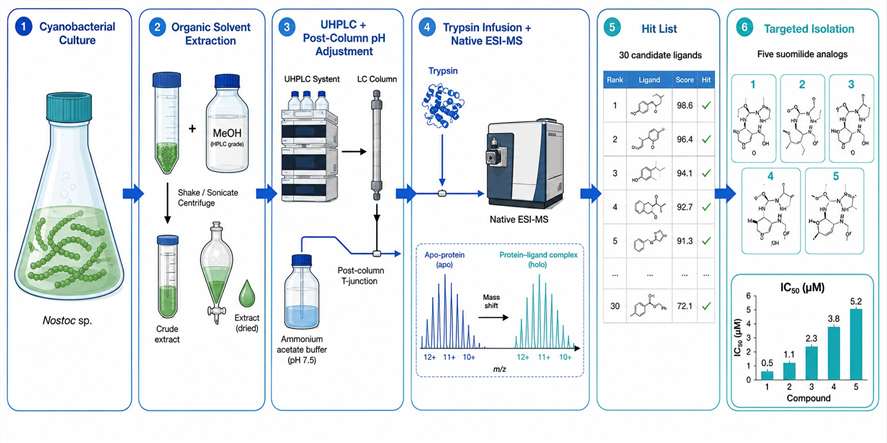
The authors applied native metabolomics to screen crude extracts of the cyanobacterium Nostoc sp. against the serine protease trypsin. The workflow consisted of:

  • Preparation of cyanobacterial crude extract by organic solvent extraction
  • UHPLC separation of the extract with post-column pH adjustment to native ESI conditions
  • Infusion of trypsin into the post-column flow and detection of protein-ligand complexes by native ESI-MS
  • Data processing to identify mass shifts corresponding to bound ligands
  • Cross-referencing hits with untargeted metabolomics data for putative identification

Results

The native metabolomics screen identified 30 potential trypsin inhibitors in a single LC-MS run — a task that would have required weeks of iterative fractionation using traditional methods. The hit list guided targeted isolation, yielding five suomilide analogs (compounds 1–5). All five compounds were characterized by NMR and MS/MS, and their trypsin inhibitory activity was confirmed by enzymatic assays.

Key Findings

  • Hit rate: 30 binding events detected from a single crude extract run
  • Validation rate: 5 of 5 isolated hits confirmed as active trypsin inhibitors
  • Potency range: IC50 values from 0.5 to 5.2 µM against trypsin
  • Speed: Native metabolomics screening completed in hours; targeted isolation and characterization completed in weeks, compared to months for blind fractionation

Conclusion

This study demonstrates the power of native metabolomics to rapidly prioritize active compounds from complex natural product extracts. By providing a direct binding readout from the crude extract, the method eliminated the need for iterative fractionation and enabled the discovery of a new family of trypsin inhibitors with drug-like potency.

Native metabolomics case study workflow for suomilide analog discovery from cyanobacterial extracts

Native metabolomics workflow applied to cyanobacterial extract screening against trypsin, leading to the identification of suomilide analogs 1–5.

Representative Native Metabolomics Results

Native mass spectrum showing apo-protein and protein-ligand complex charge state envelopes with mass shift annotation

Native MS spectrum of protein-ligand complex — the mass difference (Δm) directly reports the bound ligand mass

FAQ

Frequently Asked Questions

Q: What types of proteins can you work with?

We have run native metabolomics on soluble proteins, protein complexes, and membrane proteins (in detergent micelles or nanodiscs). The main requirement is that your protein stays folded in volatile buffers — typically ammonium acetate at near-physiological pH. Proteins from ~10 kDa to several hundred kDa are all fair game.

Q: How do you tell specific binding from non-specific binding?

We run several controls for every hit: (1) a denatured protein control to flag non-specific binders, (2) competition experiments with known ligands, (3) titration to check binding stoichiometry, and (4) orthogonal validation by SPR or enzymatic assays. Only compounds that pass all filters make it into your final hit list.

Q: How much protein do you need?

For soluble proteins, 50–200 µg per screening run is our sweet spot. Membrane proteins or complexes may need 100–500 µg depending on stability. The exact amount depends on molecular weight, ionization efficiency, and how tightly your ligands bind.

Q: Can you tell me where on the protein the ligand binds?

Native metabolomics tells you that a ligand binds and at what stoichiometry — but it does not directly reveal the binding site. For that, we would recommend complementary approaches like HDX-MS, cross-linking MS, or computational docking. We can coordinate these as part of a comprehensive characterization package.

Q: What is the typical timeline?

The screening itself takes 1–2 weeks from sample receipt to your initial hit list. If you need downstream validation, isolation, and structural characterization, budget 4–8 weeks total — it depends on how complex the hits are and how many targets you are running.

Q: Can you combine native metabolomics with other screening methods?

Absolutely — native metabolomics pairs well with ASMS, SPR, enzymatic activity assays, and molecular networking. We regularly combine approaches for comprehensive discovery campaigns. The native metabolomics results help prioritize which compounds to validate with orthogonal methods downstream.

References

  1. Reher R, Aron AT, Fajtová P, et al. Native metabolomics identifies the rivulariapeptolide family of protease inhibitors. Nature Communications, 13, 4619 (2022).
  2. Naimi A, Ulbricht C, Trinh TL, et al. Native Metabolomics Unveils Suomilide Analogs with Potent Trypsin Inhibitory Activity. Journal of Natural Products, 89(4), 1148–1160 (2026).
  3. Wagner N, et al. Native metabolomics identifies pteridines as CutA ligands and modulators of copper binding. Proceedings of the National Academy of Sciences, 122(48), e2509468122 (2025).

Identify Protein-Bound Ligands from Your Complex Mixtures

Submit your protein target and metabolite extract — or let our team prepare them for you — and we will apply native metabolomics to reveal the ligands that traditional methods cannot find.

For Research Use Only. Not for use in diagnostic procedures.

Online Inquiry

Please submit a detailed description of your project. We will provide you with a customized project plan to meet your research requests. You can also send emails directly to for inquiries.

* Email
Phone
* Service & Products of Interest
Services Required and Project Description