Kempa E.E., Hollywood K.A., Smith C.A., Barran P.E. "Rapid Screening of Diverse Biotransformations for Enzyme Evolution." JACS Au 2021;1(5):1013–1022. https://doi.org/10.1021/jacsau.1c00027 PMC: PMC8154213.
Background
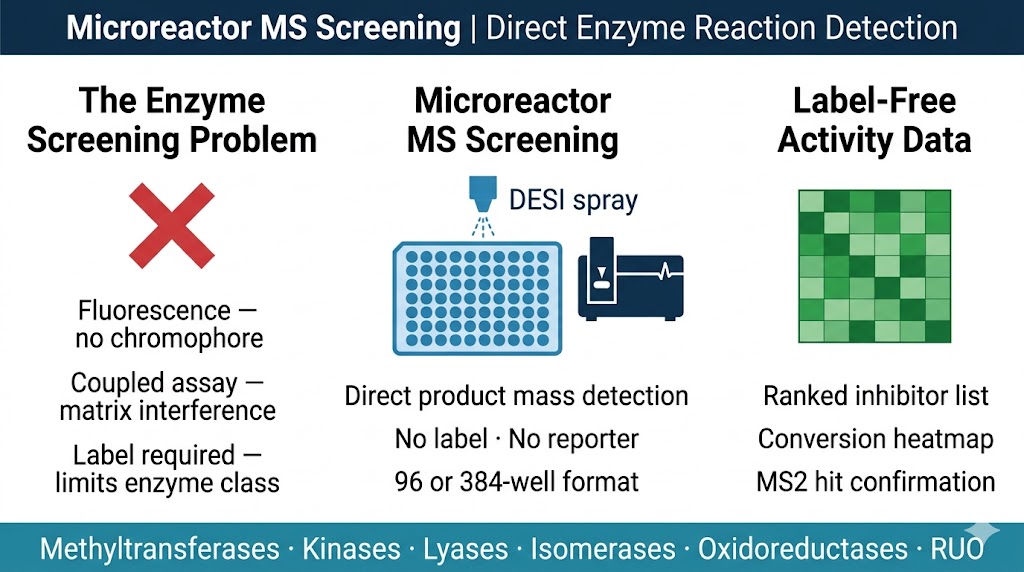
A fundamental bottleneck in directed enzyme evolution and biocatalyst discovery is the absence of label-free, high-throughput analytical methods capable of measuring diverse biotransformations across large variant panels. Fluorescence and coupled enzyme assays — the workhorses of conventional biochemical screening — are restricted to enzyme classes where the substrate or product carries a chromophore, or where a secondary reporter reaction can be coupled. This excludes a substantial fraction of synthetic biology's most valuable enzyme targets: ammonia lyases, imine reductases, kinases (measuring phosphate transfer directly), and metagenomic enzyme panels of unknown activity.
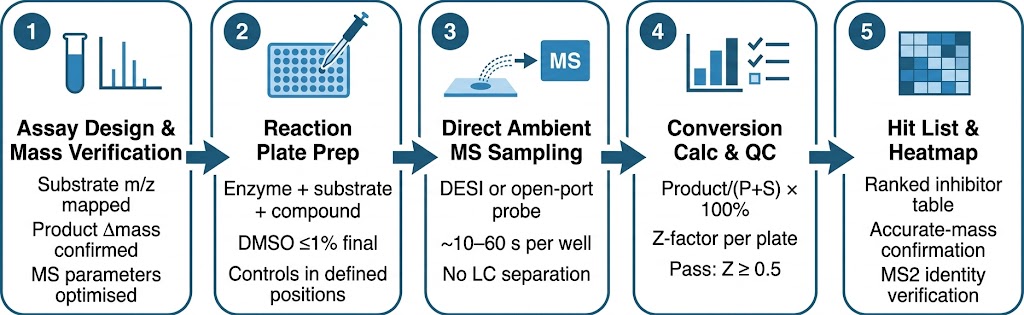
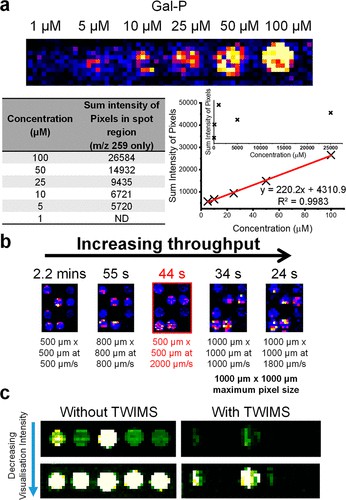
The Manchester Institute of Biotechnology team applied desorption electrospray ionisation (DESI) mass spectrometry directly to reaction spots on 96-well membranes, developing the DiBT-MS (Direct infusion of BioTransformations to Mass Spectrometry) workflow. The goal was to demonstrate that a single MS-based screening platform could assess enzyme activity across fundamentally different reaction types — kinases, imine reductases, and ammonia lyases — from crude cell lysates, without chromogenic or fluorescent substrates, and at throughputs practical for routine laboratory use.
Methods
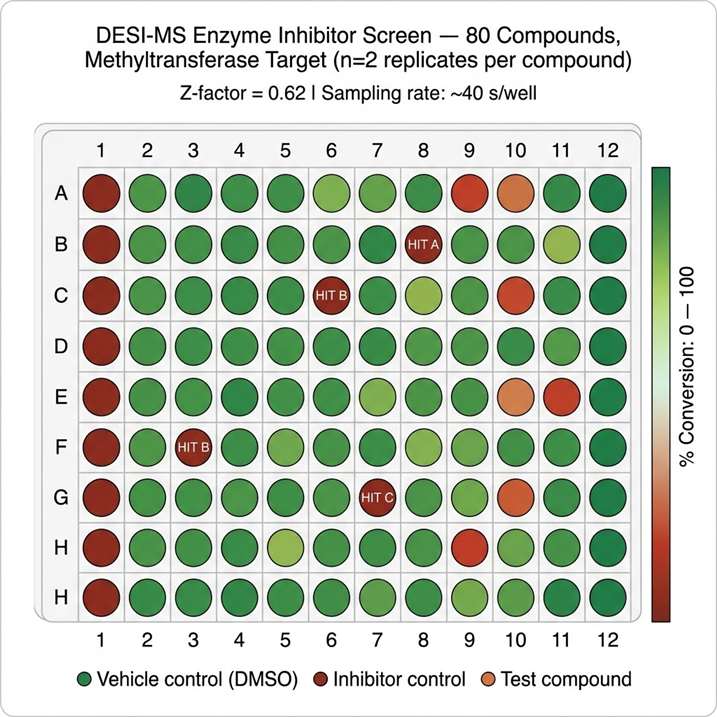
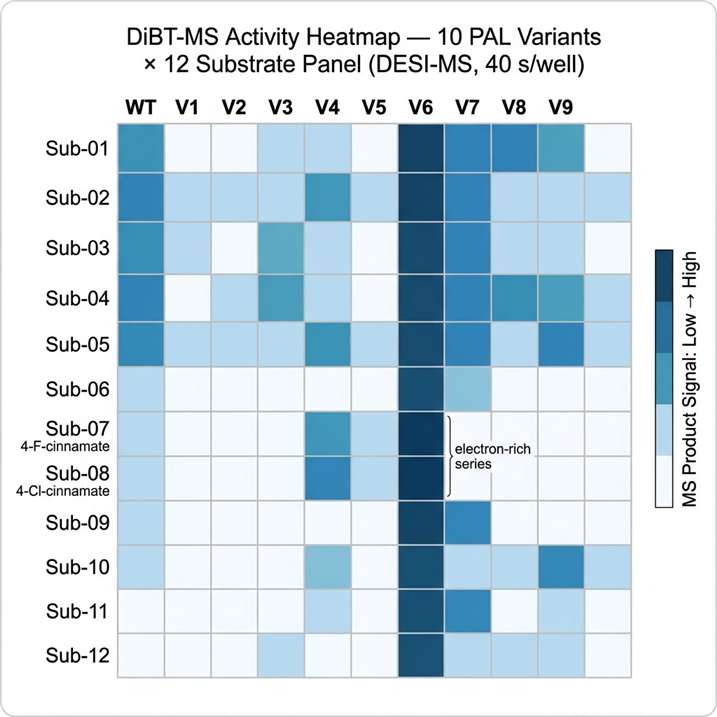
Reactions were assembled in 96-well plates and spotted onto DESI-MS-compatible membranes. The DESI source traversed each spot at a sampling rate of approximately 40 seconds per data point. Three distinct enzyme classes were screened: (1) a panel of 11 purified sugar kinases tested against 15 monosaccharide substrates; (2) imine reductase (IRED) variants from a 384-well metagenomic library against prochiral imine substrates; and (3) phenylalanine ammonia lyase (PAL) whole-cell reaction libraries — 10 PAL variants against 15 cinnamic acid derivatives. For the PAL directed evolution application, the DiBT-MS heatmap identified high-converting variants, which were sequenced to determine amino acid changes correlated with enhanced activity toward electron-rich substrates.
Results
The DiBT-MS heatmap for the kinase panel correctly identified the known substrate specificities of all 11 enzymes within a single screening run, with product ion detection confirming phosphorylation at the expected substrate masses. For the IRED metagenomic library, the heatmap format permitted visual identification of active wells within the 384-well plate in real time, without requiring prior knowledge of which variants were active — a practical demonstration that metagenomic enzyme panels can be dereplicated by direct MS without any assay development. In the PAL directed evolution campaign, DiBT-MS identified multiple high-converting variants toward electron-rich cinnamic acid substrates including 4-fluorocinnamic acid and 4-chlorocinnamic acid — derivatives relevant to lignocellulosic biomass processing. The substrate scope revealed by MS heatmap directly guided DNA sequencing priorities, shortening the variant identification cycle.
Significance for Microreactor MS Screening
This study provides three demonstrations directly relevant to our microreactor MS screening service: first, that direct ambient MS detection of biotransformations is analytically robust across chemically diverse enzyme classes without labelling; second, that throughput of ~40 seconds per sample is sufficient for meaningful variant panels and focused inhibitor libraries in standard laboratory formats; and third, that MS heatmap output is interpretable and actionable for hit selection without statistical processing overhead. The approach exemplifies the logic of reading reaction chemistry directly — measuring product mass rather than a proxy — that underpins all modes of our microreactor MS screening service.