Ion Mobility Mass Spectrometry (IM-MS) Service

4D separation for isobars, conformers, and native complexes.

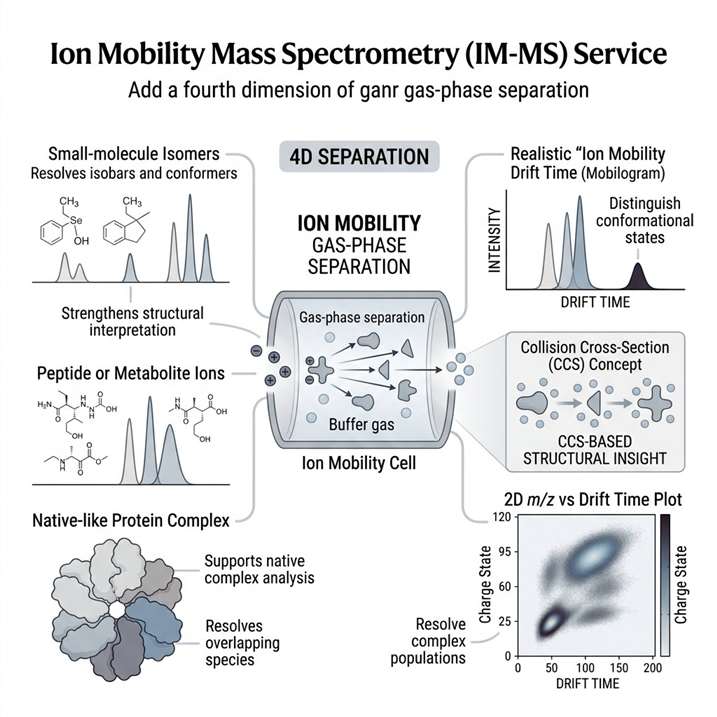
Ion Mobility Mass Spectrometry (IM-MS) Service adds shape-based gas-phase separation to mass spectrometry, helping us resolve isobars, distinguish conformers, and characterize intact complexes with greater structural confidence. It is especially useful when conventional LC-MS cannot clearly separate overlapping species or explain conformation-dependent behavior.

Key Advantages:

  • 4D separation for complex samples.
  • CCS-based structural discrimination.
  • Useful for intact complexes.
  • Supports conformational analysis.
  • Built for follow-up decisions.
Ion Mobility Mass Spectrometry service overview showing 4D separation, CCS analysis, and native complex characterization.
ResolutionCapabilitiesUse CasesWorkflowCCS & MobilityResultsSampleComparisonCase StudyFAQReferences

Breaking the Resolution Barrier with Ion Mobility Mass Spectrometry

In discovery-stage structural analysis, conventional LC-MS can reach a practical limit when mass-to-charge ratio and chromatographic retention alone cannot separate overlapping species. This becomes especially difficult in samples containing co-eluting isobars, conformational isomers, or fragile non-covalent assemblies.

Ion mobility adds another separation dimension by distinguishing ions according to their size, shape, and charge in the gas phase. That gives the analysis a stronger basis for resolving structural ambiguity and measuring collision cross-section values that can support identification, comparison, and conformational interpretation. IM-MS has become increasingly valuable in structural biology, biotherapeutic characterization, and complex molecular analysis because it can bridge the gap between simple mass measurement and higher-order structural interpretation.

This is particularly relevant for modalities whose function depends strongly on conformation, assembly state, or weak non-covalent interactions. In these settings, a mass value alone is often not enough. A more informative answer comes from combining mass with mobility behavior and CCS-based structural evidence.

Our IM-MS and TIMS-MS Service Capabilities

Isobar and isomer separation

We support projects that require mobility-based separation of overlapping species that mass and retention time alone cannot resolve.

CCS analysis

We provide collision cross-section measurements that add orthogonal structural evidence to identification and comparison workflows.

Native complex characterization

We support intact-complex and native-state mobility analysis when conformation and assembly state are central to the study question.

Conformational comparison

We analyze mobility shifts across ligand, treatment, or condition changes to support shape-sensitive structural interpretation.

CIU-oriented studies

We can support gas-phase stability and unfolding analysis for complexes and larger biologics when structural stability matters.

Decision-ready reporting

We organize mobility data into interpretable outputs that support structural review and follow-up planning.

We use ion mobility in a way that matches the analytical question. For some projects, the priority is separating small-molecule or metabolite isobars. For others, the main need is understanding how a native complex changes shape, stability, or mobility behavior after ligand binding. Published reviews and methodological papers consistently position IM-MS as a strong tool for protein conformation, assembly analysis, and orthogonal structural interpretation.

Choosing IM-MS for the Right Structural Question

Isobars and closely related structural species

When multiple compounds share the same or very similar mass but differ in shape, mobility separation can provide the extra dimension needed for confident distinction.

Conformational isomers and mobility-resolved states

For flexible molecules and conformationally dynamic systems, IM-MS can help separate and measure different gas-phase conformers rather than collapsing them into one unresolved signal envelope.

Native complexes and ligand-induced structural shifts

When combined with native electrospray conditions, IM-MS can support analysis of intact assemblies and show mobility changes associated with compaction, unfolding, or ligand-induced conformational effects.

Workflow From Sample Intake to Final Structural Interpretation

STEP 1

Sample preparation and initial QC

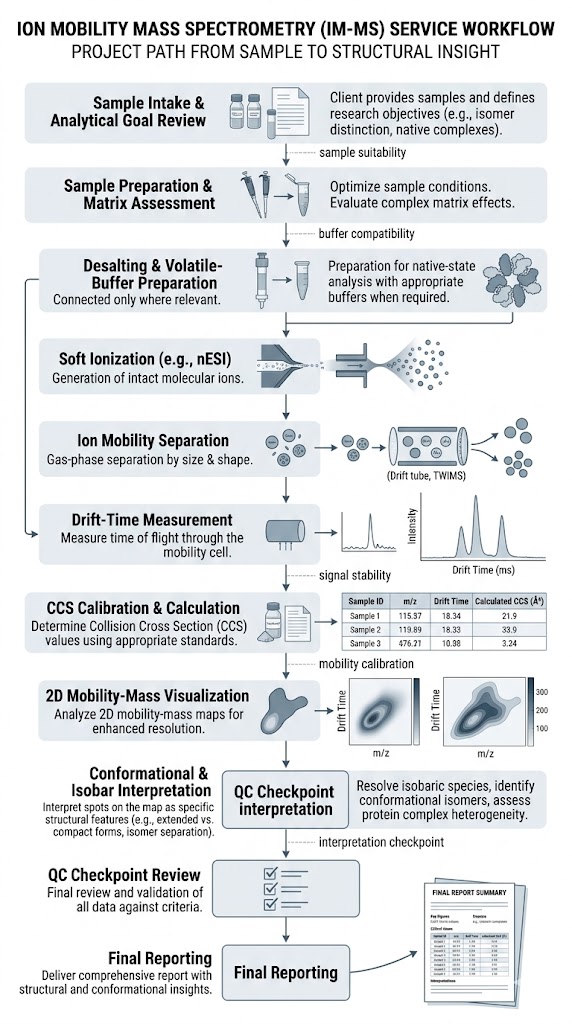
We begin with sample intake, storage check, matrix review, and method-fit assessment. For native-state projects, this usually includes transfer into MS-compatible volatile conditions and verification that the sample remains suitable for structural analysis. The technical goal at this stage is to make sure the system entering IM-MS is both MS-compatible and relevant to the biological question.

STEP 2

Soft ionization, mobility separation, and instrument QC

After initial review, the sample proceeds into ionization and mobility acquisition. For native-state studies, soft ionization conditions are used to preserve non-covalent interactions as much as possible. Mobility separation is then performed to generate drift-time or mobility-resolved structural information. QC at this stage includes instrument calibration, CCS reference alignment where needed, signal stability review, and checks on whether the mobility separation is resolving the structural question the study was designed to answer.

STEP 3

4D extraction, interpretation, and final reporting

Once the run is complete, the dataset is processed into an interpretable mobility-based result set. This may include mobilograms, CCS tables, 2D drift time versus m/z views, CIU contour plots, and comparative condition analysis. The report is structured to help your team understand what was observed, how clearly the mobility data separates the relevant states, and what the next analytical step may be.

How We Use CCS and Mobility to Improve Structural Confidence

1

CCS as an orthogonal identification metric

Collision cross-section values provide a shape-related measurement that can strengthen identification when mass alone is insufficient. This is particularly useful in isobaric or isomeric systems where retention time and m/z do not fully resolve the ambiguity.

2

Mobility-resolved conformational comparison

In conformational studies, drift-time differences can reveal the presence of more compact or more extended states. That makes IM-MS useful for tracking structural transitions and comparing treated versus untreated conditions.

3

CIU and gas-phase stability analysis

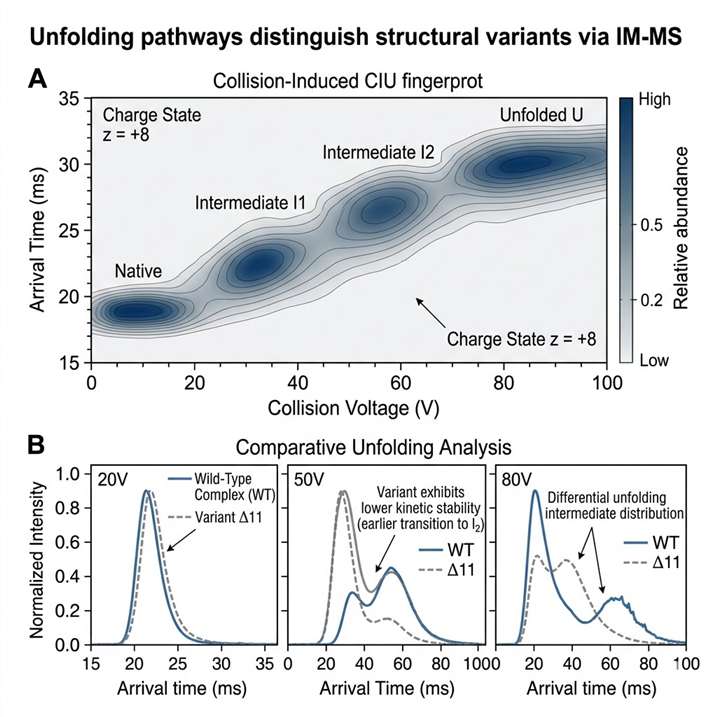
When collision-induced unfolding is added, the analysis can map how a structure unfolds as collision energy increases. This provides a practical route for comparing structural stability, higher-order architecture, and subtle variant behavior in larger biologics and complexes.

4

Data analysis and reporting

For IM-MS, the most useful analysis layer is structural interpretation based on mobility behavior, CCS values, and comparative condition analysis. Reporting can include raw files, mobilograms, CCS tables, annotated mobility plots, CIU contour maps, and concise interpretation notes that support structural review and follow-up planning.

Vertical IM-MS workflow with sample preparation, mobility separation, CCS analysis, and structural reporting.

Representative IM-MS Results You Can Receive

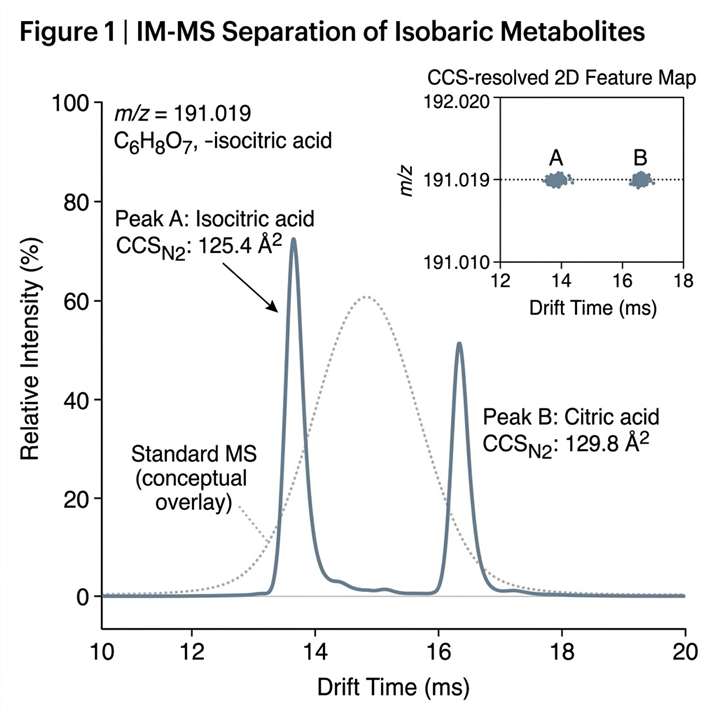
IM-MS mobilogram showing isobar resolution for metabolites or lipids.

Isobar resolution for metabolites and lipids

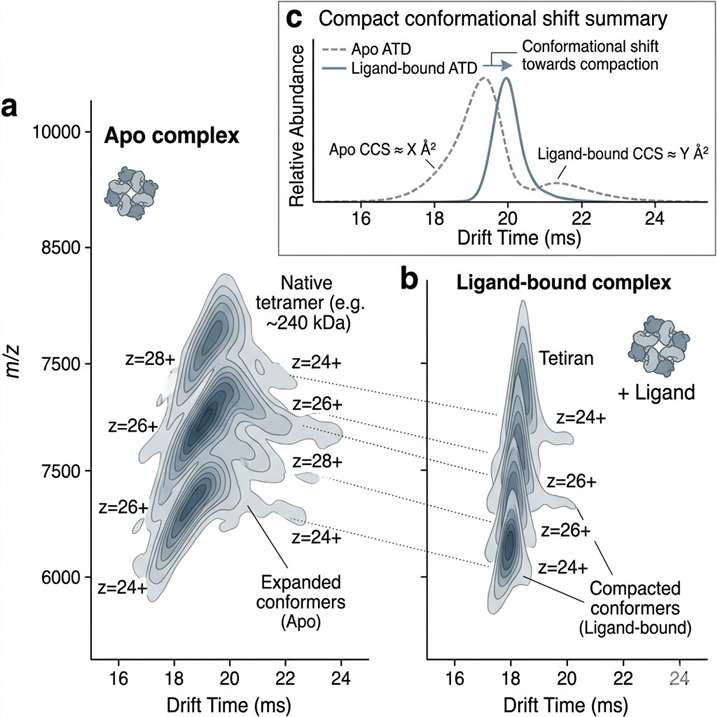
2D IM-MS view showing native complex conformation and ligand binding effects.

Native complex conformation and ligand binding

CIU contour plot showing unfolding fingerprints for protein stability comparison.

Collision-induced unfolding fingerprinting

A useful IM-MS result should help your team decide what to do next. A mobility-resolved result can show isobar separation, reveal conformation-sensitive ligand effects, or compare unfolding behavior across variants, lots, or treatment conditions.

Sample Requirements & Quality Control

Sample TypeRecommended InputBuffer RestrictionsShipping & Notes
Intact Protein Complexes>50 µL at 10–50 µMVolatile buffers preferred, such as ammonium acetate; avoid non-volatile salts and detergent-heavy systems when native preservation is requiredShip on dry ice; avoid repeated freeze-thaw cycles
Small Molecules / Metabolites>50 µL liquid or >2 mg powderSoluble in LC-MS-grade methanol, acetonitrile, water, or project-appropriate solvent systemShip cold; protect light-sensitive or oxidation-prone material
Peptide Mixtures>10 µg total peptideDesalted before analysis; lyophilized or low-salt solution preferredShip on dry ice or frozen cold packs

IM-MS Compared with Other Structural Analysis Approaches

TechnologyMain StrengthStructural OutputSample DemandBest Use CaseMain Limitation
Standard HR-LC-MSHigh-throughput mass analysisMass and retention informationLowRoutine intact-mass or compositional checksLimited shape or conformational discrimination
IM-MS / TIMS-MSShape-sensitive gas-phase separationCCS values, mobility separation, conformational comparisonLowIsobars, conformers, intact complexes, CIU analysisDoes not replace atomic-resolution structure methods
NMR SpectroscopyHigh structural detail in solutionAtomic-level structural informationHighDeep structural studies with highly pure materialHigh sample demand and lower throughput
Native ESI-MS for noncovalent complexesIntact-complex mass behaviorStoichiometry and intact-complex mass informationLow to moderateNative assembly analysisLess informative when shape-resolved mobility data is required
Charge Detection MS for large complexes(CD-MS)Very-high-mass particle distribution analysisSingle-particle mass distributionsModerateUltra-large heterogeneous assemblies such as AAV and related particlesDifferent analytical priority from mobility-resolved conformation

When the main analytical problem is overlap or conformation, IM-MS is often the strongest starting point. When the goal is atomic-resolution structure, NMR may be more suitable. When the project depends on very large heterogeneous particles rather than mobility-resolved conformers, CD-MS can be the better follow-up option.

Case Study: Conformational Landscapes Explored via IM-MS

Conformational landscapes of rigid and flexible molecules explored with variable temperature ion mobility-mass spectrometry

Background

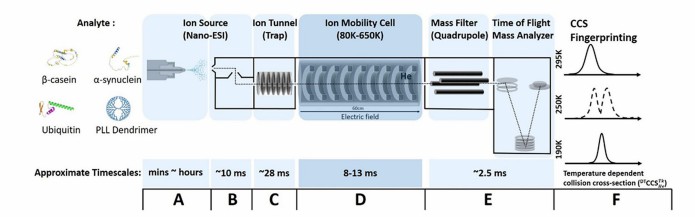
Many flexible molecules do not exist as a single static structure. Instead, they populate multiple conformational states that interconvert, making them difficult to characterize with methods that average over time or require trapping one dominant structure. The study examined this problem directly and used IM-MS to separate and measure conformational populations based on their gas-phase behavior.

Methods

The researchers used variable-temperature ion mobility-mass spectrometry to measure the collision cross-sections of both rigid and flexible molecules. By controlling the temperature of the drift environment, they monitored how conformational populations changed and how individual states could be separated through mobility behavior. This design allowed the study to compare structurally constrained molecules with flexible systems that populate multiple states.

Results

In Figure 1, the study shows how IM-MS resolves distinct conformational states that would not be separated by mass alone. The published mobilograms display discrete, mobility-separated features corresponding to different conformers, and the variable-temperature design shows how the relative populations shift as thermal conditions change. This demonstrates that IM-MS can directly separate structural states and map how conformational equilibria respond to changing conditions.

Conclusion

This case highlights one of the strongest values of IM-MS for structural biology and discovery-stage analysis: the ability to separate and compare conformational states in systems where flexibility matters. For projects involving dynamic ligands, flexible scaffolds, or mobility-sensitive structural questions, this kind of result can provide a stronger basis for identification and follow-up interpretation.

Source for verification: Conformational landscapes of rigid and flexible molecules explored with variable temperature ion mobility-mass spectrometry

Variable-temperature IM-MS figure showing mobility-separated conformational states and temperature-dependent population shifts.
FAQ

Frequently Asked Questions (FAQ)

Q: Can IM-MS distinguish stereoisomers or only structural isomers?

IM-MS is most powerful for structural isomers and conformers whose gas-phase shapes differ enough to produce measurable CCS or mobility differences. Diastereomers may also separate when their geometries differ sufficiently. Enantiomers usually require additional chiral strategies because they have identical CCS values in an achiral drift environment.

Q: How are CCS values calibrated?

CCS values are calibrated using reference compounds with established CCS measurements. This helps maintain consistency and improves cross-platform interpretability.

Q: Can fragile non-covalent complexes remain intact during IM-MS?

They can when the study uses suitable native electrospray conditions and carefully controlled source settings. This is why native-state sample review and soft-ionization optimization are important parts of the workflow.

Q: Can the CCS data be used in modeling workflows?

Yes. CCS values can act as useful structural constraints when comparing experimental results with modeled conformations or broader computational structural hypotheses.

Q: How does a project typically begin?

It begins with a technical review of the target, sample condition, buffer system, and the structural question the study needs to answer. That review helps determine whether the project should prioritize isobar resolution, native complex analysis, conformational comparison, or CIU-style stability mapping.

Discuss Your IM-MS Project

Share your sample type, structural question, and analysis priorities, and we will help you evaluate project fit, mobility-based interpretation, and the most useful next-step analytical strategy.

Disclaimer: All services and products offered by Creative Proteomics are for Research Use Only and are not intended for use in clinical diagnostic procedures.

Online Inquiry

Please submit a detailed description of your project. We will provide you with a customized project plan to meet your research requests. You can also send emails directly to for inquiries.

* Email
Phone
* Service & Products of Interest
Services Required and Project Description