Kinase MS Activity Assays

Label-free mass spectrometry-based kinase activity assays for direct, quantitative measurement of kinase inhibition and selectivity.

Our platform detects substrate phosphorylation directly by MS, eliminating the need for fluorescent labels, radiometric reagents, or coupled enzyme systems — providing clean, interference-free data for even the most challenging compound series.

Key Advantages:

  • Label-free detection — no compound autofluorescence or quenching interference
  • Direct substrate readout — measure phosphorylated product formation without coupled enzymes
  • IC₅₀, Kₘ, and mechanism-of-action from a single MS workflow
  • Peptide and full-length protein substrates supported
  • DMSO-tolerant at standard screening concentrations
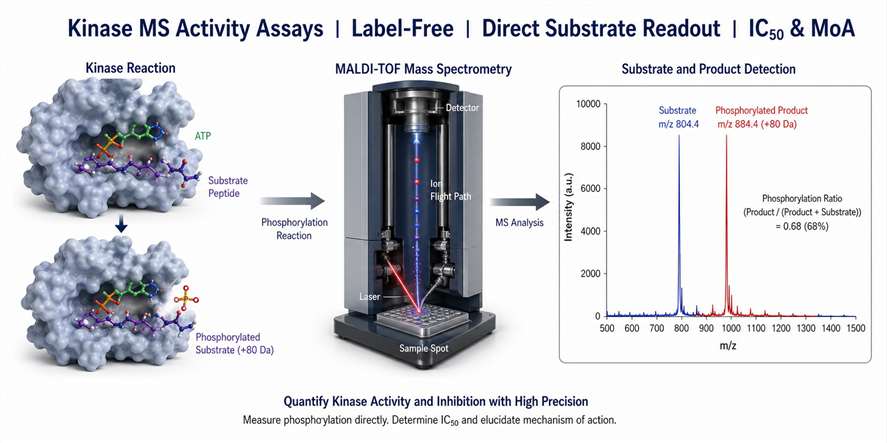
Kinase MS activity assay principle diagram showing kinase enzyme, ATP, substrate peptide, and mass spectrum with substrate and phospho-product peaks.
What Is Kinase MS Key Advantages Service Overview Workflow Tech Comparison Sample Demo FAQ

What Are Kinase MS Activity Assays?

Kinase MS activity assays use mass spectrometry to measure protein kinase catalytic activity in vitro. A purified kinase is incubated with its substrate (peptide or full-length protein), ATP, and test compounds. Mass spectrometry then directly detects and quantifies the phosphorylated product and unphosphorylated substrate, yielding a precise phosphorylation ratio that reports on kinase activity.

Unlike traditional biochemical kinase assays that rely on indirect readouts — fluorescence polarization, FRET, luminescence (ADP-Glo), or radioactivity (³³P-ATP) — MS-based detection measures the actual mass shift of phosphorylation (+80 Da) on the substrate. This direct measurement eliminates several common sources of assay interference: compound autofluorescence in fluorescence-based formats, signal quenching in luminescent readouts, and the need for coupled enzyme systems that can introduce artifacts.

The approach is compatible with both MALDI-TOF and LC-MS/MS platforms. In MALDI-TOF mode, samples are spotted directly onto a target plate after the reaction is quenched, enabling rapid acquisition at rates suitable for moderate-throughput screening. LC-MS/MS mode adds chromatographic separation as an extra dimension of specificity — especially useful for complex substrate mixtures or low-conversion reactions where higher sensitivity is needed.

Kinase MS activity assays are particularly well suited for drug discovery programs where compound interference with optical readouts is a known problem, where direct substrate phosphorylation data is preferred over surrogate signals, and where detailed kinetic characterisation (Kₘ, Vₘₐₓ, mechanism of inhibition) is required alongside routine IC₅₀ determination.

Key Advantages of MS-Based Kinase Activity Detection

Label-Free Detection Eliminates Compound Interference

Fluorescence-based kinase assays are vulnerable to compound autofluorescence, fluorescence quenching, and inner-filter effects — all well-documented sources of false positives and false negatives in high-throughput screening. MS-based detection is inherently immune to these optical interferences because the readout is based on mass, not light. Compounds that would be flagged as "hits" or "non-hits" due to optical artifacts in fluorescence assays can be evaluated cleanly by MS.

Direct Substrate Readout — No Coupled Enzyme Systems

Many popular kinase assay formats (ADP-Glo, Transcreener, enzyme-coupled fluorescence) detect kinase activity indirectly by measuring ATP depletion or ADP production rather than substrate phosphorylation itself. Coupled enzyme systems introduce additional variables — coupling enzyme kinetics, potential interference with test compounds, and indirect stoichiometry. MS-based kinase assays measure the phosphorylated product directly, providing a more faithful representation of kinase catalytic activity.

Broad Substrate Flexibility

MS-based detection imposes no constraints on substrate length or sequence beyond the requirements of mass spectrometric detection. Both short synthetic peptides (8–20 amino acids) and full-length protein substrates can be used. This is particularly valuable for kinases that require extended recognition motifs or structural context for proper catalytic activity — cases where short peptide substrates often fail to report meaningful activity.

Kinetic Characterisation from a Single Workflow

Because MS simultaneously detects both substrate and product ions, a single reaction yields a direct phosphorylation ratio. This makes the assay inherently ratiometric, reducing well-to-well variability from pipetting errors and enabling robust kinetic measurements. Kₘ determinations for ATP and peptide substrates, Vₘₐₓ measurements, and mechanism-of-inhibition studies (ATP-competitive vs. allosteric vs. mixed) can all be performed within the same analytical workflow.

DMSO Tolerance

MS-based readouts are unaffected by DMSO at concentrations typically used in compound screening (0.1–2% v/v). This eliminates a common concern in biochemical assay development, where DMSO sensitivity can limit compound solubility or introduce assay artifacts.

Service Overview — Creative Proteomics Kinase MS Activity Assay Capabilities

We offer five service modes tailored to different stages of the kinase drug discovery pipeline:

MODE 1

Single Kinase IC₅₀ Determination

For individual kinase targets, we design and execute dose-response inhibition assays using your compounds of interest. Each assay is optimised for ATP concentration (at Kₘ or saturating), substrate identity and concentration, reaction time (linear range), and enzyme concentration. IC₅₀ values are calculated from 10-point dose-response curves with technical replicates.

Typical output: IC₅₀ values with 95% confidence intervals, dose-response curves, raw MS spectra at each compound concentration.

MODE 2

Kinase Selectivity Panel Profiling

For compounds that need to be profiled across multiple kinases, we offer panel screening using our MS-based platform. Selectivity profiling can be configured as a full dose-response across the panel (for detailed selectivity ratios) or as single-concentration percentage inhibition screening (for rapid selectivity fingerprinting).

Typical output: Kinase selectivity heatmap, percentage inhibition at screening concentration, IC₅₀ values for confirmed hits, selectivity ratio table.

MODE 3

Mechanism-of-Action Studies

Understanding whether a compound is ATP-competitive, allosteric, or mixed-type is critical for medicinal chemistry optimisation. Our MS platform supports detailed kinetic mechanism studies:

  • ATP competition assays — IC₅₀ determination at multiple ATP concentrations
  • Substrate competition assays — IC₅₀ determination at multiple peptide substrate concentrations
  • Time-dependence assays — pre-incubation time variation for time-dependent inhibition assessment
  • Reversibility assessment — dilution-jump and jump-dilution experiments

Typical output: Mechanism classification, Kᵢ determination, double-reciprocal (Lineweaver-Burk) plots, residence time estimates.

MODE 4

Resistance Mutation Profiling

For kinase targets where clinical resistance mutations have been identified, we offer parallel IC₅₀ determination across wild-type and mutant kinase proteins. This service is particularly relevant for oncology programs where understanding the resistance liability of a compound series is essential for clinical candidate selection.

Typical output: Fold-change in IC₅₀ (mutant vs. wild-type), resistance profile heatmap across mutation panel.

MODE 5

Custom Assay Development

For novel kinase targets, non-standard substrate requirements, or specialised assay conditions, our scientists work with your team to develop and validate a fit-for-purpose MS-based kinase activity assay. This includes substrate identification and optimisation, assay buffer and condition screening, signal-to-noise optimisation, and full assay validation (Z′ factor, intra-assay and inter-assay precision, linearity, and stability).

Typical output: Validated assay protocol, optimisation data summary, validation report.

For related capabilities, see our high-throughput MS screening platform and activity-based protein profiling (ABPP-MS) services.

Kinase MS Activity Assay Workflow

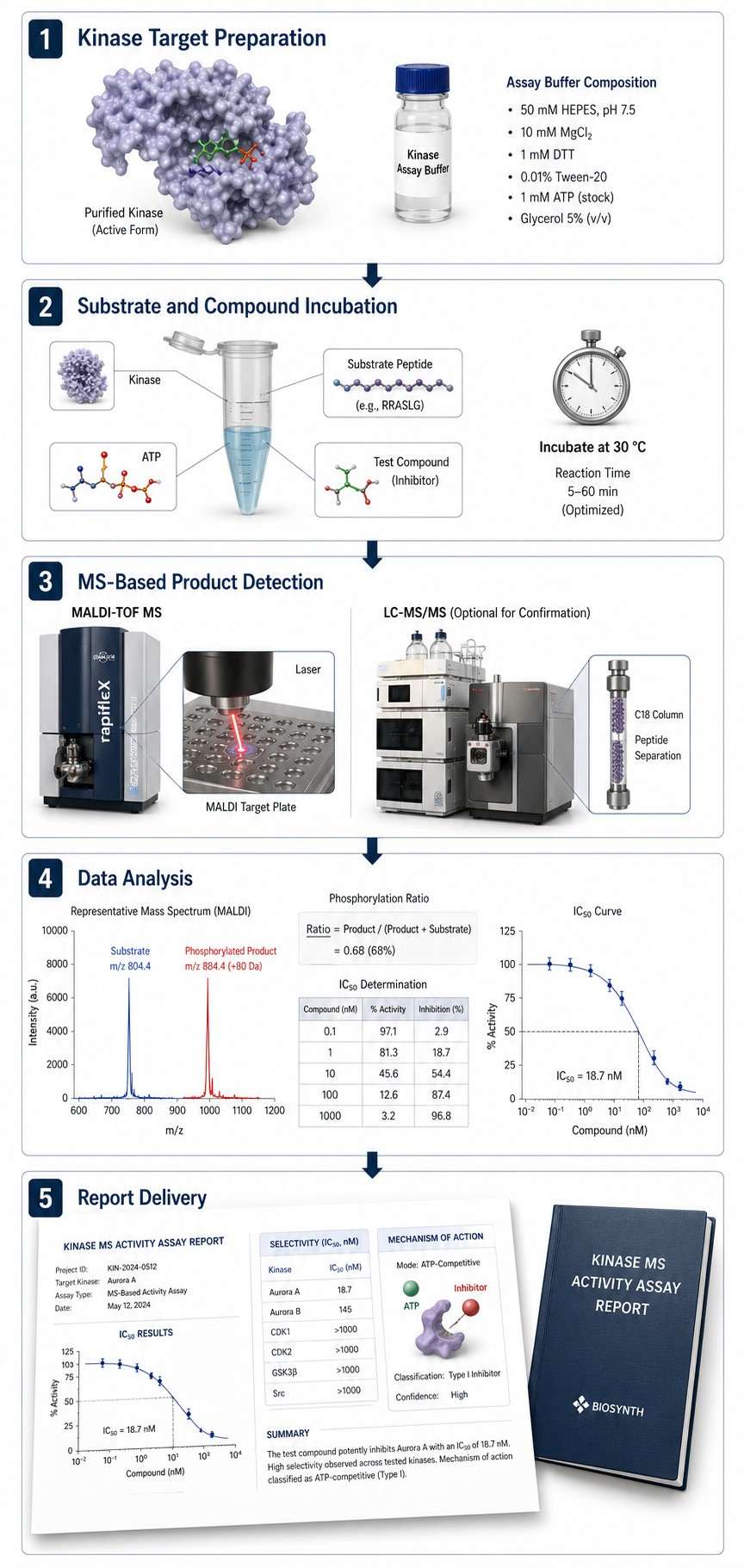
The workflow consists of five essential stages:

1

Kinase Target Preparation

Purified kinase protein is prepared in assay buffer optimised for activity (typically 50 mM HEPES, pH 7.5, 150 mM NaCl, 0.01% Tween-20, with appropriate reducing agent and metal cofactors). Enzyme concentration is titrated to establish linear reaction conditions.

2

Substrate and Compound Incubation

Kinase, ATP (at desired concentration), substrate peptide or protein, and test compound are combined in the reaction volume. Reactions are incubated at 30 °C or 37 °C for a predetermined linear-range time point, then quenched with acidified organic solvent or heat denaturation.

3

MS-Based Product Detection

Quenched reaction mixtures are analysed by MALDI-TOF MS (Bruker rapifleX or equivalent) or LC-MS/MS (Xevo G3 QTof or equivalent). For MALDI-TOF, samples are spotted onto a target plate with matrix and acquired at rates of seconds per sample. For LC-MS/MS, samples are injected onto a C18 column with a rapid gradient for separation and detection.

4

Data Analysis

Peak areas for substrate and phosphorylated product ions are extracted. Phosphorylation ratio = product area / (substrate area + product area). IC₅₀ values are calculated by nonlinear regression (four-parameter logistic fit). For kinetic studies, Kₘ and Vₘₐₓ are determined by Michaelis-Menten fitting, and mechanism-of-action is classified by global fitting of competition data.

5

Report Delivery

A comprehensive report is delivered including raw MS spectra (overlaid at each compound concentration), calculated IC₅₀ curves with statistics, selectivity data (for panel studies), and mechanism-of-action classification with supporting data.

Five-step vertical workflow diagram for kinase MS activity assays: target preparation, incubation, MS detection, data analysis, and report delivery.

Service Process:

Project Consultation — Our scientists discuss your kinase target, compound series, and experimental requirements to design the optimal assay strategy.

Assay Design and Quotation — A detailed experimental plan and quotation are provided based on the agreed scope of work.

Assay Development and Execution — Assay conditions are optimised and validated before full-scale execution.

Data Review and Interpretation — Results are reviewed with your team, with options for iterative follow-up experiments.

Final Report and Support — A complete data package is delivered, with continued support for data interpretation and publication.

Platform Instrumentation

Creative Proteomics' kinase MS activity assay platform integrates advanced MALDI-TOF and LC-MS/MS systems to support sensitive and reproducible kinase activity measurements. Our instrumentation is engineered to deliver high-precision mass accuracy, rapid acquisition rates, and robust performance for both routine IC₅₀ determination and detailed kinetic mechanism studies.

InstrumentTypeApplication in Kinase AssaysKey Specifications
Bruker rapifleXMALDI-TOF/TOFHigh-speed MALDI-TOF MS for kinase activity screening; 10 Hz laser for rapid sample acquisitionMass accuracy < 1 ppm; resolution > 40,000; acquisition rate up to 10 samples/second
Xevo G3 QTofLC-MS/MS (QTOF)LC-MS/MS-based kinase activity quantification with chromatographic separation for complex mixturesMass accuracy < 1 ppm; resolution > 40,000; sensitivity in attomole range
Thermo Q Exactive HFOrbitrap MSHigh-resolution MS for full-length protein substrate phosphorylation analysisResolution up to 240,000; mass accuracy < 3 ppm; HCD and ETD fragmentation
Agilent 1290 Infinity IIUHPLC SystemFront-end separation for LC-MS/MS kinase assays; rapid gradient for high sample throughputPressure up to 1300 bar; flow rate 0.001 – 5 mL/min; autosampler with temperature control

Technology Comparison: MS-Based vs. Traditional Kinase Assay Formats

ParameterKinase MS (This Service)Fluorescence PolarisationADP-Glo LuminescenceRadiometric (³³P-ATP)FRET / TR-FRET
Detection PrincipleDirect mass measurement of substrate phosphorylationPolarisation change on tracer bindingATP consumption via luciferase-coupled reactionIncorporation of radioactive ³³P into substrateFluorescence resonance energy transfer between donor and acceptor
Label RequirementLabel-freeFluorescent tracer requiredNo label (coupled enzyme)Radioactive ATP requiredFluorescent labels required
Compound Interference RiskNone (mass-based readout)High (autofluorescence, quenching)Moderate (luciferase inhibition)LowHigh (autofluorescence, quenching, FRET interference)
Substrate FlexibilityPeptide and full-length proteinPeptide only (tracer competition)Peptide and protein (ATP consumption)Peptide and proteinPeptide only
ThroughputModerate (MALDI-TOF: seconds/sample)High (384/1536-well plates)High (384-well plates)Moderate (wash steps required)High (384/1536-well plates)
Kinetic InformationFull (IC₅₀, Kₘ, Vₘₐₓ, MoA classification)Limited (IC₅₀ only)Moderate (IC₅₀, ATP Kₘ)Full (IC₅₀, Kₘ, MoA)Limited (IC₅₀ only)
DMSO ToleranceExcellent (up to 2%)ModerateModerateGoodModerate

Sample Requirements

Sample TypeRecommended QuantityPurity / QualityNotes
Purified Kinase Protein≥ 50 µg per target≥ 85% purity by SDS-PAGEFull-length or catalytic domain; active form preferred
Test Compounds≥ 10 µL of 10 mM stock in DMSO≥ 95% purity10-point 3-fold dilution series recommended
Substrate Peptide≥ 100 µg per assay condition≥ 90% purity8–20 amino acids; sequence verified by MS
ATPProvided by laboratoryN/AStandard concentration range: 1 µM – 1 mM
Reference Inhibitor≥ 10 µL of 10 mM stock≥ 95% purityKnown inhibitor for the target kinase; used as positive control

Representative Kinase MS Activity Assay Demo Data

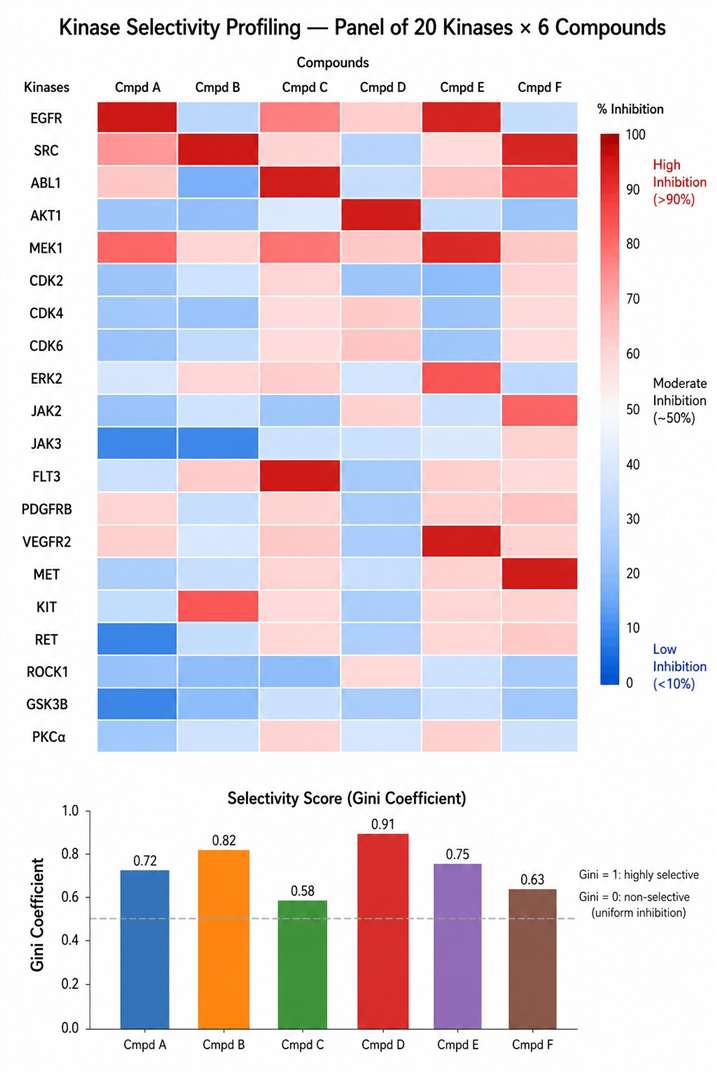
Kinase selectivity heatmap showing 20 kinase targets profiled against 6 test compounds with color gradient from blue to red.

Kinase Selectivity Profiling — Panel of 20 Kinases × 6 Compounds

Case Study: Kinase Selectivity Profiling for a Lead Optimisation Program

Kinase Selectivity Profiling — Panel of 20 Kinases × 6 Compounds

Background

A lead optimisation program required selectivity profiling of 6 development compounds against a panel of 20 kinases to identify the most selective candidate for in vivo efficacy studies.

Methods

Using our MS-based kinase activity assay platform, all 120 compound-kinase combinations were evaluated in a single study. Each compound was tested in a 10-point dose-response format against each kinase target. IC₅₀ values were calculated by nonlinear regression, and selectivity scores (Gini coefficient) were computed for each compound across the panel.

Results

The resulting selectivity heatmap identified Compound D as the most selective candidate (selectivity score = 0.82), while Compound B showed broad off-target activity across the panel. Compound D demonstrated >100-fold selectivity against 18 of 20 kinases tested, with only two off-target hits at sub-micromolar concentrations.

Conclusions

The study enabled the medicinal chemistry team to prioritise Compound D for in vivo efficacy studies and to initiate a structural optimisation campaign to address the off-target liabilities of Compound B. The MS-based platform provided interference-free data across all compound-kinase combinations, including for compounds known to exhibit autofluorescence in traditional fluorescence-based kinase assays.

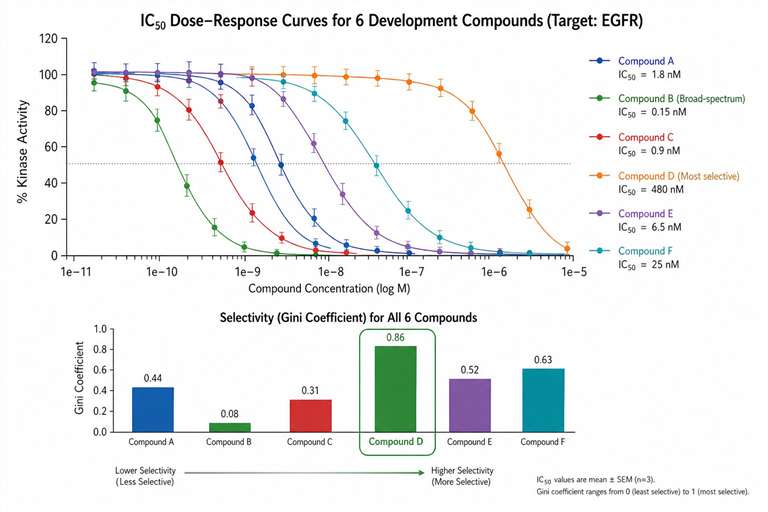
Overlaid IC₅₀ dose-response curves for 6 development compounds against a kinase target, showing differential potency with sigmoidal curves in multiple colors.

IC₅₀ dose-response curves showing differential potency profiles of 6 development compounds against a representative kinase target.

FAQ

Frequently Asked Questions

Q: What types of kinases can be analysed by MS-based activity assays?

MS-based kinase activity assays are compatible with virtually all protein kinases that can be purified in active form, including tyrosine kinases (RTKs and non-receptor TKs), serine/threonine kinases, and dual-specificity kinases. The key requirement is that the kinase must be able to phosphorylate a substrate that is detectable by mass spectrometry — which applies to all kinases that phosphorylate peptide or protein substrates. Lipid kinases and other non-protein kinases require alternative assay formats.

Q: How does the sensitivity of MS-based kinase assays compare to fluorescence-based methods?

MS-based detection typically achieves sensitivity comparable to or better than fluorescence-based methods for kinase activity assays. MALDI-TOF MS can detect phosphorylation events at substrate conversion rates as low as 1–5%, while LC-MS/MS methods can detect sub-1% conversion in favourable cases. The practical advantage of MS is not raw sensitivity but the absence of interference — a fluorescence assay with 100% theoretical sensitivity is useless if the compound quenches the signal, whereas MS provides clean data regardless of compound optical properties.

Q: What is the throughput of MALDI-TOF MS for kinase screening?

With modern MALDI-TOF instruments such as the Bruker rapifleX, acquisition rates of approximately 1 sample per second are achievable. This translates to throughput of approximately 3,000–4,000 samples per hour under optimal conditions, making MALDI-TOF MS suitable for moderate-throughput screening campaigns. For comparison, this is slower than 1536-well plate fluorescence readers but faster than most LC-MS/MS methods and comparable to 384-well plate formats.

Q: Can MS-based kinase assays detect allosteric inhibitors?

Yes. Because MS-based assays measure substrate phosphorylation directly and can be configured to vary ATP and substrate concentrations independently, they are well suited for distinguishing ATP-competitive, substrate-competitive, and allosteric mechanisms. Allosteric inhibitors that bind outside the ATP-binding pocket and modulate kinase activity through conformational changes are readily detected, and the mechanism can be classified through appropriate kinetic experiments (e.g., IC₅₀ determination at multiple ATP concentrations, substrate competition assays, and time-dependence studies).

Q: How much compound is needed for a full IC₅₀ determination?

For a standard 10-point dose-response curve with technical duplicates, we recommend approximately 10 µL of 10 mM compound stock in DMSO. This provides sufficient material for the full dose-response curve at a typical top concentration of 10 µM with 3-fold serial dilution. The actual compound consumption per assay point is in the low nanomole range. For selectivity panel studies, proportionally more compound is needed depending on the number of kinase targets in the panel.

Q: What is the turnaround time for a typical kinase MS activity assay project?

Standard single-target IC₅₀ determination projects typically require 2–3 weeks from sample receipt to data delivery, including assay optimisation, execution, and data analysis. Kinase selectivity panel studies (10–30 kinases) typically require 3–5 weeks depending on panel size. Mechanism-of-action studies and custom assay development projects are scheduled on a case-by-case basis. Expedited timelines are available for urgent projects — please contact us to discuss your specific requirements.

References

  1. Meyer, C., et al. (2023). LIMS-Kinase provides sensitive and generalizable label-free in vitro measurement of kinase activity using mass spectrometry. Cell Reports Physical Science, 4(10), 101599. https://doi.org/10.1016/j.xcrp.2023.101599
  2. Heap, R. E., et al. (2017). Identifying inhibitors of inflammation: A novel high-throughput MALDI-TOF screening assay for salt-inducible kinases (SIKs). SLAS Discovery, 22(10), 1193–1202. https://doi.org/10.1177/2472555217717473
  3. Anastassiadis, T., et al. (2011). Comprehensive assay of kinase catalytic activity reveals features of kinase inhibitor selectivity. Nature Biotechnology, 29(11), 1039–1045. https://doi.org/10.1038/nbt.2017

Ready to advance your kinase drug discovery program with label-free, interference-free activity data?

Contact our team to discuss your project requirements and receive a detailed quotation.

Online Inquiry

Please submit a detailed description of your project. We will provide you with a customized project plan to meet your research requests. You can also send emails directly to for inquiries.

* Email
Phone
* Service & Products of Interest
Services Required and Project Description