Drug-Target Interaction Validation Service

Orthogonal biophysical binding validation integrating SPR, BLI, native ESI-MS, equilibrium dialysis, thermal shift assays, and HDX-MS for confirmed compound-target interaction data.

Your screening campaign has delivered a list of hits. But before committing synthetic resources, one question must be answered definitively: does this compound actually bind the proposed target?

The MassTarget platform provides an integrated suite of biophysical and MS-based binding validation approaches that together cover the full spectrum of drug-target validation scenarios. Our team selects the optimal approach based on your target, compound series, and project requirements.

Key Advantages:

  • Multiple orthogonal methods based on different physical principles
  • Covers soluble, membrane, and challenging target classes
  • Wide affinity detection range from pM to mM
  • Kinetic parameters (ka, kd, KD) from SPR and BLI
  • Binding stoichiometry and site information from native MS and HDX-MS
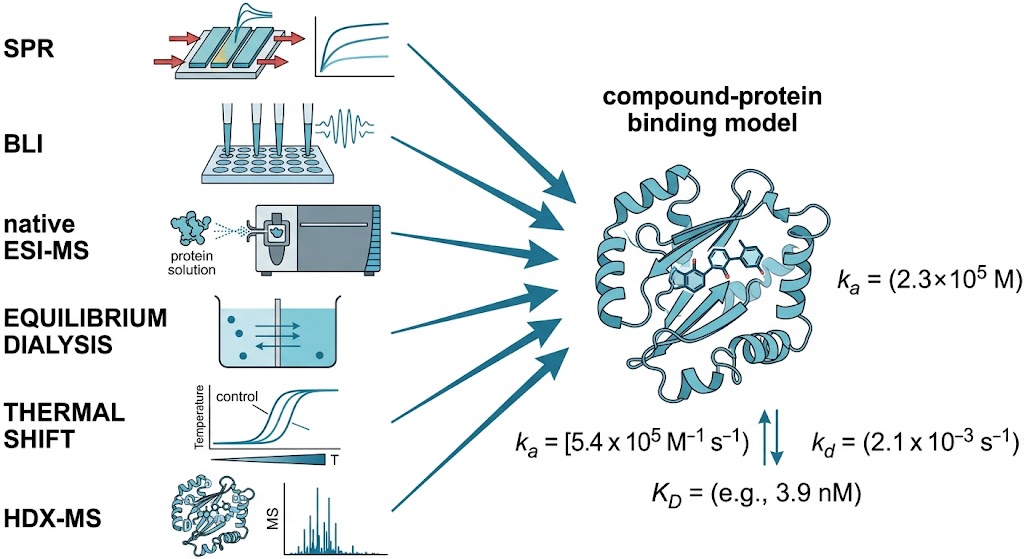
Drug-target interaction validation platform showing orthogonal biophysical approaches SPR, BLI, native ESI-MS, equilibrium dialysis, thermal shift, and HDX-MS converging on confirmed binding data.
Overview Approaches Workflow Applications Demo Data Sample Why Orthogonal Case Study FAQ

From Hit to Confirmed Binder — Why Validation Matters

Hit validation is the critical gateway between discovery and development. A compound that produces activity through an off-target mechanism, aggregation, or assay interference will waste medicinal chemistry effort and mislead downstream biology. Orthogonal binding validation — confirming the compound-target interaction through an independent, label-free biophysical method — is the only way to build confidence before advancing a hit into optimization.

The challenge is that different compounds, target classes, and project stages require different validation approaches. A membrane protein with limited solubility may not tolerate SPR immobilization. A fragment with weak affinity requires a method with wide dynamic range. Matching the validation method to the compound and target properties is essential for generating interpretable, decision-grade binding data.

At MassTarget, we provide an integrated suite of biophysical and MS-based binding validation approaches — including SPR, BLI, native ESI-MS, equilibrium dialysis-MS, targeted thermal shift assays, HDX-MS epitope mapping, and ligandability mapping — that together cover the full spectrum of drug-target validation scenarios. For complementary cellular target engagement profiling, see our thermal proteome profiling (TPP) service.

Orthogonal Binding Validation Approaches

Hit validation demands more than a single measurement. Each biophysical method interrogates binding from a different physical principle, and concordant results across orthogonal methods provide the strongest evidence for a genuine compound-target interaction.

Surface Plasmon Resonance (SPR)

The gold standard for label-free binding analysis. Target protein immobilized on a sensor chip detects compound binding in real time through refractive index change, providing association and dissociation rate constants (ka, kd) and equilibrium KD. Applicable to purified soluble proteins and membrane proteins in nanodiscs. Typical throughput: 50-200 compounds per day. Minimum target: 50-100 microg purified protein.

Bio-Layer Interferometry (BLI)

An optical dip-and-read method measuring binding through white-light interference. Offers kinetic information similar to SPR with practical advantages: no microfluidics (eliminating clogging), compatibility with crude lysates and complex buffers, and higher DMSO tolerance. Particularly well-suited for antibody screening, fragment binding, and challenging targets. Our bio-layer interferometry (BLI) service provides full kinetic characterization.

Native ESI-MS for Noncovalent Complexes

Unlike optical methods, native ESI-MS detects the compound-target complex directly by mass. The target protein in native folded state is sprayed into the mass spectrometer; bound and unbound species are resolved by mass, providing unambiguous binding stoichiometry. Can detect weak binding up to 1 mM KD, making it ideal for fragment validation. Our native ESI-MS for noncovalent complexes service covers all workflow stages.

Equilibrium Dialysis-MS Binding

A solution-phase equilibrium method with no immobilization requirement. Target and compound are separated from free compound by a semi-permeable membrane; bound fraction is measured by LC-MS. Compatible with membrane proteins, insoluble targets, and compounds with challenging spectroscopic properties. Our equilibrium dialysis-MS binding service is ideal for targets resisting SPR or BLI surface immobilization.

Targeted Thermal Shift Assay

When a compound binds its target, thermal stability often increases. We measure this shift using an MS-based readout across a temperature gradient. Unlike fluorescence-based thermal shift, our MS-based approach works with unpurified targets in lysates and targets that do not produce a reliable fluorescence signal. Our targeted thermal shift assay service provides dose-response thermal stability data.

HDX-MS Binding Site Confirmation

Beyond confirming that binding occurs, HDX-MS determines where the compound binds on the target protein. The binding interface becomes protected from deuterium exchange, producing a local HDX signature that maps the interaction site at peptide-level resolution. Answers both "does it bind?" and "where does it bind?" in a single experiment. Our HDX-MS / HDX-driven epitope mapping service provides full workflow support.

For a comprehensive assessment of whether a target is amenable to small-molecule intervention, our ligandability mapping service combines multiple binding validation approaches into a single integrated evaluation.

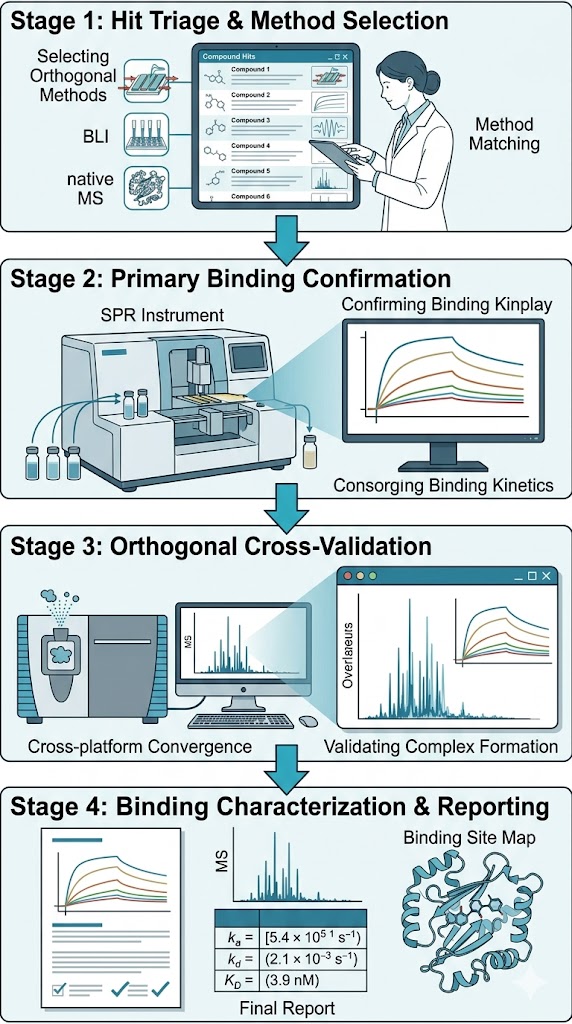
Our Workflow — From Hit List to Validated Binder

A structured process designed to deliver confirmed, characterized binding data for your hits.

1

Hit Triage and Method Matching

We review your hit list, target properties, and compound characteristics. Based on this assessment, we recommend the optimal primary and orthogonal validation methods. A soluble kinase with purified protein available routes to SPR with native ESI-MS as orthogonal confirmation. A membrane protein with limited material routes to equilibrium dialysis-MS or BLI.

2

Primary Binding Confirmation

Hits are tested using the primary method. For SPR and BLI: single-concentration screening, then multi-concentration kinetics for confirmed binders. For native ESI-MS: binding stoichiometry determination and affinity estimation by titration. For equilibrium dialysis: bound fraction measurement at fixed compound concentration.

3

Orthogonal Cross-Validation

Confirmed binders are retested using an orthogonal method based on a different physical principle. Concordance between SPR (refractive index) and native ESI-MS (direct mass measurement) provides high confidence that binding is genuine and not a method-specific artifact.

4

Binding Characterization and Reporting

For validated binders, we determine kinetic parameters (ka, kd, KD), binding stoichiometry, and binding site location where requested. The final report includes binding sensorgrams or mass spectra, kinetic fits, affinity values, and a confidence assessment for each validated pair.

Four-stage workflow for drug-target interaction validation: hit triage and method matching, primary binding confirmation, orthogonal cross-validation, and binding characterization and reporting.

Applications in Drug Discovery

Binding validation is applied across multiple stages of drug discovery, each requiring different throughput and information content.

Fragment Hit Validation

Fragment screening by NMR, AS-MS, or X-ray often produces weak binders (KD 100 microM to 1 mM) requiring orthogonal confirmation. Native ESI-MS and SPR both detect weak fragment binding, with native MS offering the widest affinity range.

Output: Confirmed fragment binders with KD estimates and binding stoichiometry.

HTS Hit Confirmation

Primary HTS hits must be confirmed orthogonally before committing resources. SPR or BLI kinetics provide both confirmation and preliminary SAR through rank-ordering confirmed hits by affinity.

Output: Rank-ordered hit list with KD values; kinetic classification (fast/slow off-rate).

Lead Optimization Binding Support

Medicinal chemists need rapid feedback on how structural modifications affect binding affinity and kinetics. SPR and BLI provide real-time kinetic data guiding SAR decisions more informatively than endpoint assays.

Output: Comparative kinetic data across compound series; on-rate/off-rate profiling.

Binding Site Confirmation

When a crystal structure or computational model predicts a specific binding mode, HDX-MS epitope mapping confirms the compound binds at the predicted site, providing critical validation for structure-based design.

Output: Peptide-level HDX protection map; binding interface residues identified.

Biologic Binding Assessment

For antibody and protein therapeutics, BLI and SPR provide comprehensive binding characterization including target affinity, epitope competition, and cross-reactivity profiling.

Output: Affinity determination; epitope binning; cross-reactivity panel data.

Target Ligandability Assessment

Before committing to a full screening campaign, ligandability mapping determines whether a target can bind small molecules. Multiple validation approaches applied in parallel assess whether the target has druggable pockets.

Output: Ligandability score; fragment hit rate by native MS; thermal shift response.

Representative Results

SPR sensorgram overlay showing concentration-dependent binding of a hit compound series to immobilized kinase domain, with kinetic fits and KD values annotated.

SPR kinetic analysis: hit series binding affinity and kinetics

Overlay of SPR sensorgrams for 18 hit compounds tested against an immobilized kinase domain. Each curve represents a different compound concentration series (twofold dilutions from 100 nM to 1.56 nM). Kinetic fits shown in black overlaid on raw data. KD values range from 2.1 nM to 1.8 microM. Association rates: 1.2 x 10^5 to 8.5 x 10^6 M-1s-1. Dissociation rates: 1.1 x 10^-4 to 5.2 x 10^-2 s-1. The KD rank order correlates well with cellular activity (R2 = 0.87).

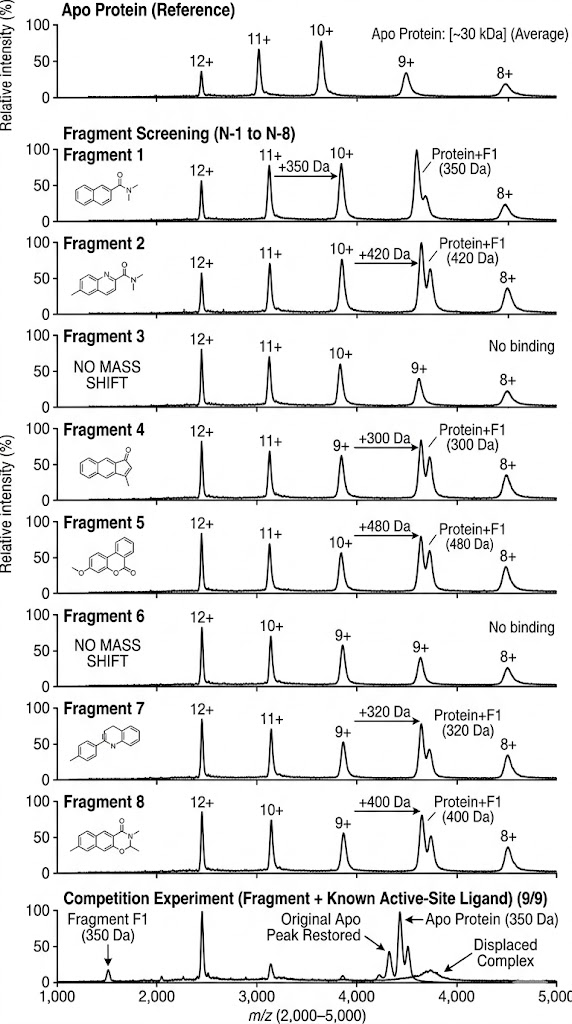
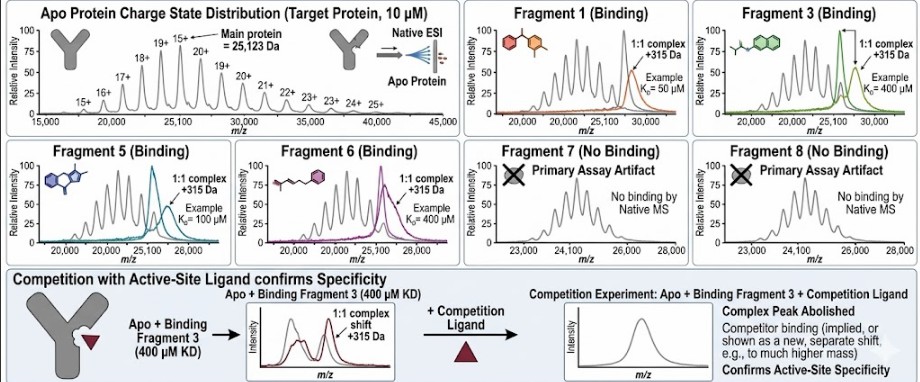
Native ESI-MS mass spectra showing protein peaks with and without compound binding, demonstrating direct detection of compound-target complex by mass shift.

Native ESI-MS: direct detection of compound-target complex

Native ESI-MS spectra of a target protein (10 microM) with 8 fragment compounds tested. Top panel: apo protein charge state distribution. Panels 2-9: protein with each fragment, showing mass shifts corresponding to 1:1 binding for 6 of 8 fragments. Bottom panel: competition experiment with active-site ligand confirms binding site specificity. Estimated KD values range from 50 to 800 microM. Two fragments show no binding by native MS, flagged as potential primary assay artifacts.

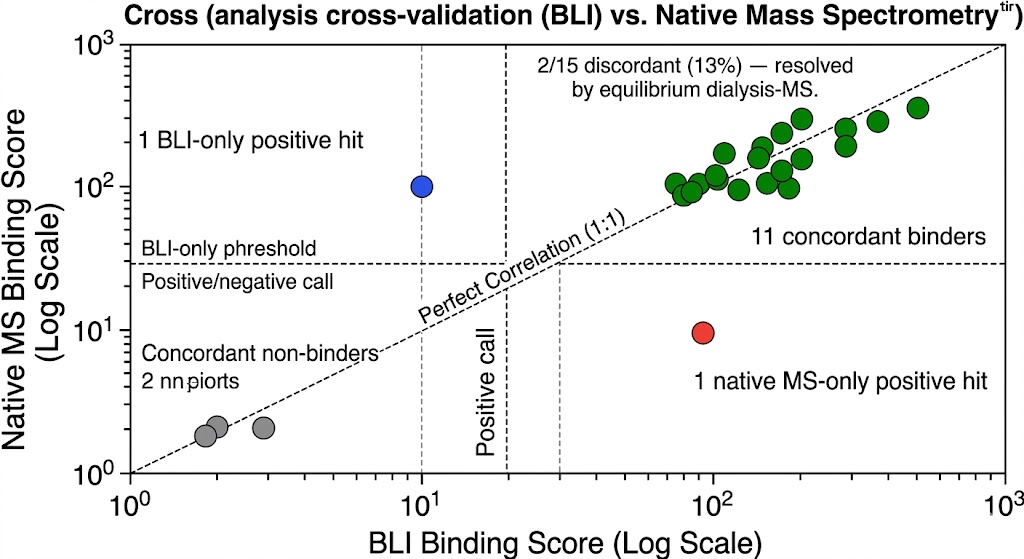
Orthogonal BLI and native ESI-MS cross-validation comparison plot showing concordant and discordant binding calls across 15 compounds, with equilibrium dialysis-MS tie-breaking for discordant results.

Orthogonal cross-validation: BLI vs native ESI-MS concordance

Cross-validation plot comparing BLI and native ESI-MS results for 15 compounds from a phenotypic screen. Upper right quadrant: 11 concordant binders (positive by both methods). Lower left: 2 concordant non-binders. Upper left: 1 BLI-only positive (later confirmed by equilibrium dialysis-MS as genuine). Lower right: 1 native MS-only positive (confirmed as genuine by equilibrium dialysis). Discordant rate: 2/15 (13%), highlighting the value of orthogonal cross-validation for maximizing confidence in hit selection.

Sample Requirements

Sample TypeMinimumRecommendedConcentrationBuffer
Purified protein (SPR/BLI)50 microg100-500 microg0.5-2 mg/mLPBS or compatible
Purified protein (native MS)10 microg50 microg5-20 microMVolatile (NH4OAc)
Purified protein (HDX-MS)50 microg200 microg5-20 microMPBS, no glycerol
Compound library0.1 mg per 10 cmpds0.5 mg per 10 cmpds10 mM in DMSO96-well plate
Antibody/biologic10 microg50 microg0.1-1 mg/mLPBS

Note: SPR and BLI require target immobilization or capture. For targets that cannot tolerate immobilization, equilibrium dialysis-MS or native ESI-MS are preferred alternatives. HDX-MS requires target stability in deuterated buffer for up to 4 hours.

Why Use Orthogonal Validation Approaches

CriterionSingle-Method ConfirmationCore FacilityOur Integrated Approach
Physical principles1 method1-2 methods3+ (optical + mass + thermal)
Target compatibilityImmobilization-dependentLimitedSoluble, membrane, insoluble
Affinity rangeMethod-dependentMethod-dependentnM to mM
Kinetic dataFrom SPR/BLI onlyFrom SPR/BLI onlyFrom SPR or BLI
Binding stoichiometryNot measuredNot measuredFrom native MS
Binding site infoNot includedNot includedFrom HDX-MS

What sets this approach apart: Multiple biophysical methods based on different physical principles — optical (SPR, BLI), mass-based (native ESI-MS, equilibrium dialysis-MS), and thermal (targeted thermal shift) — providing comprehensive cross-validation across a wide affinity range from a single platform.

Case Study: Chemical Proteomics Reveals the Target Landscape of 1,000 Kinase Inhibitors

Klaeger S, Reinecke M, Brear P, et al. "Chemical proteomics reveals the target landscape of 1,000 kinase inhibitors." Nature Chemical Biology, 2024, 20, 577-585. DOI: 10.1038/s41589-023-01459-3 (CC BY 4.0).

Background

Medicinal chemistry has produced thousands of potent kinase inhibitors, but the full target landscape — which kinases each inhibitor actually engages — remained incompletely characterized. The study aimed to systematically validate drug-target interactions across 1,183 kinase inhibitors against the human kinome using chemical proteomics and orthogonal binding validation.

Methods

Kinobeads-based chemical proteomics was used to affinity-purify endogenously expressed kinases from cell lysates. Each inhibitor's target engagement was assessed by competition with the immobilized beads — compounds binding a given kinase prevent its capture, and the reduction in pulldown signal is quantified by LC-MS/MS. Over 375,000 compound-kinase interaction data points were generated across multiple cell lines. Orthogonal SPR validation was performed for selected compound-kinase pairs.

  • Kinobeads affinity purification from K562, HEK293, and MV4-11 cell lysates.
  • Multiplexed LC-MS/MS quantification of kinase pulldown with and without competitor compound.
  • IC50 determination for confirmed drug-kinase interactions by dose-response competition.
  • Orthogonal SPR validation for 15 compound-kinase pairs to confirm chemical proteomics data.

Results

The study identified approximately 38,000 high-confidence drug-kinase interactions. Many clinically used kinase inhibitors were found to engage 10-30 kinases at clinically relevant concentrations, revealing substantially more promiscuity than previously appreciated. Orthogonal SPR measurements for selected pairs confirmed that the kinobeads competition data accurately reflect direct compound-kinase binding. The complete dataset was made publicly available as the Kinase Inhibitor Resource (KIR), enabling researchers worldwide to validate drug-kinase interactions for their compounds.

Conclusions

This study demonstrated that systematic chemical proteomic profiling, combined with orthogonal SPR validation, provides robust drug-target interaction data at the proteome scale. The integration of chemical proteomics with biophysical validation serves as a model for systematic drug-target interaction assessment in drug discovery programs.

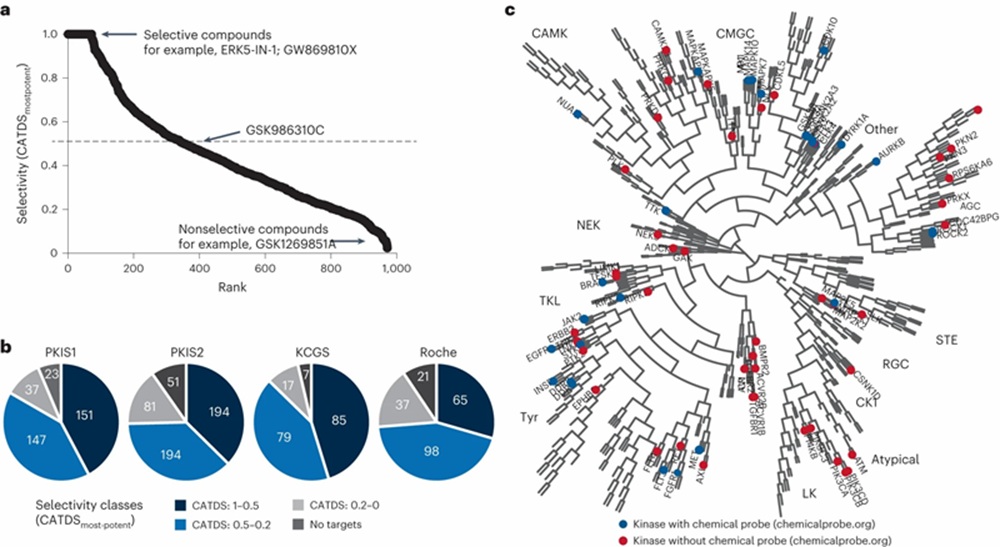
Fig. 2 from Klaeger et al. 2024 showing chemical proteomics profiling of kinase inhibitors with kinobeads competition and orthoganal SPR validation of drug-kinase interactions.

Fig. 2, 4 from Klaeger S, et al. 2024 (Nature Chemical Biology). Kinobeads-based drug-kinase interaction profiling with orthogonal SPR validation. CC BY 4.0.

FAQ

Frequently Asked Questions

Q: What is the difference between SPR and BLI?

Both measure real-time binding kinetics. SPR uses microfluidics and refractive index detection on a sensor chip. BLI uses dip-and-read biosensor tips with optical interference detection. BLI is more tolerant of crude samples and DMSO; SPR offers higher sensitivity for small-molecule binding.

Q: How much protein is needed for binding validation?

SPR and BLI typically require 50-500 microg purified protein. Native ESI-MS needs as little as 10-50 microg. Equilibrium dialysis-MS can work with lysate-level material, making it suitable for targets with limited purified protein.

Q: What affinity range can these methods detect?

Native ESI-MS detects binding from low nM to approximately 1 mM KD. SPR typically covers pM to low microM. BLI covers nM to low microM. Thermal shift assays detect binders up to approximately 100 microM. The wide combined range covers essentially all drug-relevant affinities.

Q: Can you validate binding for membrane protein targets?

Yes. Membrane proteins in detergent micelles or nanodiscs are compatible with SPR, BLI, and native ESI-MS. Equilibrium dialysis-MS is also compatible with membrane protein preparations, providing an alternative when surface immobilization is not feasible.

Q: How do you distinguish specific from nonspecific binding?

We use multiple strategies: competition with known active-site ligands, inactive enantiomer controls, compound titration to verify concentration dependence, and orthogonal cross-validation using methods based on different physical principles to rule out method-specific artifacts.

References

  1. Klaeger S, et al. "Chemical proteomics reveals the target landscape of 1,000 kinase inhibitors." Nature Chemical Biology, 2024, 20, 577-585. DOI: 10.1038/s41589-023-01459-3
  2. Gavriilidou AFM, et al. "High-throughput native mass spectrometry screening in drug discovery." Frontiers in Molecular Biosciences, 2022, 9, 837901. DOI: 10.3389/fmolb.2022.837901
  3. Jug A, et al. "Biolayer interferometry and its applications in drug discovery and development." Trends in Analytical Chemistry, 2024, 176, 117759. DOI: 10.1016/j.trac.2024.117759

Design your binding validation strategy with the MassTarget team

Tell us about your target, compound series, and project stage — our scientists will recommend the optimal validation approach and provide a detailed project proposal with timelines and pricing.

For Research Use Only (RUO). Not intended for diagnostic, therapeutic, or clinical decision-making purposes. Creative Proteomics services are designed to support preclinical research, drug discovery, and mechanism of action studies only.

Online Inquiry

Please submit a detailed description of your project. We will provide you with a customized project plan to meet your research requests. You can also send emails directly to for inquiries.

* Email
Phone
* Service & Products of Interest
Services Required and Project Description