Proteome Integral Solubility Alteration (PISA) Service

Accelerate your hit deconvolution and ligand discovery with our high-throughput, label-free Proteome Integral Solubility Alteration (PISA) service.

When you have multiple phenotypic hits or are working with incredibly scarce primary cell samples, traditional thermal profiling methods often hit a wall. Generating detailed thermal melt curves for every single compound requires massive amounts of biological material, lengthy mass spectrometry run times, and significant budgets. At Creative Proteomics, we help you overcome these early-stage discovery bottlenecks.

Our PISA service is specifically engineered to compress the thermal shift workflow. By leveraging intelligent sample pooling and high-resolution multiplexed mass spectrometry, we deliver up to a 10-fold increase in screening throughput. This allows you to rapidly evaluate compound-target interactions and conduct proteome-wide toxicity triaging without compromising the depth of your data or forcing you to use artificial chemical tags.

Key Benefits for Your Discovery Pipeline:

  • Massive Throughput Gains: By analyzing the pooled AUC, we can screen multiple compounds, concentrations, or physiological states in a fraction of the time required by conventional assays.
  • Unprecedented Sample Savings: Because we compress the analysis into pooled fractions, PISA requires significantly less starting material, making it ideal for precious patient biopsies or hard-to-culture primary cell lines.
  • True Native State Screening: Your compounds require absolutely no chemical modification, linkers, or immobilization. We test the drug exactly as it will enter the clinic, ensuring we capture true physiological binding affinities.
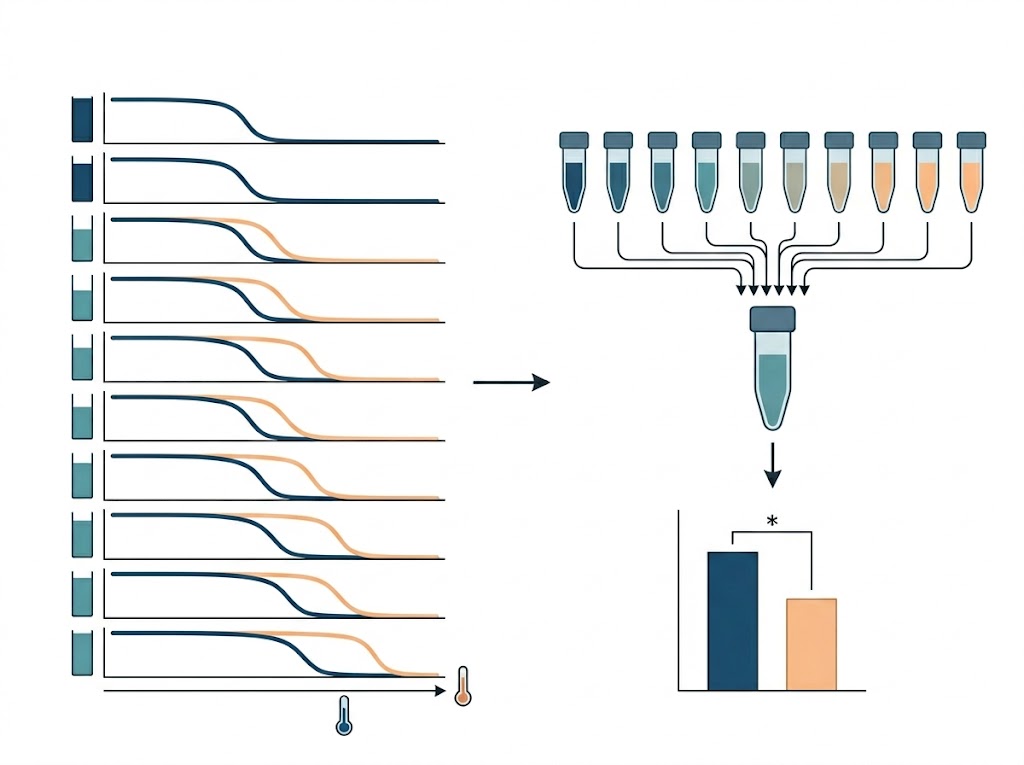
PISA Service hero diagram highlighting sample pooling, high-throughput MS, and integral solubility curves.
What Is PISA Service Overview The PISA Workflow Applications Platform Instrumentation Technology Comparison Sample Requirements Deliverables & Demo Case Study FAQ

What Is Proteome Integral Solubility Alteration (PISA)?

Proteome Integral Solubility Alteration (PISA) is a revolutionary, label-free screening technique that exponentially multiplies the analytical efficiency of standard Thermal Proteome Profiling (TPP) assays. By pooling temperature fractions, PISA enables researchers to monitor drug-protein interactions across the entire proteome in a near-native physiological environment without sacrificing data depth.

In a traditional thermal shift assay, evaluating a single drug's effect requires heating cell aliquots across ten or more different temperatures, followed by ten separate mass spectrometry measurements to build a melting curve. PISA dramatically simplifies this. Instead of analyzing each temperature fraction individually, we extract the soluble proteins from all the heated aliquots and pool them into a single analytical tube.

Think of it like taking a single, long-exposure photograph instead of ten separate snapshots. The resulting mass spectrometry signal represents the "Area Under the Curve" (AUC)—the integral solubility of the protein across the entire temperature range. If a drug binds and stabilizes a target, the total amount of soluble protein in that pooled sample shifts significantly compared to an untreated control.

Service Overview – Creative Proteomics PISA Capabilities

Our PISA platform integrates state-of-the-art liquid chromatography, high-resolution mass spectrometry, and advanced bioinformatics to support your scalable screening needs. We partner with biotech and pharmaceutical teams to deploy this technology across several critical discovery modes:

MODE 1

High-Throughput Library Screening

When your phenotypic screen yields dozens of active structural analogs, we use PISA to simultaneously map their direct binding targets across the proteome, helping you confidently select the best lead candidate for further development.

MODE 2

Scarce Sample Profiling

For translational research projects relying on primary cells, PBMCs, or ex vivo organ tissues where gathering enough material for standard 2D-TPP is functionally impossible, PISA provides the deep proteomic coverage you need with up to 90% less input material.

MODE 3

Broad-Spectrum Off-Target Triaging

Before investing heavily in detailed validation or animal models, we can run a rapid PISA screen to flag potential off-target toxicity networks, unwanted kinase binding, or indirect protein interactions.

MODE 4

Multi-Variable MoA Studies

We can efficiently compare how target engagement shifts across multiple time points, varying drug dosages, or different disease models in a single streamlined experiment, providing a dynamic view of your drug's mechanism of action.

The PISA Workflow

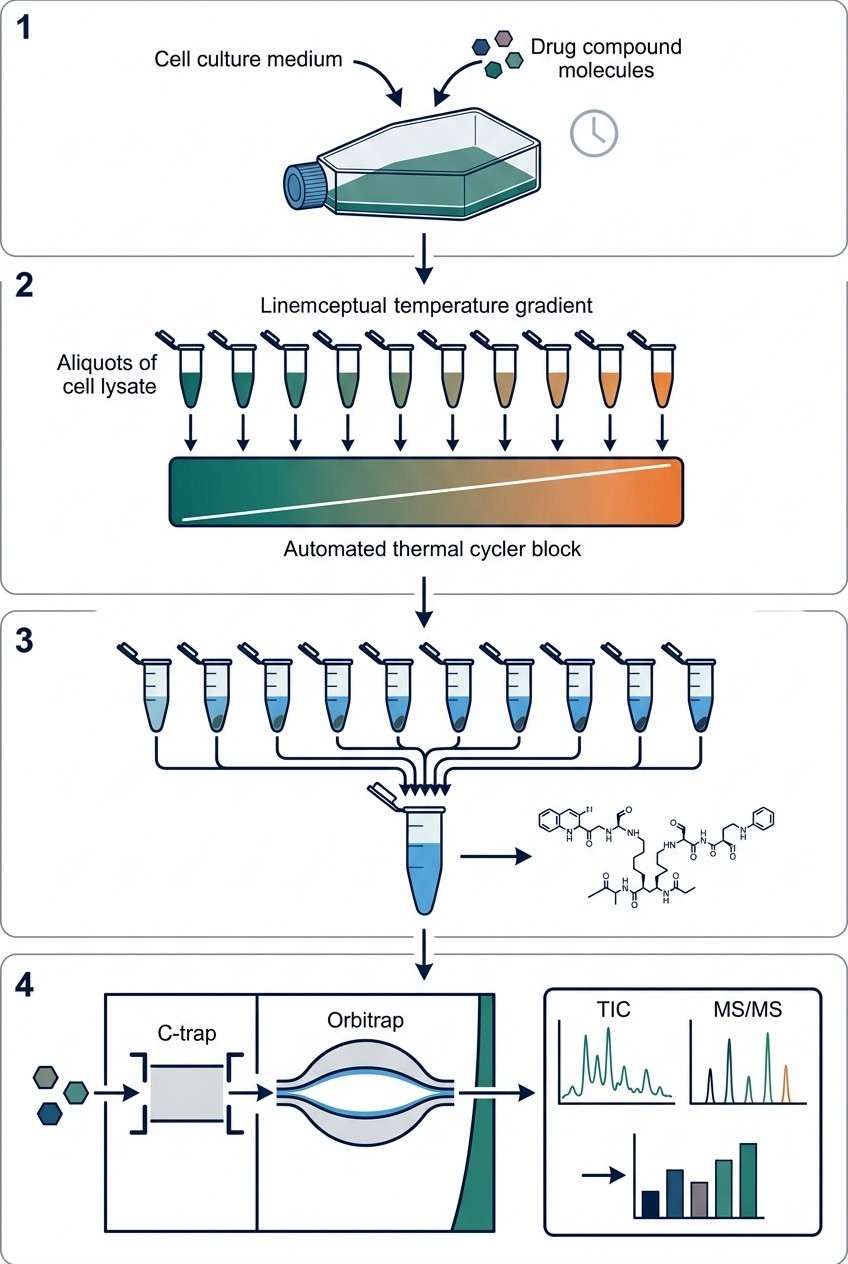
Our standardized, robust workflow ensures that sample pooling never compromises data integrity. We utilize advanced multiplexing and strict quality control checkpoints at every single stage of the process.

1

Target-Library Incubation

We incubate your unmodified compounds with living cells, tissue lysates, or ex vivo organ samples under carefully controlled, physiological conditions, allowing natural drug-target binding to occur in the presence of endogenous cellular competition.

2

Temperature Gradient Heating

The treated samples are distributed across a highly precise thermal gradient using our automated thermal cyclers. This induces heat-dependent protein unfolding and subsequent precipitation of denatured proteins.

3

Smart Pooling & TMT Labeling

The soluble, folded protein fractions from every temperature point are carefully extracted and physically pooled together. To allow us to compare multiple drugs or biological conditions simultaneously, we label these pooled samples using isobaric Tandem Mass Tags (TMT).

4

Deep MS Profiling & AUC Extraction

The multiplexed samples undergo extensive peptide fractionation before entering our advanced Thermal Shift Proteomics platforms. High-resolution mass spectrometers quantify the relative abundance of thousands of proteins, allowing our bioinformatics team to precisely calculate the integral solubility shifts (AUC) for definitive target identification.

PISA Workflow diagram: Pooling temperature fractions to increase multiplexing throughput.

PISA Workflow: Pooling temperature fractions to increase multiplexing throughput.

Applications

PISA is most impactful when you encounter throughput or sample volume limitations that conventional screening approaches simply cannot solve. We highly recommend deploying PISA in the following complex scenarios:

When Screening Analog Series in Medicinal Chemistry

If your medicinal chemistry team has synthesized 20 to 30 structural variations of a lead compound, standard profiling is too slow. PISA can rapidly profile the entire series in parallel to see which specific analog has the cleanest on-target profile with the fewest off-target liability risks, guiding your next round of synthesis.

When Working With Primary Human Tissues

Immortalized cell lines do not always accurately reflect true disease biology or patient-specific tumor microenvironments. When you must use limited patient-derived tissues, PISA's uniquely low sample requirement ensures you still get comprehensive, proteome-wide engagement data without running out of precious biopsy material.

When Conducting Organ-Specific Profiling

Drugs behave vastly differently depending on the tissue environment due to differing protein expression levels, metabolic enzymes, and local pH. PISA allows you to efficiently screen drug engagement across brain, liver, heart, and kidney tissues simultaneously, providing a holistic view of systemic drug distribution and organ-specific engagement.

Platform Instrumentation

To ensure that pooling complex biological samples does not result in the loss of low-abundance protein signals, we deploy only the most sensitive and advanced mass spectrometry instrumentation available in the industry.

High-Precision Thermal Cyclers

Guarantees absolute, sub-degree temperature accuracy across the entire heating matrix, ensuring highly reproducible unfolding behavior across all biological replicates.

Nano-UPLC Systems

Provides ultra-deep peptide separation prior to mass spectrometry, mitigating the extreme complexity of pooled protein mixtures and ensuring excellent chromatographic resolution.

Orbitrap & Q-TOF Mass Spectrometers

Delivers the extreme mass accuracy, speed, and dynamic range required to quantify TMT reporter ions without co-isolation interference, ensuring sensitive detection of subtle AUC shifts.

Automated Bioinformatics Pipelines

Proprietary, cloud-based processing that rapidly calculates integral solubility ratios and applies rigorous statistical models to ensure accurate false discovery rate (FDR) thresholds.

Technology Comparison: PISA vs. Alternative Techniques

Understanding which label-free mass spectrometry technique fits your current discovery phase is vital for optimizing your research budget. Here is how PISA compares to other established proteomics methodologies.

TechniqueCore PrincipleTypical ApplicationsKey StrengthsKey Limitations
PISAPool temperature fractions into one sample → extract AUC via MSHigh-throughput hit screening, primary cell profiling, organ-specific MoAUp to 10x throughput; extremely low sample consumption; highly scalable for large libraries.Does not provide a visual melting curve shape; relies on purely mathematical AUC outputs.
2D-TPPAnalyze every temperature and dose point individuallyDeep validation of a single lead compoundProvides beautifully detailed, concentration-dependent thermal stabilization curves.Requires massive amounts of biological sample and highly expensive, prolonged MS run times.
Activity-based protein profiling (ABPP-MS)Use reactive chemical probes to covalently tag specific binding pocketsCovalent inhibitor profiling, specific enzyme family screeningExtremely high sensitivity for specific reactive residues.Requires synthesizing complex chemical probes; modifying the drug may alter its natural activity.

Solution Selection Strategy:

  • Select PISA for screening large compound libraries, comparing multiple analogs simultaneously, or when using precious primary cells and ex vivo organs.
  • Choose 2D-TPP when you have already narrowed your search down to a single, high-priority lead compound and require detailed, concentration-dependent melting curves for definitive mechanistic proof.
  • Opt for ABPP-MS when you are validating specific reactive sites using well-established covalent chemical probes rather than reversible binders.

Sample Requirements

Because PISA expertly compresses the analysis, our sample requirements are drastically lower than those of traditional proteome-wide thermal shift assays.

Sample TypeRequired AmountConcentration / PurityBuffer ConditionsPISA Advantage Notes
Primary Cells / PBMCs2–5 × 10⁶ cells per conditionViable, intact cellsPhysiological media (e.g., RPMI/DMEM)Requires up to 90% less cellular input than traditional 2D-TPP methods.
Tissue Biopsies / Ex Vivo Organs10–30 mg (wet weight)Flash-frozen immediatelyAvoid repeat freeze-thaw cyclesIdeal for organ-specific engagement profiling directly from small animal models.
Cell Lines5–10 × 10⁶ cells per condition>90% viabilityWashed with cold PBSHighly scalable input for testing dozens of diverse compounds simultaneously.

Deliverables & Representative PISA Demo Data

We firmly reject the "black box" approach to proteomics bioinformatics. Our PISA service delivers highly transparent, statistically robust data packages that are immediately ready for your internal review, presentations, and grant applications.

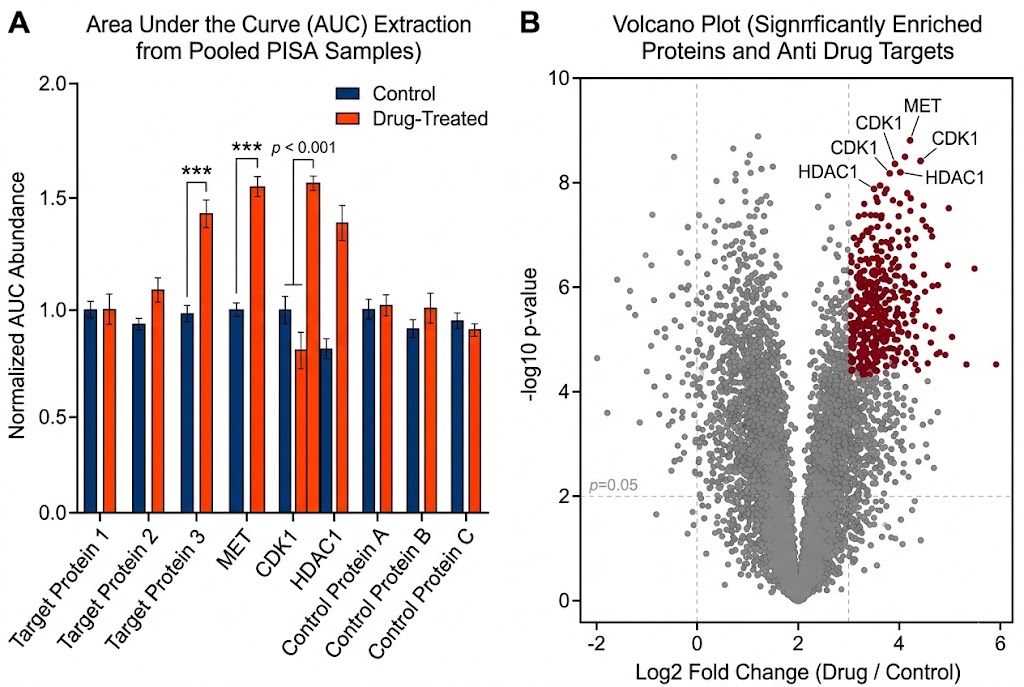
Demo Results: AUC extraction and target confidence scoring scatter plot.

Demo Results: AUC extraction and target confidence scoring

By comparing the integral solubility (AUC) of the drug-treated sample against a vehicle control, we can mathematically identify true binding events.

Standard Data Deliverables Include:

  • Ranked List of Hits: An actionable, highly structured spreadsheet of identified proteins, ranked by their relative AUC abundance ratios and binding confidence.
  • Target Confidence Volcano Plots: Comprehensive visual mapping of all proteome targets. We plot the AUC fold-change against statistical p-value significance, providing a clear visual representation of your drug's selectivity.
  • Integral Solubility Bar Plots: Clear visual representations of the integrated thermal stability shift between your compound and the control, replacing the need for full melting curves.
  • Statistical Scoring: Full transparency into our p-value and False Discovery Rate (FDR) calculations, ensuring you trust the data.
  • Raw MS Spectra: Complete raw mass spectrometry data files are securely provided for your internal bioinformaticians to archive or re-process.

We also offer powerful optional add-ons, including organ-specific target engagement profiling (to map how engagement shifts between tissues) and pathway enrichment mapping (to contextualize your off-target hits into functional biological networks).

Case Study: Identifying Organ-Specific Drug Targets via Streamlined PISA

Batth et al. "Streamlined analysis of drug targets by proteome integral solubility alteration indicates organ-specific engagement." Nature Communications (2024). https://doi.org/10.1038/s41467-024-53240-2

Background

Identifying potential drug targets and comprehensively mapping off-target toxicity in a living organism is crucial for successful drug design and repurposing. However, traditional thermal profiling methods lack the throughput and scalability required for testing multiple compounds across different physiological tissues simultaneously. Researchers aimed to deploy a streamlined PISA workflow capable of true proteome-wide screening of small organic molecules in a scalable, rapid, and label-free manner.

Methods

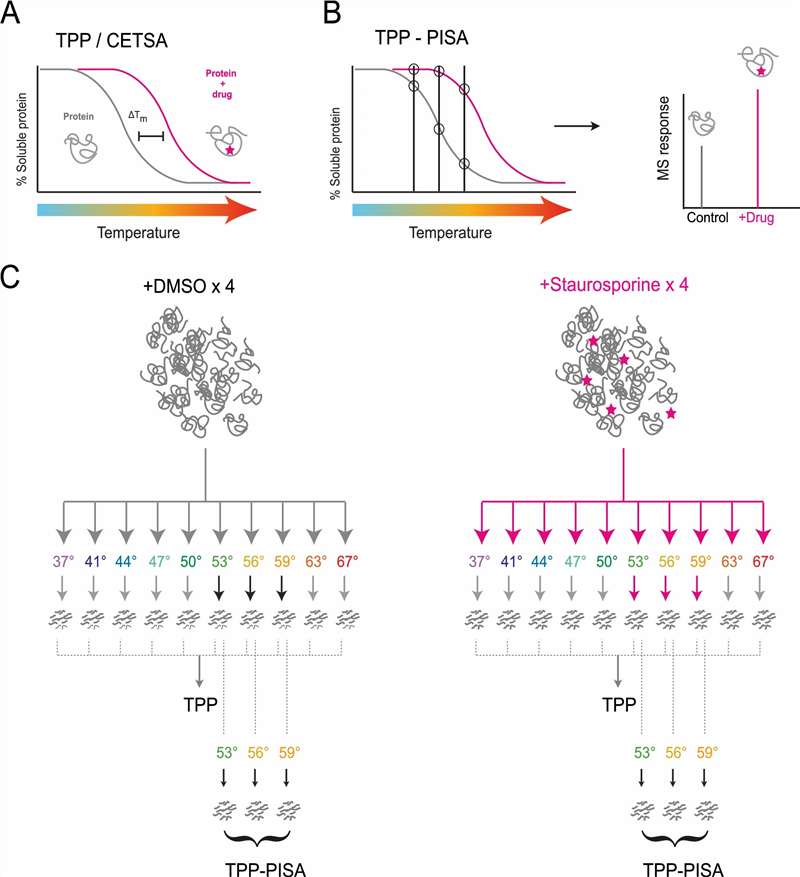
Moving beyond standard in vitro immortalized cell lines, the study utilized actual organ-level ex vivo samples—specifically rat brain, liver, kidney, and lung tissues. These highly complex tissue lysates were treated with a library of 23 different compounds, including widely used medical drugs like Ibuprofen. The samples were processed using a streamlined PISA workflow, carefully pooling the temperature fractions to enable high-throughput multiplexed mass spectrometry without overwhelming the instrument's dynamic range.

Results

The PISA data output enabled comprehensive, proteome-wide target engagement profiling across the entire compound library. This scalable screening successfully achieved known drug target confirmation (acting as a robust proof-of-concept) while simultaneously enabling the discovery of previously uncharacterized off-target interactions and indirect physiological effects. Crucially, the robust data analysis revealed distinct, organ-specific target engagement signatures for the tested compounds, highlighting that drugs interact differently depending on the specific organ microenvironment.

Conclusions

This approach definitively proves that PISA can handle incredibly complex, multi-compound library screening in true physiological organ models. By utilizing PISA, pharmaceutical discovery teams can gather robust, in vivo-relevant pharmacological insights that directly guide drug safety assessments, toxicity evaluation, and intelligent repurposing efforts with incredible efficiency.

PISA workflow applied to ex vivo rat organs, showcasing distinct target engagement signatures across brain, liver, kidney, and lung tissues.

Proteome-wide target engagement profiling across diverse rat organ tissues using the PISA workflow.

FAQ

Frequently Asked Questions

Q: What is Proteome Integral Solubility Alteration (PISA), and how does it differ from traditional TPP?

While traditional TPP analyzes 10 to 15 different temperature points individually to meticulously draw a melting curve, PISA physically pools all those temperature points into one single analytical sample before mass spectrometry analysis. This single pooled sample provides the mathematically integrated "Area Under the Curve" (AUC) of the protein's overall solubility, increasing throughput by up to 10-fold while heavily reducing precious sample requirements.

Q: Does pooling temperature samples in PISA dilute the signal of low-abundance targets?

No. We utilize advanced nanoscale liquid chromatography (Nano-UPLC) and the extreme resolution of Orbitrap or Q-TOF mass spectrometers. Combined with precise TMT multiplexing, our platform easily resolves high-complexity pooled samples, ensuring that subtle AUC shifts from even low-abundance proteins are accurately quantified and statistically evaluated.

Q: Which types of samples and targets are compatible with PISA services?

Because of its exceptionally low input requirement, PISA is uniquely suited for primary cells, PBMCs, patient biopsies, and ex vivo animal organs. Like all rigorous thermal shift assays, it works beautifully for soluble proteins, multiprotein complexes, and membrane proteins (when properly solubilized using compatible detergents).

Q: How do I prepare my compound library for PISA screening?

We recommend providing your small molecules, fragments, or structural analogs in highly pure DMSO stocks. During your initial project consultation, our scientific team will help you determine the optimal pooling strategies, incubation times, and concentration gradients to maximize hit detection for your specific library size.

Q: Can I transition from PISA screening directly to standard TPP validation?

Absolutely. PISA is the perfect "first pass" screening tool to quickly narrow down a large list of compounds or identify broad organ-specific targets. Once you have confidently identified your top lead candidates, our team can seamlessly transition those specific compounds into a detailed 2D-TPP assay to generate precise, concentration-dependent thermal melting curves.

Disclaimer: All services and products offered by Creative Proteomics are for Research Use Only (RUO). They are not intended for use in diagnostic procedures, clinical decision-making, or any therapeutic applications. We do not provide medical advice or clinical diagnostic conclusions.

Ready to accelerate your hit identification pipeline?

Request a Project Consultation today to discuss your compound library and target goals with our proteomics experts to maximize your sample utility.

Online Inquiry

Please submit a detailed description of your project. We will provide you with a customized project plan to meet your research requests. You can also send emails directly to for inquiries.

* Email
Phone
* Service & Products of Interest
Services Required and Project Description