Microfluidics & Emerging MS Platforms

Eight integrated microfluidic-mass spectrometry technologies for label-free, miniaturized drug discovery — accessible through a single service engagement.

The convergence of microfluidics with mass spectrometry is reshaping drug discovery workflows. Droplet compartmentalization, digital sample preparation, ambient ionization, and electrochemical reaction monitoring now enable analysis at sub-microliter scale with throughput that challenges conventional plate-based screening — all without fluorescent labels or engineered reporter systems.

Our Microfluidics & Emerging MS Platforms service provides unified access to eight distinct technologies under one engagement, eliminating the capital investment and specialized training typically required to evaluate and deploy emerging MS instrumentation.
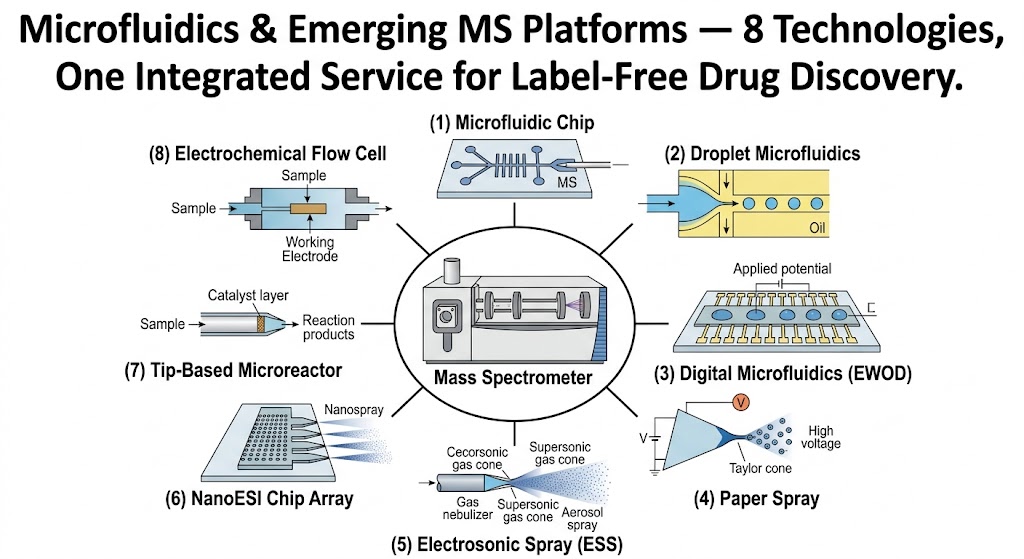
Microfluidics & Emerging MS Platforms integrated technology overview
What Is Microfluidics-MS Platform Suite Technology Comparison Workflow Sample Demo FAQ

What Is Microfluidics–Mass Spectrometry Integration?

Microfluidics–mass spectrometry integration refers to the direct coupling of miniaturized fluid-handling devices — chips, droplet generators, digital electrode arrays, or paper substrates — with mass spectrometric detection. Unlike conventional LC-MS workflows that require microliter-to-milliliter sample volumes and minutes of chromatographic separation, microfluidic-MS platforms manipulate picoliter-to-nanoliter volumes with millisecond-to-second ion generation times, delivering label-free molecular weight information directly from the sample matrix.

This convergence addresses persistent bottlenecks in drug discovery: compound library consumption, fluorescent interference in optical assays, sample preparation labor, and the capital cost of maintaining multiple dedicated MS platforms. By miniaturizing and integrating sample handling with ionization, microfluidic-MS platforms reduce each of these constraints by orders of magnitude while preserving — and in many cases improving — the sensitivity and structural information content that make mass spectrometry indispensable for pharmaceutical research.

Key Benefits of Microfluidics-MS Platforms

Label-Free, Information-Rich Detection

Every analyte carries its own intrinsic mass-to-charge signature — no fluorescent tags, no engineered reporters, no aggregation-based false positives. Tandem MS provides simultaneous activity confirmation and structural identity in a single analytical step.

100- to 1,000-Fold Reduction in Sample Consumption

Picoliter-to-nanoliter reaction volumes make screens feasible for synthetically demanding or scarce compound libraries. Single-cell and low-input proteomics workflows that are impossible with plate-based formats become routine.

Multi-Platform Access Without Capital Investment

Rather than committing to a single instrument vendor, you gain access to eight complementary technologies through one service contract — with our scientific team guiding platform selection based on your specific molecular question.

Broad Target and Matrix Compatibility

From membrane proteins analyzed under native conditions via gentle ESSI ionization to drugs quantified directly from whole blood by paper spray — each platform addresses a distinct analytical challenge within a unified project workflow.

Platform Suite

PLATFORM 1

Microfluidic Chip–MS

Direct coupling of microfluidic chip-based sample handling with MS detection. On-chip SPE, single-cell drug uptake by ICP-MS (>500 cells/min), and integrated sample cleanup for TDM from complex matrices. Sample consumption in the nanoliter-to-microliter range.

Explore Microfluidic Chip–MS »

PLATFORM 2

Droplet Microfluidics MS

Massively parallel, label-free screening in picoliter-to-nanoliter aqueous droplets. Mass-activated droplet sorting (MADS) achieves 0.7 samples/s with >98% accuracy. Applied to mAb titer/glycan profiling and 15,000+ enzyme variant screens.

Explore Droplet Microfluidics MS »

PLATFORM 3

Digital Microfluidics MS

EWOD-based programmable droplet manipulation automates reduction, alkylation, digestion, isobaric labeling, and direct HPLC-MS/MS on a single chip. Processes 25–75 cells for quantitative proteomics (>2,200 protein groups per HeLa cell).

Explore Digital Microfluidics MS »

PLATFORM 4

Paper Spray MS

Ambient ionization directly from a paper substrate — zero chromatography, results in seconds. LODs of 80–400 pg for xenobiotics from dried matrix spots, microliter biofluid volumes, and portable MS compatibility for on-site deployment.

Explore Paper Spray MS »

PLATFORM 5

Electrosonic Spray MS

Supersonic nebulizing gas combined with micro-ESI delivers exceptionally gentle ionization preserving native protein conformations. Solution-correlated KD determination for protein–ligand complexes with superior buffer tolerance vs. conventional ESI/nanoESI.

Explore Electrosonic Spray MS »

PLATFORM 6

NanoESI HT-MS

Chip-based nanoESI arrays and perfusion nano-ESI devices for high-throughput operation at nL/min flow rates. Sub-pg/mL LODs, automated ligand screening, single-cell metabolomics with electrical lysis, and cycle times under 10 seconds.

Explore NanoESI HT-MS »

PLATFORM 7

Microreactor MS Screening

Tip-based nanozyme microreactors, TiO2 photocatalytic microchips, and IMERs coupled directly to MS for real-time intermediate capture. Enzyme inhibitor Ki determination and catalyst profiling at sub-nmol substrate consumption.

Explore Microreactor MS Screening »

PLATFORM 8

Electrochemical-MS Reaction Profiling

Online EC-LC-MS simulates oxidative and conjugative metabolism without biological matrices. N-dealkylation, hydroxylation, S-oxidation, and GSH adduct trapping for reactive metabolite detection and metabolic soft-spot mapping.

Explore Electrochemical-MS Reaction Profiling »

Workflow

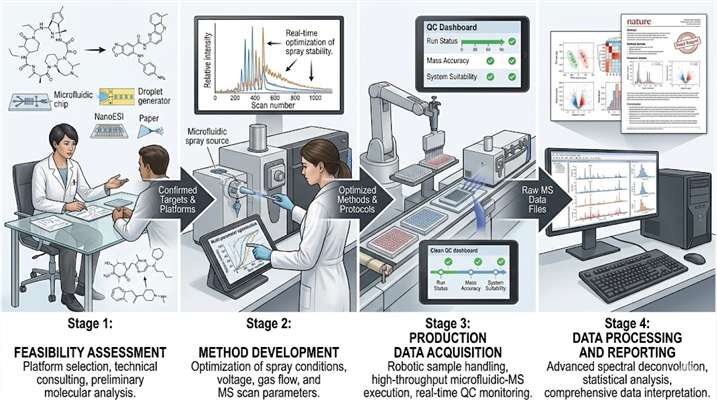
1

Feasibility Assessment & Platform Selection

Structured consultation covering analyte class, matrix, throughput needs, and sensitivity requirements. Pilot experiments conducted where technical feasibility is uncertain.

2

Method Development & Optimization

Spray conditions, ionization polarity, MS acquisition parameters (full scan/MRM/DDA/DIA), and sample preparation protocols optimized for your specific analytes.

3

Production Data Acquisition

Samples processed on selected platform(s) with embedded QC standards, blank injections, and replicate measurements monitoring system stability throughout.

4

Data Processing & Reporting

Platform-appropriate software for peak integration, spectral deconvolution, or database searching. Comprehensive report: data tables, annotated spectra, QC metrics, statistical analysis, and written interpretation.

Microfluidics-MS project workflow diagram

Platform Instrumentation

Module CategoryInstrument / SystemCore Capability
Microfluidic InterfacesChip-based (glass/PDMS), droplet generators (flow-focusing/T-junction), EWOD digital arrays, paper spray substrates, nanoESI chip arrays, tip-based microreactors, electrochemical flow cellsMulti-platform sample introduction and manipulation at pL–μL scale
Ionization SourcesESI, nanoESI, ESSI, paper spray, DESIAmbient to low-flow ionization covering native to denaturing conditions
Mass SpectrometryOrbitrap ID-X Tribrid HRMS, Q Exactive HF, Sciex QTRAP 6500+, TSQ Altis triple quadrupoleHigh-resolution accurate mass, MRM quantitation, tandem MS for structural elucidation
ChromatographyACQUITY UPLC I-Class (HILIC + RP), nanoLC systemsOptional pre-MS separation for isomer resolution and complex mixture analysis

Technology Comparison

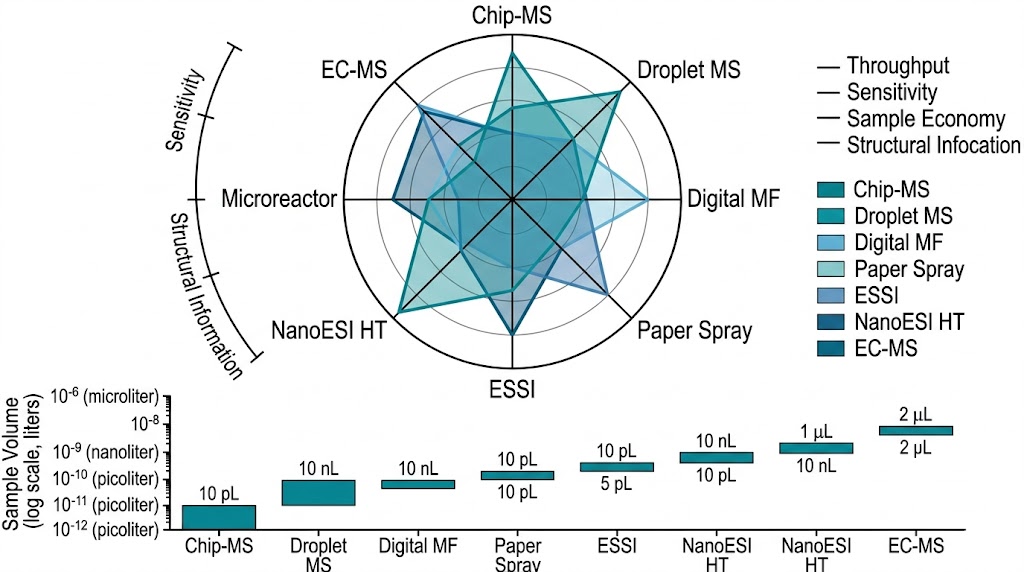
PlatformThroughputSample VolumeKey Strength
Microfluidic Chip–MSUp to 500 cells/minnL–μLOn-chip sample preparation + direct MS
Droplet Microfluidics MS0.3–0.7 samples/spL–nLLabel-free compartmentalized screening
Digital Microfluidics MS8–16 samples parallel60 nL–μLEnd-to-end automated proteomics prep
Paper Spray MS<1 min/sample0.5–5 μLZero chromatography, direct analysis
Electrosonic Spray MS~30 s/sampleμM concentrationNative protein–ligand KD fidelity
NanoESI HT-MS<10 s/sample0.5–3 μLUltra-trace sensitivity (sub-pg/mL)
Microreactor MS ScreeningContinuous flowsub-nmol substrateReal-time intermediate capture
Electrochemical-MS ProfilingOnline EC-LC-MSnmol per runReactive metabolite detection without biology

Sample Requirements

Platform CategoryTypical Sample AmountCompatible Matrices
Microfluidic Chip–MS1–10 μL or ~103–106 cellsCell suspensions, plasma, tissue homogenates
Droplet Microfluidics MSpL–nL per droplet; total compound may be<1 μgAqueous reaction mixtures, enzyme preparations
Digital Microfluidics MS25–1,000 cells or 1–100 ng proteinCell lysates, tissue biopsies
Paper Spray / ESSI / NanoESI HT-MS0.5–5 μL biofluid or 1–10 μM protein solutionWhole blood, plasma, urine, protein in MS-compatible buffer
Microreactor / Electrochemical-MSLow nmol compound per metabolic runDMSO or acetonitrile stocks; aqueous buffer for enzyme assays

Deliverables

  • Processed data tables in industry-standard formats (mzML, CSV, Excel)
  • Annotated MS and tandem MS spectra for key findings
  • QC metrics report (system suitability, carryover, replicate CV%)
  • Statistical analysis with platform-appropriate significance testing
  • Written interpretation of results with project-specific conclusions
  • Raw instrument files available upon request for independent reprocessing

Representative Demo Data

Microfluidics-MS platform capability comparison radar chart and sample volume comparison
FAQ

Frequently Asked Questions

Q: How do I determine which platform fits my project?

During project initiation, our scientific team conducts a structured consultation covering your analyte class, sample matrix, throughput needs, sensitivity requirements, and desired information depth. We match these parameters against each platform's capabilities. When the optimal choice is unclear, we run a brief comparative pilot experiment to guide the final decision.

Q: Can I combine multiple platforms in one project?

Yes. Many discovery programs benefit from a multi-platform strategy — for example, droplet microfluidics MS for initial hit screening, nanoESI HT-MS for dose–response confirmation, and electrochemical-MS profiling for early metabolic stability assessment. Our integrated project management coordinates sample routing across platforms within a single engagement.

Q: What throughput can I realistically expect?

Throughput is platform-dependent: droplet microfluidics MS achieves 0.3–0.7 samples per second; nanoESI HT-MS processes one sample every 5–10 seconds; digital microfluidics proteomics handles 8–16 samples in parallel over 4–6 hours. We provide realistic throughput estimates during feasibility assessment based on your specific assay parameters.

Q: How do you ensure data quality for emerging platforms?

Each platform operates under documented SOPs with system suitability criteria, QC sample monitoring, carryover assessment, and defined replicate minimums. For quantitative work, calibration curves with internal standard normalization run alongside study samples. QC metrics are reported with your data.

Q: Can proprietary compound structures be handled confidentially?

All projects operate under a confidentiality agreement executed before sample transfer. Our data management infrastructure segregates client data, with access restricted to the assigned project team. Compound structures, screening results, and all derived data remain your exclusive intellectual property.

Q: Do these platforms replace conventional LC-MS?

Our microfluidic-MS platforms complement rather than replace conventional LC-MS. They excel at speed, miniaturization, and label-free detection for early discovery screening. For applications requiring chromatographic resolution of structural isomers or comprehensive metabolome coverage, we recommend our established high-throughput MS screening and enzyme activity and reaction mechanism analysis services.

Advancing Drug Discovery Through Miniaturized MS Innovation

Droplet compartmentalization, digital sample preparation, ambient ionization, and electrochemical metabolism mimicry are converging toward an integrated discovery paradigm — accessible to your programs today through a single service engagement. Contact our scientific team to discuss your specific application and platform requirements.

Online Inquiry

Please submit a detailed description of your project. We will provide you with a customized project plan to meet your research requests. You can also send emails directly to for inquiries.

* Email
Phone
* Service & Products of Interest
Services Required and Project Description