Metabolic Stability (Microsomes/S9/Hepatocytes) Assay Service

Reliable in vitro metabolic stability data to guide compound selection and preclinical development.

Metabolic stability assays measure how quickly a drug candidate is metabolized by liver enzymes—a critical parameter influencing half-life, bioavailability, and dosing frequency. At MassTarget, we provide a comprehensive platform covering liver microsomes, S9 fractions, and hepatocytes across human and preclinical species, using LC-MS/MS, HRMS, and RapidFire MS detection with rigorous ICH M10-ready QC.

Three test systems, one integrated platform:

  • Multi-species coverage: human, rat, mouse, dog, monkey
  • Three complementary systems: microsomes, S9, hepatocytes
  • Full LC-MS/MS method development with ICH M10 framework
  • Seamless expansion to MetID, soft-spot analysis, and PK bioanalysis
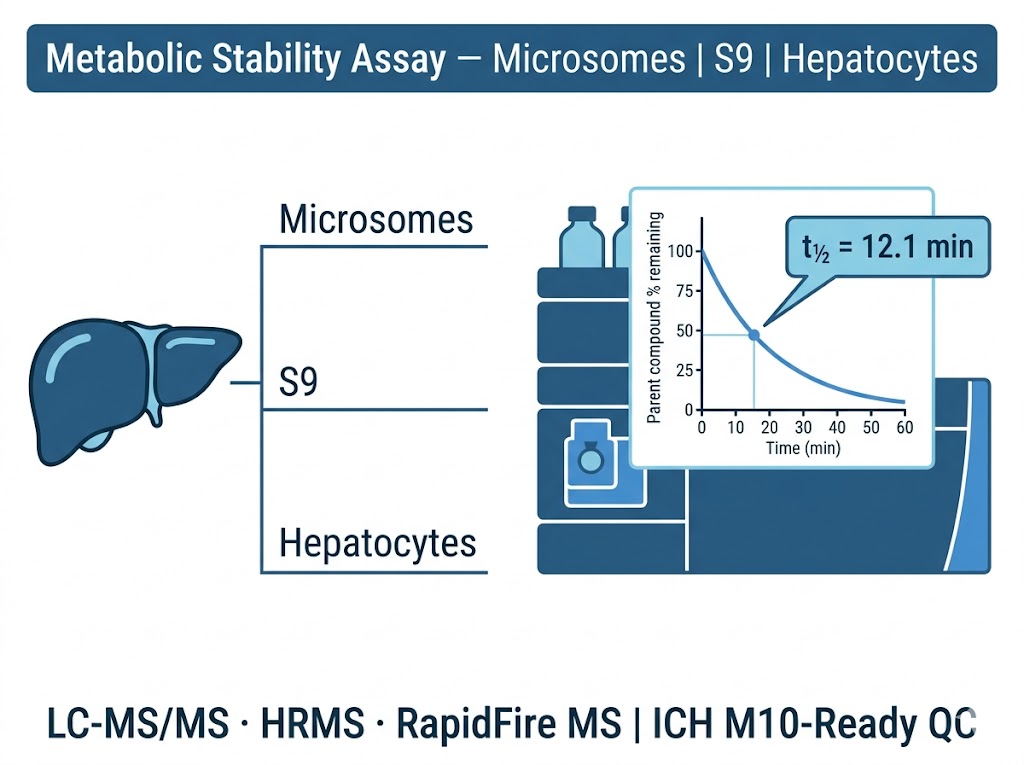
Metabolic stability assay workflow with LC-MS/MS analysis and liver microsome illustration
Overview Why MS-Centric Test Systems Workflow Comparison Sample Demo Case Study FAQ

What Is Metabolic Stability and Why Does It Matter in Drug Discovery?

Metabolic stability refers to the susceptibility of a drug candidate to enzymatic biotransformation, primarily in the liver. Compounds that are rapidly metabolized may require higher or more frequent dosing to maintain therapeutic concentrations, while those that are excessively stable may accumulate and cause toxicity. Measuring metabolic stability early in the discovery pipeline allows medicinal chemists and DMPK scientists to identify liabilities, optimize lead structures, and select the most promising candidates for progression to in vivo pharmacokinetic studies.

The standard approach involves incubating the test compound with liver-derived metabolic systems (microsomes, S9, or hepatocytes) in the presence of NADPH and other cofactors, then quantifying the parent compound remaining at multiple time points using mass spectrometry. The resulting depletion curve yields two key parameters: in vitro half-life (t½) and intrinsic clearance (CLint), which can be scaled to predict in vivo hepatic clearance.

Our MassTarget platform integrates this entire workflow under one roof—from assay design and LC-MS/MS method development through data analysis and regulatory-ready documentation—eliminating the handoff gaps that often occur when metabolic stability is outsourced to fragmented service providers.

As part of our comprehensive ADME / DMPK / PK-PD Research Platforms, this metabolic stability service connects seamlessly to downstream metabolite identification and PK bioanalysis workflows.

Why an MS-Centric Approach Delivers Better Metabolic Stability Data

The quality of metabolic stability data depends critically on the analytical method used to quantify the parent compound. Many CROs rely on generic LC-MS/MS methods that may lack the sensitivity or selectivity needed for challenging compounds. Our MS-centric approach addresses this at every level.

Method Development Excellence

Each compound receives a dedicated LC-MS/MS method development cycle. We optimize ionization parameters, MRM transitions, chromatographic separation, and internal standard selection to achieve the lowest possible limit of quantitation (LLOQ), typically in the sub-ng/mL range for triple quadrupole instruments. This sensitivity ensures that even at late time points with extensive metabolism, the parent compound remains quantifiable, producing reliable depletion curves.

Multi-Platform Flexibility

Not all compounds or screening stages require the same analytical depth. We offer three MS platforms matched to different throughput and information needs:

  • LC-MS/MS (Triple Quadrupole) — The gold standard for routine quantitation. High sensitivity, excellent selectivity via MRM, and established regulatory acceptance.
  • HRMS (Orbitrap / Q-TOF) — Full-scan acquisition enables simultaneous quantitation and metabolite detection, useful when metabolic stability data is paired with preliminary MetID.
  • RapidFire MS — Ultra-high throughput (10–15 seconds per sample) for early-stage screening of large compound libraries, with sensitivity comparable to conventional LC-MS/MS.

Reproducibility and QC

Every assay batch includes system suitability standards, QC samples at multiple concentration levels, and blank matrix controls. Acceptance criteria follow ICH M10 bioanalytical method validation guidelines, even at the discovery stage, so that data generated here can support regulatory submissions without reanalysis.

Seamless Downstream Integration

Metabolic stability data generated on our platform can be directly expanded into Metabolite Identification (MetID) and Metabolic Soft-Spot Analysis without redeveloping methods or requalifying instruments, saving time and ensuring data consistency across studies.

Test Systems: Microsomes, S9 Fractions, and Hepatocytes

Choosing the right test system is critical for generating meaningful metabolic stability data. Each system captures a different level of metabolic complexity, and the optimal choice depends on the compound class, the metabolic pathways involved, and the stage of the drug discovery program.

1

Liver Microsomes

Liver microsomes are subcellular fractions enriched in cytochrome P450 (CYP) and flavin-containing monooxygenase (FMO) enzymes, the primary drivers of phase I oxidative metabolism. They are the most widely used system for early-stage metabolic stability screening due to their ease of preparation, long storage stability, and high enzyme activity per milligram of protein.

Best for: Initial compound rank-ordering, CYP-mediated metabolism assessment, high-throughput screening, and species comparison studies.

Limitations: Do not contain cytosolic enzymes (e.g., sulfotransferases, glutathione S-transferases) or phase II conjugating enzymes (UGTs), unless supplemented with UDPGA.

2

S9 Fractions

S9 fractions contain both microsomal and cytosolic enzymes, providing a more complete metabolic picture than microsomes alone. They include phase I enzymes (CYPs, FMOs) and certain phase II enzymes (sulfotransferases, glutathione S-transferases), making them suitable for compounds that may undergo non-CYP-mediated metabolism.

Best for: Mid-stage screening where broader enzyme coverage is needed, compounds with suspected cytosolic metabolism, and bridging studies between microsomal and hepatocyte data.

Limitations: Lower enzyme activity per milligram than microsomes; still lack the full complement of phase II enzymes present in hepatocytes.

3

Hepatocytes (Cryopreserved)

Cryopreserved hepatocytes represent the most physiologically relevant in vitro system for metabolic stability assessment. They contain the full repertoire of phase I and phase II drug-metabolizing enzymes, intact cellular architecture, and active transport processes, providing the closest approximation to in vivo hepatic metabolism.

Best for: Late-stage lead optimization, compounds with complex metabolic profiles, regulatory submission support, and when accurate in vivo clearance prediction is critical.

Limitations: Higher cost per incubation, shorter usable window after thawing, and greater inter-donor variability compared to microsomes.

4

Species Coverage

We offer all three test systems across human and the most commonly used preclinical species—rat, mouse, dog, and monkey—enabling direct cross-species comparison of metabolic stability profiles. This multi-species dataset is essential for selecting the most appropriate animal model for toxicology and pharmacokinetic studies.

Our Workflow

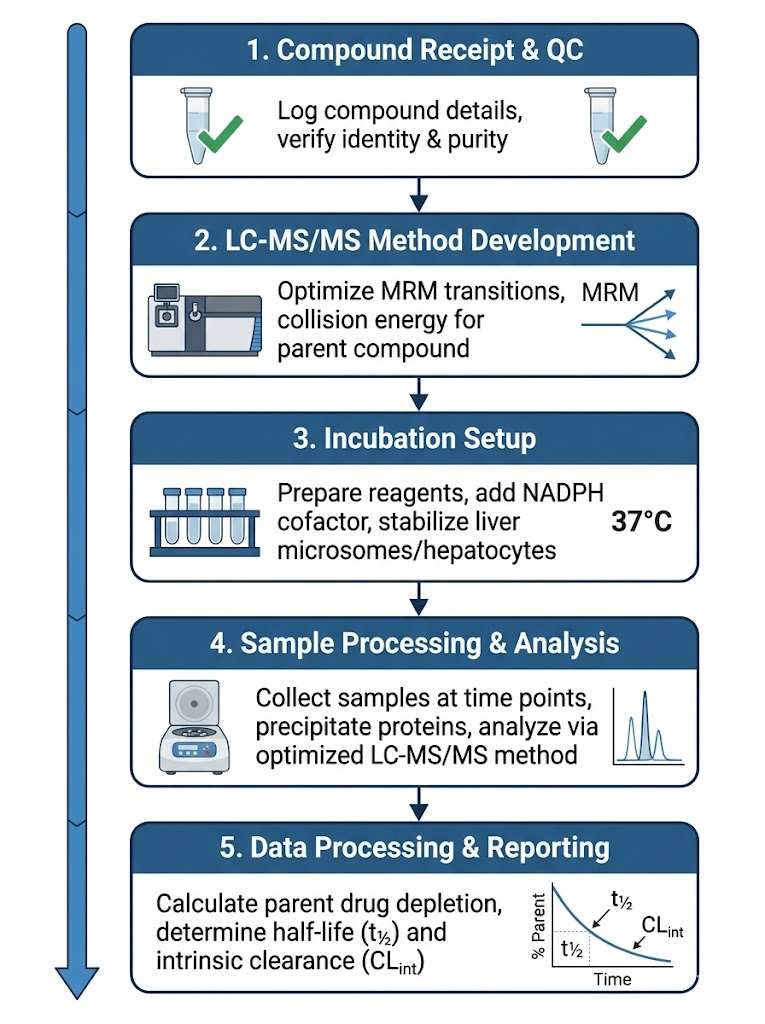
From sample receipt to data delivery, our metabolic stability workflow is designed for efficiency, reproducibility, and regulatory readiness.

1

Compound Receipt and QC

Upon sample submission, we verify compound identity, purity, and solubility. Stock solutions are prepared in appropriate solvents (DMSO, acetonitrile, or buffer) and stored under controlled conditions.

2

LC-MS/MS Method Development

Each compound receives a dedicated method: optimization of ionization parameters, MRM transition selection, chromatographic conditions, and internal standard matching. LLOQ is established to ensure quantitation across the full incubation time course.

3

Incubation Setup

Test compound is incubated with the selected metabolic system (microsomes, S9, or hepatocytes) at 37°C in the presence of NADPH and appropriate cofactors. Time points typically include 0, 5, 15, 30, 45, and 60 minutes, with additional points for slowly metabolized compounds.

4

Sample Processing and Analysis

At each time point, aliquots are quenched with cold acetonitrile containing internal standard, centrifuged, and the supernatant analyzed by LC-MS/MS. Each time point is analyzed in duplicate or triplicate with appropriate QC samples.

5

Data Processing and Reporting

Parent compound depletion data are fitted to a first-order exponential decay model. In vitro t½ and CLint are calculated, and scaled CLhep (hepatic clearance) is estimated using the well-stirred or parallel-tube model.

Metabolic stability assay workflow from sample receipt to data reporting

Technology Comparison: Which MS Platform Fits Your Metabolic Stability Needs?

DimensionLC-MS/MS (Triple Quad)HRMS (Orbitrap / Q-TOF)RapidFire MSTraditional Biochemical Assays
ThroughputHigh (2–5 min/sample)Moderate (10–20 min/sample)Very high (10–15 sec/sample)High (plate-based)
SensitivityExcellent (sub-ng/mL LLOQ)Good (ng/mL range)GoodVariable
SelectivityHigh (MRM mode)Very high (full MS + MS/MS)High (MRM mode)Low–moderate
Metabolite CoverageTargeted onlyComprehensiveTargeted onlyN/A
Data DepthQuantitativeQuantitative + structuralQuantitative (fast)Single readout
Best ForRoutine quantitationMetID, soft-spot analysisHigh-throughput screeningLabel-dependent assays

Which platform should you choose? For most metabolic stability projects, LC-MS/MS (QQQ) provides the optimal balance of sensitivity, selectivity, and throughput. If you need simultaneous metabolite identification, HRMS is the better choice. For large library screening (>100 compounds), RapidFire MS offers substantial time savings without sacrificing data quality. Our LC-MS/MS Bioanalysis platform provides the quantitative backbone for these studies.

Sample Requirements

Proper sample preparation ensures reliable metabolic stability data. Please review the following guidelines before submitting your compound.

Assay TypeSample RequiredQuantity / VolumeTest SystemKey Parameters Reported
Microsomal StabilityCompound (powder or DMSO stock)1–10 μM final; 50–100 μL per time pointLiver microsomes (human + preclinical species)t½, CLint, scaled CLhep, % remaining
S9 StabilityCompound (powder or DMSO stock)1–10 μM final; 50–100 μL per time pointS9 fractions (human + preclinical species)t½, CLint, scaled CLhep, % remaining
Hepatocyte StabilityCompound (powder or DMSO stock)1–10 μM final; 50–100 μL per time pointCryopreserved hepatocytes (human + preclinical species)t½, CLint, scaled CLhep, % remaining, metabolite profile

If your compound is poorly soluble, highly protein-bound, or requires special handling (e.g., light-sensitive, volatile), please note this during consultation so that appropriate assay modifications can be implemented.

Deliverables

Each metabolic stability project delivers a comprehensive data package designed for direct use in compound progression decisions and regulatory documentation:

  • Method Development Report — LC-MS/MS method parameters, LLOQ, linearity, and system suitability data
  • Raw Data Tables — Peak area ratios, % remaining at each time point, replicate data
  • Depletion Curves — Semi-log plots of % remaining versus time for each test system and species
  • Calculated Parameters — In vitro t½, CLint (μL/min/mg or μL/min/106 cells), scaled CLhep (mL/min/kg)
  • QC Documentation — System suitability results, QC sample accuracy and precision, batch acceptance summary
  • Species Comparison Summary — Side-by-side comparison of metabolic stability parameters across all species tested

Demo Results

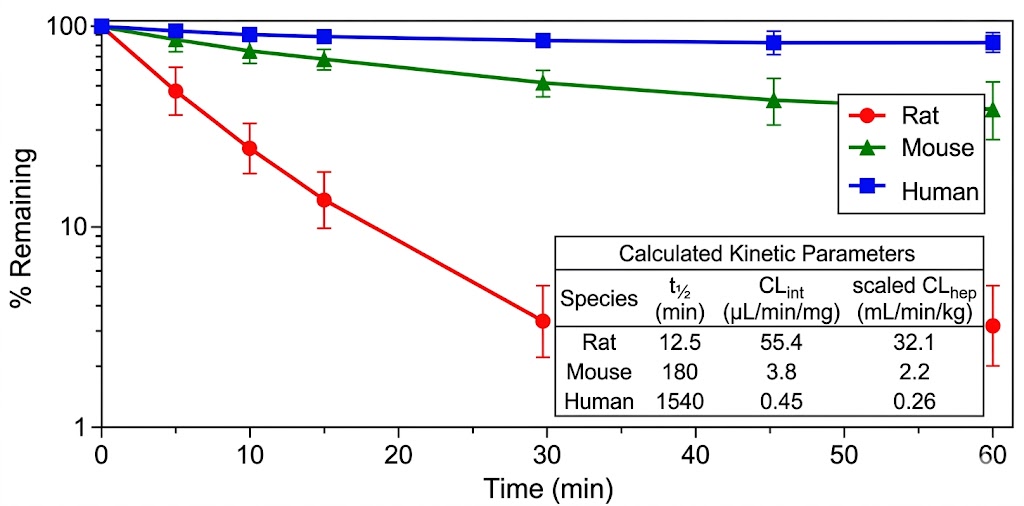
The following representative data illustrates the type of metabolic stability results generated using our platform. A test compound was incubated with rat, mouse, and human liver microsomes, and parent compound depletion was monitored over 60 minutes by LC-MS/MS.

Metabolic stability half-life comparison across rat mouse and human microsomes

Metabolic stability comparison across species

SpeciesIn Vitro t½ (min)CLint (μL/min/mg)Scaled CLhep (mL/min/kg)% Remaining at 60 min
Rat~12~230~55~3%
Mouse~190~15~25~80%
Human~770~3.6~8~95%

These results demonstrate the dramatic species-dependent differences in metabolic stability that can occur for certain compound classes. The compound was rapidly metabolized in rat microsomes (t½ ≈ 12 min) but highly stable in human microsomes (t½ ≈ 770 min), highlighting the importance of multi-species testing for accurate preclinical-to-clinical extrapolation.

Note: These data are adapted from published literature [SOURCE: Godoi et al., 2024]. Actual results for your compound will vary depending on its chemical structure, physicochemical properties, and metabolic pathway.

Case Study: Metabolic Stability and Metabolite Identification of N-Ethyl Pentedrone (NEP) in Rat, Mouse, and Human Liver Microsomes

Godoi AB, Antunes NJ, Cunha KF, Martins AF, Huestis MA, Costa JL. "Metabolic Stability and Metabolite Identification of N-Ethyl Pentedrone Using Rat, Mouse and Human Liver Microsomes." Pharmaceutics, 2024, 16(2):257. https://doi.org/10.3390/pharmaceutics16020257

Background

N-Ethyl pentedrone (NEP) is a synthetic cathinone with documented abuse potential. Understanding its metabolic stability and metabolite profile across species is essential for toxicological risk assessment and forensic interpretation.

Methods

Godoi and colleagues incubated NEP (10 μM) with rat, mouse, and human liver microsomes in the presence of NADPH at 37°C. Samples were collected at 0, 15, 30, and 60 minutes, quenched, and analyzed by LC-MS/MS for parent compound depletion. Metabolite identification was performed using HRMS with data-dependent acquisition [SOURCE: Godoi et al., 2024].

Results

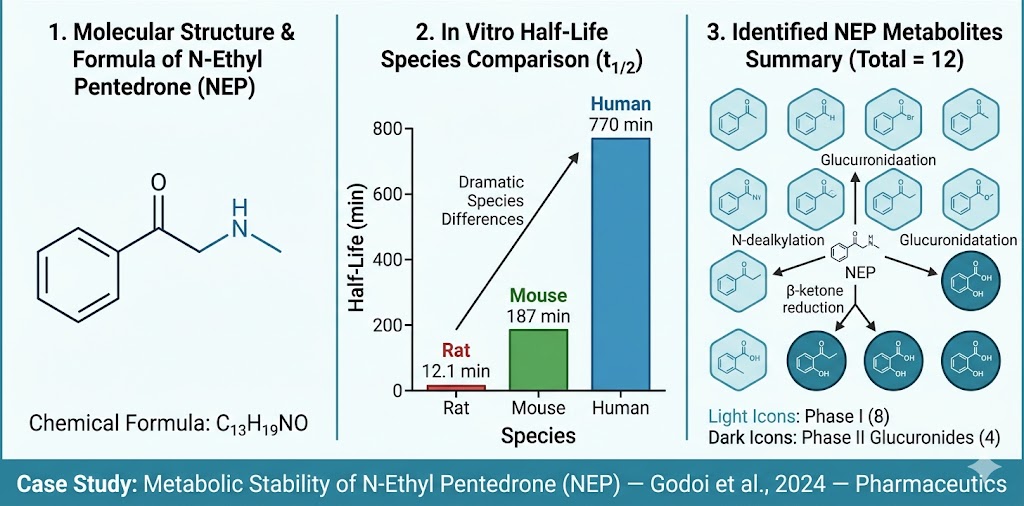
NEP exhibited pronounced species-dependent metabolic stability. In rat liver microsomes, NEP was rapidly metabolized with an in vitro half-life of 12.1 minutes and intrinsic clearance of 229 μL/min/mg. In mouse liver microsomes, metabolism was substantially slower (t½ = 187 min; CLint = 14.8 μL/min/mg). Human liver microsomes showed the highest stability (t½ = 770 min; CLint = 3.6 μL/min/mg). A total of 12 metabolites were identified, including 8 phase I metabolites (predominantly β-ketone reduction, N-dealkylation, and hydroxylation products) and 4 phase II glucuronide conjugates. The major metabolic pathway in human liver microsomes was β-ketone reduction, producing the dihydro-metabolite M2.

Conclusion

This study demonstrates the critical value of multi-species metabolic stability assessment. The dramatic interspecies differences observed for NEP underscore that single-species data can be misleading for clearance prediction. The combination of metabolic stability profiling with comprehensive metabolite identification provides a complete picture of a compound's disposition—a capability that our MassTarget platform offers as an integrated service.

Metabolic stability species comparison for NEP in rat mouse and human microsomes

Species-dependent metabolic stability of NEP in rat, mouse, and human liver microsomes. Data from Godoi et al., 2024.

FAQ

Frequently Asked Questions

Q: What is the difference between microsomal stability and hepatocyte stability?

Microsomal stability assays measure metabolism mediated by CYP and FMO enzymes, which are enriched in the microsomal fraction. Hepatocyte stability assays capture the full metabolic capacity of the liver, including phase I and phase II enzymes, cytosolic enzymes, and active transport processes. Hepatocyte data generally provides more accurate in vivo clearance predictions, while microsomal data is faster and more cost-effective for early screening.

Q: Which test system should I choose for my compound?

For initial rank-ordering of compound series, liver microsomes are the recommended starting point. If your compound is suspected to undergo non-CYP metabolism (e.g., conjugation, cytosolic metabolism), S9 fractions or hepatocytes are more appropriate. For late-stage leads where accurate human clearance prediction is critical, cryopreserved hepatocytes are the preferred system.

Q: How many time points do you use for metabolic stability assays?

Our standard protocol includes six time points (0, 5, 15, 30, 45, and 60 minutes). For slowly metabolized compounds, we extend the incubation to 120 minutes with additional time points. For rapidly metabolized compounds, we may add early time points (1, 2, 3 minutes) to capture the initial depletion phase.

Q: What species do you offer for metabolic stability testing?

We offer human, rat, mouse, dog, and monkey for all three test systems. Additional species (minipig, rabbit, guinea pig) are available upon request. Multi-species panels are recommended to identify the most appropriate preclinical model for PK and toxicology studies.

Q: Can you perform metabolic stability on challenging compounds (covalent binders, natural products)?

Yes. Our method development team has experience with a wide range of compound classes, including covalent binders, natural products, peptides, and poorly soluble compounds. For challenging compounds, we implement modified protocols (e.g., reduced DMSO concentration, alternative solvent systems, extended equilibration) to ensure reliable data.

Q: How do you calculate intrinsic clearance (CLint) from metabolic stability data?

CLint is calculated from the first-order depletion rate constant (k), derived from the slope of the ln(% remaining) versus time plot. CLint = k / protein concentration (for microsomes/S9) or k / cell concentration (for hepatocytes). Scaled CLhep is then estimated using the well-stirred or parallel-tube liver model, incorporating species-specific physiological parameters.

Q: What QC measures do you include in metabolic stability studies?

Each assay batch includes: system suitability standards (injection reproducibility, carryover check), QC samples at low, medium, and high concentrations, blank matrix controls, NADPH-negative controls (to confirm enzyme-dependent metabolism), and reference compound incubations (e.g., midazolam, testosterone) as positive controls. Acceptance criteria follow ICH M10 guidelines.

Q: Can I expand from metabolic stability to full MetID or PK studies?

Absolutely. Our MassTarget platform is designed as an integrated ADME/DMPK ecosystem. Metabolic stability data can be seamlessly expanded to full Metabolite Identification (MetID), Metabolic Soft-Spot Analysis, and LC-MS/MS Bioanalysis for in vivo PK studies—all within the same platform, using consistent methodologies and documentation standards.

References

1. Godoi AB, Antunes NJ, Cunha KF, Martins AF, Huestis MA, Costa JL. "Metabolic Stability and Metabolite Identification of N-Ethyl Pentedrone Using Rat, Mouse and Human Liver Microsomes." Pharmaceutics, 2024, 16(2):257. https://doi.org/10.3390/pharmaceutics16020257

2. Cai H, Xing X, Su Y, Yang C. "Innovative applications and future perspectives of chromatography-mass spectrometry in drug research." Frontiers in Pharmacology, 2025, 16:1529468. https://doi.org/10.3389/fphar.2025.1529468

3. Shen Y, Yao B, Guo Y, Yang Y, Liang C, Huang J, Zhang Y, Wang X. "Development of an LC-MS/MS method to quantitatively analyze escitalopram and its metabolites with application in liver and placenta microsome metabolism." Frontiers in Pharmacology, 2025, 16:1714686. https://doi.org/10.3389/fphar.2025.1714686

Plan Your Metabolic Stability Study with the MassTarget Team

Share your compound details and project requirements, and our DMPK scientists will recommend the optimal test system, analytical platform, and species panel for your metabolic stability study. We provide a detailed proposal within two business days, including assay specifications, timeline, and cost.

Disclaimer: All products and services provided by Creative Proteomics are for research use only (RUO). They are not intended for use in diagnostic, therapeutic, or clinical procedures.

Online Inquiry

Please submit a detailed description of your project. We will provide you with a customized project plan to meet your research requests. You can also send emails directly to for inquiries.

* Email
Phone
* Service & Products of Interest
Services Required and Project Description