Toxic Metabolite Detection Service | Reactive Metabolite Screening by LC-MS/MS

Multi-agent chemical trapping platform for early identification of reactive metabolite risks.

Drug-induced liver injury (DILI) remains a leading cause of clinical attrition. Many toxicities trace back to electrophilic reactive metabolites that covalently modify proteins and DNA. Our reactive metabolite screening service uses multi-agent chemical trapping with high-resolution LC-MS/MS to detect and quantify these intermediates early — before they become costly late-stage failures.

We integrate this service within our broader ADME/DMPK/PK-PD Research Platforms, ensuring seamless data continuity from metabolic stability through reactive metabolite profiling.

Key Advantages:

  • Multi-Trapping Agent Panel: GSH, KCN, Cysteine, Semicarbazide
  • HRMS Structural Elucidation with Stable Isotope Confirmation
  • Integrated CYP Phenotyping for Bioactivation Risk Assessment
  • Flexible Throughput — Single Compound to 50+ Libraries
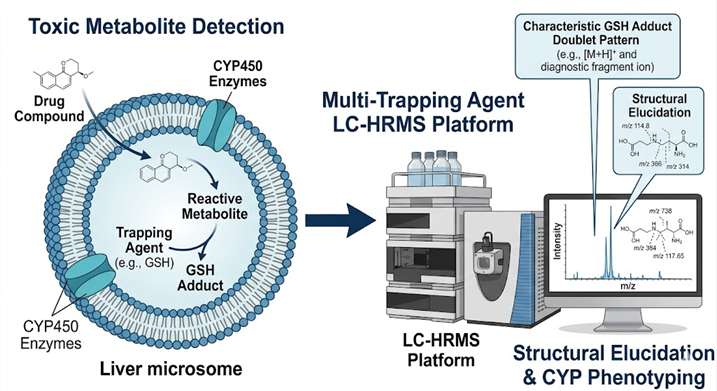
Reactive metabolite screening platform with multi-agent trapping and LC-HRMS analysis
Overview Advantages When to Use Trapping Agents Workflow CYP Comparison Sample Deliverables Demo Case Study FAQ

Reactive Metabolite Screening for Safer Drug Candidates

Drug-induced liver injury (DILI) remains a leading cause of clinical attrition. Many toxicities trace back to electrophilic reactive metabolites that covalently modify proteins and DNA. Our reactive metabolite screening service uses multi-agent chemical trapping with high-resolution LC-MS/MS to detect and quantify these intermediates early — before they become costly late-stage failures.

We integrate this service within our broader ADME/DMPK/PK-PD Research Platforms, ensuring seamless data continuity from metabolic stability through reactive metabolite profiling.

Why Choose Our Reactive Metabolite Screening Platform

Multi-Trapping Agent Panel

We deploy GSH, potassium cyanide (KCN), cysteine, and semicarbazide in parallel, covering the full spectrum of electrophilic species — Michael acceptors, epoxides, iminium ions, soft electrophiles, and aldehydes. No single trapping agent catches everything; our panel ensures you miss nothing.

HRMS Structural Elucidation with Stable Isotope Confirmation

Our Q-TOF and Orbitrap platforms deliver sub-ppm mass accuracy for confident adduct identification. Stable isotope-labeled trapping agents produce characteristic doublet patterns that eliminate false positives — a gold-standard approach validated in the peer-reviewed literature.

Integrated CYP Phenotyping

We identify which cytochrome P450 enzymes drive bioactivation using recombinant CYP isoforms and selective chemical inhibitors. This data is critical for assessing drug-drug interaction (DDI) risk and guiding medicinal chemistry efforts to design out metabolic liability.

Flexible Throughput — Single Compound to 50+ Libraries
Whether you need a single compound assessed before a key milestone or a full library triaged during lead optimization, our workflow scales to match your timeline. We batch-process compounds with consistent incubation conditions for comparable data across your series.

Quantitative Bioactivation Assessment

We go beyond qualitative yes/no reporting. Using response factor-corrected peak areas and internal standardization, we provide semi-quantitative estimates of the extent of bioactivation — enabling rank-ordering of compounds within a chemical series.

Comprehensive Reporting with Structural Assignments

Your final report includes annotated extracted ion chromatograms (EICs), MS/MS spectra with fragment assignments, proposed adduct structures, CYP phenotyping data, and a risk interpretation summary. We tell you not just whether reactive metabolites form, but which ones, how much, and through which enzymes.

When to Order a Reactive Metabolite Assessment

Reactive metabolite screening is most valuable at specific decision points in the drug discovery pipeline. Below are the scenarios where this assessment provides the greatest impact.

Lead Optimization for Compounds with Structural Alerts

Compounds containing aniline, hydrazine, thiophene, furan, or other structural alert motifs should be screened early. Our assay helps you decide whether to advance, modify, or deprioritize a chemotype based on bioactivation risk. Pair this with our metabolic stability assessment for a complete early ADME profile.

Pre-IND Enabling Studies

Regulatory agencies increasingly expect reactive metabolite data as part of IND packages, especially for compounds with hepatotoxicity signals in preclinical species. Our documented methodology supports your regulatory narrative.

Hit-to-Lead Triage

When your screening campaign yields multiple chemotypes, reactive metabolite burden can be a powerful differentiator. We can process 20–50 compounds per week, providing rank-ordered bioactivation data to guide your selection.

Natural Product Toxicity Investigation

Botanical extracts and natural product isolates can contain pro-toxic constituents that only reveal themselves after metabolic activation. Our platform deconvolutes complex mixtures to identify which components form reactive metabolites.

Drug Repurposing Safety Assessment

Existing drugs being evaluated for new indications may have unrecognized bioactivation liabilities in different dosing regimens or patient populations. A targeted reactive metabolite screen provides the safety data you need.

Chemical Trapping Agents We Use

The choice of trapping agent determines which types of reactive intermediates you detect. We maintain a panel of four complementary agents and recommend the optimal combination based on your compound's structure and known metabolic pathways.

Trapping AgentReactive Species TargetedTypical Adduct Type
Glutathione (GSH)Michael acceptors, epoxides, arene oxides, quinones, nitrenium ionsGSH conjugates (neutral loss of 129 Da — pyroglutamic acid)
Potassium Cyanide (KCN)Iminium ions, alicyclic amines, N-dealkylation intermediatesCyanide adducts (stable nitrile derivatives)
CysteineSoft electrophiles, α,β-unsaturated carbonylsCysteine conjugates
SemicarbazideAldehydes, ketones (from oxidative deamination, alcohol oxidation)Semicarbazone derivatives

For comprehensive coverage, we recommend running GSH + KCN as a minimum panel, with cysteine and semicarbazide added when the compound structure suggests aldehyde or soft electrophile formation.

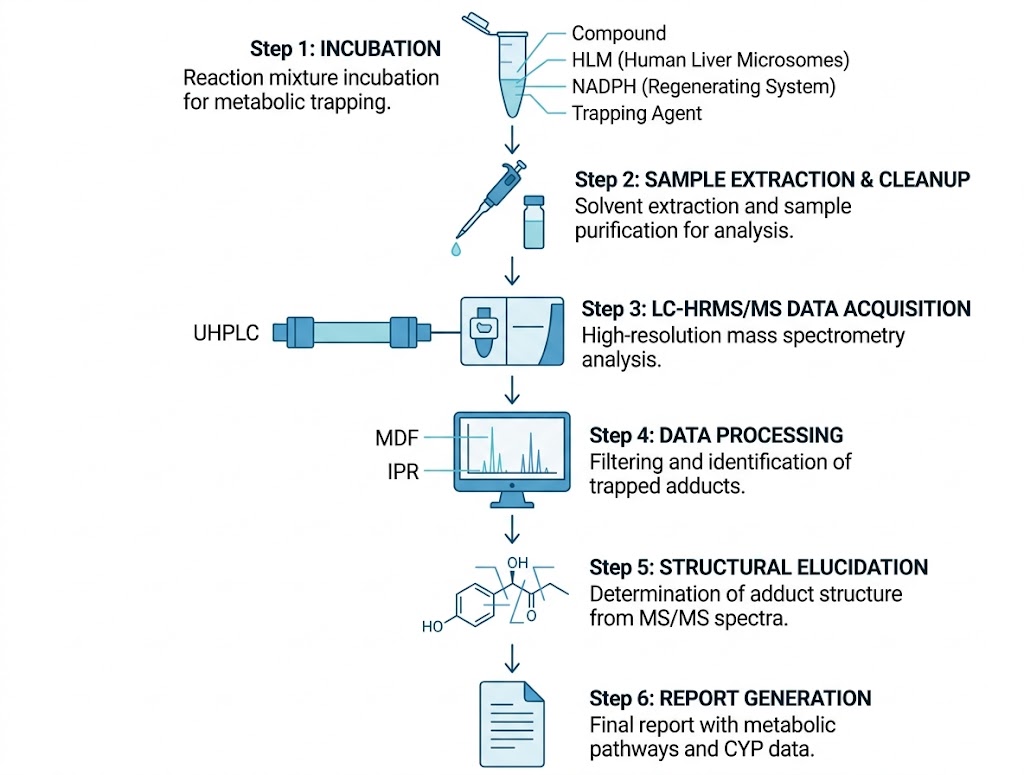
Our Reactive Metabolite Detection Workflow

Our standardized workflow ensures reproducibility across projects while allowing flexibility for compound-specific optimization.

1

Compound Incubation

Test compound is incubated with pooled human liver microsomes (HLM) or primary hepatocytes in the presence of NADPH and the selected trapping agent(s). Incubation conditions follow established protocols optimized for reactive metabolite capture.

2

Sample Preparation

After incubation, samples are quenched with ice-cold acetonitrile containing internal standard, centrifuged to remove protein, and the supernatant is concentrated for LC-MS analysis.

3

LC-HRMS/MS Data Acquisition

Extracts are analyzed on a Q-TOF or Orbitrap mass spectrometer coupled to a UHPLC system. Data-dependent acquisition (DDA) and targeted MS/MS modes capture both known and unexpected adducts.

4

Data Processing

We apply multiple orthogonal filters: mass defect filtering (MDF) to eliminate background ions, isotope pattern recognition to identify characteristic isotope doublets, and neutral loss scanning for GSH conjugates (129 Da).

5

Structural Elucidation

MS/MS spectra are interpreted to assign adduct structures. Fragmentation pathways are proposed to confirm the site of conjugation. For complex cases, we perform additional MSⁿ experiments.

6

Report Generation

All findings are compiled into a comprehensive report. If CYP phenotyping was requested, data from recombinant CYP incubations and inhibitor studies are included. For deeper structural characterization, see our metabolite identification (MetID) service.

Reactive metabolite screening workflow from incubation through LC-HRMS analysis and structural elucidation

CYP-Mediated Bioactivation Assessment

Identifying the enzymes responsible for bioactivation is essential for predicting drug-drug interactions and designing safer analogs. Our CYP phenotyping service integrates seamlessly with the reactive metabolite screen:

  • Recombinant CYP Isoforms: We incubate your compound with a panel of 10 individual recombinant CYP enzymes (CYP1A2, 2B6, 2C8, 2C9, 2C19, 2D6, 3A4, 3A5, 2E1, 2J2) in the presence of trapping agents. Adduct formation is compared across isoforms to identify the major contributors.
  • Chemical Inhibition: Selective inhibitors (e.g., ketoconazole for CYP3A4/5, furafylline for CYP1A2) are used in HLM incubations to confirm the contribution of specific CYP enzymes.
  • Correlation Analysis: Adduct formation across a panel of individual HLM donors with known CYP activities is correlated with enzyme-specific activities.

This integrated approach is directly applicable to LC-MS/MS bioanalysis for PK studies, where understanding bioactivation pathways informs metabolite monitoring strategies.

How We Compare: Reactive Metabolite Screening Methods

DimensionCreative ProteomicsCyprotex / EvotecCreative BiolabsIn-House
Trapping Agent PanelGSH, KCN, Cysteine, SemicarbazideGSH, KCN, CysteineGSH, KCN, CysteineTypically GSH only
MS PlatformQ-TOF & Orbitrap HRMSQ-TOF HRMSLC-HRMS (platform not specified)Variable; often triple quad
CYP PhenotypingIntegrated (10 isoforms + inhibitors)Not standardNot standardPossible but resource-intensive
Throughput1–50+ compounds/projectStandardized panelsFlexibleLimited by instrument access
Quantitative CapabilitySemi-quantitative (response factor-corrected)Qualitative primarilyQualitative primarilyVariable
Report DepthFull structural assignments + risk interpretationData summary + representative figuresData reportVariable

Sample Submission Guidelines

Sample TypeRecommended AmountConcentrationSolubility RequirementsShipping Conditions
Test compound (powder)1–5 mg10 mM in DMSO (100 µL)≥10 mM in DMSO or methanol; aqueous solubility ≥100 µMRoom temperature (powder) or dry ice (solution)
Test compound (solution)100 µL of 10 mM stock10 mM in DMSOClear solution, no precipitationDry ice
Control compound (e.g., diclofenac, clozapine)1–2 mg10 mM in DMSO≥10 mM in DMSORoom temperature (powder)
HLM (if client-provided)0.5–1 mg total protein0.5–1 mg/mLDry ice
NADPH regenerating system (if client-provided)As per protocolAs per protocolDry ice

Note: All samples are handled under research-use-only conditions. For compounds requiring special handling (light-sensitive, air-sensitive, or controlled substances), please contact us in advance.

What You Receive: Deliverables Package

  • Full Experimental Report: Detailed methods, incubation conditions, instrument parameters, and data processing workflow.
  • Extracted Ion Chromatograms (EICs): For each detected adduct, with retention times and peak areas.
  • MS/MS Spectra with Structural Assignments: Annotated fragmentation spectra with proposed adduct structures.
  • CYP Phenotyping Data: Contribution of individual CYP isoforms to bioactivation (if requested).
  • Quantitative Assessment: Semi-quantitative estimates of bioactivation extent, enabling compound rank-ordering.
  • Risk Interpretation Summary: A plain-language assessment of bioactivation risk, with recommendations for medicinal chemistry follow-up.
  • Raw Data Files: Instrument raw files (.d, .raw, or .wiff) for your internal archive.

For compounds where reactive metabolites form covalent protein adducts, we also offer targeted drug-protein adduct analysis to characterize the downstream protein targets.

Representative Data: GSH Adduct Detection by LC-HRMS

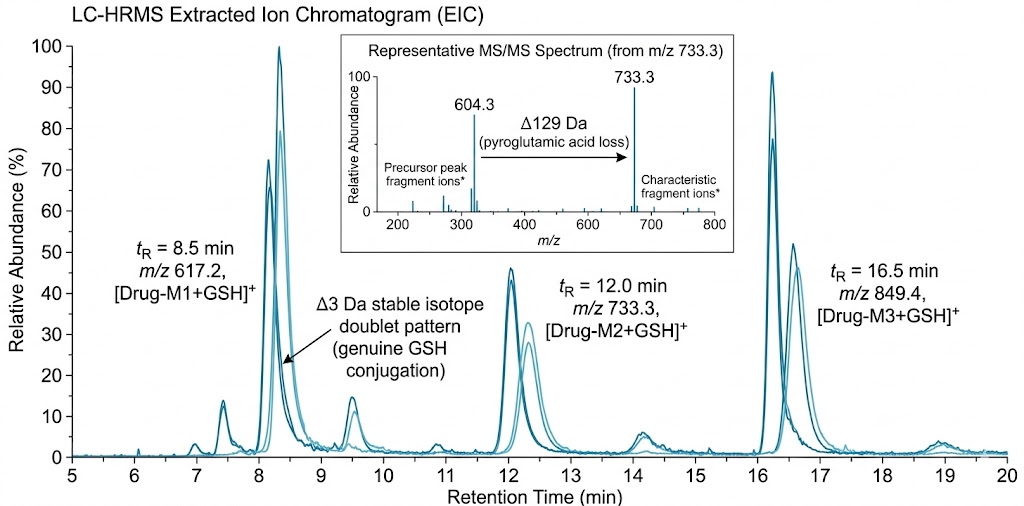
LC-HRMS extracted ion chromatogram showing GSH adduct isotope doublet pattern

GSH adduct EIC with characteristic isotope doublet pattern

The extracted ion chromatogram shows GSH adducts detected from a model compound incubated with HLM in the presence of isotope-labeled GSH. The characteristic doublet pattern (spaced by 3 Da) confirms genuine GSH conjugation and eliminates false positives from background ions. Each adduct peak is annotated with its m/z value, retention time, and proposed structure.

The corresponding MS/MS spectrum of a representative adduct shows the characteristic neutral loss of 129 Da (pyroglutamic acid), a diagnostic fragmentation for GSH conjugates. Together, the accurate mass, isotope pattern, and diagnostic fragmentation provide three independent lines of evidence for adduct identification.

Case Study: Identifying Reactive Metabolites of Pexidartinib by LC-MS-Based Metabolomics

Li F, et al. "Identifying the Reactive Metabolites of Tyrosine Kinase Inhibitor Pexidartinib In Vitro Using LC–MS-Based Metabolomic Approaches." Chem Res Toxicol. 2023;36(8):1358-1368. doi:10.1021/acs.chemrestox.3c00164

Background

Pexidartinib (PEX), a CSF1R inhibitor approved for tenosynovial giant cell tumor, carries an FDA black box warning for hepatotoxicity. The molecular mechanism remained unclear — reactive metabolite formation was hypothesized but uncharacterized.

Methods

Li et al. (2023) incubated PEX with pooled human liver microsomes (HLM) and primary human hepatocytes (PHH) in the presence of GSH and methoxyamine (NH₂OMe) as trapping agents. LC-HRMS-based metabolomic approaches were used to identify trapped adducts, and recombinant CYP isoforms with selective chemical inhibitors were employed to determine the enzymes responsible for bioactivation.

Results

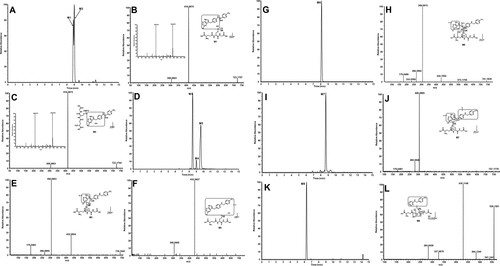
Eleven PEX-GSH adducts (M1–M11) and seven PEX-NH₂OMe oximes (M12–M18) were identified by LC-HRMS/MS. CYP3A4 and CYP3A5 were determined as the primary enzymes responsible for PEX bioactivation — ketoconazole (a CYP3A inhibitor) reduced total adduct formation by >80%.

Conclusion

PEX undergoes CYP3A-mediated bioactivation to form multiple structurally diverse reactive metabolites, providing a mechanistic basis for its hepatotoxicity. This study demonstrates how multi-agent trapping combined with HRMS and CYP phenotyping delivers a complete bioactivation profile — the same integrated approach we apply to every compound in our service.

Pexidartinib reactive metabolite identification workflow with GSH trapping and LC-HRMS analysis

Research workflow: Pexidartinib incubation with HLM + GSH/NH₂OMe → LC-HRMS analysis → 11 GSH adducts + 7 NH₂OMe adducts → CYP3A4/3A5 phenotyping. Source: Li et al. (2023) Chem Res Toxicol. CC BY 4.0.

FAQ

Frequently Asked Questions About Reactive Metabolite Detection

Q: What is the difference between GSH trapping and covalent binding assay?

GSH trapping detects electrophilic reactive metabolites by capturing them with glutathione before they bind to proteins. It's faster, more cost-effective, and suitable for early-stage screening. A covalent binding assay measures actual covalent modification of proteins and typically requires radiolabeled compound, making it more resource-intensive and better suited for later-stage confirmatory studies.

Q: How many compounds can you screen in a single project?

We can screen from single compounds up to 50+ compound libraries. Throughput depends on the number of trapping agents and whether CYP phenotyping is included. A typical single-agent screen for 10 compounds can be completed within 15 business days.

Q: Do you provide CYP phenotyping as part of the reactive metabolite service?

Yes. We offer integrated CYP phenotyping using recombinant CYP isoforms (10 individual enzymes) and selective chemical inhibitors to identify which CYP enzymes are responsible for bioactivation. This data is essential for DDI risk assessment.

Q: Can you work with natural product extracts or complex mixtures?

Yes. Our HRMS platform is well-suited for deconvoluting complex mixtures. We use mass defect filtering and isotope pattern recognition to identify reactive metabolite signals even in the presence of abundant background components from botanical extracts.

Q: What is the typical turnaround time?

Standard turnaround is 10–15 business days from sample receipt for a single trapping agent panel. Rush options are available for time-sensitive projects. Multi-agent panels and CYP phenotyping studies may require additional time.

Q: Is the data suitable for regulatory submissions?

Our data is generated under research-use-only (RUO) conditions. For IND-enabling studies requiring GLP compliance, please contact us to discuss study design options and documentation requirements.

Assess bioactivation risk for your drug candidates

Share your compound details and our scientists will design a tailored reactive metabolite screening strategy for your drug discovery program.

For research use only. Not for use in diagnostic or clinical procedures.

Online Inquiry

Please submit a detailed description of your project. We will provide you with a customized project plan to meet your research requests. You can also send emails directly to for inquiries.

* Email
Phone
* Service & Products of Interest
Services Required and Project Description