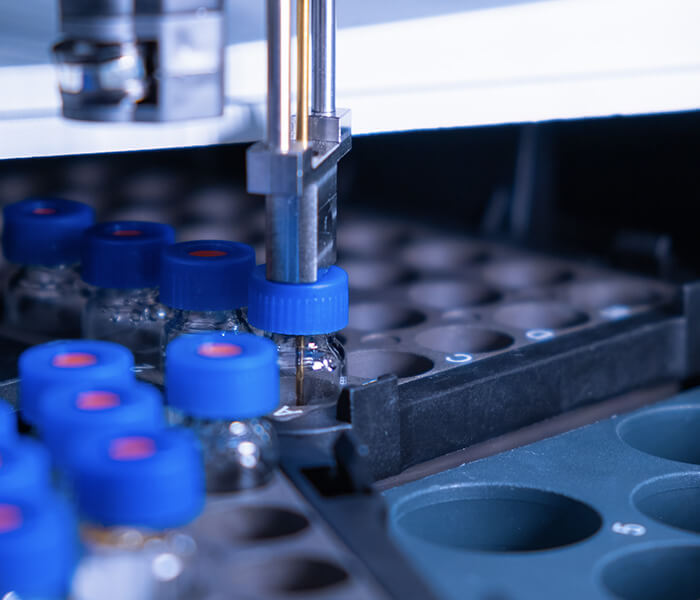
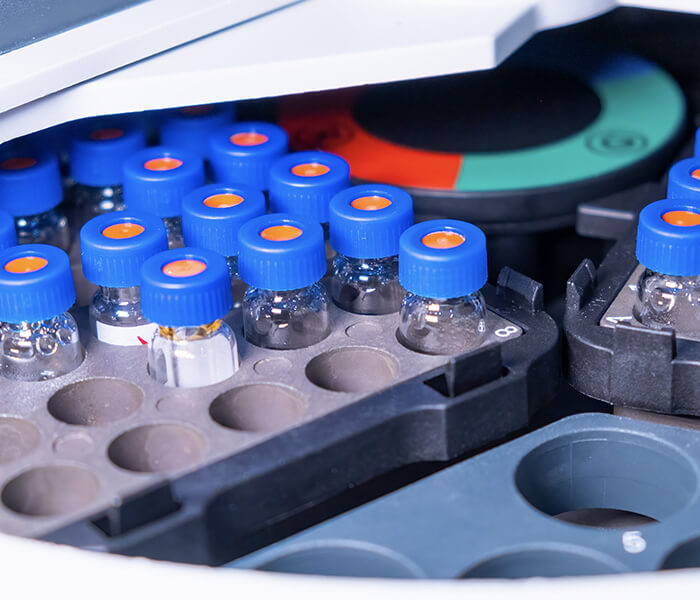
A targeted LC-MS/MS workflow is not just "running a triple quadrupole method." In a defensible RUO setting, it is a linked system that includes sample preparation, chromatographic separation, predefined transitions, internal-standard correction, calibration-based concentration assignment, and batch-level QC review. Recent reviews describe LC-MS/MS as the reference approach for measuring endocannabinoids in complex biological matrices because it can address low abundance, structural similarity, and matrix-related interferences more effectively than less selective formats. Recent advances in LC-MS/MS methods to determine endocannabinoids in biological samples
The first distinction to keep clear is targeted quantitation versus semi-quantitative comparison. In targeted quantitation, concentration is assigned through a calibration model, usually supported by stable-isotope internal standards and QC samples distributed across the run. In semi-quantitative workflows, peak area ratios or normalized signal may still be useful, but they should not be described as concentration values. Mixing those two reporting logics is a common source of confusion in project review.
The second distinction is panel scope. Some projects only need AEA and 2-AG. Others need a broader panel of endocannabinoids, related monoacylglycerols, or neighboring lipid mediators because the analytical question is pathway-oriented rather than molecule-oriented. That is where scope comparison becomes useful: readers weighing narrow and broader panels can move between Targeted Metabolomics and Targeted Lipidomics depending on whether the study is metabolite-centered or signaling-lipid-centered.
For teams deciding whether to stay narrow or expand panel coverage, the workflow language should connect naturally to adjacent services such as Targeted Lipidomics and Lipidomics Service, because those choices determine not just analyte count but also extraction burden, QC design, and downstream interpretation.
A practical provider review should ask a simpler question: what is the minimum evidence package that proves the reported concentrations are audit-ready? Endocannabinoids Analysis Service explicitly lists raw and processed LC-MS/MS data, absolute quantitation tables with LOD, LOQ, and CV, multi-point calibration curves, and statistical outputs among the deliverables. Those are the right categories to inspect before comparing vendors.
Recommended review table: minimum evidence to request
| Module | Purpose | Common risk | Minimum evidence to review |
|---|---|---|---|
| Analyte list | Confirms what is being measured | Scope drift | Named analytes and abbreviations |
| Sample prep | Controls recovery and cleanliness | Variable recovery, degradation | Matrix-specific prep summary |
| LC separation | Reduces co-elution | Interference, peak distortion | Representative chromatograms |
| MRM method | Supports selective detection | Wrong transition choice | Transition list or qualifier logic |
| Internal standards | Corrects loss and suppression | Under-correction | IS list and matching rationale |
| Calibration | Converts signal to concentration | Inflated linearity claims | Multi-point curve summary |
| QC | Monitors batch stability | Hidden drift | QC positions and pass or fail rules |
| Data review | Makes release auditable | Untracked reintegration | Change log and flagged peaks |
 Figure 1. Workflow risk map for targeted LC-MS/MS endocannabinoid quantification, showing where collection, chilling, extraction, internal-standard addition, calibration, and QC review most often introduce bias.
Sample Handling First: Collection, Chilling, Storage, and Stability Risks
Endocannabinoids are unusually sensitive to casual sample handling. Analytical reviews and serum-focused pre-analytics work repeatedly show that variability can be introduced before extraction begins, especially when sample temperature, processing delay, and matrix-specific handling are not standardized. 2-AG is especially vulnerable because it can undergo non-enzymatic isomerization, and freshly collected material can continue to change ex vivo if the collection-to-processing window is poorly controlled.
What must be standardized first:
The collection-to-chill interval should be predefined. The collection-to-separation interval should also be predefined. Matrix choice should be deliberate rather than habitual.
That sounds simple, but it is often where inter-study comparability breaks down. Plasma, serum, tissue homogenate, cell pellets, exosome-enriched material, and milk-like matrices each impose different burdens on extraction, background suppression, and recovery control. The broader endocannabinoid review literature emphasizes that low abundance and matrix complexity must be considered together, not as separate design topics.
Freeze-thaw history is another control point that should never be treated as a footnote. A sample with undocumented thaw cycles is not analytically neutral. Even if signal remains measurable, reproducibility and analyte ratios may not remain comparable across groups or batches.
What the SOP must capture:
The SOP should capture matrix type, collection container, timestamps, chilling and separation windows, aliquot strategy, storage temperature, allowed freeze-thaw count, and blank and QC requirements. It should also capture deviations in a machine-readable way so they can travel with the final results table.
For external projects, this is where workflow design connects naturally to Bioinformatic Data Preprocess and Normalization Service, Statistical Analysis Service, and broader Bioinformatics for Metabolomics. Those steps are useful only after sample-handling variance is documented; they do not erase uncontrolled ex vivo change.
If the study question extends beyond AEA and 2-AG into related signaling lipids, a broader Signaling Molecule Analysis or Fatty Acids Metabolomics Service may be a better upstream design fit than forcing a narrow panel to answer a wider pathway question.
Sample receipt and handling checklist
- Confirm matrix and container type.
- Record collection time and processing-start time.
- Record chilling conditions and hold-time window.
- Aliquot early to minimize repeated thawing.
- Define acceptable storage temperature and duration.
- Include process blank and extraction blank.
- Track freeze-thaw count.
- Interleave groups across prep batches where possible.
- Capture deviations in the metadata sheet.
- Release the data package with sample-level handling metadata attached.
Extraction & Cleanup: Protein Precipitation vs SPE (and How to Choose)
Cleanup design is where many workflows either gain or lose quantitation confidence. For endocannabinoids, the real decision is not "simple versus advanced." It is a trade-off among throughput, extract cleanliness, matrix suppression, recovery consistency, and the stability of low-level readouts.
Protein precipitation is attractive because it is fast and scalable. It may be sufficient for cleaner matrices, pilot screens, or semi-quantitative comparisons where the project is still deciding whether the analyte panel is worth pursuing. But precipitation alone can leave behind enough phospholipid and endogenous background to worsen ion suppression and increase batch-to-batch variance.
SPE adds time and method optimization, but it often pays off when the matrix is chemically crowded or the analytes are low abundance. That is why many published analytical workflows and commercial targeted services rely on SPE or hybrid cleanup designs for endocannabinoids and related lipids. Reviews and matrix-effect literature consistently describe cleaner extracts as a major advantage when low-level targeted LC-MS/MS data must be released with confidence.
A good extraction decision starts with four questions.
How complex is the matrix?
How low are the expected analyte levels?
Is throughput more important than the cleanest defensible extract?
Is 2-AG central to the analytical question?
That last question matters because 2-AG is a higher-risk analyte. The literature consistently flags isomerization and handling sensitivity as recurring sources of quantitation error.
Provider-side language should reflect that. Endocannabinoids Analysis Service describes optimized SPE, isotope-dilution quantitation, multi-point calibration, and QC metrics such as recovery, precision, LOD, and LOQ. Those are exactly the categories a buyer should compare during outsourcing review.
Decision matrix: precipitation vs SPE
| Matrix type | Typical recommendation | Why | Main risk if underspecified |
|---|---|---|---|
| Simple cell extracts | Precipitation may be acceptable | Lower background, higher throughput | Underestimated matrix effects |
| Plasma or serum | SPE often preferred | Cleaner extract, better suppression control | Variable low-level quantitation |
| Tissue homogenate | SPE or hybrid cleanup | Dense lipid background | Recovery inconsistency |
| Exosome-rich material | SPE strongly favored | High matrix burden | Strong ion suppression |
| Pilot screen | Precipitation can triage feasibility | Faster iteration | False confidence in borderline data |
| Confirmatory targeted panel | SPE or validated hybrid | Better release defensibility | Weak inter-batch comparability |
A scope-comparison paragraph should also point readers to adjacent coverage options. Here, the natural comparison is between Lipidomics Service, Targeted Lipidomics, and Integrated Transcriptomic and Lipidomics Analysis, depending on whether the project is prioritizing analyte-level certainty or pathway-level context.
 Figure 2. Analytical comparison of AEA and 2-AG, highlighting relative stability, isomerization risk, cleanup sensitivity, and the QC watchpoints that affect quantitation confidence.
Internal Standards & Calibration: The Non-negotiables for Trustworthy Numbers
If sample handling is where hidden bias often begins, internal-standard design is where much of that bias is either controlled or allowed to persist. Endocannabinoid workflows depend heavily on isotope-labeled internal standards because they need to correct for extraction loss, matrix suppression, and injection-level variability. A targeted assay that reports concentration without a clear internal-standard rationale is difficult to audit with confidence.
The closer the internal standard behaves to the analyte during extraction, cleanup, chromatography, and ionization, the stronger the correction logic becomes. A single generic internal standard may be better than none, but it is rarely enough for a panel spanning multiple related lipids. The same logic applies to calibration. A vague standard scheme should not be treated as equivalent to a documented multi-point curve covering the actual working range.
Endocannabinoids Analysis Service states that its workflow uses deuterated internal standards, multi-point calibration curves, and reports LOD, LOQ, CV, recovery, and linearity-related evidence. Those categories are useful as a buyer-side checklist even when project-specific performance still needs matrix-level confirmation.
A strong calibration and QC section in a report should answer these questions:
- How many calibration levels were used, and across what range?
- Was the calibration matrix appropriate or justified?
- Were low, mid, and high QC samples distributed across the run?
- Were process blanks, extraction blanks, and carryover checks included?
- Were flagged integration changes logged?
- Was matrix fit demonstrated or at least justified?
Quick buyer-review table
| QC element | Minimum expectation |
|---|---|
| Calibration levels | 6–8 points across expected range |
| QC placement | low, mid, and high distributed across run |
| Blanks | process, extraction, and carryover checks |
| Integration review | flagged changes logged |
| Matrix fit | matrix-aware or matrix-justified calibration |
This is also where the article should pivot naturally into outsourcing review. Once internal standards and QC logic are clear, the next question is what evidence should appear in the delivered package. That is exactly why readers here should review what QC/acceptance evidence you should request from a service provider.
For downstream data handling, the most useful package is not just a report PDF. It is a release-ready set of files: concentration tables, metadata map, calibration summary, QC summary, flagged integrations, and exports suitable for Bioinformatics for Metabolomics, Multivariate Analysis Service, and project-specific Bioinformatic Data Preprocess and Normalization Service.
 Figure 3. RUO review workflow for targeted endocannabinoid quantification, including blanks, calibration levels, distributed QCs, flagged integrations, and release gates for final reporting.
Pitfalls & Troubleshooting: When Numbers Look "Off"
Troubleshooting becomes easier when problems are separated into four buckets: sample issue, prep issue, acquisition issue, and data-review issue. For endocannabinoids, unexpected results often trace back to workflow control rather than the analyte biology alone.
1) Unexpectedly high values
This often points to sample handling drift, ex vivo generation, or matrix-dependent change rather than a real analytical contrast. Blood-derived matrices are particularly sensitive to this.
Check: collection-to-processing interval, temperature logs, and blank behavior.
Fix: shorten hold time, re-extract reserved aliquots if available, and reassess matrix-specific calibration.
2) Unexpectedly low values
This may reflect poor recovery, adsorption loss, late internal-standard addition, or an upper-biased calibration range.
Check: spike timing, extraction recovery notes, and the proportion of samples near LLOQ.
Fix: add internal standard earlier, tighten cleanup, and verify low-end fit.
3) Replicates disagree
Replicate mismatch often points to prep inconsistency or unstable integration rather than instrument failure.
Check: prep plate, operator window, and chromatogram-level review.
Fix: compare raw traces before rewriting the method.
4) QC looks fine but sample drift remains
That can happen when QC material is not matrix-relevant or not distributed often enough to reveal drift.
Check: QC spacing and carryover after high-abundance injections.
Fix: increase QC frequency and strengthen blank strategy.
5) Peak shape is poor
Dirty extracts, co-elution, source contamination, and injection-solvent mismatch are all common causes.
Check: representative chromatograms and maintenance logs.
Fix: improve cleanup before changing transitions.
6) 2-AG behaves worse than AEA
That is analytically plausible and should be expected. Reviews repeatedly note that 2-AG is more vulnerable to isomerization and handling artifacts.
Check: storage temperature, delay before extraction, and whether 2-AG-specific watchpoints were defined.
Fix: shorten warm handling and make 2-AG a separate QC discussion rather than treating it as "just another analyte."
7) Matrix transfer fails
A workflow that behaved well in one matrix may not release defensible numbers in another.
Check: recovery, suppression, and calibration logic by matrix.
Fix: revalidate by matrix rather than assuming portability.
8) Batch effects dominate the data review
This usually means order effects, prep-batch effects, or handling metadata were not controlled strongly enough upstream.
Check: run order, prep batch, collection day, and freeze-thaw history.
Fix: rebalance later runs and document artifacts before applying Clustering Analysis Service, Multivariate Analysis Service, or other downstream summarization steps.
9) The provider's report is polished but hard to audit
That is a deliverables problem, even if the instrument work was otherwise competent.
Check: are raw chromatograms, calibration summaries, QC positions, and flagged integrations present?
Fix: ask for a transparent release package before interpreting subtle differences.
10) The team is arguing over what was actually measured
This is often a scope-definition problem before it becomes a data problem. Right after that first reset point, the most useful reference is endocannabinoids 101 and what you're actually measuring, because it re-establishes analyte scope, terminology, and what belongs inside an endocannabinoid-focused panel.
Troubleshooting table
| Symptom | Likely cause | Confirm with | Fix |
|---|---|---|---|
| High 2-AG values | Warm delay or ex vivo change | Handling log, matrix review | Tighten processing window |
| Low signal | Recovery loss or range mismatch | Recovery notes, LLOQ frequency | Re-optimize prep and curve |
| Poor replicate CV | Prep inconsistency | Plate or operator comparison | Tighten SOP and re-review raw traces |
| Drift across run | Sparse QC or carryover | QC spacing, blanks | Add distributed QC and blanks |
| Poor peaks | Dirty extract or co-elution | Chromatograms, maintenance | Improve cleanup and LC conditions |
| Matrix-specific failure | Unvalidated transfer | Matrix-wise performance review | Revalidate by matrix |
| Weak auditability | Thin deliverables | Missing raw or QC evidence | Require fuller release package |
A Practical Decision Framework: When to Use, and When Not to Use, Targeted LC-MS/MS for Endocannabinoids
Use targeted LC-MS/MS when the analytes are predefined, concentration-oriented reporting matters, and the workflow can support disciplined sample handling, matrix-aware cleanup, and release-level QC. That is the setting in which targeted methods create the most value.
Do not default to a narrow targeted panel when the question is still exploratory, the relevant lipid classes are not yet clear, or the available samples carry weak metadata and uncontrolled handling history. In those cases, it may be better to start with Lipidomics Service or a broader Integrated Transcriptomic and Lipidomics Analysis, then narrow into a focused targeted assay once analyte scope is stable.
That staged design is especially useful when the analytical question spans endocannabinoids, related signaling lipids, and pathway-level context. Teams comparing adjacent options should also review Targeted Metabolomics alongside Targeted Lipidomics to decide whether the project is better framed as a narrow metabolite panel or a broader lipid-signaling workflow.
Conclusion
Targeted LC-MS/MS can generate highly defensible endocannabinoid data, but only when the workflow is treated as an analytical system rather than as an instrument booking. For AEA and 2-AG, the biggest determinants of data quality are usually sample-handling discipline, matrix-aware cleanup, sufficiently matched internal standards, realistic calibration design, and transparent QC evidence. Teams evaluating providers should resist comparing only platform names or sensitivity claims. The stronger comparison is whether the provider can show how the numbers were protected from collection to final table.
For RUO teams, the value of the workflow lies in analytical transparency, batch defensibility, and downstream usability of the delivered data package.
FAQ
1) Is targeted LC-MS/MS always the right first step?
No. It is strongest when the analytes are already defined and concentration-level reporting matters. Earlier-stage projects may benefit more from broader profiling.
2) Can AEA and 2-AG be handled as analytically equivalent targets?
No. 2-AG usually needs tighter watchpoints because of isomerization and handling sensitivity.
3) Is protein precipitation enough for every matrix?
No. It may work for cleaner matrices or pilot work, but complex matrices often need SPE or hybrid cleanup for more defensible low-level quantitation.
4) What should a provider deliver for the data package to be audit-ready?
At minimum: raw and processed LC-MS/MS files, analyte concentration tables, calibration summary, QC summary, and flagged integration records. Endocannabinoids Analysis Service lists these categories as core deliverables.
5) What is the most common reason published numbers disagree?
Differences in sample handling, matrix choice, cleanup approach, and calibration or QC design are major contributors.
6) Can downstream normalization rescue poor pre-analytics?
Only partially. It can structure known variance, but it does not reverse ex vivo analyte change.
7) What should a bioinformatics lead care about most?
Concentration tables alone are not enough. Audit-ready calibration, QC placement, integration logs, and metadata alignment matter just as much.
8) When should the project move from targeted endocannabinoids to broader lipid coverage?
When pathway-level interpretation requires neighboring lipid classes or when the initial narrow panel cannot answer the question without broader context.
References:
- Kratz D, Thomas D, Gurke R. Endocannabinoids as potential biomarkers: It's all about pre-analytics. Journal of Mass Spectrometry and Advances in the Clinical Lab. 2021;22:56-63. DOI: 10.1016/j.jmsacl.2021.11.001
- Hargreaves J, Ney L. Experimental and Pre-Analytical Considerations of Endocannabinoid Quantification in Human Biofluids Prior to Mass Spectrometric Analysis. Targets. 2025;3(1):11. DOI: 10.3390/targets3010011
- Marchioni C, de Souza ID, Acquaro Junior VR, de Souza Crippa JA, Tumas V, Queiroz MEC. Recent advances in LC-MS/MS methods to determine endocannabinoids in biological samples. Analytica Chimica Acta. 2018;1044:12-28. DOI: 10.1016/j.aca.2018.06.016
- Kratz D, Sens A, Schäfer SMG, Hahnefeld L, Geisslinger G, Thomas D, Gurke R. Pre-analytical challenges for the quantification of endocannabinoids in human serum. Journal of Chromatography B. 2022;1190:123102. DOI: 10.1016/j.jchromb.2022.123102
- Zoerner AA, Gutzki F-M, Batkai S, May M, Rakers C, Engeli S, Jordan J, Tsikas D. Quantification of endocannabinoids in biological systems by chromatography and mass spectrometry: a comprehensive review from an analytical and biological perspective. Biochimica et Biophysica Acta - Molecular and Cell Biology of Lipids. 2011;1811(11):706-723. DOI: 10.1016/j.bbalip.2011.08.004
- Röhrig W, Achenbach S, Deutsch B, Pischetsrieder M. Quantification of 24 circulating endocannabinoids, endocannabinoid-related compounds, and their phospholipid precursors in human plasma by UHPLC-MS/MS. Journal of Lipid Research. 2019;60(8):1475-1488. DOI: 10.1194/jlr.D094680
- Villate A, San Nicolas M, Aizpurua-Olaizola O, Olivares M, Usobiaga A, Etxebarria N. Quantification of Endocannabinoids in Human Plasma. Methods in Molecular Biology. 2023. DOI: 10.1007/978-1-0716-3307-6_9
- Battista N, Fanti F, Sergi M. LC-MS/MS Analysis of AEA and 2-AG. Methods in Molecular Biology. 2022. DOI: 10.1007/978-1-0716-2728-0_4