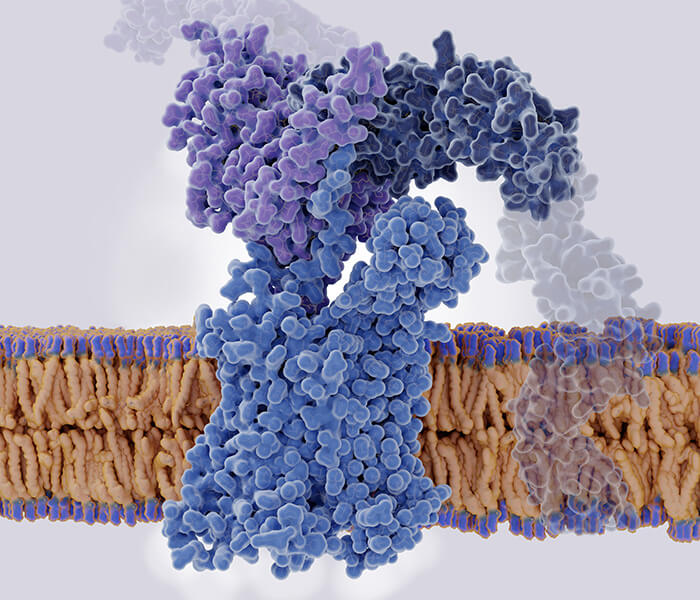
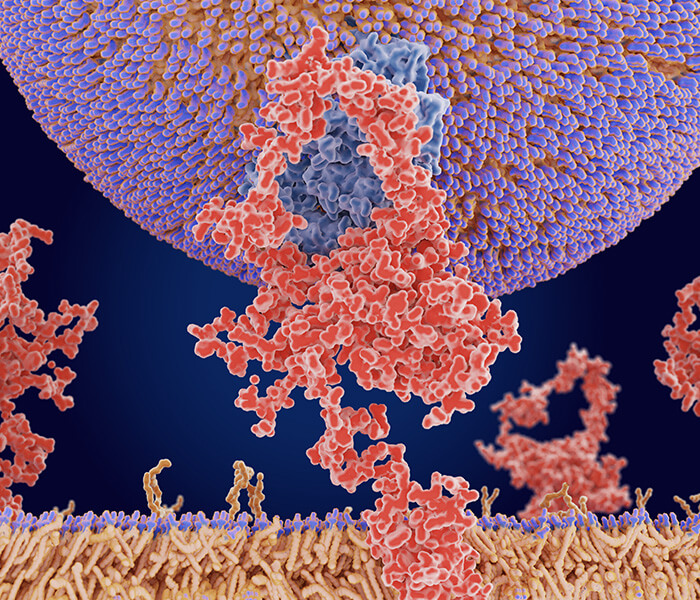
Corticosterone is a glucocorticoid-family steroid hormone that appears frequently in research workflows focused on stress-response research, endocrine signaling research, metabolism, signaling, neurobiology, and cross-omics interpretation. In RUO settings, the most useful starting point is not a maximal biochemical deep dive, but a clear framework: what the term means, how it relates to other glucocorticoid terms such as cortisol and cortisone, and what researchers are actually measuring when they design a corticosterone readout.
Definition & Terminology: "Corticosterone" in Research Context
In research language, corticosterone refers to one member of the glucocorticoid steroid family. Glucocorticoids are steroid hormones produced through adrenal steroidogenesis and act through glucocorticoid receptor signaling; which analyte receives priority in a project depends on the organism, matrix, and question being studied.
For search intent, several query forms often point to the same entry topic. A reader may search for "corticosterone," "corticosterona," "corticosterone hormone," or even a phrase like "the most common glucocorticoids are…" and still be looking for the same thing: a concept-level page that explains where corticosterone sits within glucocorticoid terminology and how that affects measurement choices. Those queries do not automatically imply different biology; they are often different linguistic routes into the same research concept.
A common early mistake is to treat corticosterone, cortisol, and cortisone as interchangeable labels. They are related, but they are not the same analyte, and they do not carry identical interpretive meaning. Reviews of glucocorticoid biology and 11β-hydroxysteroid dehydrogenase biology make the distinction important because corticosteroid metabolism includes active/inactive relationships and analyte interconversion context that can affect how a panel is interpreted.
Another common mistake is to turn a vocabulary answer into a biological conclusion too quickly. Knowing that corticosterone belongs to the glucocorticoid family does not yet tell you which matrix is most informative, whether a single time point is meaningful, whether a pathway-linked readout is needed, or whether a single-analyte assay is sufficient. Those choices belong to assay design, sample handling, and interpretation planning rather than to terminology alone.
For consistency, this article uses six terms in a narrow way:
| Term | Working meaning in this article |
|---|---|
| glucocorticoids | the broader steroid-family context |
| corticosterone | the focal analyte of this page |
| cortisol | a related glucocorticoid analyte discussed for distinction |
| cortisone | a related corticosteroid term that should not be collapsed into cortisol or corticosterone |
| matrix | the biological sample type being measured |
| assay specificity | the method's ability to distinguish the intended analyte from related compounds and matrix interference |
For projects that need broader steroid context rather than a single-marker view, a targeted metabolomics workflow can be more informative than a one-analyte-first design. When the project emphasis is hormone-linked pathway interpretation, an animal hormone profiling solution can help align analyte scope with measurable outputs.
 Figure 1. Search variants → one research concept → matrix / time point / assay specificity. Concept illustration showing variant search terms converging into a single corticosterone research concept, then branching into the three measurement-planning questions that matter most in RUO work: which matrix, which sampling window, and what level of assay specificity.
Glucocorticoids Overview: A Practical Map
At a concept level, it is useful to think of glucocorticoids as a family map, not a single-molecule story. Researchers frequently encounter corticosterone, cortisol, and cortisone in overlapping literature spaces because these molecules sit within related corticosteroid biology, receptor signaling, and prereceptor metabolism. That overlap is real, but it should not be mistaken for one-to-one equivalence.
A practical rule is that the analyte choice is model-dependent. Reviews of glucocorticoid biology consistently frame analyte selection in the context of organismal biology, tissue context, and enzymatic handling of active versus inactive forms. For that reason, a useful TOFU resource should explain relationship and positioning first, then let method choice follow from the model and matrix rather than from a memorized list of names.
A second practical rule is that matrix and time point shape interpretation. The same analyte can carry different experimental value depending on whether it is captured as a basal measurement, a perturbation-linked measurement, or a recovery-phase measurement. Glucocorticoid-family readouts also display pronounced rhythmicity, so isolated values should be interpreted in light of collection timing rather than as timeless quantities. Here, the rhythmicity literature is used only as background for sampling design, not for any clinical claim.
Concept map: corticosterone, cortisol, cortisone
| Term | When it is typically prioritized in RUO work | Interpretation risk if confused |
|---|---|---|
| Corticosterone | When the study question is explicitly centered on corticosterone as a readout in stress-response research, endocrine signaling research, metabolism, neurobiology, or perturbation-response models | Assuming that a corticosterone-centered design automatically generalizes across every model or matrix |
| Cortisol | When broader glucocorticoid-family interpretation or corticosteroid panel design is under consideration | Treating cortisol as a synonym for corticosterone |
| Cortisone | When inactive/active corticosteroid context and analyte discrimination matter to assay planning or panel interpretation | Treating cortisone as merely another name for cortisol or corticosterone |
For projects that may need panel-level interpretation beyond one analyte, metabolomics service support can be a useful next layer, and bioinformatics for metabolomics becomes relevant once analyte naming turns into pathway-level comparison.
What Researchers Typically Measure: Readouts, Matrices, and Time-Point Logic
Once the term is clear, the next question is not "what is corticosterone?" but "what exactly am I measuring?" In RUO work, corticosterone readouts usually fall into four practical categories: a single concentration measurement, a time-series design, a before/after perturbation comparison, or a corticosterone-linked readout interpreted alongside pathway or panel data. Those categories are much more useful for project design than a generic instruction to "measure the hormone."
1) Single-point concentration
This is the simplest format and often the least interpretable by itself. A single concentration can be useful for pilot work, feasibility checks, or tightly controlled comparisons, but it compresses all temporal structure into one value. Because glucocorticoid-family analytes show strong temporal dynamics, single-point measurements should be used with tightly defined collection timing and consistent handling. The rhythmicity literature supports this only as background for time-aware study design.
2) Time-series measurement
A time-course design is often more informative when the biological question involves induction, adaptation, or recovery. High-resolution steroid profiling studies reinforce the broader point that temporal structure can carry information a single time point misses. Even a modest series with baseline, response, and recovery windows is often more defensible than one isolated measurement. Here, the high-resolution sampling reference is used only to support temporal sampling logic.
3) Pre/post-treatment or perturbation-linked change
This design asks whether corticosterone shifts under a defined intervention, exposure, or experimental condition. It is often the most accessible bridge between TOFU learning and actual assay planning because the readout is directly tied to a question of change. The key requirement is that preanalytical handling, extraction, and collection timing be harmonized between conditions.
4) Pathway-linked readout
Sometimes corticosterone is not the endpoint but a node in a larger mechanistic story. In those cases, corticosterone may be interpreted alongside signaling outputs, transcript-level changes, protein markers, metabolite panels, or network-level shifts. This is often where single-analyte measurement becomes limiting and where broader analytical scope becomes more useful.
Matrix matters more than many TOFU pages admit
The term matrix should be taken seriously from the beginning. In steroid analytics, matrix is not a minor implementation detail; it affects extraction behavior, background interference, recovery, and signal suppression. LC-MS/MS method-development literature repeatedly highlights the need to account for matrix effects during analytical design and validation. Here, the analytical-method paper is cited only for assay-design background.
In practice, researchers may work with plasma, serum, tissue extracts, cell lysates, or cell-culture supernatants. Each matrix carries a different combination of abundance range, background complexity, and preprocessing burden. A defensible RUO workflow therefore starts by pairing the biological question with the matrix, not by choosing the assay in isolation.
Time-point logic: baseline, response, recovery
For glucocorticoid-family measurements, time is part of the signal. Reviews of adrenal glucocorticoid rhythmicity show that these analytes vary across the day, while higher-resolution profiling work shows that time structure can be meaningful beyond a simple day-night contrast. For research design, that means collection windows should be defined prospectively and kept highly consistent across groups. Again, these references are used here only to support rhythmicity-aware planning.
A practical framework is:
- Baseline: What does the analyte look like before intervention?
- Response window: When would you expect the earliest measurable shift?
- Peak or plateau window: Is the biology acute, sustained, or oscillatory?
- Recovery window: Does the signal normalize, remain shifted, or reconfigure?
Eight questions that turn a research idea into a measurable corticosterone readout
- Is the project asking about a state, a change, or a time-dependent trajectory?
- Is corticosterone the main endpoint or one analyte in a broader steroid panel?
- Which matrix best represents the biology of interest?
- How stable is the chosen matrix during collection, storage, thawing, and extraction?
- Does the design need single-analyte simplicity or panel-level specificity?
- Could related steroids interfere if the assay is not selective enough?
- Is there enough discipline around time-point consistency to make differences interpretable?
- Will the final dataset need only concentrations, or also normalization, clustering, multivariate analysis, or pathway integration?
Decision framework
The questions above become more useful when converted into a quick planning grid. For an early-stage team, the goal is not to predict every downstream result, but to narrow the next experimental move: which matrix to prioritize, how much specificity is needed, whether one analyte is enough, and which supporting page or workflow should come next.
| Research question | Matrix priority | Specificity priority | Scope | Next step |
|---|---|---|---|---|
| "Do I need a first-pass signal in a controlled pilot?" | Choose the most stable and operationally consistent matrix available | Moderate to high, depending on related-steroid risk | Single analyte may be acceptable | Start with sample handling discipline and one clearly defined time point |
| "Do I expect a time-dependent response?" | Use a matrix that can be collected reproducibly across time windows | High, because timing effects are easy to confound | Time series or repeated sampling | Define baseline, response, peak, and recovery windows first |
| "Could related steroids change interpretation?" | Prefer matrices with manageable background and validated extraction | High | Panel-level design preferred | Move toward LC-MS/MS-style analytical planning |
| "Is corticosterone only one part of a broader biology question?" | Matrix should support paired downstream readouts if possible | High | Expanded or integrated scope | Connect corticosterone with signaling, pathway, or multi-omics interpretation |
| "Do I mainly need assay practicality?" | Choose the matrix that the workflow can handle consistently | Fit-for-purpose | Narrow scope | Compare immunoassay simplicity versus LC-MS/MS specificity |
For the operational side of that transition, sample preparation and data preprocess and normalization often determine whether a corticosterone dataset is clean enough to compare across conditions.
QC and preanalytical checkpoints
Many hard-to-explain corticosterone datasets are not caused by the molecule itself; they come from weak preanalytical control. A useful QC section for this topic should therefore focus on timing consistency, matrix effects, cross-reactivity risk, and freeze-thaw burden rather than on generic assay boilerplate. The cross-reactivity reference is cited here only for immunoassay background, and the LC-MS/MS paper only for analytical-design background.
| Checkpoint | What to watch for | Why it matters | Practical response |
|---|---|---|---|
| Timing | Collection windows drift between groups or batches | Glucocorticoid-family analytes are time-sensitive | Lock collection windows before data generation |
| Matrix effects | Suppression, enhancement, poor recovery, inconsistent extraction | Matrix can distort analytical signal | Validate extraction logic for the chosen matrix |
| Cross-reactivity | Related steroids may be measured together unintentionally in immunoassay-style workflows | Apparent signal may not reflect one analyte cleanly | Increase specificity requirement when related steroids matter |
| Freeze-thaw burden | Repeated handling or inconsistent storage | Preanalytical variability accumulates before analysis | Standardize storage, aliquoting, and thaw count |
| Scope mismatch | One analyte is measured when the biology really requires a panel | Interpretation becomes too narrow | Revisit analyte scope before scaling up |
| Normalization gap | Raw abundance differences dominate the comparison | Downstream interpretation becomes fragile | Plan preprocessing and normalization before final comparison |
Where This Goes Next: Mechanism Questions vs Measurement Choices
After the terminology and readout logic are clear, most readers naturally split into two groups.
The first group asks a mechanism question: how does corticosterone connect to signaling, metabolism, or regulatory networks in my model? In that case, the next step is not another definition page, but a page that translates mechanistic curiosity into measurable experimental outputs, such as LKB1/AMPK signaling deep-dive and measurable experimental readouts.
The second group asks a measurement question: should corticosterone be measured by an immunoassay-style workflow or by LC-MS/MS, and what is gained or lost with each? In that case, the most relevant next page is ELISA vs LC-MS/MS for corticosterone: specificity and reuse of data.
This split matters because biology questions and assay questions are not the same question. A mechanism-oriented reader wants readouts that connect corticosterone to pathways, perturbation logic, or downstream interpretation. A method-oriented reader wants specificity, cross-reactivity control, matrix compatibility, and the option to expand from one analyte to a broader steroid panel. Good RUO planning keeps those routes separate at first, then reconnects them once assay and biology are aligned.
When an immunoassay-style approach may be enough
An immunoassay-style approach can be reasonable when the project is tightly focused, the target analyte is predefined, throughput matters more than analyte breadth, and the design does not require broad steroid discrimination. The trade-off is that structurally related steroids can create cross-reactivity or interpretation risk, which is a well-established background issue in steroid immunoassays. This reference is used here only for cross-reactivity background.
When LC-MS/MS becomes the stronger choice
LC-MS/MS becomes especially attractive when assay specificity is a priority, when related steroids may confound interpretation, when a broader steroid panel may become useful later, or when the team wants the option to reuse the dataset for deeper multi-analyte interpretation. Method-development literature consistently highlights advantages in selectivity, multiplexing, and matrix-aware analytical control. This reference is used here only for analytical-design background.
Three quick rules: mechanism page first or method page first?
Go to the mechanism page first when your main uncertainty is biological: which pathway outputs, paired markers, or perturbation windows should accompany corticosterone.
Go to the method page first when your main uncertainty is analytical: do you need one analyte, a panel, or stronger analyte discrimination.
Design both together when the project already knows interpretation will depend on both pathway context and assay specificity.
When the next step is mechanism-centered interpretation, signaling molecule analysis and network analysis can help contextualize a corticosterone readout inside broader pathway structure. For projects that later extend from steroid readouts into signaling-lipid crosstalk, targeted phosphoinositides analysis may become relevant at a later stage.
 Figure 2. Decision tree for "mechanism route" versus "method route." Concept illustration showing corticosterone at the entry point, followed by a true branch decision: if the uncertainty is about pathway biology, go to mechanism-linked readouts; if the uncertainty is about analytical discrimination, go to ELISA-vs-LC-MS/MS style method selection.
FAQ (RUO): Common Corticosterone Questions for Research Planning
 Figure 3. Comparison figure for corticosterone, cortisol, and cortisone: not interchangeable; assay specificity matters. Concept illustration designed as a differentiation figure rather than a decorative family map, emphasizing that related corticosteroid terms are useful to compare but should not be treated as identical analytes in RUO planning.
What is corticosterone hormone?
In RUO language, corticosterone is a glucocorticoid-family steroid hormone that researchers measure when studying endocrine signaling research, stress-response research, metabolism, time-dependent perturbation responses, or related multi-analyte contexts. The useful next question is usually not definition alone, but which matrix, time point, and assay format best match the project.
Is corticosterone the same as cortisol?
No. They are related glucocorticoid analytes, but they are not interchangeable terms. A project should decide which analyte to prioritize based on model logic, matrix, and measurement intent rather than on name familiarity.
Is corticosterone the same as cortisone?
No. Cortisone is a distinct corticosteroid term and is relevant because corticosteroid metabolism includes analyte interconversion context regulated by 11β-HSD enzymes. Treating corticosterone and cortisone as the same molecule creates avoidable interpretation errors.
What does "corticosterona" mean?
In most search contexts, corticosterona is a language variant pointing to the same corticosterone topic. It should usually be normalized to the same concept page rather than treated as a separate analyte.
"The most common glucocorticoids are …" — how should that be interpreted?
As a concept question, not as a one-line decision rule. In research use, glucocorticoid-related analytes such as corticosterone, cortisol, and cortisone should be understood as related terms within a broader family, with interpretation shaped by model, matrix, and assay specificity.
What do researchers actually measure when they measure corticosterone?
Usually one of four things: a single concentration, a time-series profile, a pre/post change, or a corticosterone value interpreted alongside additional pathway or panel data. The design should be explicit about which of those it is trying to capture.
Does sample type matter?
Yes. Matrix affects extraction behavior, interference risk, and analytical performance. A corticosterone value from one matrix should not be assumed to mean the same thing as a value from a different matrix unless preprocessing and interpretation were designed for that comparison.
When should I think beyond a single corticosterone assay?
When related steroids may matter, when specificity is critical, when the project may need broader steroid context later, or when corticosterone is only one node in a larger biological story. Those are common signs that a panel-oriented analytical strategy may be more durable than a single-target approach.
What is the safest way to avoid over-interpreting corticosterone data?
Define the model, matrix, assay specificity requirement, and time-point logic before data generation. Many difficult datasets come from under-specified readout design rather than from the molecule itself.
For teams that expect interpretation to extend beyond one endpoint, integrated proteomics and metabolomics analysis and multivariate analysis are often natural next layers once corticosterone is placed into a broader project framework. In more exploratory programs, customized experiments can help align matrix choice, analyte scope, and downstream analysis before full-scale execution.
References
The references below are included to support RUO terminology, analytical specificity, rhythmicity, and assay-planning context only.
Reference note. References are used here for method support, terminology alignment, sampling logic, and analyte-specificity background in RUO settings. Titles that include clinical wording are not cited here for diagnosis, treatment, or patient-level conclusions; they are cited only for analytical, rhythmicity, or biochemical context. Verified DOI links are provided below.
- Timmermans S, Souffriau J, Libert C. A General Introduction to Glucocorticoid Biology. Frontiers in Immunology. 2019;10:1545. DOI: 10.3389/fimmu.2019.01545. (Frontiers)
- Chapman K, Holmes M, Seckl J. 11β-Hydroxysteroid Dehydrogenases: Intracellular Gate-Keepers of Tissue Glucocorticoid Action. Physiological Reviews. 2013;93(3):1139-1206. DOI: 10.1152/physrev.00020.2012.
- Lockett J, Inder WJ, Clifton VL. The Glucocorticoid Receptor: Isoforms, Functions, and Contribution to Glucocorticoid Sensitivity. Endocrine Reviews. 2024;45(4):593-624. DOI: 10.1210/endrev/bnae008. (OUP Academic)
- Chung S, Son GH, Kim K. Circadian rhythm of adrenal glucocorticoid: Its regulation and clinical implications. Biochimica et Biophysica Acta. 2011;1812(5):581-591. DOI: 10.1016/j.bbadis.2011.02.003. Used here only for rhythmicity background.
- Upton TJ, Zavala E, Methlie P, Kampe O, Tsagarakis S, Oksnes M, Bensing S, Vassiliadi DA, Grytaas MA, Botusan IR, Ueland G, Berinder K, Simunkova K, Balomenaki M, Margaritopoulos D, Henne N, Crossley R, Russell G, Husebye ES, Lightman SL. High-resolution daily profiles of tissue adrenal steroids by portable automated collection. Science Translational Medicine. 2023;15(701):eadg8464. DOI: 10.1126/scitranslmed.adg8464. Used here only for high-resolution temporal sampling logic.
- Krasowski MD, Drees D, Morris CS, Maakestad J, Blau JL, Ekins S. Cross-reactivity of steroid hormone immunoassays: clinical significance and two-dimensional molecular similarity prediction. BMC Clinical Pathology. 2014;14:33. DOI: 10.1186/1472-6890-14-33. Used here only for immunoassay cross-reactivity background.
- Braun V, Stuppner H, Risch L, Seger C. Design and Validation of a Sensitive Multisteroid LC-MS/MS Assay for the Routine Clinical Use: One-Step Sample Preparation with Phospholipid Removal and Comparison to Immunoassays. International Journal of Molecular Sciences. 2022;23(23):14691. DOI: 10.3390/ijms232314691. Used here only for LC-MS/MS analytical design background.