Tissue microenvironment research has entered a phase where single-modality spatial data — whether transcriptomic or metabolomic — is no longer sufficient to answer the most interesting questions. Gene expression tells you what a cell is programmed to do. The metabolome tells you what is actually happening. Combining the two in spatial context reveals relationships that neither modality can resolve alone: a metabolic pathway that is transcriptionally upregulated may show no corresponding metabolite accumulation, or a lipid gradient visible by mass spectrometry imaging may trace back to a small population of cells invisible in transcriptomic clustering.
The challenge is not whether to integrate, but how to design an experiment that produces integrable data in the first place. A common scenario in spatial multi-omics projects is that transcriptomics and metabolomics data are generated independently, only to reveal at the analysis stage that the sections cannot be meaningfully aligned. Differences in section depth, storage conditions, or acquisition resolution can prevent effective data integration.
This guide focuses on the practical decisions — tissue sectioning strategy, modality sequencing, sample handling, and result interpretation — that determine whether a paired spatial multi-omics project generates meaningful biological insight or an irreproducible correlation. Every step in the workflow, from block preparation to data registration, has consequences for the quality of the final integration.
Figure 1: Complementary Information Layers — RNA vs. Metabolites.
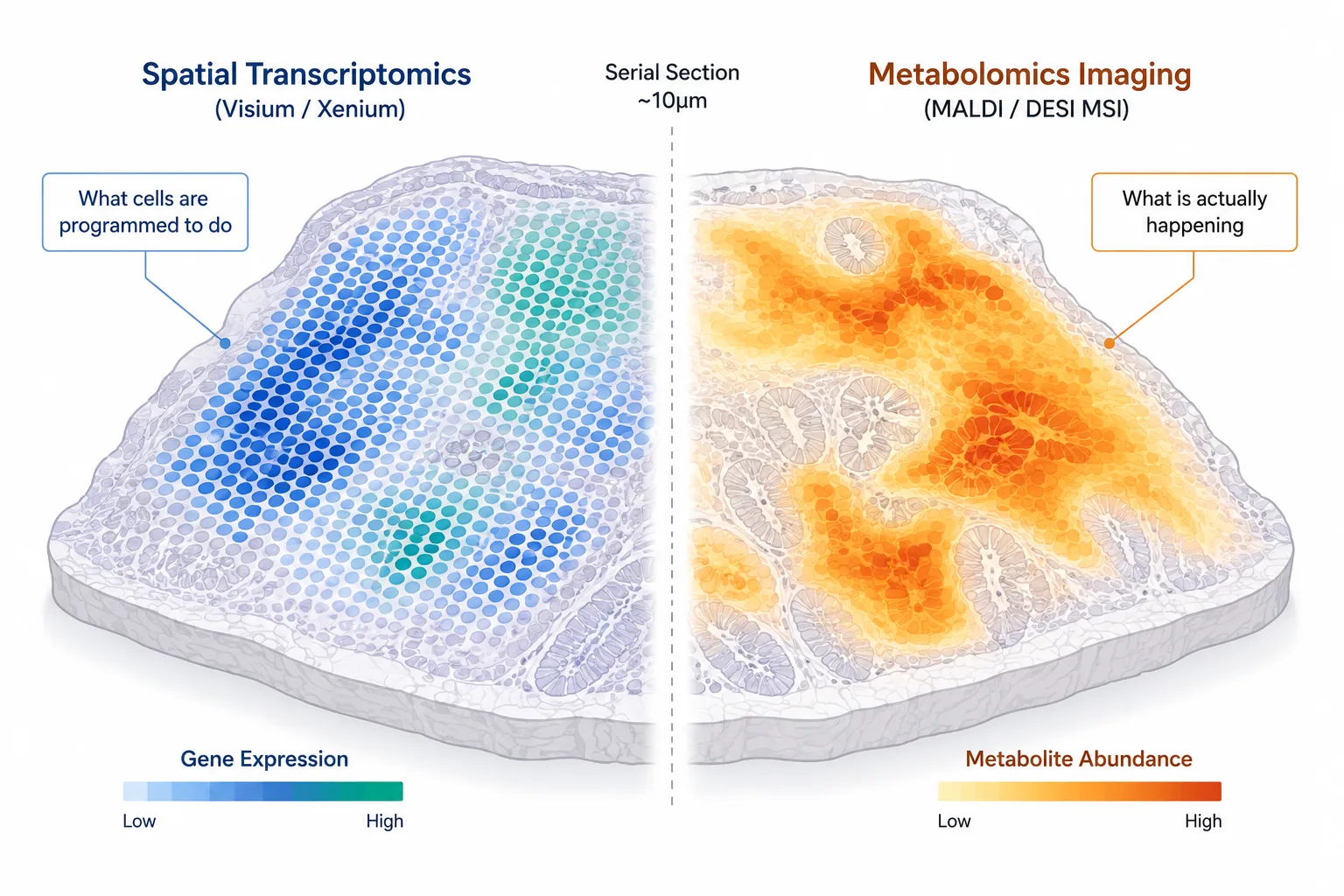 A split-field illustration showing the same tissue block analyzed by spatial transcriptomics (left) and spatial metabolomics (right). The transcriptomics side highlights gene expression programs, while the metabolomics side shows the corresponding metabolite distributions, illustrating how the two modalities capture different functional dimensions of the same tissue microenvironment.
Serial Sections vs. Coregistration: Choosing Your Alignment Strategy
The first and most consequential decision in a paired spatial experiment is how the two tissue sections relate to each other. Two main strategies exist, and the choice depends on your research question and the spatial precision required to answer it.
Serial Sections for Independent Validation
Serial sections — consecutive slices cut from the same tissue block, each assigned to a different analytical modality — are the most practical and widely used approach. Each section captures a nearly identical tissue region, with the distance between sections typically ranging from 5 to 20 micrometers. This gap is small enough that the cellular composition remains consistent across adjacent slices, yet large enough that the same cell is never measured by both modalities.
Serial sections are well suited for projects where the goal is to identify spatial correlations between gene expression and metabolite distribution at the tissue-region level. A tumor microenvironment study, for example, might use one serial section for Visium spatial transcriptomics and the adjacent section for MALDI mass spectrometry imaging of metabolites and lipids. The resulting datasets can be aligned by registering the histological features visible in both sections, and correlations between transcriptional programs and metabolic profiles can be assessed at the level of tissue domains rather than individual cells.
The practical workflow for serial sections is straightforward. The tissue block is mounted and sectioned continuously. Sections are collected in order, alternating or assigning specific section numbers to each modality. Section 1 might go to spatial transcriptomics, section 2 to metabolomics, section 3 to H&E staining for registration, and section 4 reserved as a backup. This numbering scheme ensures that the distance between every pair of sections is known and consistent.
The main limitation is that the spatial gap between slices introduces uncertainty. A metabolite enriched in the 5-micrometer gap between two sections may be missed entirely, and the correlation between a transcript and a metabolite measured on adjacent slices is always an approximation. For projects requiring cell-level precision, serial sections are not sufficient.
Coregistration for Cell-Level Precision
When the research question demands spatial alignment at single-cell or sub-cellular resolution, coregistration becomes necessary. Coregistration refers to the use of the same tissue section — or two sections so closely matched that they can be computationally treated as one — for both transcriptomic and metabolomic measurements.
This approach is technically more demanding. It requires either splitting a single tissue section between two workflows or performing both measurements on the same section sequentially, which is possible only when the two methods are chemically compatible. The advantage is that the spatial relationship between every transcript and every metabolite is preserved at the highest resolution the platforms can provide.
Coregistration is preferred for mechanistic studies that ask whether a specific metabolite is produced by a specific cell type, or for projects investigating cell-to-cell metabolic signaling where spatial precision is essential. The trade-off is that coregistration workflows are less established, and the protocols for multi-modal measurement on a single section are still evolving.
Sequencing the Experiments: Which Modality Runs First
After deciding between serial sections and coregistration, the next decision is the order in which the two spatial omics measurements are performed. Three approaches are common, each with distinct advantages depending on the biological question.
Transcriptomics First, Then Metabolomics
This is the most common workflow. Spatial transcriptomics is performed first — typically using a whole-transcriptome platform such as Visium — and the resulting data is used to identify transcriptionally distinct tissue regions. Selected regions are then analyzed by mass spectrometry imaging on the paired section to determine whether the transcriptional differences correspond to metabolic or lipidomic changes.
This approach is efficient because the transcriptomic data is information-rich and can guide the targeted metabolomics analysis. It is best suited for projects where the primary goal is to validate transcriptomic findings at the functional (metabolite) level. For example, if spatial transcriptomics identifies a hypoxic region marked by HIF1A target gene expression, the paired metabolomics section can be analyzed specifically for lactate accumulation, tricarboxylic acid cycle intermediates, and other metabolites associated with hypoxia.
Metabolomics First, Then Transcriptomics
When the research is driven by an observed metabolic phenotype — a lipid accumulation zone, a region of metabolic stress, or an unexpected metabolite distribution — it makes sense to start with spatial metabolomics. The mass spectrometry imaging data identifies metabolically distinct regions, and spatial transcriptomics on the paired section is used to identify the gene expression programs underlying those metabolic patterns.
This reverse workflow is particularly valuable for drug distribution studies, metabolic disease research, and projects investigating the metabolic consequences of genetic perturbations. A researcher studying lipid accumulation in non-alcoholic steatohepatitis, for instance, might first identify lipid-enriched regions by MALDI-MSI and then profile gene expression in those same regions on the adjacent section.
Parallel Processing
When tissue availability is not a constraint, both modalities can be run in parallel on separate serial sections, with integrated analysis performed at the analysis stage. This approach is the fastest in terms of experimental timeline and is suitable for exploratory studies where the spatial patterns are not known in advance.
Parallel processing requires careful coordination to ensure that both sections are handled identically up to the point of analysis. Any deviation in section thickness, storage time, or processing temperature can introduce artifacts that manifest as false positive correlations between the two datasets.
Figure 3: Modality Sequencing Decision Flowchart.
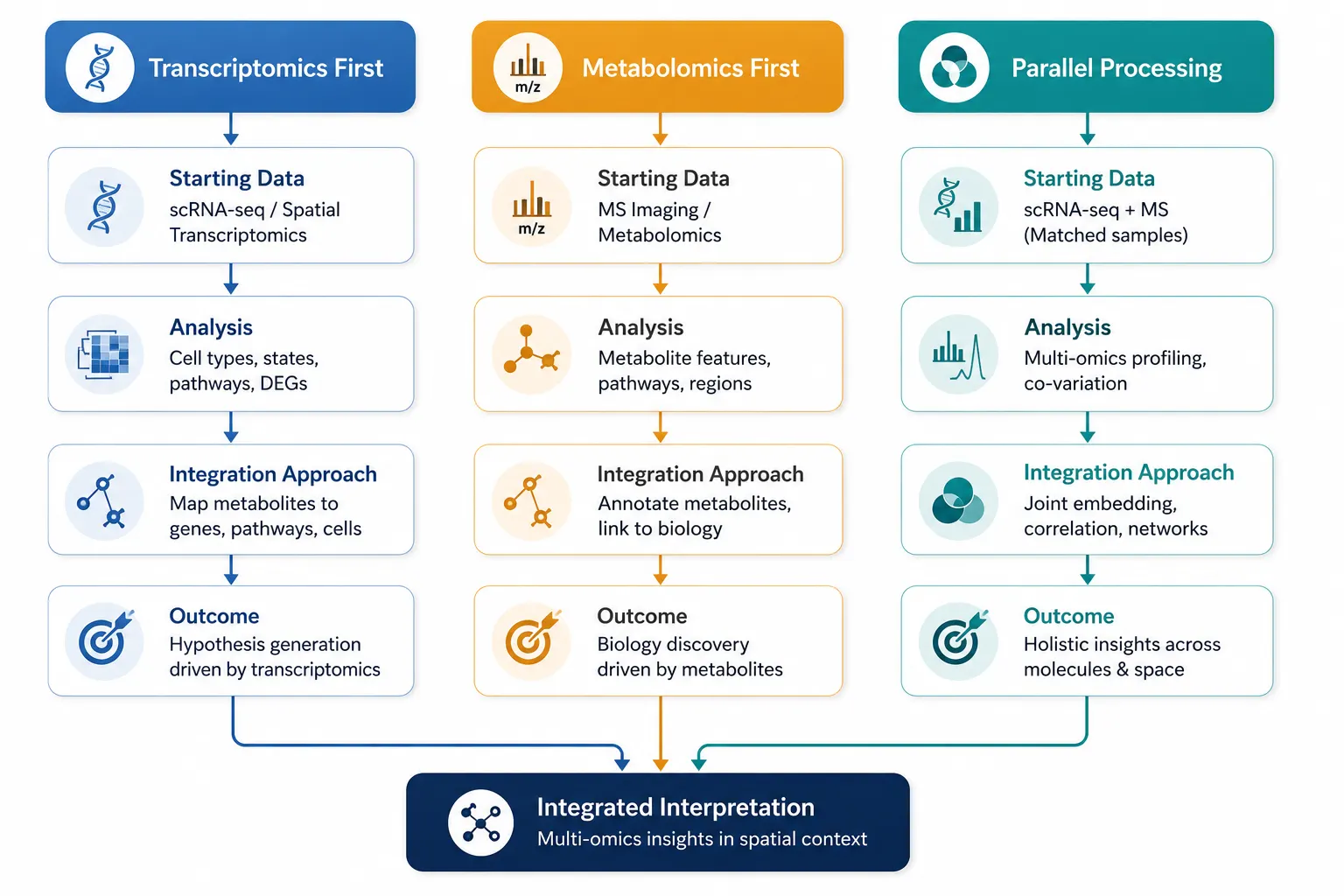 A three-path decision flowchart showing the Transcriptomics First, Metabolomics First, and Parallel Processing workflows. Each path outlines the starting data, analysis approach, and integration strategy, converging on integrated biological interpretation.
Sample Preparation for Paired-Section Experiments
Sample handling decisions made at the start of a paired spatial project have outsized consequences for data quality. The two modalities impose different, sometimes conflicting, requirements on tissue preparation, and failing to account for these differences at the planning stage can compromise the entire experiment.
Fresh Frozen vs. FFPE
Spatial metabolomics and lipidomics strongly favor fresh-frozen tissue. Fixation, especially formalin fixation, extracts and crosslinks metabolites and lipids, dramatically reducing the molecular information available for mass spectrometry imaging. Studies comparing fresh-frozen and FFPE tissues for spatial metabolomics consistently report 60 to 80 percent fewer detectable features in FFPE samples. Metabolites that are particularly affected include nucleotides, phospholipids, and small organic acids — exactly the classes most informative for metabolic pathway analysis.
For researchers designing multi-omics projects, untargeted metabolomics on fresh-frozen sections provides the broadest molecular coverage. This is especially important in the discovery phase, where the goal is to identify unexpected metabolite patterns without bias toward known targets.
Spatial transcriptomics, by contrast, is compatible with both fresh-frozen and FFPE tissue, with FFPE compatibility being a major advantage for clinical cohort studies. For paired-section experiments, the practical recommendation is to use fresh-frozen tissue whenever possible. When FFPE tissue is the only option, targeted metabolomics approaches focusing on metabolite classes resistant to fixation may be more suitable than untargeted discovery.
Section Thickness and Storage
The optimal section thickness differs between modalities. Spatial transcriptomics typically uses 10-micrometer sections. Mass spectrometry imaging for metabolites and lipids can use sections ranging from 5 to 20 micrometers, with thinner sections providing better spatial resolution but lower metabolite signal.
Storage conditions also diverge. Fresh-frozen sections for metabolomics must be stored at -80 degrees Celsius and analyzed within weeks to prevent metabolite degradation. Phospholipids, in particular, are susceptible to oxidation at higher temperatures, and nucleotide metabolites degrade rapidly even at -80 degrees. Sections for spatial transcriptomics are more stable and can be stored for months under the same conditions. The practical recommendation is to section both samples at the same time, analyze the metabolomics section first, and store the transcriptomics section for later processing.
Data Integration Strategies
Once both datasets have been generated, the central analytical challenge is aligning them in space. Several computational tools and strategies are available, and the choice depends on the resolution mismatch between the two datasets and the biological question being asked.
Image Registration Using Histology as a Bridge
The most straightforward integration strategy uses the H&E-stained section — or a virtual H&E derived from the same block — as a common reference. Both the transcriptomic and metabolomic datasets are registered to the H&E image using affine or non-rigid transformations, and the spatial correspondence between gene expression and metabolite abundance is evaluated within aligned tissue domains.
Tools such as MAGPIE and SMINT provide end-to-end pipelines for this registration, including correlation mapping, spatial clustering of multimodal data, and identification of regions where transcriptomic and metabolomic signals converge or diverge. These tools have been demonstrated across multiple tissue types and platform combinations, including Visium with MALDI and DESI mass spectrometry.
The registration process typically follows three steps. First, a common coordinate system is established by identifying corresponding landmarks in the transcriptomic and metabolomic images. Second, non-rigid transformations are applied to warp the metabolomic image onto the transcriptomic coordinate system, or vice versa, depending on which dataset has higher spatial resolution. Third, the aligned datasets are overlaid, and spatial correlation metrics — such as Spearman correlation across tissue domains or mutual information between modalities — are calculated for each gene-metabolite pair.
Addressing the Resolution Mismatch
A persistent challenge in spatial multi-omics integration is the resolution gap between platforms. Visium captures transcriptomic data at 55-micrometer spot resolution. MALDI-MSI can achieve 10 to 50 micrometers depending on the instrument. DESI-MSI operates at 50 to 100 micrometers. When the two modalities have different spatial resolutions, the standard approach is to analyze at the resolution of the coarser dataset. Transcriptomic spots are mapped onto the metabolomic image, and metabolite signals are averaged within each spot boundary. Alternatively, metabolomic features can be interpolated to a finer grid that matches the transcriptomic coordinate system.
For projects using targeted metabolomics approaches, the resolution mismatch is less problematic because the metabolite panel is smaller and the analysis can be designed around the transcriptomic grid from the start.
Figure 4: Modality Resolution Comparison Scale.
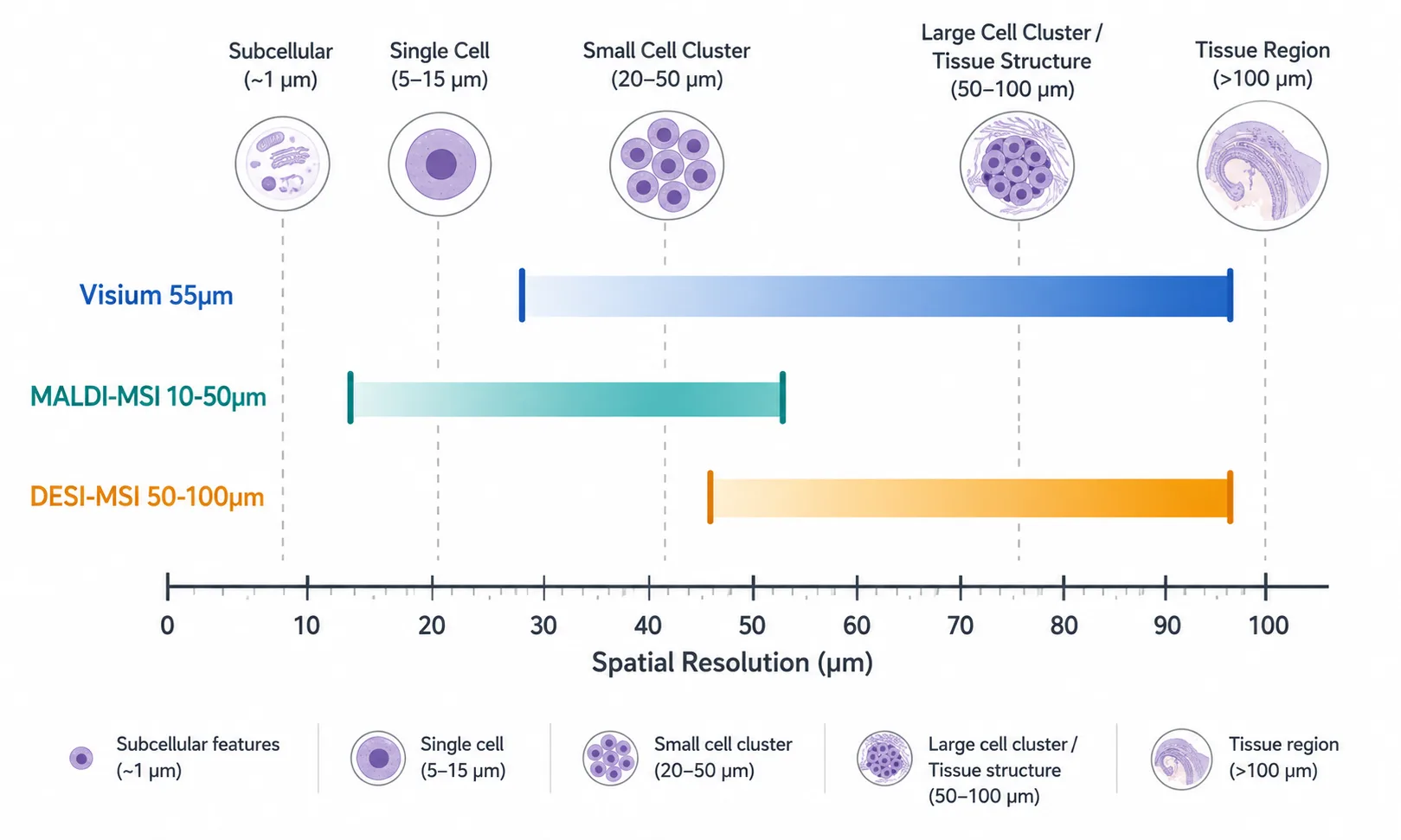 A horizontal resolution bar chart comparing Visium (55 µm), MALDI-MSI (10–50 µm), and DESI-MSI (50–100 µm), showing the spatial resolution range of each platform and the tissue features resolvable at each scale.
Computational vs. Biological Integration
Not every integration requires computational alignment. When serial sections are used and the tissue has clear histological landmarks — tumor margins, cortical layers, zonal boundaries — biological integration by comparing spatial patterns across the same anatomical regions can be sufficient. A researcher studying metabolic zonation in the liver, for instance, can identify periportal and pericentral regions by histology and compare the transcript and metabolite profiles across those zones without pixel-level registration.
Computational integration becomes essential for three scenarios: when spatial patterns are subtle and not visible by histology alone, when the tissue lacks clear anatomical reference points, and when the analysis requires testing statistically significant co-localization across thousands of features. Tools like MAGPIE, SMINT, and integrated multi-omics analysis pipelines automate this registration and provide quantitative metrics for spatial correlation.
Discovery vs. Validation: A Critical Distinction
One of the most important — and most frequently overlooked — concepts in spatial multi-omics is the difference between a discovery and a validation. Confusing the two leads to overclaimed results, irreproducible findings, and wasted follow-up effort.
What Counts as Discovery
Any spatial correlation observed between a transcript and a metabolite in a single cohort is a discovery. It generates a hypothesis: that the gene and the metabolite are functionally linked in the tissue context. This includes co-localization heatmaps, correlation clusters, and spatial patterns that coincide across modalities. Discovery-level findings are valuable for generating new biological hypotheses and prioritizing targets for follow-up.
What Counts as Validation
A spatial multi-omics finding becomes a validated result only after independent confirmation. Three levels of validation are generally recognized, in increasing order of rigor.
Level 1 involves an independent cohort analyzed using the same paired-section workflow. If the same transcript-metabolite correlation appears in a second set of tissue samples processed and analyzed independently, the finding is substantially more likely to reflect real biology rather than technical artifact. This level of validation is the minimum standard for reporting spatial multi-omics findings as robust observations rather than exploratory signals.
Level 2 adds orthogonal technique confirmation. For the transcript, this could mean RNAscope or immunohistochemistry on an additional set of serial sections. For the metabolite, it could mean targeted mass spectrometry imaging, or laser capture microdissection of the region of interest followed by LC-MS/MS quantification. Orthogonal confirmation using a different measurement principle significantly reduces the probability that the observed correlation is a platform-specific artifact.
Level 3 requires a functional experiment demonstrating causality. This could involve knocking down the gene of interest and showing that the corresponding metabolite distribution is altered, or inhibiting the metabolic pathway and measuring the transcriptional response. Level 3 validation is rarely achieved in spatial multi-omics studies and is not expected for most publications, but it represents the gold standard for mechanistic claims.
Figure 5: Discovery to Validation Pipeline.
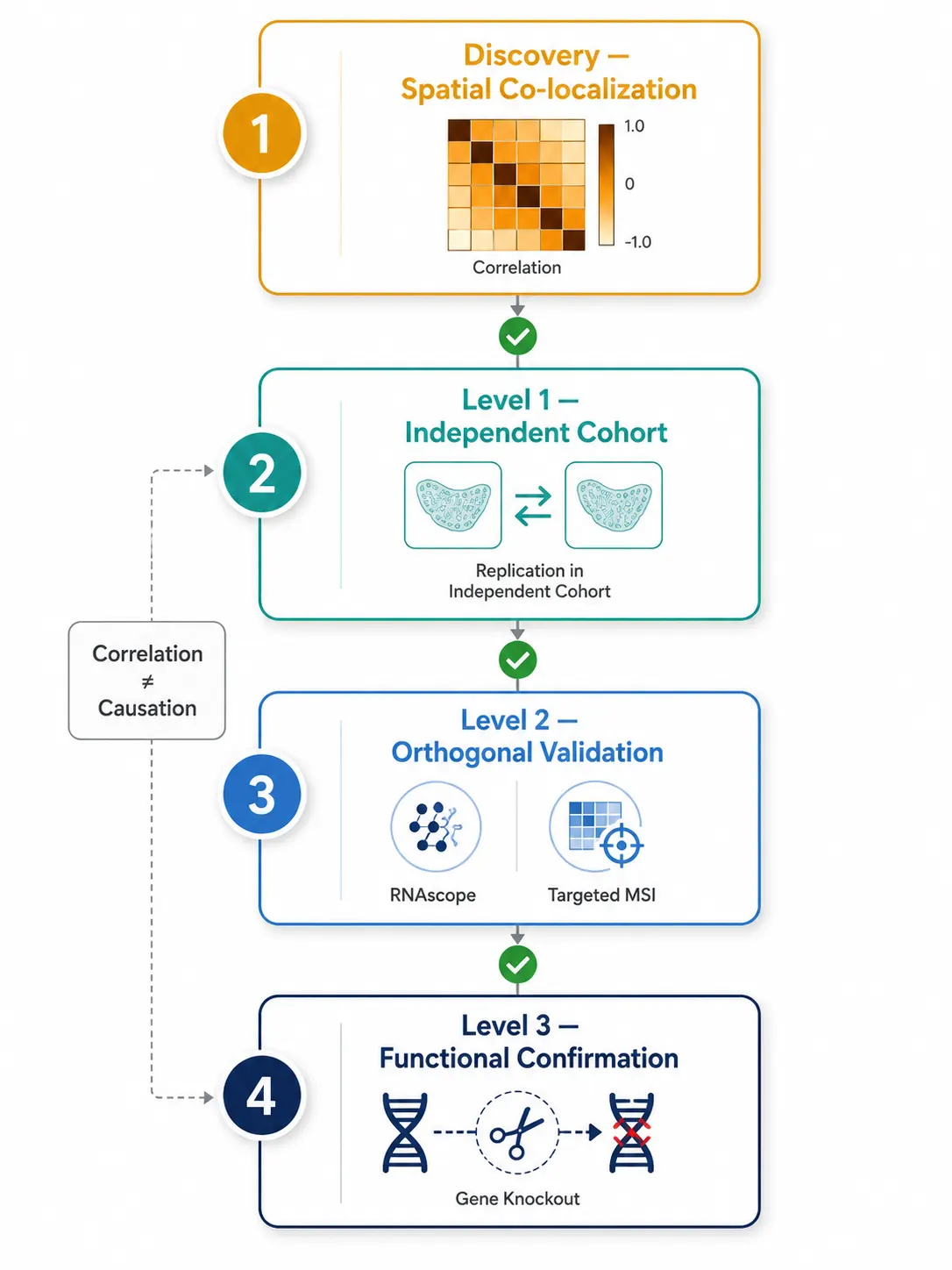 A vertical pipeline showing the progression from spatial co-localization discovery through three validation levels: independent cohort replication, orthogonal technique confirmation, and functional experimentation. Each stage includes representative icons and quality criteria.
Most published spatial multi-omics studies reach Level 1. Very few reach Level 3. This is not a weakness of the field, but it means that most findings should be described as "discoveries" or "candidates" rather than "validated biomarkers."
Common Pitfalls
The most frequent error is treating a single-cohort correlation as proof of mechanism. Batch effects, sample processing order, and platform-specific biases can all generate spatially patterned signals that appear biologically meaningful but are not reproducible. A second common error is ignoring the temporal dimension. Metabolites turn over on timescales of seconds to minutes, while transcript levels change over hours. A transcript-metabolite correlation observed at one time point may not hold under different conditions.
Case Example: Designing a TME Study with Paired Sections
Consider a researcher studying metabolic heterogeneity in clear cell renal cell carcinoma. The study has two goals: identify metabolic pathways that distinguish tumor subtypes, and determine whether a lipid species enriched in the invasive margin can serve as a candidate biomarker.
Experimental Design
The researcher uses serial sections from fresh-frozen ccRCC tissue. Section 1 is processed for Visium spatial transcriptomics. Section 2 is analyzed by MALDI-MSI for lipid profiling, focusing on glycerophospholipids and sphingolipids known to be altered in ccRCC. Both sections are cut at 10 micrometers. Section 2 is analyzed immediately to minimize metabolite degradation, while Section 1 is stored at -80 degrees Celsius for later processing.
Data Integration
The Visium and MALDI-MSI data are registered using the H&E image as a bridge. MAGPIE generates a spatial correlation map, revealing that several glycerophospholipids — particularly PE(18:0/20:4) — are spatially correlated with fatty acid desaturase gene expression at the invasive margin.
From Discovery to Validation
This correlation is a discovery. To validate it, the researcher runs an independent cohort of 10 ccRCC samples and confirms the same spatial pattern. A separate RNAscope experiment on additional sections confirms that FADS1 expression localizes to the MSI-identified regions. At this point, the finding has reached Level 2 validation and can be reported as a candidate mechanism with supporting evidence.
Figure 6: ccRCC Paired-Section Experimental Design.
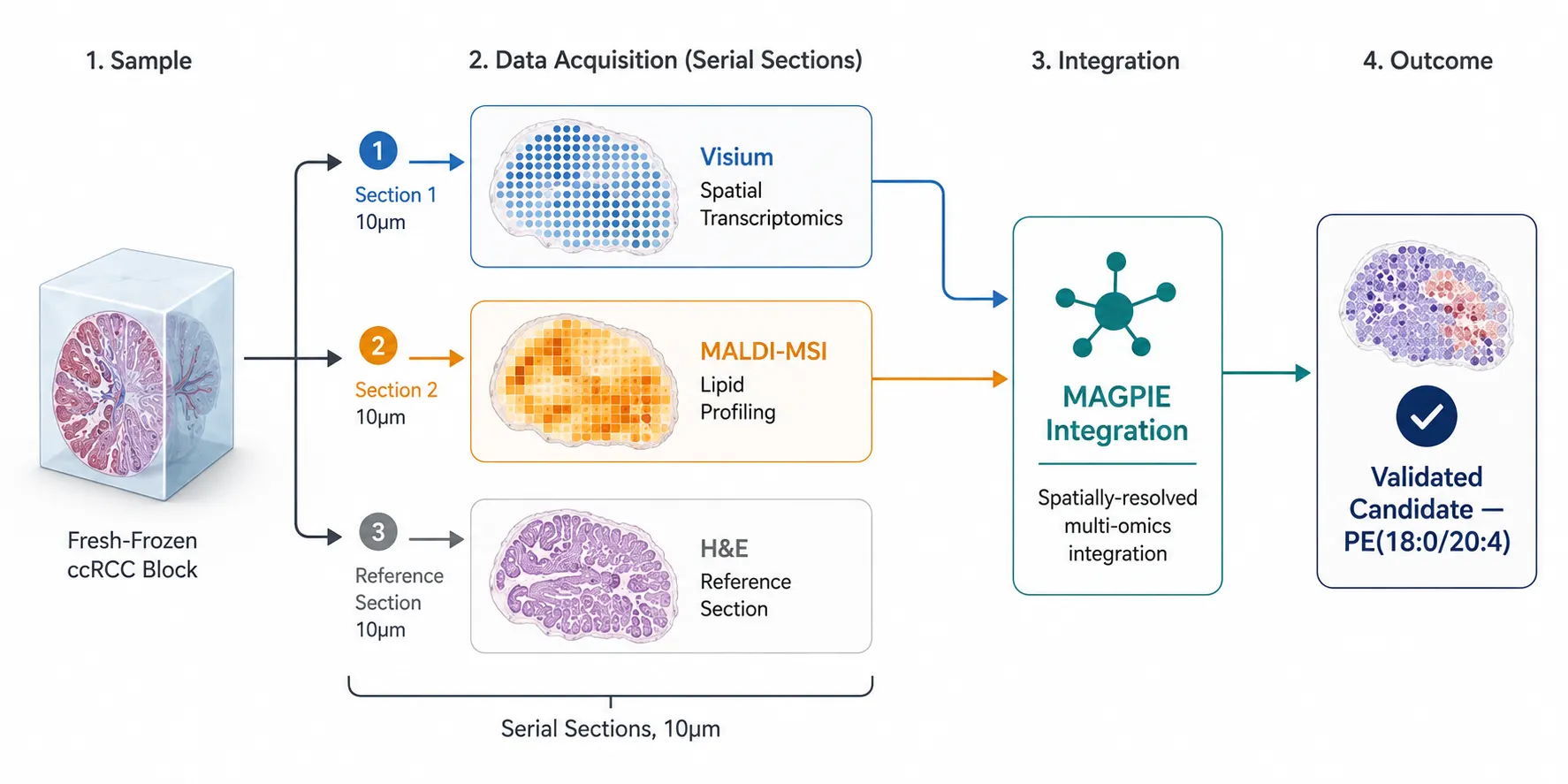 An experimental design diagram for a ccRCC tumor microenvironment study, showing serial sections routed to Visium transcriptomics and MALDI-MSI lipid profiling, with MAGPIE integration and validation workflow.
Common Mistakes in Paired-Section Experiments
- Sample mismatch. Serial sections more than 20 micrometers apart sample different cell populations. In heterogeneous tissues — tumors, brain, liver — this can introduce significant variability. Verify section proximity by reviewing the H&E image of each section before committing to the full analysis pipeline.
- Overinterpreting co-localization. A spatial correlation between a transcript and a metabolite does not imply a causal relationship. Use the discovery-validation framework described earlier to communicate findings at the appropriate confidence level.
- Metabolite instability. Metabolites degrade rapidly after tissue sectioning. Phospholipids oxidize within hours at room temperature, and nucleotides are particularly labile. Prioritize metabolite acquisition immediately after sectioning and store sections at -80 degrees Celsius with desiccant for any delay.
- Ignoring the bioinformatics load. Multi-modal integration requires computational skills beyond those needed for single-modality analysis. Planning for bioinformatics for metabolomics support at the project design stage prevents bottlenecks later in the workflow.
- Assuming FFPE compatibility. Not all metabolomics methods work on FFPE tissue. If FFPE is your only option, validate metabolite detection on a test section before committing your full cohort.
How Creative Proteomics Supports Your Spatial Multi-Omics Project
Designing a paired spatial multi-omics experiment requires coordination across tissue preparation, mass spectrometry imaging, spatial transcriptomics, and multi-modal data integration. Each of these steps has its own protocols, quality control metrics, and failure modes. Getting them to work together in a single project requires experience with all the modalities involved.
Creative Proteomics provides end-to-end support from experimental design through data acquisition and integrated analysis. Our team can help you choose between serial sections and coregistration, determine the optimal modality sequencing order, prepare tissue for both transcriptomic and metabolomic analysis, and implement the computational pipelines needed for spatial alignment and biological interpretation.
Contact our team to discuss your paired-section strategy, tissue preparation requirements, and analysis pipeline. Whether you are starting a new project or adding a metabolomics layer to existing spatial transcriptomics data, we can help you design a workflow that produces data robust enough to support both discovery and validation. Submit your project outline for a free feasibility assessment, including recommended sectioning strategy and modality sequencing plan.
FAQ
- Q1: I already have spatial transcriptomics data but no spatial metabolomics. Can I add metabolomics later?
Yes, if you have retained frozen tissue blocks. Cut serial sections and analyze by mass spectrometry imaging. The new data can be integrated with existing transcriptomics using image registration. - Q2: Can spatial metabolomics be performed on FFPE tissue?
With significant limitations. Coverage is reduced by 60 to 80 percent compared to fresh-frozen tissue. Consider targeted approaches for fixation-resistant metabolite classes. - Q3: How do I align Visium spots with MALDI-MSI pixels?
Register both datasets to the H&E image using affine transformations. Averaging metabolite signals within each Visium spot boundary is the standard approach. - Q4: Are serial sections guaranteed to contain the same cells?
Not at single-cell resolution. Sections more than 10 micrometers apart will sample different cell populations. At the tissue-region level — tumor margin, cortical layer, tissue zone — cellular composition is reproducible across adjacent sections cut within 20 micrometers. - Q5: How much computational resource is needed?
Small-scale integration (hundreds of spots, thousands of MSI pixels) runs on a standard workstation. Large multi-section studies require dedicated resources. - Q6: What level of validation is sufficient for publication?
Independent cohort confirmation is the minimum expectation. Orthogonal validation strengthens the result significantly. Causal claims require functional experiments.
References
- Sutton G, et al. MAGPIE: spatially resolved integrative analysis of transcriptomic and metabolomic data. Nat Commun. 2026;17:68003. doi: 10.1038/s41467-025-68003-w
- Yuan Y, et al. SMIntegration: a web tool for comprehensive spatial metabolomics and transcriptomics integration. Gigascience. 2026;15:giag033. doi: 10.1093/gigascience/giag033/8539742
- Vandereyken K, et al. Mapping biology in space: from spatial transcriptomics platforms to multi-omics integration. Sci China Life Sci. 2026;69:1-20. doi: 10.1007/s11427-025-2600-x
- Dries R, et al. SpatialMETA: a framework for integrating spatial transcriptomics and metabolomics data. Zenodo. 2025. doi: 10.5281/zenodo.14982604
- Janesick A, et al. Systematic benchmarking of imaging spatial transcriptomics platforms in FFPE tissues. Nat Commun. 2025;16:64990. doi: 10.1038/s41467-025-64990-y