Urinary Peptidomics for Endogenous Peptide Profiling
Urine contains naturally occurring peptides generated by protein processing, proteolysis, filtration, tubular handling, secretion, and shedding from the urinary tract. Urinary peptidomics examines these endogenous peptide species without routine enzymatic digestion, preserving information about native peptide termini, overlapping peptide families, and proteolytic processing that can be lost in conventional bottom-up proteomics.
A useful study can begin with a broad urine peptide profiling question, a defined biological comparison, a candidate biomarker list, or a specific protease-processing hypothesis. The analytical route should be chosen around that decision rather than treating every urine sample with the same workflow.
This page focuses on urine-specific study design and interpretation. For broader endogenous peptide profiling across multiple tissues and biofluids, see our Endogenous Peptidomics Platform.
Urinary Peptidomics vs. Urinary Proteomics
| Feature | Urinary Peptidomics | Urinary Proteomics |
|---|---|---|
| Primary analytes | Naturally occurring endogenous peptides already present in urine | Intact urinary proteins analyzed directly or, more commonly, after enzymatic digestion |
| Routine digestion | Not used for the discovery workflow because native peptide termini and sequence boundaries are part of the biological signal | Frequently uses tryptic or other enzymatic digestion for bottom-up protein identification |
| Biological information | Peptide abundance, cleavage patterns, precursor regions, peptide families, and selected endogenous modifications | Protein abundance, protein identity, pathway-level protein changes, and protein-level modifications when specifically analyzed |
| Typical use | Endogenous peptide profiling, proteolytic processing research, peptide biomarker discovery, and targeted peptide follow-up | Protein biomarker discovery, urinary protein profiling, and broader proteome characterization |
Pre-Analytical Study Design and Urine Sample Preparation
Urine is easy to collect but highly variable in dilution and composition. Collection timing, void type, hydration status, processing delay, storage history, particulates, blood contamination, protein load, and repeated freeze-thaw cycles can all affect comparability. These variables should be documented and kept as consistent as practical across study groups.
LC-MS/MS and CE-MS Strategies for Urinary Peptidomics
LC-MS/MS and capillary electrophoresis-mass spectrometry (CE-MS) answer overlapping but not identical questions. Platform selection should reflect whether the priority is sequence-rich discovery, reproducible peptide-pattern profiling, large-cohort comparison, targeted confirmation, or a combination of these tasks.
| Analytical Strategy | Best Fit | Key Considerations |
|---|---|---|
| LC-MS/MS | Sequence-centric discovery, broad endogenous peptide identification, modification-aware analysis, and flexible targeted follow-up | Requires effective desalting and chromatography; non-tryptic search space and peptide identification confidence need to be managed carefully |
| CE-MS | Reproducible urinary peptide pattern profiling, relative profiling, cohort comparison, and established urinary peptide signature workflows | Sequence assignment may be supported by tandem MS or complementary LC-MS/MS; migration-time alignment and reference matching are central to cross-run comparability |
| Targeted PRM/MRM | Verification or quantitative follow-up of prioritized peptide candidates | Best used after candidate sequence and analytical behavior are established; isotope-labeled standards can be incorporated when the project requires higher quantitative confidence |
| Combined Discovery and Targeted Workflow | Projects moving from broad urinary peptidome discovery to a defined candidate panel | Discovery and verification should be treated as separate evidence stages with method-specific QC and normalization |
LC-MS/MS is particularly useful when the project needs direct sequence evidence and detailed peptide annotation. CE-MS is well established for urinary peptide fingerprinting and longitudinal or cohort-level profiling. A hybrid strategy can use one platform for reproducible feature profiling and another for confident sequence assignment or targeted verification.
Quantification, Normalization, and Peptide Interpretation
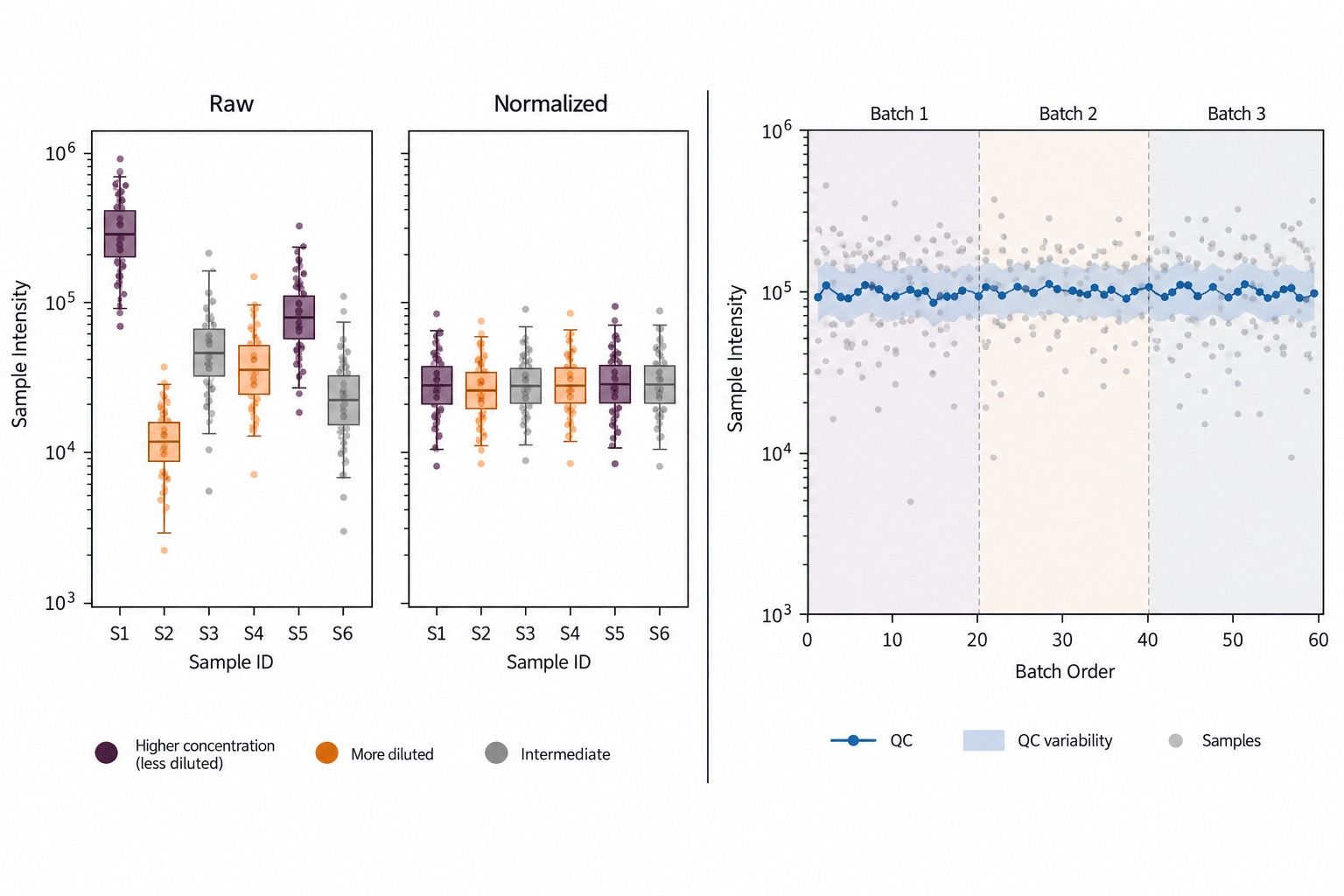
Urinary peptide abundance is influenced by both biology and urine concentration. No single normalization rule is appropriate for every study. The strategy should distinguish analytical normalization from biological dilution correction and should be chosen before statistical testing whenever possible.
| Normalization Approach | Typical Use | Interpretation Point |
|---|---|---|
| Creatinine-Referenced Normalization | Spot-urine studies where variation in urine concentration is an important source of noise | Useful in many cohorts but not a universal correction; creatinine itself can vary with subject and study context |
| Specific Gravity or Osmolality | Dilution adjustment when these measurements are collected consistently | Reflects urine concentration but does not directly measure peptide excretion |
| Timed-Volume or Excretion-Based Normalization | Timed urine collections designed to estimate output over a defined interval | Depends on reliable collection timing and completeness |
| Internal Standard / Analytical Normalization | Controls extraction, injection, detector response, or batch-level technical variation | Improves analytical comparability but does not replace correction for biological urine dilution |
| Global Peptide Signal Normalization | Discovery datasets when global intensity behavior and study assumptions support it | Should be assessed carefully when large biological shifts or heavy proteinuria alter the overall peptide distribution |
Projects focused specifically on protease substrates, cleavage networks, or enzyme-centered interpretation can be connected to our Degradomics and Protease Profiling Services.
Urinary Peptide Biomarker Discovery and Targeted Follow-Up
Urine is especially useful for research biomarker discovery because it can be collected repeatedly and contains peptide patterns that reflect renal handling, extracellular matrix remodeling, proteolysis, and other systemic or urinary-tract processes. The goal of a discovery study is not simply to generate a long peptide list, but to identify candidates that remain technically reproducible, biologically interpretable, and suitable for verification.
For broader candidate-discovery strategy, see Peptide Biomarker Identification Services. Candidates that are ready for sequence-specific MS follow-up can transition to PRM-Based Peptide Quantification.
Common Urinary Peptidomics Project Scenarios
Urinary Peptidomics Workflow
Study Design
Define urine collection, groups, time points, normalization plan, and
discovery or verification goal
Sample QC & Peptide Enrichment
Review pre-analytics, clarify samples, reduce matrix interference, and
enrich endogenous peptides
LC-MS/MS or CE-MS Profiling
Select sequence-centric discovery, reproducible feature profiling, or a
combined analytical route
Normalization & Interpretation
Control dilution and batch effects, identify peptides, map precursor
regions, and compare groups
Candidate Prioritization & Follow-Up
Rank reproducible peptide candidates and transfer selected sequences to
targeted verification when needed
1
Study Design
Define the biological comparison, collection type, time points,
known confounders, batch structure, available urine metadata, and the intended decision. The
normalization strategy and analytical platform are planned before data generation whenever
possible.
2
Sample QC and Peptide Enrichment
Samples are reviewed for handling consistency and matrix
quality, then clarified and processed with a urine-compatible peptide enrichment and desalting
strategy. The objective is to retain endogenous peptide information while reducing protein,
particulate, salt, and small-molecule interference.
3
LC-MS/MS or CE-MS Profiling
The analytical route is matched to the study goal. LC-MS/MS
supports sequence-rich identification and flexible peptide characterization, while CE-MS can
support reproducible feature-pattern analysis in urine cohorts. Complementary workflows can be
combined when profiling and sequence assignment need different strengths.
4
Normalization and Interpretation
Peptide data are normalized using a strategy appropriate to the
collection design and available metadata. Identified peptides are mapped to source proteins
and overlapping sequence regions, followed by differential analysis, batch-aware QC, and
cleavage-pattern interpretation where relevant.
5
Candidate Prioritization and Follow-Up
Candidates are ranked using analytical confidence,
reproducibility, biological context, and performance across the research dataset. Selected
sequences can move into targeted-MS or other orthogonal follow-up studies with a clearly
separated validation stage.
Information Needed to Start a Urinary Peptidomics Project
| Project Information | What to Provide | Why It Matters |
|---|---|---|
| Research Goal | Discovery profiling, group comparison, longitudinal monitoring, protease-processing research, candidate verification, or another defined objective | Determines whether the project should begin with broad profiling, targeted analysis, or a combined workflow |
| Urine Collection Design | First-morning, spot, timed, or another collection scheme; include timing consistency and collection-site information when available | Collection design affects biological variability and the most appropriate normalization strategy |
| Processing and Storage | Time to processing/freezing, centrifugation or filtration steps, storage temperature, aliquoting, and freeze-thaw history | Helps assess whether pre-analytical variation could confound peptide differences |
| Available Normalization Metadata | Creatinine, specific gravity, osmolality, timed volume, or other relevant measurements if collected | Supports a defensible strategy for urine dilution correction |
| Study Groups and Batches | Group labels, time points, randomization constraints, collection sites, and expected analytical batches | Allows QC, bridge samples, and batch-aware statistics to be planned before acquisition |
| Known Candidate Peptides | Sequences, precursor proteins, prior MS evidence, or target analytes if the study is not purely discovery-based | Determines whether targeted PRM/MRM or stable-isotope-assisted follow-up should be incorporated |
For project scoping, the most useful starting information is the biological comparison, urine collection protocol, storage history, available dilution markers, approximate cohort structure, and whether the goal is discovery or verification. Exact material requirements can then be defined around the analytical route rather than applying one universal urine volume.
Representative Results
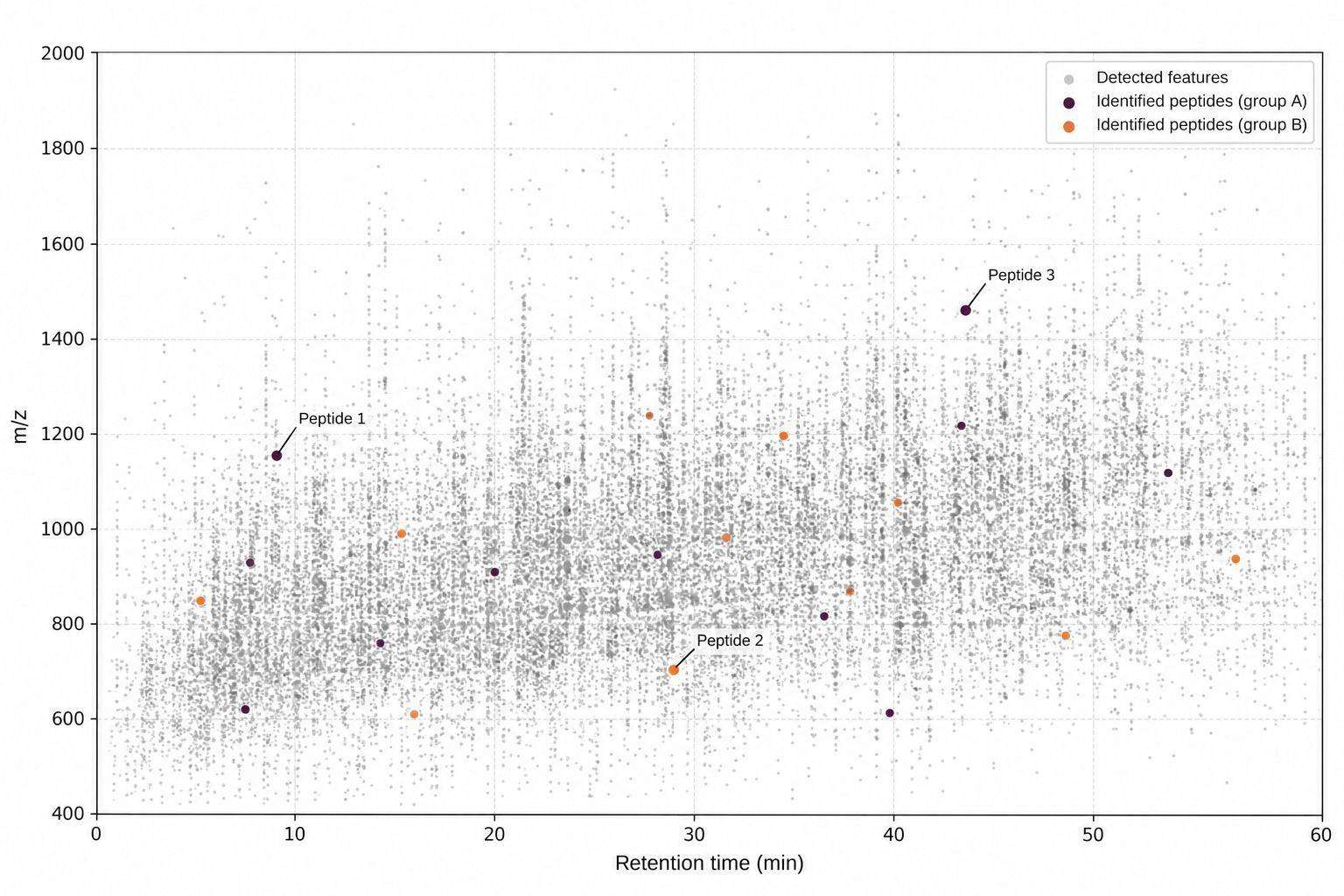
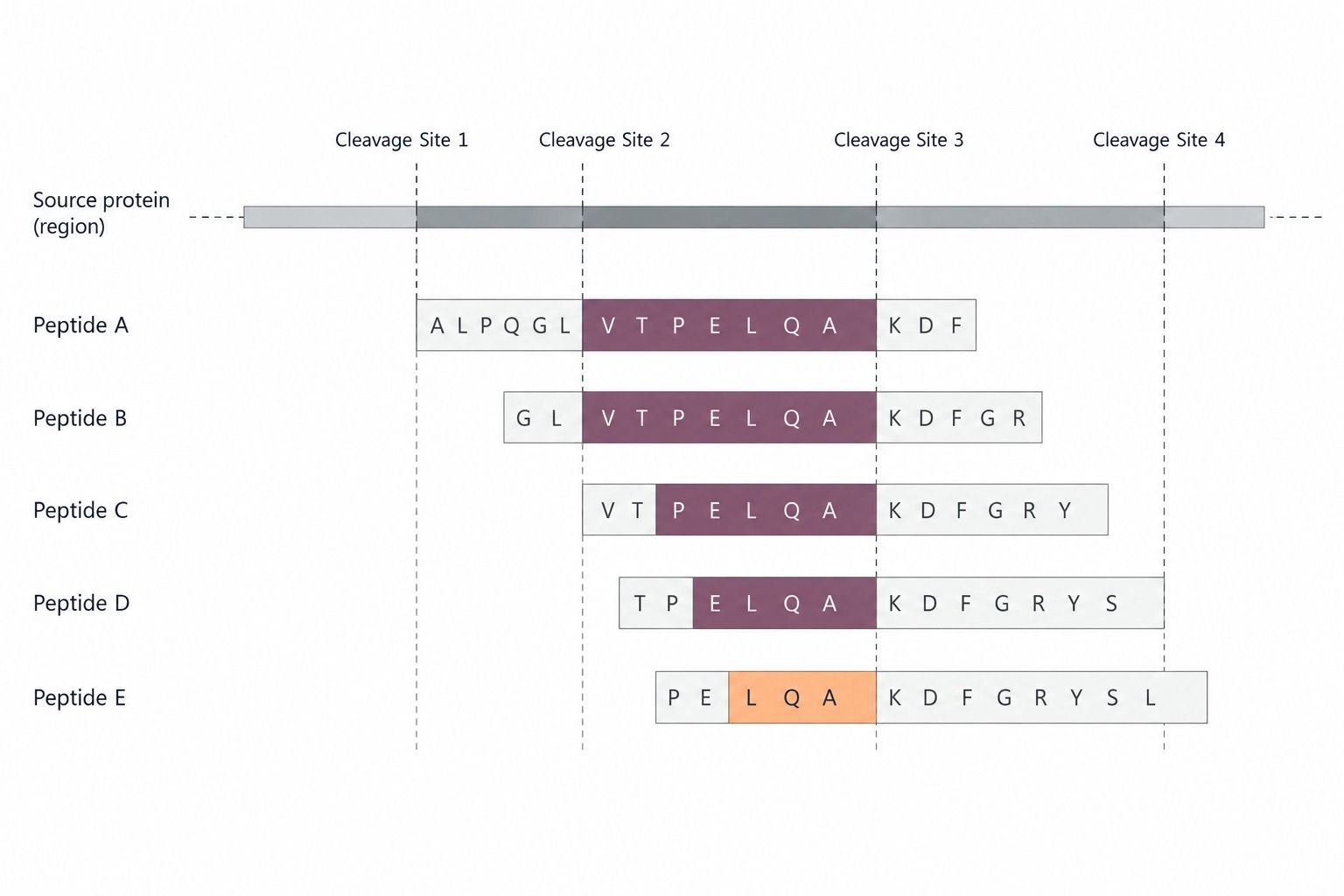
The result types below illustrate how urinary peptidomics data can be presented for research projects. They are schematic examples rather than data from a specific customer study.
Urinary Peptide Feature Landscape
Normalization and Batch QC
Source-Protein and Cleavage Mapping
Targeted Verification of Candidate Peptides
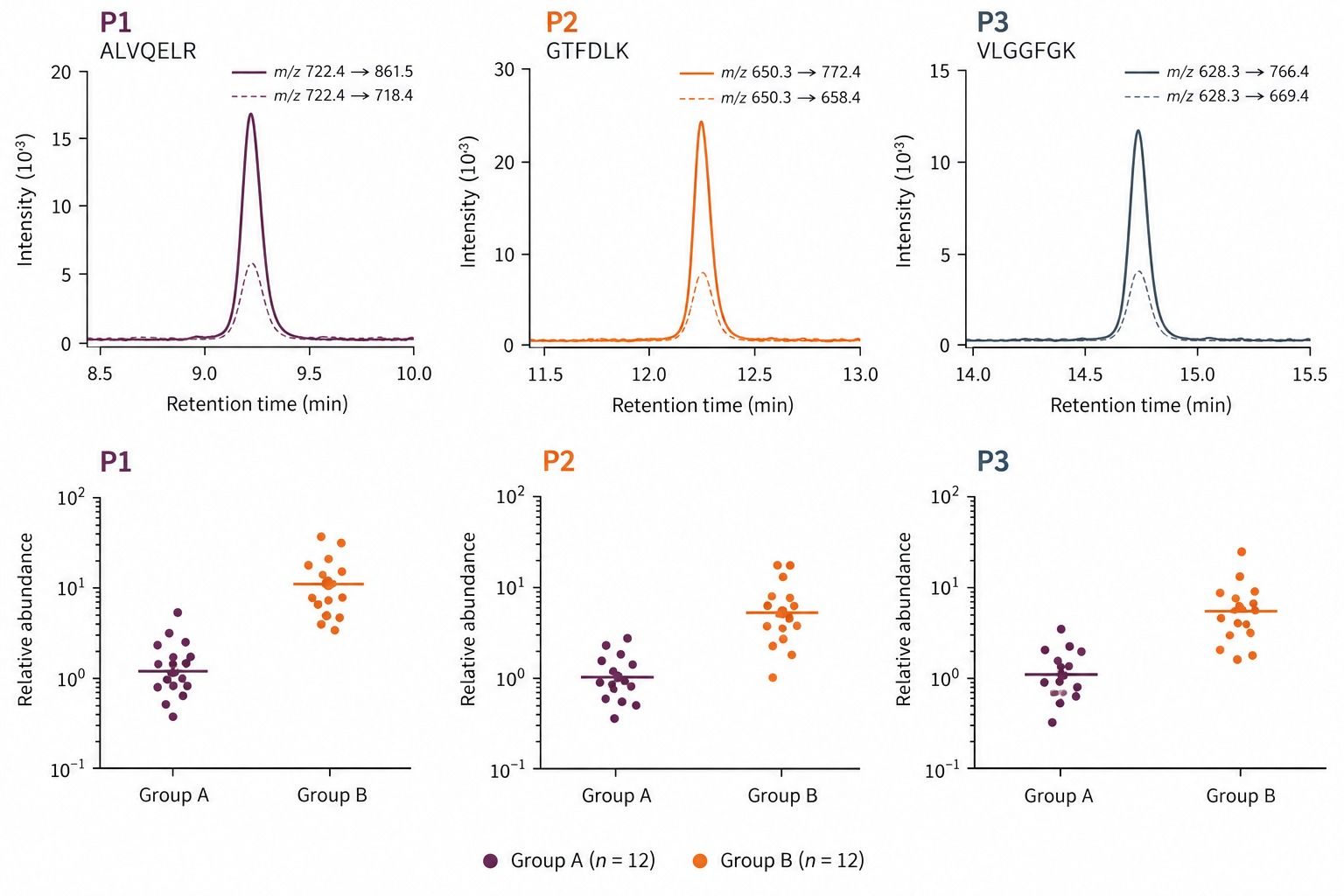
Representative outputs are illustrative. Final plots, normalization, statistical comparisons, and verification formats depend on sample collection, analytical platform, cohort design, and project-specific data quality.
Typical Deliverables
- Urinary Peptide Identification Table
Endogenous peptide sequences with analytical evidence and confidence fields appropriate to the selected LC-MS/MS or CE-MS-supported workflow. - Normalized Peptide-Abundance Matrix
Peptide-level quantitative or relative abundance data with the normalization strategy and QC logic documented. - Source-Protein and Peptide-Family Annotation
Mapping of peptides to source proteins, precursor regions, overlapping sequence families, and cleavage positions when supported by the data. - Comparative and Statistical Results
Study-design-appropriate differential analysis, longitudinal comparison, clustering, multivariate summaries, or other prespecified research statistics. - Biomarker Candidate Prioritization
A ranked set of peptide candidates or panels with evidence level, reproducibility, analytical behavior, and proposed follow-up route. - Targeted Follow-Up Data
PRM, MRM, stable-isotope-assisted, or other verification results when included in the project scope. - Analytical Report and Data Package
Methods, QC summaries, representative spectra or electrophoretic/chromatographic views, processed data, interpretation notes, and project-specific data files.
References
- Zakharova NV, Bugrova AE, Indeykina MI, Brzhozovskiy AG, Nikolaev EN, Kononikhin AS. The Strategy for Peptidomic LC-MS/MS Data Analysis: The Case of Urinary Peptidome Study. Methods Mol Biol. 2024;2758:389-399. https://doi.org/10.1007/978-1-0716-3646-6_21
- Catanese L, Siwy J, Mischak H, Wendt R, Beige J, Rupprecht H. Recent Advances in Urinary Peptide and Proteomic Biomarkers in Chronic Kidney Disease: A Systematic Review. Int J Mol Sci. 2023;24(11):9156. https://doi.org/10.3390/ijms24119156
- Palanski BA, Weng N, Zhang L, et al. An efficient urine peptidomics workflow identifies chemically defined dietary gluten peptides from patients with celiac disease. Nat Commun. 2022;13:888. https://doi.org/10.1038/s41467-022-28353-1
- Sirolli V, Pieroni L, Di Liberato L, Urbani A, Bonomini M. Urinary Peptidomic Biomarkers in Kidney Diseases. Int J Mol Sci. 2020;21(1):96. https://doi.org/10.3390/ijms21010096
- Magalhaes P, Pontillo C, Pejchinovski M, et al. Comparison of Urine and Plasma Peptidome Indicates Selectivity in Renal Peptide Handling. Proteomics Clin Appl. 2018;12(5):e1700163. https://doi.org/10.1002/prca.201700163
For research use only. Not for use in diagnostic or therapeutic procedures.
FAQ for Urinary Peptidomics
What is the difference between urinary peptidomics and urinary proteomics?
+
Urinary peptidomics focuses on naturally occurring endogenous peptides already
present in urine and normally avoids routine enzymatic digestion so native peptide boundaries are
preserved. Urinary proteomics primarily studies proteins, often after tryptic digestion. Peptidomics is
therefore better suited to peptide-level abundance, cleavage-pattern, and proteolytic-processing
questions.
Should I choose LC-MS/MS or CE-MS for a urine peptidomics study?
+
LC-MS/MS is well suited to sequence-centric discovery and detailed peptide
identification, while CE-MS is established for reproducible urinary peptide patterning and cohort-level
relative profiling. The best choice depends on whether sequence depth, cross-run feature consistency,
cohort scale, or targeted follow-up is the primary goal. Some projects combine the strengths of both.
What type of urine collection is best for peptidomics?
+
There is no universal best collection type. First-morning, standardized spot,
random spot, or timed urine may all be appropriate depending on the research question. The most
important rule for comparative studies is to standardize the chosen collection design across groups and
document timing, processing, and storage variables.
How should urine peptide data be normalized?
+
Normalization depends on collection design and available metadata. Creatinine,
specific gravity, osmolality, timed-volume information, internal standards, and global peptide-signal
approaches can each be useful in different contexts. Analytical normalization and biological dilution
correction are separate issues and may need to be combined rather than relying on one universal method.
Can archived or previously frozen urine be analyzed?
+
Often yes, provided the samples and metadata are suitable for the study. Storage
temperature, processing delay, aliquoting, freeze-thaw history, collection protocol, and batch structure
should be reviewed before analysis. Archived cohorts are most interpretable when these variables are
reasonably consistent or can be incorporated into the statistical design.
Do urinary peptidomics samples require tryptic digestion?
+
Not for a standard endogenous urinary peptidomics discovery workflow. The purpose
is to measure peptides that are already present in urine, so routine digestion would replace native
peptide boundaries with digestion-derived peptides. Digestion-based urinary proteomics is a different
analytical question.
Can urinary peptidomics be used for biomarker discovery?
+
Yes, for research biomarker discovery. Comparative studies can identify
reproducible peptide candidates or peptide panels and then prioritize them for targeted verification.
Candidate interpretation should consider sample dilution, batch effects, sequence confidence,
source-protein context, and independent research validation rather than relying on differential
abundance alone.
Can urinary peptide candidates be verified by PRM or MRM?
+
Yes. Once candidate sequences and analytical behavior are established, selected
peptides can move into PRM, MRM, stable-isotope-assisted quantification, or another fit-for-purpose
targeted workflow. Discovery and verification should be treated as distinct evidence stages with
appropriate controls and QC.
Can protease activity be inferred from urinary peptide patterns?
+
Urinary peptide termini and overlapping peptide families can support hypotheses
about altered proteolytic processing and candidate proteases. Such inference is not the same as directly
measuring enzyme activity, so stronger mechanistic claims require orthogonal evidence or a dedicated
protease-focused experiment.
How much urine is required? +
Input is project-dependent. The required amount depends on sample concentration,
peptide enrichment strategy, LC-MS/MS or CE-MS route, replicate design, and whether targeted follow-up
is planned. Exact requirements should be determined during project scoping rather than applying one
fixed volume to every study.
What information should I provide for a project quote?
+
Provide the research question, urine collection protocol, storage and processing
history, approximate number of samples and study groups, available creatinine or other dilution
measurements, and whether the goal is discovery or verification. If candidate peptides are already
known, include their sequences and any prior analytical evidence.