Why Untargeted Neuropeptidomics Reveals Biology Beyond Proteomics
Understanding the genetic potential of a cell is no longer enough to map complex biological phenotypes. While transcriptomics and spatial mapping have revolutionized our view of cellular architecture, a fundamental biological gap remains: transcript levels rarely equate to active functional peptides. Furthermore, conventional bottom-up proteomics is heavily biased toward high-abundance structural and housekeeping proteins, often acting as a blunt instrument that misses the nuanced signaling layer.
Neuropeptides and endogenous signaling fragments exist at the very apex of biological execution. To uncover the true drivers of a phenotype, researchers must profile the native peptidome. Our untargeted neuropeptidomics service is designed as the ultimate "missing link" engine. By capturing peptides in their naturally cleaved, endogenously modified states, we reveal a critical layer of biology that standard omics pipelines structurally destroy.
When to Use Untargeted Neuropeptidomics
Creative Proteomics delivers a turnkey neuropeptidomics solution, combining low-MW peptide enrichment, advanced LC-MS/MS, and deep PTM-aware bioinformatics. This platform uncovers functional neuropeptides with high precision across diverse experimental settings:
What Biological Questions Untargeted Neuropeptidomics Can Answer
Our endogenous peptide discovery pipeline is highly customized to address complex, high-order biological questions that span both fundamental neuroscience and translational medicine:
- Uncovering Hidden Signaling Pathways: Which previously uncharacterized neuroendocrine pathways are activated or suppressed under specific physiological conditions, disease states, or environmental stressors?
- Revealing System-Level Remodeling: How does the global peptidome network shift in response to neuroinflammation, neurodegeneration, metabolic stress, or targeted pharmacological intervention across the gut-brain axis?
- Detecting Low-Abundance Regulators: Can we efficiently identify transient, highly potent signaling fragments that operate well below the dynamic detection threshold of conventional mass spectrometry?
- Mapping Prohormone Processing Dynamics: How do specific disease states alter the precise enzymatic cleavage patterns of parent prohormones, leading to entirely different bioactive outputs and signaling outcomes?
From Global Discovery to Mechanistic Insights
A standard mass spectrometry output is often just a massive, unstructured list of peptide identifications—leaving your bioinformatics team to spend weeks deciphering the actual biological meaning. Our service is structurally different. We focus on transforming raw untargeted data into actionable biological assets.
We deliver a comprehensive Mechanism Package designed to instantly clarify your phenotype. By mapping differential endogenous peptides against highly curated biological databases, our pipeline provides two critical interpretative deliverables:
- Pathway Enrichment Mapping: We definitively identify which metabolic, synaptic, or neuroinflammatory networks are significantly disrupted by your experimental conditions.
- Peptide-Precursor Network Analysis: We connect individual active signaling fragments back to their parent prohormones to determine if specific enzymatic cleavage dynamics have been altered.
(For multi-omics researchers, we also provide advanced integrated analysis of neuropeptidomics.)
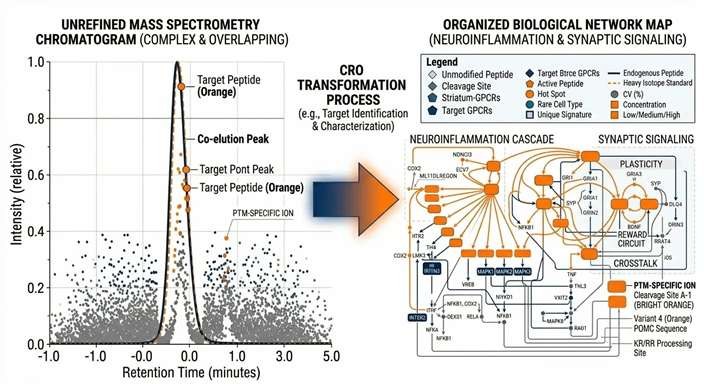
Untargeted Neuropeptidomics Workflow for Endogenous Peptide Discovery
To successfully map the native peptidome, the workflow must fundamentally diverge from conventional tryptic-digestion protocols. We employ highly specialized techniques to halt degradation, enrich for functional signals, and interpret complex mass spectra:
Thermal Quenching
Native Extraction
Deep MS Acquisition
Custom Bioinformatics
1
Pre-Analytical Thermal Quenching
Endogenous neuropeptides are highly unstable and can degrade in seconds ex vivo. We utilize rapid thermal inactivation protocols (e.g., focused microwave irradiation at 95°C) immediately upon tissue collection to instantly neutralize endogenous proteases and lock the peptidome in its true physiological state.
2
Non-Tryptic, Native Extraction
Instead of using trypsin to digest bulk proteins into uniform fragments, we employ advanced <10-30 kDa Molecular Weight Cut-Off (MWCO) ultrafiltration combined with tailored solid-phase extraction techniques. This deliberately discards high-mass structural proteins while carefully preserving the intact native peptides in the flow-through.
3
PTM-Aware Deep MS Acquisition
Using state-of-the-art Orbitrap Astral™ and timsTOF Pro platforms, we execute deep scans optimized for low-molecular-weight analytes. We guarantee unparalleled analytical confidence with resolving power up to 120,000 FWHM and mass accuracy < 2 ppm, critical for distinguishing complex PTMs on short peptides.
4
Custom Bioinformatics Pipeline
Searching for non-tryptic peptides creates an exponentially massive bioinformatic search space. Raw spectra are mapped using unconstrained database searches combined with de novo sequencing assisted identification. We utilize strict Target-Decoy approaches to rigorously control the False Discovery Rate (FDR < 1%) at the peptide level.
Why Standard Proteomics Misses Neuropeptide Biology
While conventional bottom-up proteomics is excellent for profiling fundamental cellular machinery, it operates on biological principles that are actively detrimental to neuropeptide pathway analysis.
| Analytical Dimension | Untargeted Neuropeptidomics (Our Service) | Conventional Bottom-Up Proteomics |
|---|---|---|
| Enzymatic Cleavage Strategy | Preserved (Non-tryptic, native extraction) | Destroyed by forced trypsin digestion |
| Bioinformatics Search Space | Unconstrained (No specific cleavage rules, requiring high-power algorithms) | Highly predictable (Strict trypsin cleavage rules applied) |
| Short Peptide (<10 aa) Detection | High (Optimized for low-MW endogenous fragments) | Very Poor (Washed out or ignored by algorithms) |
| PTM Integrity | Intact (e.g., C-terminal amidation retained) | Often lost, unpredictable, or unmappable |
| Primary Biological Insight | Active signaling & actual physiological cleavage events | Precursor protein abundance and structural potential |
Selection Strategy: Use untargeted neuropeptidomics when your primary research goal is to map intercellular communication, signaling networks, neuroendocrine responses, or secretory profiles. Use conventional shotgun proteomics when profiling overall intracellular structure, organelle composition, or broad metabolic enzyme abundance.
Applications in Mechanism Discovery and Candidate Generation
Our untargeted peptidomics analysis spans highly diverse sample origins—ranging from precise brain microdissections to complex circulating biofluids—empowering a wide array of high-impact research applications:
- Pathway Discovery: Mapping novel, region-specific neuropeptidergic circuits in central nervous system structures or peripheral tissues.
- Drug Mechanism of Action (MOA) Profiling: Identifying the exact secondary signaling cascades and off-target molecular events triggered by a novel pharmacological compound.
- Phenotype Explanation: Providing robust molecular definitions for unique behavioral models, metabolic anomalies, or stress-related animal models that lack clear genomic drivers.
- Upstream Biomarker Candidate Generation: Establishing a foundational, data-driven pool of differentially expressed peptides for future diagnostic exploration and translational assay development.
What You Gain: From Discovery Outputs to Candidate Panels
Discovery without rigorous downstream validation is scientifically incomplete. Our bioinformatics deliverables are intentionally structured as a seamless, actionable bridge to your next research phase.
Beyond providing a global view of the peptidome, we distill the massive mass spectrometry dataset down to a highly curated candidate shortlist (typically identifying the top 10 to 100 high-confidence, differentially expressed peptides based on strict p-value and fold-change thresholds). This shortlist is analytically vetted for mass spectrometry suitability, ensuring that your transition into downstream targeted PRM validation is a precise, scientific necessity.
To instantly accelerate this translational handoff, we deliver a ready-to-use PRM Transition List—including empirical precursor m/z, optimal charge states, high-intensity fragment ions, and observed retention times—ensuring your targets are instantly prepared for rapid, large-cohort assay design.
Demo Results and Deliverables for Mechanism Discovery
Our comprehensive mechanism package includes publication-ready visual assets and deep analytical datasets designed for rigorous peer review:
PCA / PLS-DA
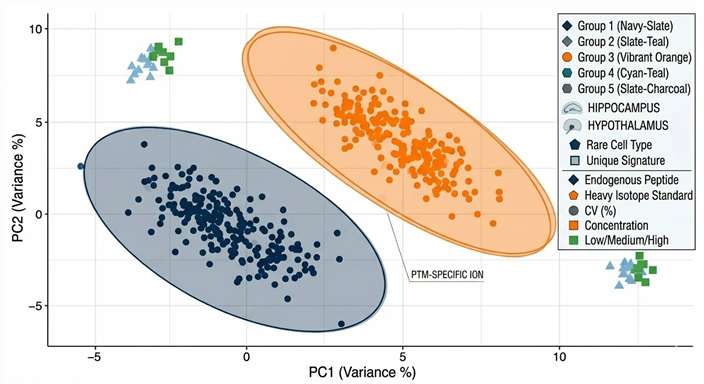
Demonstrates robust, system-level separation between your experimental and control groups based purely on their native peptidome profiles.
Volcano Plots
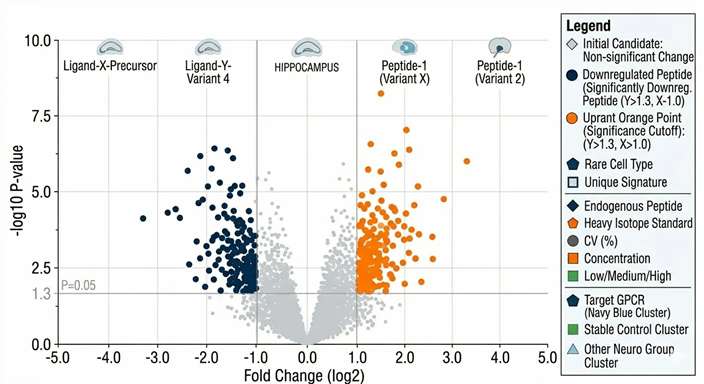
Rapidly identifies the most statistically significant endogenous peptide shifts driving your phenotype, clearly mapping up- and down-regulated targets.
Pathway Enrichment
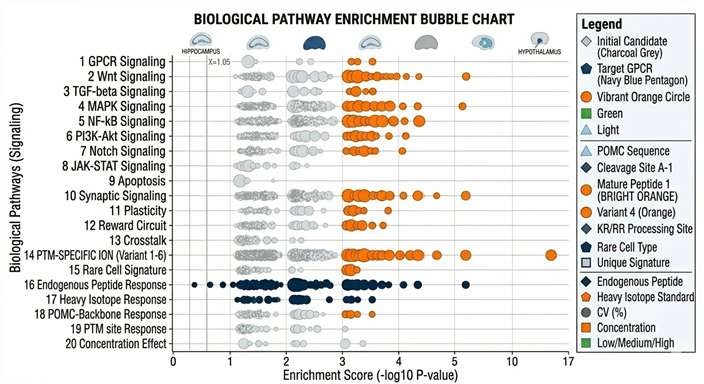
Maps identified endogenous peptides to known biological cascades and ontologies to definitively explain drug MOAs or complex phenotypic traits.
Peptide Network
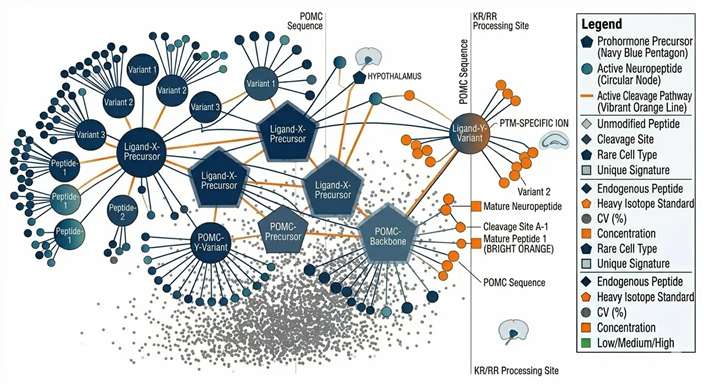
Visualizes the hierarchical relationship between active cleavage products and their parent prohormones, powerfully illustrating complex enzymatic remodeling across tissue states.
Sample Requirements for Untargeted Neuropeptidomics
We accept a highly versatile range of sample inputs, carefully processing everything from deep spatial mapping tissues to circulating biofluids. Strict adherence to pre-analytical stabilization is critical for peptidomics success:
| Sample Type | Discovery Application | Minimum Input | Stabilization & Key Notes |
|---|---|---|---|
| Brain Tissue / Microdissections | Regional mechanism & pathway profiling | 20 mg | Immediate snap-freeze in liquid nitrogen or rapid thermal inactivation required to halt post-mortem degradation. |
| Cerebrospinal Fluid (CSF) | Central signaling pool discovery | 500 µL | Protease inhibitor cocktail must be added immediately upon collection. Centrifuge at 4°C to remove cell debris prior to freezing. |
| Cell Culture Supernatant | In vitro release mechanisms & secretome | 2 mL | Rapid thermal quenching required. Media should ideally be serum-free or rigorously depleted of high-abundance proteins. |
| Plasma / Serum | Systemic regulatory networks | 500 µL | Collect in EDTA tubes (plasma) with broad-spectrum protease inhibitors (e.g., Aprotinin/DPP-IV inhibitors). Avoid freeze-thaw cycles. |
Disclaimer: All services and platforms described are for Research Use Only (RUO). Not for use in diagnostic procedures.
What is the main difference between untargeted neuropeptidomics and conventional bottom-up proteomics? +
Standard shotgun proteomics relies on utilizing enzymes like trypsin to digest large proteins into uniform, predictable fragments. This fundamentally destroys naturally occurring short signaling peptides. Our specialized peptidomics service intentionally avoids enzymatic digestion, utilizing MWCO filtration and specific extraction buffers to capture, sequence, and quantify the endogenous, biologically active peptidome in its native state.
Why do you use a non-tryptic extraction method? +
Endogenous neuropeptides are already cleaved by highly specific physiological enzymes (like prohormone convertases) to become biologically active. Applying trypsin in the laboratory would cleave these already-short molecules further into pieces too small for mass spectrometers to capture or accurately sequence, effectively erasing the biological signal we are trying to measure.
How does your bioinformatics pipeline handle complex Post-Translational Modifications (PTMs)? +
Endogenous peptides frequently carry critical PTMs—such as C-terminal amidation, N-terminal pyroglutamation, or phosphorylation—which strictly dictate their receptor binding affinity and biological half-life. Our unconstrained database search algorithms and de novo pipelines are specifically configured to identify these dynamic modifications without artificially inflating the False Discovery Rate (FDR < 1%). We report the exact modified state of the peptide, ensuring your mechanistic insights reflect true bioactive molecules.
How many differential peptides can I expect to find? +
While our global high-resolution scans may detect thousands of mass features, a high-quality, well-controlled biological experiment typically yields hundreds of statistically significant differential peptides. From this broad pool, our expert bioinformatics team will collaborate with you to curate a highly robust, actionable shortlist of 10 to 100 ideal candidates for downstream mechanistic follow-up or cohort validation.
How do your outputs transition into targeted validation? +
Our mechanism packages are inherently designed with the end in mind. We do not just provide names; we provide the exact peptide sequences, PTM locations, empirical retention times, and m/z transition lists of your most promising candidates. This physical and chemical data is perfectly formatted to instantly build custom panels for Parallel Reaction Monitoring (PRM), seamlessly transitioning your project from an open discovery phase to rigorous, absolute quantification.