Why Targeted Neuropeptide Quantification Matters for Validation
Identifying a novel peptide biomarker in a discovery cohort is merely the first step. The true challenge—often referred to as the "valley of death" in biomarker development—lies in translating that finding into a validated marker across hundreds of clinical samples. Unlike untargeted discovery proteomics, which screens for the broad presence of thousands of potential signals but suffers from missing values and stochastic sampling limits, clinical translation demands the precise, reproducible, and rapid measurement of specific candidate molecules.
Validating neuropeptides requires a robust, targeted approach tailored specifically to endogenous fragments. These bioactive molecules exist in extremely low physiological abundances (often in the low picogram/mL range) and lack the predictable tryptic cleavage sites relied upon by standard proteomics platforms. Furthermore, they are highly susceptible to rapid ex vivo degradation. Our targeted neuropeptide quantification service bridges this exact gap. It moves your project from initial discovery omics to definitive clinical reality by providing the exact mass-to-charge (m/z) specificity and attomole-level sensitivity required for regulatory-grade, high-throughput validation.
When to Use Targeted Neuropeptide Quantification for Validation
Our PRM/MRM platform is the definitive solution when you need clinical-grade certainty but lack the time, budget, or biological feasibility to develop custom immunoassay tools.
| Clinical Translation Scenario | Why Targeted PRM/MRM is Required |
|---|---|
| Validating Discovery Hits | Confirm top CSF or plasma candidates from an integrated analysis of neuropeptidomics in a larger, independent Phase II/III clinical cohort. |
| Monitoring Treatment Response | Longitudinally track the up- or down-regulation of specific neuropeptides across multiple patient visits to establish pharmacodynamic (PD) proof-of-concept. |
| Bypassing Antibody Limitations | Commercial ELISAs are unavailable, lack analytical sensitivity, or fail to distinguish between native and functional post-translationally modified (PTM) forms. |
| Translational Method Setup | Require a robust, multiplexed analytical assay scalable into a Laboratory Developed Test (LDT) for future diagnostic applications. |
What We Quantify: From Candidate Neuropeptides to Custom Panels
We do not offer a generic "one-size-fits-all" proteomics assay; we build customized multiplexed neuropeptide assay MRM panels designed explicitly to answer your specific biological questions.
Relative vs. Absolute Quantification
Our targeted analytical pipelines are highly adaptable to the specific phase, regulatory requirements, and budget of your translational research program:
| Feature | Relative Quantification (Label-Free PRM) | Absolute Quantification (AQUA) |
|---|---|---|
| Primary Use Case | Initial screening & condition comparison. | Clinical biomarker validation & regulatory submission. |
| Target Multiplexing | High (e.g., 30–50+ targets). | Focused panels (e.g., 5–20 targets). |
| Internal Standard | Not required. | Heavy Isotope-Labeled Peptides (13C/15N). |
| Data Output Metric | Fold-change (Relative abundance ratio). | Exact absolute concentration (e.g., pg/mL). |
| Matrix Effect Control | Standard computational normalization. | Precise correction via co-eluting heavy standard. |
Why Antibody-Free Quantification Matters for Neuropeptides
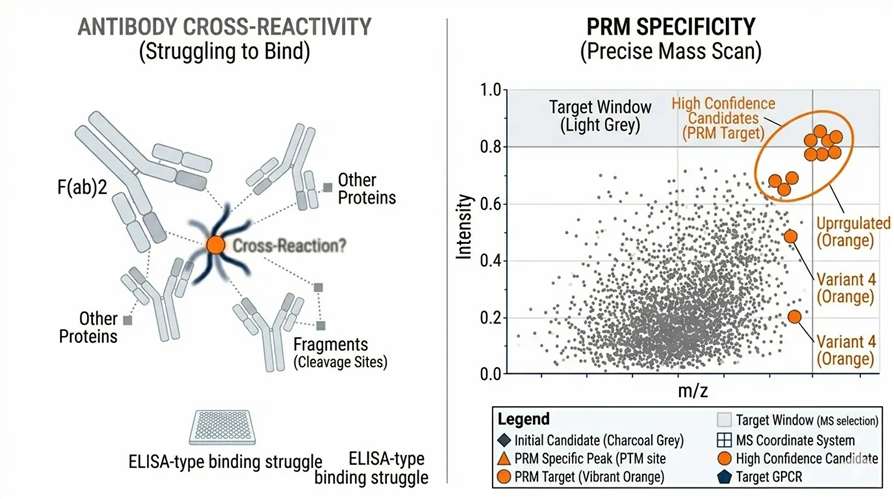
Limitations of Immunoassays: Developing antibodies for short neuropeptides (<10 amino acids) is notoriously difficult due to poor immunogenicity. Commercial antibodies often suffer from cross-reactivity with homologous prohormones and fail to distinguish functional PTMs.
The Mass-Spec Advantage: Our antibody-free peptide quantification service eliminates the 6–12 month antibody development risk. By utilizing precise mass-to-charge (m/z) ratios of intact peptides and their fragmentation ions, PRM/MRM delivers 100% sequence specificity. We measure the molecule itself—not a secondary binding event—ensuring unparalleled accuracy and zero lot-to-lot variability in complex matrices.
Targeted PRM/MRM Workflow and QC Checkpoints for Neuropeptides
Achieving a CV of < 15% across hundreds of clinical samples is not an accident; it demands an uncompromising, end-to-end workflow designed specifically to halt neuropeptide degradation and maximize signal recovery:
Pre-Analytical Stabilization
Endogenous Enrichment
Assay Optimization
Multiplexed Acquisition
Bioinformatic QC
1
Pre-Analytical Stabilization
Immediate application of proprietary rapid thermal stabilization and specialized protease inhibitor cocktails upon sample collection to lock the native peptidome.
2
Endogenous Enrichment
Non-tryptic, low-molecular-weight extraction protocols that actively discard high-abundance structural proteins while selectively preserving fragile endogenous peptide fragments.
3
Assay Development & Optimization
Rigorous in silico transition selection, collision energy (CE) optimization, and empirical retention time (RT) validation using synthetic heavy reference peptides.
4
Multiplexed Acquisition
Ultra-high sensitivity LC-MS/MS acquisition via advanced Orbitrap Astral™ or timsTOF Pro mass spectrometers.
5
Bioinformatic Extrapolation & QC
Automated peak integration, transition interference checking, and absolute concentration calculation using industry-standard Skyline software, enforcing strict FDR and CV controls.
Targeted PRM/MRM vs. ELISA for Neuropeptide Validation
| Feature | Targeted PRM/MRM (Our Service) | Traditional ELISA | Non-Targeted (Discovery) MS |
|---|---|---|---|
| Specificity | Absolute (Sequence & mass exact match) | Moderate (Cross-reactivity common) | High |
| Antibody Required? | No (Antibody-free peptide quantification) | Yes (Often unavailable for peptides) | No |
| Multiplexing | High (20-50+ peptides per run) | Low (Usually singleplex) | Massive (Thousands, but random) |
| PTM Discrimination | Yes (Distinguishes amidated vs non-amidated) | Poor (Antibodies bind both forms) | Yes |
| Quantification | Absolute (using heavy isotopes) | Relative / Absolute | Relative |
Selection Strategy: Use targeted PRM/MRM when transitioning from discovery data to clinical cohort peptide PRM profiling, or when commercial ELISA kits suffer from cross-reactivity and fail to distinguish critical neuropeptide PTMs.
Demo Results and Deliverables for Targeted Neuropeptide Quantification
We deliver decision-grade data packages that seamlessly integrate with your clinical data structures. Our outputs are designed to satisfy regulatory reviewers and internal stakeholders alike:
XIC Overlays
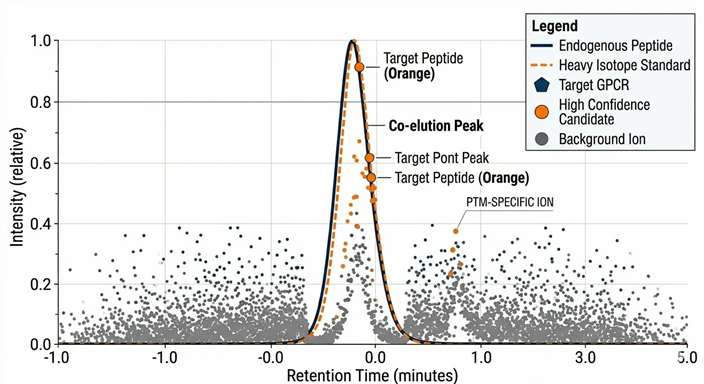
Visual validation of target identity, showing exact retention time alignment and co-elution between the endogenous light peptide and the heavy standard.
Calibration Curves
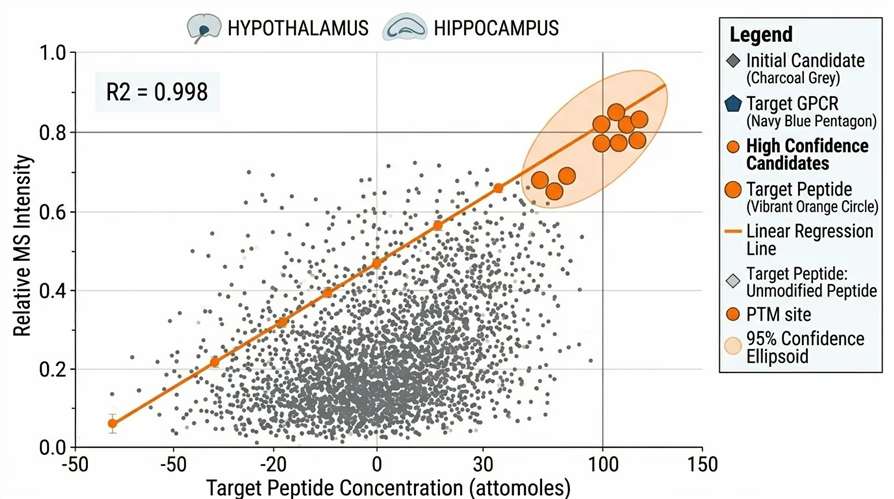
Definitive proof of assay linearity, establishing the LOD and LOQ required for absolute quantification (e.g., R-squared > 0.99).
CV Distribution
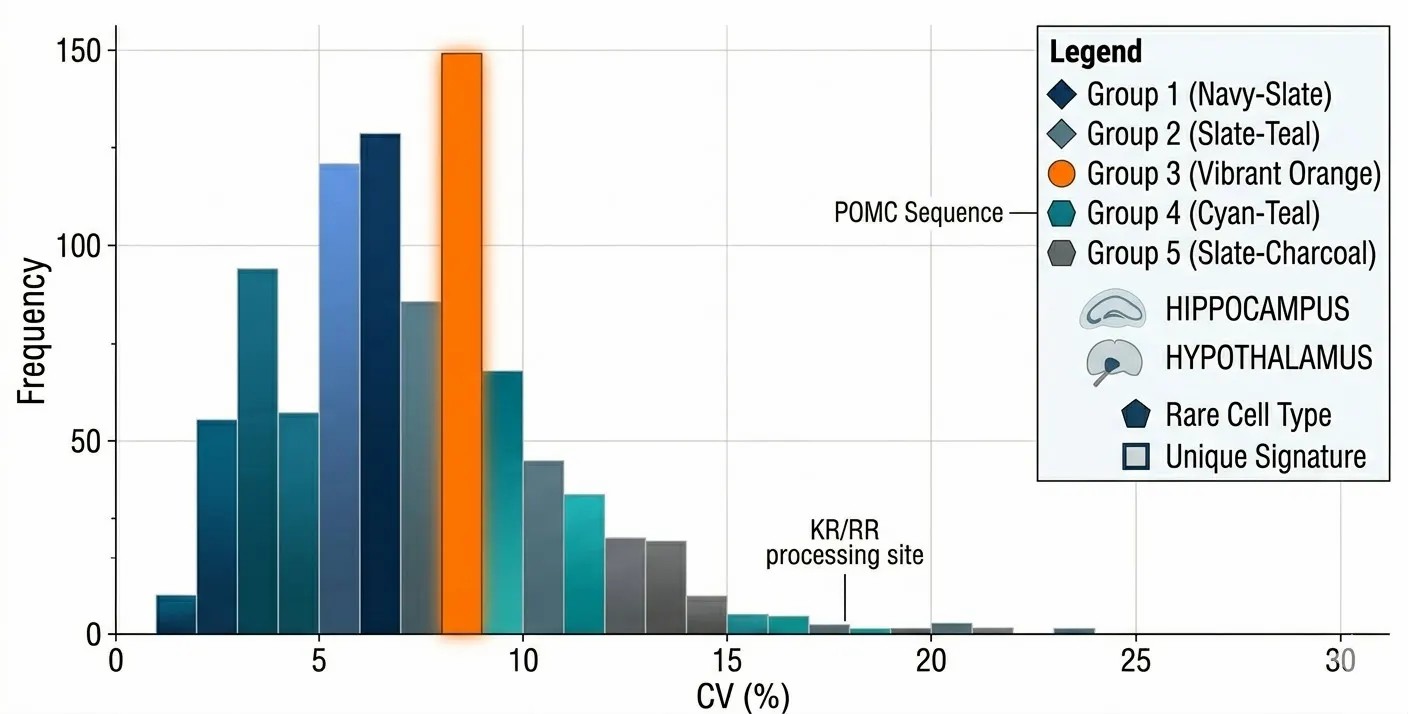
Statistical validation of assay stability across hundreds of cohort runs, demonstrating consistent clinical-grade reproducibility (CV < 15%).
Quantitative Heatmap
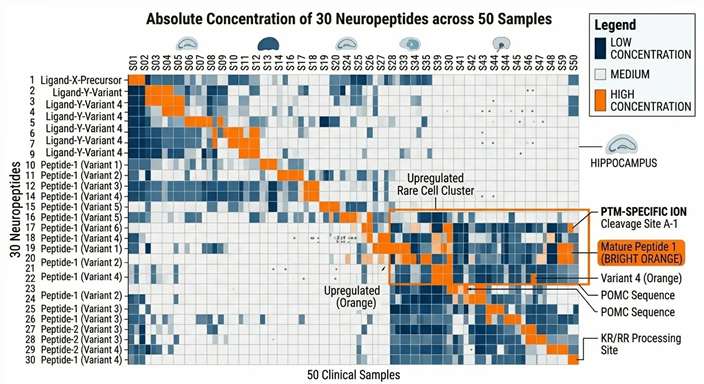
A comprehensive visual matrix displaying the absolute concentration of your targeted neuropeptide panel across diverse clinical groups.
Sample Requirements for PRM/MRM-Based Neuropeptide Validation
| Sample Type | Recommended Use | Minimum Input | Stabilization & Key Notes |
|---|---|---|---|
| CSF | CNS biomarker validation | 200 µL | Aliquot immediately; rigorous protease inhibition required. |
| Plasma / Serum | Systemic clinical cohort profiling | 200 µL | Collect in EDTA tubes (plasma); avoid freeze-thaw cycles. |
| Brain Tissue | Region-specific validation | 10 mg | Rapid thermal inactivation (snap-freeze) upon collection. |
| Cell Culture Media | In vitro secretion assays | 1 mL | Quench media immediately to prevent rapid peptide cleavage. |
Disclaimer: All services and platforms described are for Research Use Only (RUO). Not for use in diagnostic procedures.
What is the difference between PRM and MRM in neuropeptide quantification? +
Multiple Reaction Monitoring (MRM) is typically performed on triple quadrupole (QqQ) instruments, focusing on pre-selected precursor-to-fragment transitions. Parallel Reaction Monitoring (PRM), performed on high-resolution instruments like Orbitraps, monitors all fragment ions of a targeted precursor simultaneously. For complex neuropeptides in tricky matrices, PRM offers superior resolution and confidence in sequence confirmation.
How do you achieve absolute quantification without antibodies? +
We achieve neuropeptide biomarker validation PRM by synthesizing a "Heavy" version of your target neuropeptide (incorporating stable isotopes like 13C or 15N). This internal standard is spiked into every sample at a known concentration. Because the mass spectrometer can distinguish the mass difference between the endogenous "Light" peptide and the spiked "Heavy" standard, we calculate the exact absolute concentration based on the ratio of their peak areas.
How do you overcome matrix effects in CSF or plasma samples? +
Matrix effects—where high-abundance proteins suppress the ionization of low-abundance neuropeptides—are mitigated through our specialized, low-molecular-weight enrichment protocols. Furthermore, the use of perfectly co-eluting heavy isotope internal standards mathematically corrects for any remaining ion suppression, ensuring the reported concentrations remain accurate across hundreds of samples.
Can you quantify modified peptides (like C-terminal amidation)? +
Absolutely. Because PRM/MRM relies on the exact mass and unique fragmentation pattern of the molecule, we can design specific transitions to definitively distinguish an amidated neuropeptide from its unamidated precursor, a level of specificity often impossible to achieve with ELISA.
Do I need to synthesize heavy isotope-labeled standard peptides? +
You do not need to manage the synthesis. As part of our comprehensive assay development service, we handle the design, procurement, and purity validation of all necessary heavy isotope-labeled (AQUA) internal standards for your custom panel.