Profiling the Endogenous Plasma and Serum Peptidome
Plasma and serum contain naturally occurring peptides that are distinct from the intact blood proteome. These peptides can arise from proteolytic processing, coagulation and complement activity, platelet-associated events, tissue turnover, and regulated processing of peptide hormones and other bioactive precursors. Their abundance and composition can therefore reflect systemic proteolysis, secretory processing, tissue turnover, and other biological processes.
Mass spectrometry-based peptidomics analyzes this endogenous peptide pool without routine tryptic digestion. After enrichment of the low-molecular-weight fraction, peptides are separated by liquid chromatography and characterized by tandem mass spectrometry, providing direct evidence of peptide species present in the sample and complementing intact-protein proteomics and predefined immunoassays.
Because peptide profiles are highly sensitive to collection, processing, and storage, plasma and serum peptidomics requires tighter pre-analytical control than many conventional proteomics workflows. For a broader platform spanning additional sample types, see our endogenous peptidomics platform.
Plasma vs. Serum for Peptidomics Studies
Plasma and serum are related but not interchangeable matrices. The preferred sample type depends on the biological question, peptide classes of interest, available cohort material, and the consistency of the collection protocol.
| Feature | Plasma | Serum |
|---|---|---|
| Collection principle | Anticoagulated whole blood followed by cell removal | Whole blood allowed to clot before serum separation |
| Anticoagulant context | Tube chemistry should be selected and kept consistent across the study | No anticoagulant; clotting conditions become a major source of pre-analytical variation |
| Coagulation-related peptides | Better preserves the pre-clotting blood environment | Clot formation can substantially reshape coagulation- and platelet-related peptide signals |
| Platelet contribution | Can be reduced through platelet-poor preparation when required by the study | Platelet activation during clotting may contribute additional peptide species |
| Pre-analytical risk | Ongoing ex vivo proteolysis remains possible and should be controlled | Clotting introduces an additional processing interval that should be standardized |
| Typical research fit | Prospective studies, protease-system research, and quantitative comparisons | Retrospective or banked serum cohorts and studies built around an established serum protocol |
Whichever matrix is selected, consistency across all study groups is essential. Tube type, clotting or centrifugation conditions, processing delay, storage history, and other pre-analytical variables should be standardized as far as the study design allows.
Plasma and Serum Peptidomics Workflow
The workflow is adapted to the blood matrix, study objective, and required analytical depth rather than relying on one fixed preparation route.
Study Design
Define matrix, cohort structure, collection variables, and discovery or validation goals
Collection & Pre-Analytical QC
Standardize handling and review hemolysis, processing history, and matrix quality
Endogenous Peptide Enrichment
Use matrix-appropriate fractionation, cleanup, and low-molecular-weight peptide enrichment
LC-MS/MS Profiling
Characterize non-tryptic endogenous peptides with high-resolution tandem MS
Interpretation & Follow-Up
Perform peptide QC, source mapping, comparative analysis, and targeted verification when needed
1
Study Design
Define the blood matrix, biological groups, replication, collection variables, batch structure, and intended endpoint. Discovery, comparative profiling, and follow-up validation may require different analytical strategies.
2
Collection and Pre-Analytical QC
Collection and processing history are reviewed to reduce ex vivo peptide generation or degradation. Matrix quality, visible hemolysis, processing consistency, and other project-relevant quality indicators are considered before analysis.
3
Endogenous Peptide Enrichment
Low-molecular-weight peptide enrichment can be tailored using ultrafiltration, solid-phase extraction, precipitation, fractionation, or other matrix-appropriate cleanup strategies. The preparation route is selected to balance peptide recovery, matrix removal, and downstream analytical goals.
4
LC-MS/MS Peptide Profiling
Enriched endogenous peptides are analyzed without routine enzymatic digestion using high-resolution LC-MS/MS. Acquisition and search settings are adapted to non-tryptic peptide identification and selected peptide classes or modifications when included in the project scope.
5
Interpretation and Follow-Up
Peptide identifications are quality-controlled, mapped to source proteins or precursor regions, and summarized according to the study design. Prioritized candidates can be transferred to targeted MS or other orthogonal follow-up workflows when project goals require additional verification.
Analysis Modules and Project Options
Projects may focus on one analytical objective or combine discovery, interpretation, and follow-up validation in a staged program.
Applications of Plasma and Serum Peptidomics
Plasma and serum peptidomics is particularly useful when the research question depends on peptide-level events such as proteolytic processing, hormone maturation, bioactive peptide release, or circulating peptide signatures.
For projects centered on candidate peptide markers, see our peptide biomarker identification services. Broader quantitative workflows are available through our quantitative peptidomics services.
Sample Handling, QC, and Study Design
Pre-Analytical Control
Blood peptidomics is unusually sensitive to ex vivo processing. Proteases may remain active after collection, clotting can reshape the serum peptide pool, hemolysis can introduce additional peptide material, and repeated freeze-thaw or inconsistent handling can alter measured abundance. These variables should therefore be documented and controlled across all study groups.
- Matrix and tube consistency: use one matrix and one collection approach within a comparison unless the study is explicitly designed to evaluate matrix effects.
- Processing consistency: standardize clotting, centrifugation, handling delay, and storage conditions as far as practical.
- Quality screening: record hemolysis, degradation, and other matrix-quality flags consistently.
- Batch awareness: use suitable QC, reference, and normalization strategies when the study spans multiple batches or sites.
Cohort and Batch Design
| Design Element | Recommended Information | Why It Matters |
|---|---|---|
| Matrix choice | Plasma subtype or serum, selected according to the research question and available material | Plasma and serum differ in coagulation-, platelet-, and processing-related peptide content |
| Sample input | Project-dependent and confirmed during scoping | Required input varies with enrichment strategy, analytical depth, sample quality, and follow-up needs |
| Collection history | Tube type, clotting or centrifugation procedure, processing delay, storage history, and freeze-thaw information when available | Pre-analytical differences can create peptide changes unrelated to the biological comparison |
| Study groups | Balanced groups, biological replication, and batch structure | Determines whether differential and cohort-level interpretation is statistically meaningful |
| Validation plan | Targeted MS, immunoassay, or other orthogonal follow-up for prioritized candidates when required | Helps define the evidence threshold and analytical strategy during discovery |
Data Analysis and Biological Interpretation
Representative Results
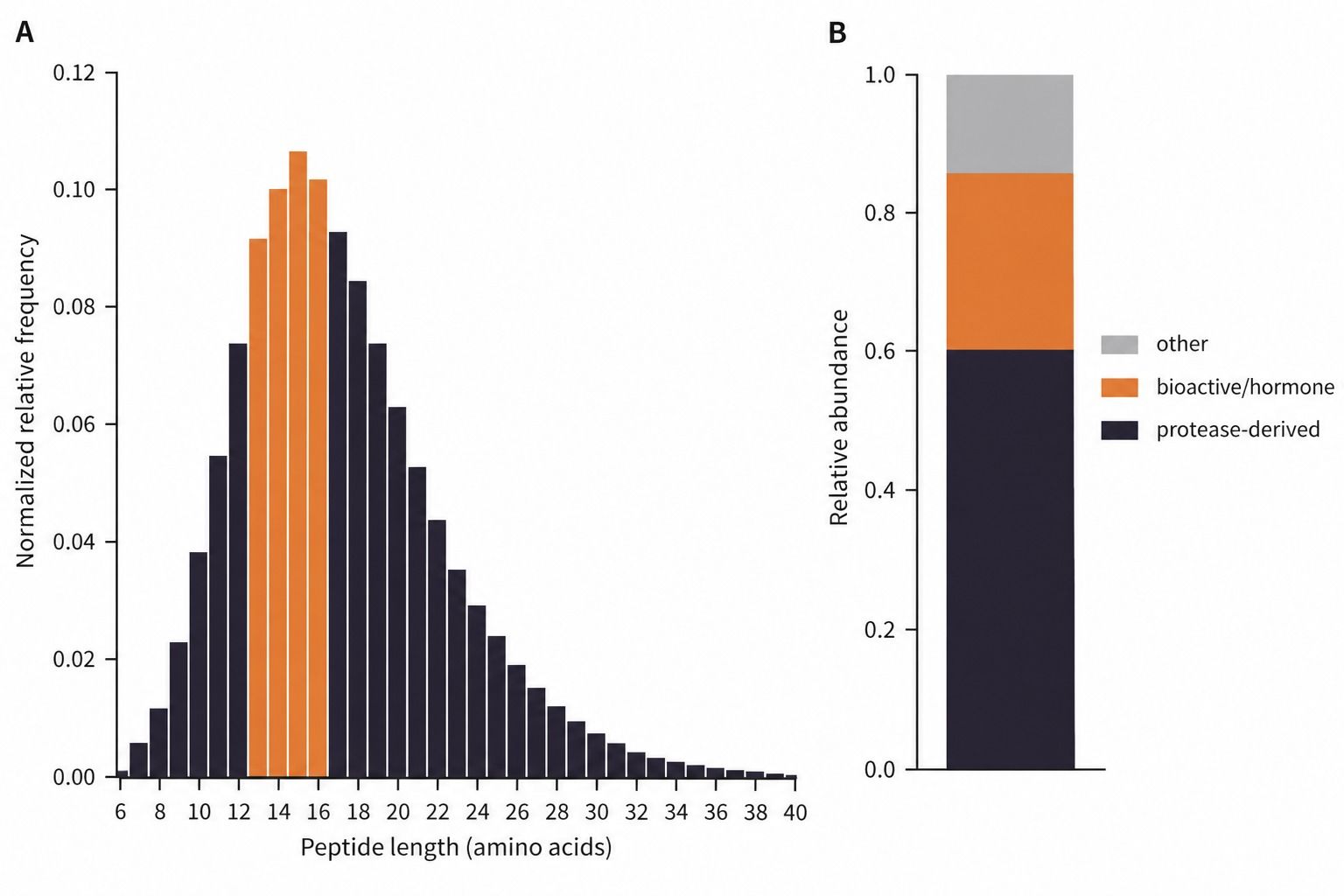
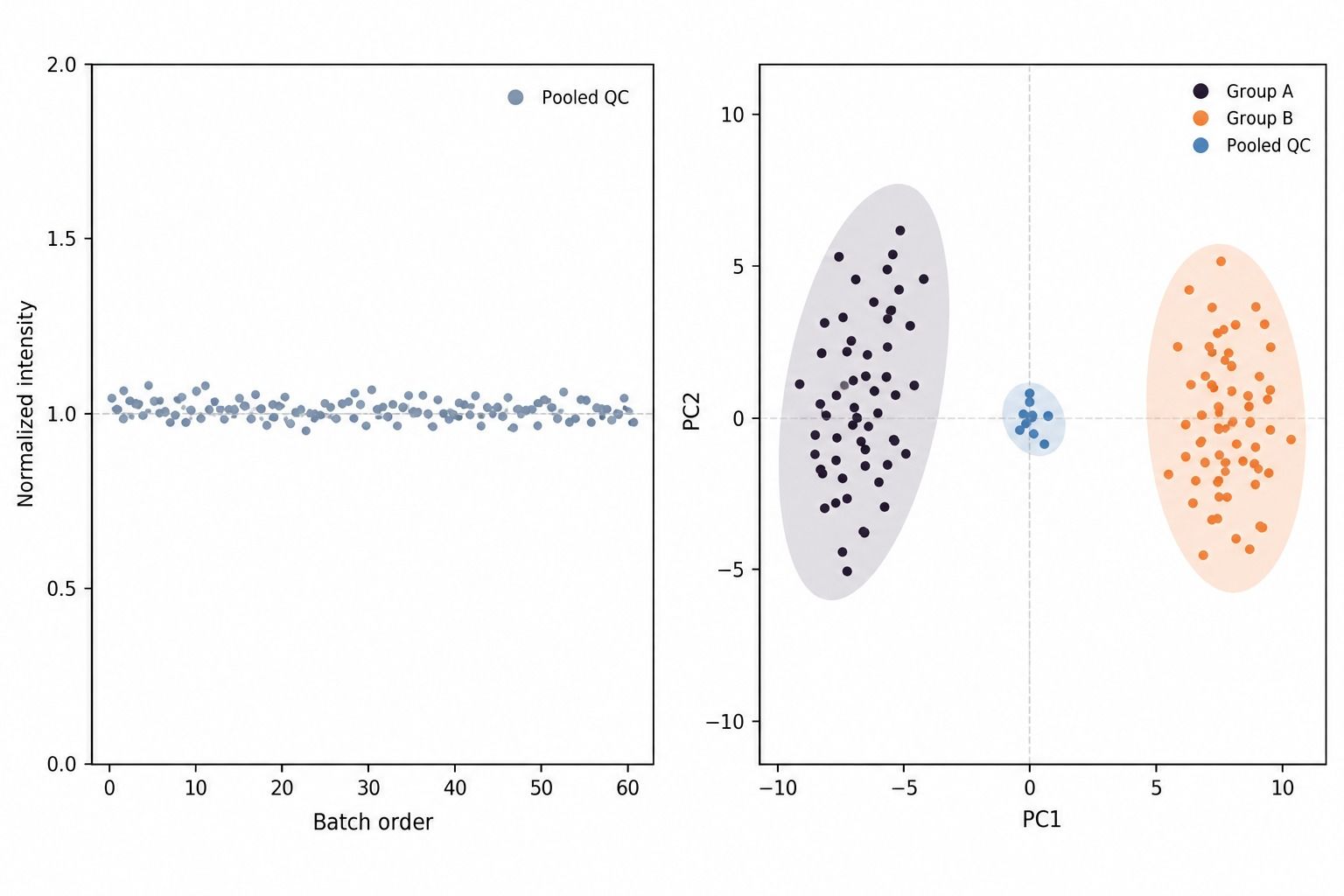
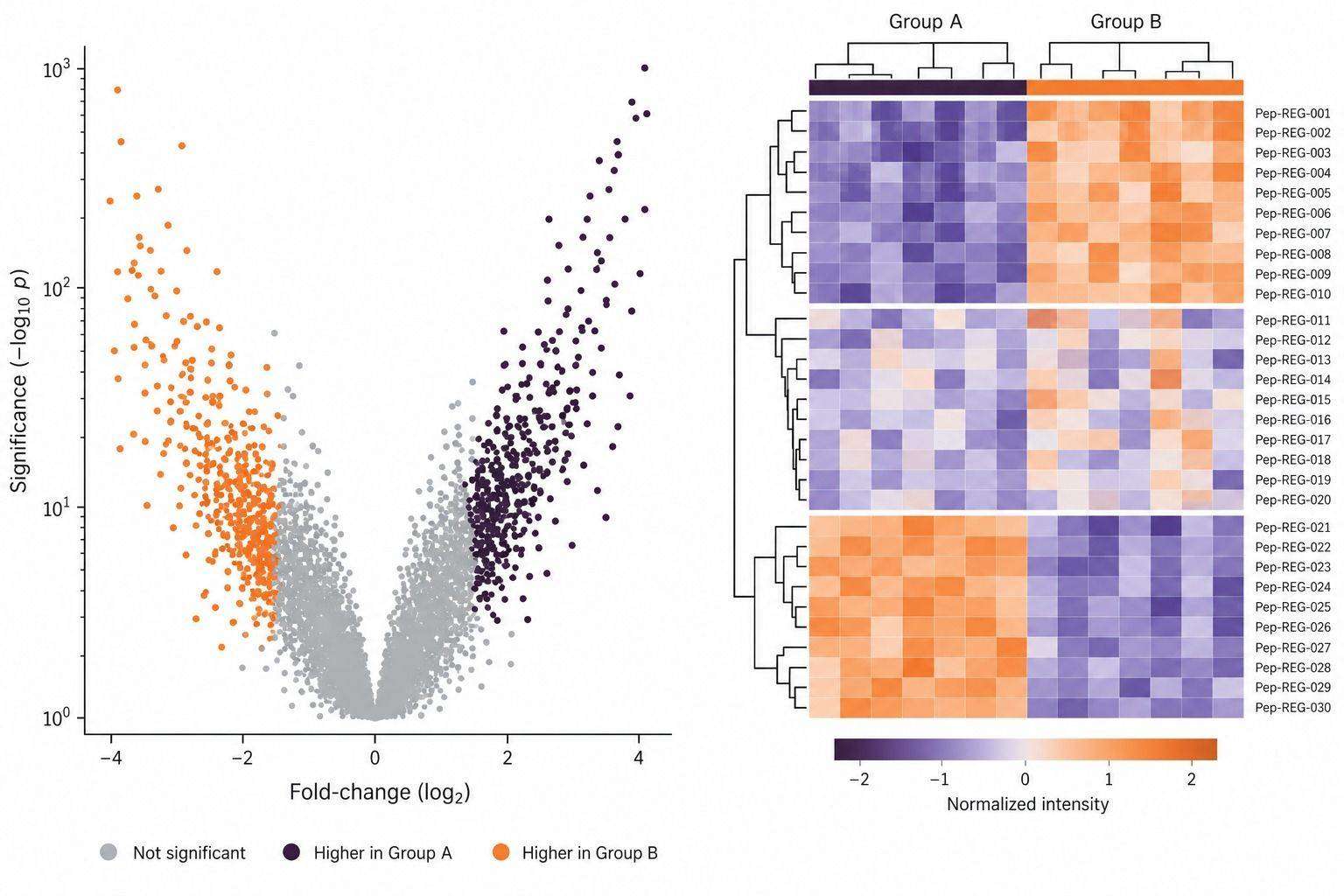
The following visualizations illustrate common result types for plasma and serum peptidomics projects. Final plots depend on the matrix, cohort design, analytical strategy, and project-specific data.
Plasma vs. Serum Peptide Repertoire
Pre-Analytical Stability and Batch QC
Differential Endogenous Peptide Profile
Targeted Verification of Candidate Peptides
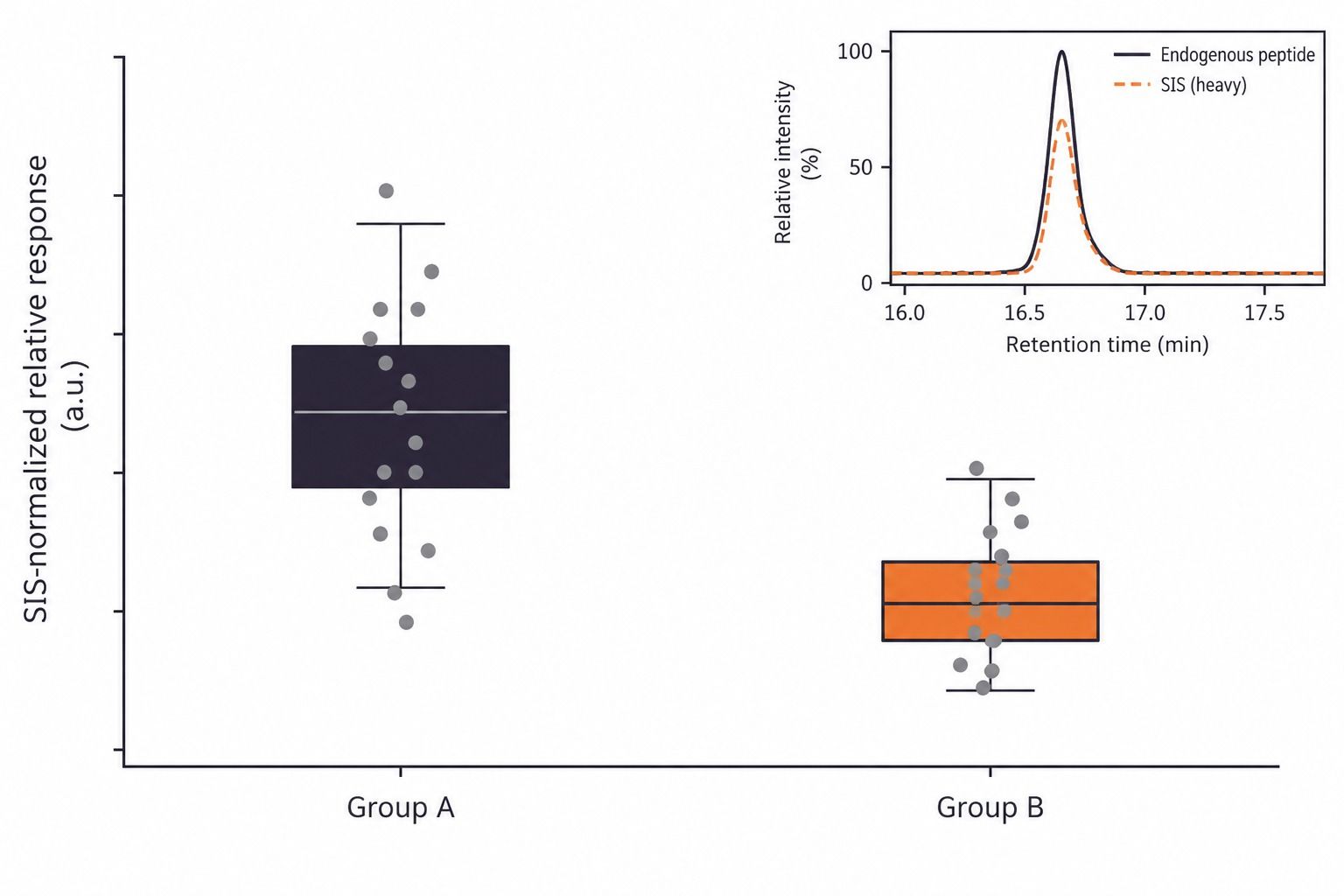
Representative outputs are illustrative and are not presented as data from a specific customer project.
Typical Deliverables
Deliverables are matched to the project scope and may include:
- Endogenous Peptide Identification Table
Peptide sequences with MS evidence and confidence fields appropriate to the selected workflow. - Source-Protein and Cleavage Mapping
Mapping of identified peptides to source proteins, precursor regions, and overlapping peptide families. - Quantitative and Statistical Summaries
Normalized peptide-level data and study-design-appropriate comparative analyses. - Peptide Class and Modification Annotation
Annotation of selected peptide classes or modifications when included in the project scope. - Candidate Prioritization and Follow-Up Data
Ranked candidate outputs and, when included, targeted or orthogonal verification results. - Analytical Report and Data Package
Methods, QC summaries, key visualizations, interpretation notes, and project-specific data files.
References
- Sajid MS, Ding Y, Varghese RS, Kroemer A, Ressom HW. Unveiling Endogenous Serum Peptides as Potential Biomarkers for Hepatocellular Carcinoma in Patients with Liver Cirrhosis. J Proteome Res. 2024. https://doi.org/10.1021/acs.jproteome.4c00269
- Maurer J, Grouzmann E, Eugster PJ. Tutorial review for peptide assays: An ounce of pre-analytics is worth a pound of cure. J Chromatogr B. 2023;1229:123904. https://doi.org/10.1016/j.jchromb.2023.123904
For research use only. Not for use in diagnostic or therapeutic procedures.
FAQ for Plasma and Serum Peptidomics
What is the difference between plasma/serum peptidomics and plasma/serum proteomics? +
Plasma/serum proteomics usually analyzes proteins after enzymatic digestion. Plasma and serum peptidomics instead focuses on naturally occurring endogenous peptides present before digestion, including proteolytic fragments, peptide hormones, and other bioactive peptides. It therefore provides a peptide-level view of protein processing and protease-related biology.
Should I use plasma or serum for my peptidomics study? +
The choice depends on the research question and the available cohort material. Plasma is often useful when the pre-clotting blood environment or quantitative comparison is important, while serum may be preferable for banked cohorts or studies built around an established serum collection protocol. Whichever matrix is selected, it should remain consistent across the comparison.
Which anticoagulant should I use for plasma collection? +
The most suitable anticoagulant depends on the study objective, downstream analysis, and available collection workflow. Different tube chemistries can affect the recovered peptide profile, so one anticoagulant and tube type should normally be used consistently across all study groups.
How much plasma or serum is required? +
Input is project-dependent. The required volume depends on sample quality, enrichment strategy, analytical depth, number of analyses, and whether follow-up verification is planned. Exact requirements should therefore be confirmed during project scoping rather than applying one universal minimum.
How do you control peptide degradation and ex vivo proteolysis? +
The study is designed around consistent collection, prompt and standardized processing, appropriate storage, and matrix-aware stabilization or cleanup strategies where needed. Hemolysis and other sample-quality indicators are also reviewed so pre-analytical artifacts can be distinguished from biological differences.
How are abundant plasma proteins handled during peptide enrichment? +
The preparation strategy is selected according to the project and may include molecular-weight-based separation, solid-phase extraction, precipitation, fractionation, or other cleanup approaches. The goal is to enrich endogenous peptides while reducing high-abundance protein and matrix interference without assuming one universal depletion method.
Can peptide hormones and post-translational modifications be investigated? +
Yes, when they are included in the project design. Peptide hormones, bioactive peptides, and selected modifications can be incorporated into the analytical strategy, with search scope and confidence criteria adapted to the biological question.
Can discovery candidates be validated by targeted quantification? +
Prioritized candidates can be transferred into targeted MS or other fit-for-purpose verification workflows. The follow-up strategy depends on whether the study requires relative confirmation, quantitative measurement, orthogonal detection, or biological validation.
Can results from different batches or sites be compared? +
Cross-batch comparability depends on study design and sample handling. Suitable QC, reference samples, normalization, bridge strategies, and batch-aware statistics can be incorporated when the project spans multiple runs, batches, or collection sites.
How does this service differ from CSF and biofluid neuropeptidomics? +
CSF and biofluid neuropeptidomics focuses on neuropeptides and CNS-related signaling in cerebrospinal fluid and related matrices. Plasma and serum peptidomics addresses the broader systemic circulating peptidome, including proteolytic fragments, peptide hormones, and other bioactive peptides. For CNS-focused projects, see our CSF and biofluid neuropeptidomics service.