Direct Profiling of Naturally Presented HLA Class I Peptides
HLA class I immunopeptidomics is most useful when a project has moved beyond sequence prediction and needs experimental evidence of which peptides are naturally presented by HLA-I complexes in the relevant biological model. This can be the decisive step when prioritizing pHLA targets, comparing antigen presentation across perturbations, or determining whether a nominated epitope is actually observed in cells or tissue.
Peptide-HLA complexes are enriched from the sample, HLA-bound peptides are released and analyzed by LC-MS/MS, and the resulting sequences are interpreted in the context of HLA typing, peptide length, binding motifs, source proteins, and study design. For broader class I and class II project selection, see HLA Peptidomics.
HLA-I immunopeptidomics is particularly useful when:
- a predicted epitope or pHLA target needs direct presentation evidence in a biologically relevant model;
- HLA-I presentation must be compared across treatment, engineering, infection, or another defined perturbation;
- HLA-B, HLA-C, or another allotype of interest has limited project-specific experimental ligand evidence;
- a nominated peptide was not detected in untargeted discovery data and requires a more focused follow-up strategy; or
- a candidate shortlist must be prioritized before peptide-HLA binding, pHLA/TCR, or functional T-cell studies.
A detected HLA-I peptide is evidence that the sequence was observed in the enriched HLA-I ligand pool under the selected experimental conditions. It does not by itself establish T-cell immunogenicity, absolute cell-surface pHLA abundance, or a unique restricting allele in a multiallelic sample. Those questions require additional evidence matched to the downstream claim.
HLA-A, HLA-B, and HLA-C Ligandome Analysis
HLA-I projects can be designed around broad class I ligandome profiling or a defined HLA context. The most informative strategy depends on the sample, HLA background, capture scope, and whether the goal is discovery, comparison, or confirmation of a predefined candidate.
Broad HLA-I enrichment does not automatically generate separate HLA-A, HLA-B, and HLA-C fractions. In multiallelic material, locus or allotype attribution may rely on HLA typing, motif structure, and binding context unless the enrichment strategy or experimental model provides direct restriction evidence.
Experimental and Analytical Strategy for HLA-I Immunopeptidomics
The most consequential HLA-I decisions are usually made before data acquisition: whether the sample contains recoverable HLA-I complexes, whether the capture scope matches the HLA question, whether the project is discovery- or candidate-driven, and what evidence will be required after an MS identification.
Selected PTMs, sequence variants, pathogen-derived sequences, or non-canonical peptide sources can be added when the biological rationale, database design, and validation strategy justify the expanded search space. Projects centered on alternative ORFs, cryptic translation products, or other non-canonical antigen sources are better developed through Cryptic Antigen Discovery rather than treating an unrestricted search space as a routine HLA-I analysis.
Choosing the Right HLA-I Research Workflow
HLA-I immunopeptidomics is most informative when the project needs direct evidence of natural peptide presentation. Other MHC-related assays answer different questions and can be used before or after ligandome discovery.
| Research Question | Best-Fit Approach | What It Establishes |
|---|---|---|
| Which peptides are naturally presented by HLA-I in my biological sample? | HLA Class I Immunopeptidomics | Direct MS evidence of peptides recovered from enriched HLA-I complexes |
| I already have one or a few candidate peptides and need a focused presentation check. | Targeted HLA-I Candidate Follow-Up | Targeted MS evidence for nominated peptides; does not establish immunogenicity or absolute cell-surface density |
| Does a predefined peptide bind a selected MHC/HLA molecule? | MHC Binding & Epitope Screening | Candidate peptide binding or screening evidence; does not by itself prove natural processing and presentation |
| Is the project focused on HLA-DR, HLA-DQ, or HLA-DP presentation and CD4+ T-cell antigen research? | HLA Class II Peptidomics | Direct analysis of naturally presented HLA-II ligands |
| Are mutation-derived tumor antigens the main discovery target? | Neoantigen Discovery | Integrated candidate generation and prioritization around tumor-specific sequence alterations and immunopeptidomic evidence |
| Are alternative ORFs, cryptic translation, or other non-canonical sources central to the project? | Cryptic Antigen Discovery | A dedicated non-canonical search and validation framework with tighter control of expanded search space |
| Does a prioritized peptide-HLA complex support receptor-level recognition? | TCR-pMHC Validation | Downstream evidence for peptide-HLA/TCR recognition in the selected research system |
Common HLA Class I Immunopeptidomics Projects
Sample Requirements and Study Design
HLA-I immunopeptidome depth depends on HLA abundance, sample type, biological heterogeneity, capture efficiency, peptide recovery, and acquisition depth. Material requirements therefore need to be scoped for the specific project rather than reduced to one universal minimum-input value.
| Design Element | Information to Provide | Why It Matters |
|---|---|---|
| Sample Type | Cell line, primary-cell material, tissue, organoid, or another research model | HLA-I abundance, biological heterogeneity, matrix complexity, and handling constraints influence ligand recovery |
| HLA Background | HLA-A/B/C typing when available | Supports motif interpretation and candidate peptide-to-allele assignment |
| Target HLA-I Scope | Broad HLA-I survey, selected locus/allotype emphasis, or candidate-focused objective | Guides capture strategy, interpretation boundaries, and expected allele resolution |
| Study Groups | Controls, perturbations, biological replicates, and planned batch structure | Determines whether comparative presentation analysis is interpretable |
| Treatment and Harvest Context | Cytokine stimulation, drug or pathway perturbation, engineering, infection status, and harvest timing when applicable | These variables can change HLA-I abundance, antigen processing, and the ligand repertoire itself |
| Sample Preservation and Processing History | Fresh/frozen state, fixation or archival history, prior lysis or extraction, and known handling differences | Certain processing histories can change the feasibility of native HLA-peptide enrichment or introduce group-specific bias |
| Candidate or Custom Sequences | Predicted epitopes, variant sequences, pathogen proteins, or custom databases when applicable | Defines whether targeted confirmation or an expanded discovery search is required |
| Downstream Validation Goal | Synthetic-peptide confirmation, binding assessment, targeted MS, TCR/pMHC work, or T-cell testing | Helps set the evidence threshold used for candidate prioritization |
Sample handling and storage should preserve the biological material and HLA-peptide complexes as consistently as practical across study groups. Archived or limited material may still be evaluated, but feasibility depends on sample history, HLA expression, and the depth of evidence required. HLA-modulating treatments such as cytokine stimulation should be treated as biological variables rather than as a neutral way to increase signal, because they can reshape both HLA abundance and the presented peptide repertoire.
HLA Class I Immunopeptidomics Workflow
Sample & HLA Context Review
Define sample type, HLA background, study groups, target HLA-I scope, and
validation endpoint
HLA-I Immunoaffinity Enrichment
Isolate HLA-I peptide complexes using a capture strategy matched to
project scope
Peptide Elution & LC-MS/MS
Release endogenous HLA-I ligands, reduce matrix interference, and acquire
tandem MS data
Identification, Motif & Allele Analysis
Identify non-tryptic ligands, map source proteins, and integrate HLA
typing and motif evidence
Comparative Interpretation & Prioritization
Summarize presentation evidence, condition-associated changes, HLA
context, and next-step candidates
1
Sample and HLA Context Review
Define sample type, HLA background, study groups, target class
I scope, custom sequence requirements, and the downstream decision the study must support.
2
HLA-I Immunoaffinity Enrichment
HLA-I peptide complexes are isolated using a capture strategy
matched to the intended breadth or selectivity of the project. HLA expression and capture
coverage are considered when interpreting the recovered repertoire.
3
Peptide Elution, Cleanup and LC-MS/MS
Endogenous HLA-I ligands are released from enriched complexes,
cleaned to reduce matrix interference, and analyzed by high-resolution LC-MS/MS without
assuming tryptic cleavage.
4
Peptide Identification, Motif and Allele Analysis
Identified ligands are evaluated with peptide-level quality
control, mapped to source proteins, and reviewed for peptide-length and motif consistency. HLA
typing, motif deconvolution, and binding predictions can be integrated for allele-aware
interpretation.
5
Comparative Interpretation and Candidate Prioritization
Results are organized around direct presentation evidence,
comparative peptide patterns, candidate HLA assignments, source-protein context, and the
downstream validation priorities defined during project scoping.
Identification Confidence and Biological Interpretation
Representative Results
The visualizations illustrate representative HLA-I immunopeptidomics output formats. Final plots and annotations depend on sample type, HLA context, study design, and data quality.
HLA-I Peptide Length Distribution
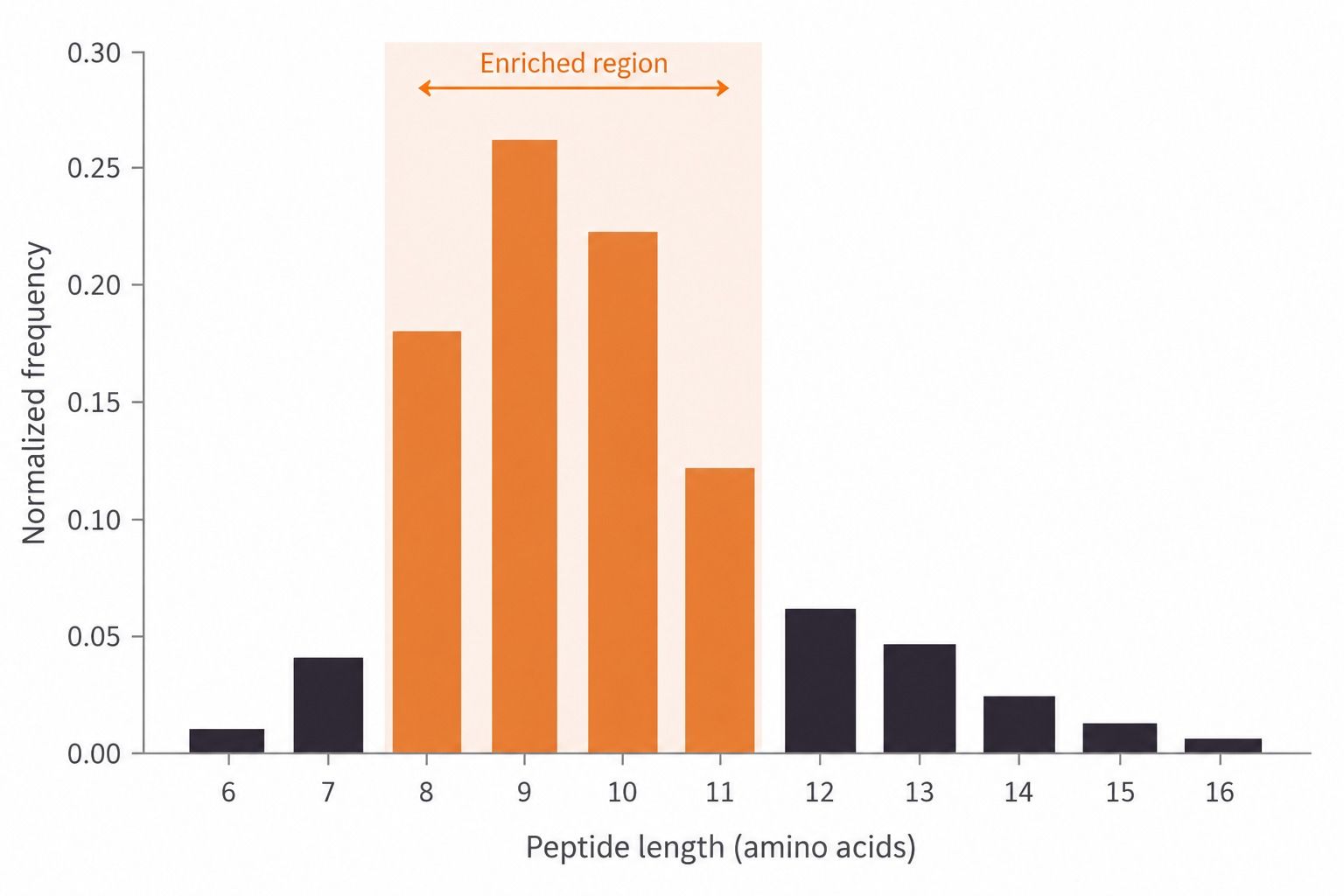
Length-frequency output used to evaluate the characteristic size profile of recovered HLA-I ligands and identify unexpected background or enrichment patterns.
HLA-A/B/C Motif Deconvolution
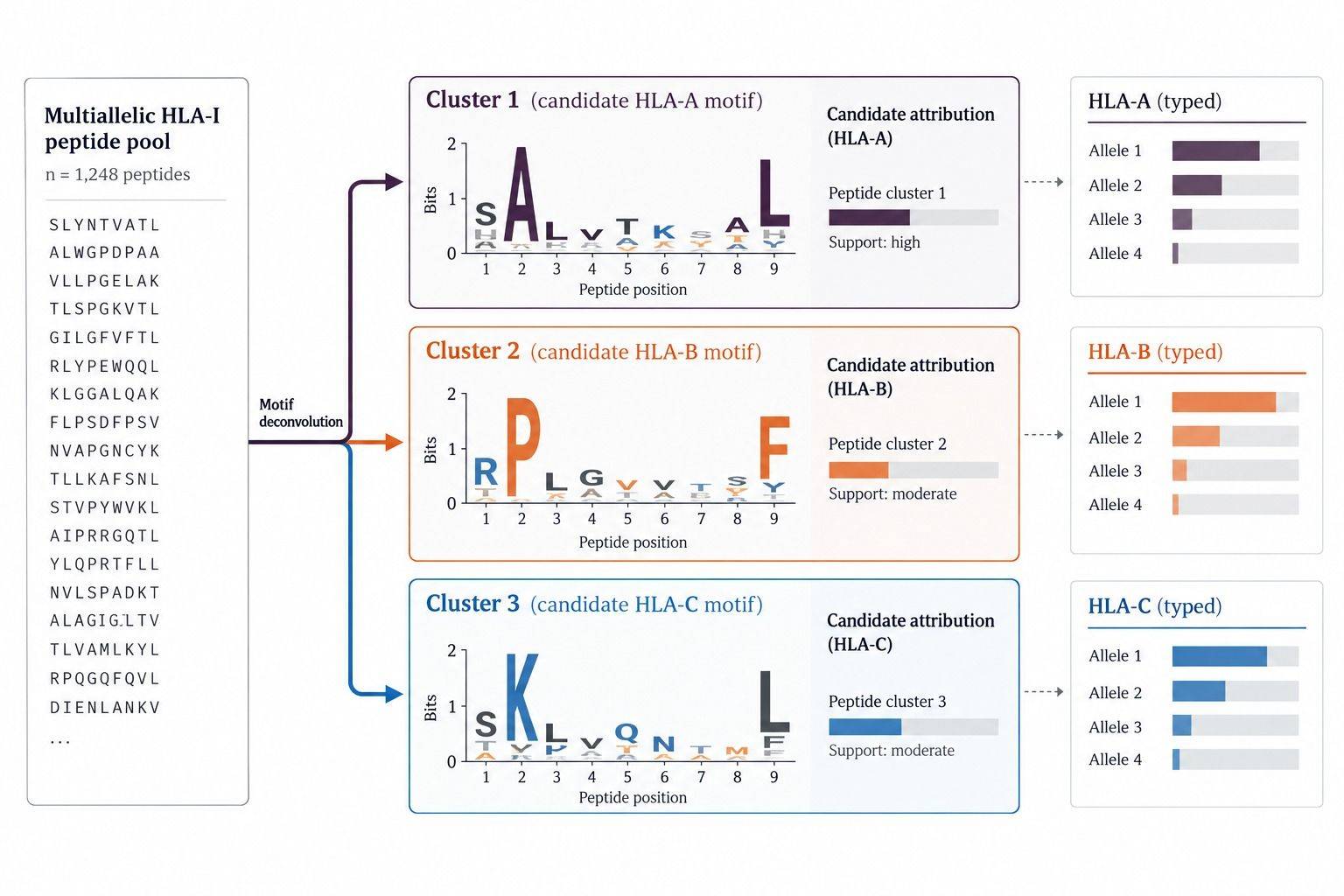
Sequence-motif output showing how a multiallelic HLA-I ligand pool can separate into candidate motif clusters supported by HLA typing and binding context.
Comparative HLA-I Presentation
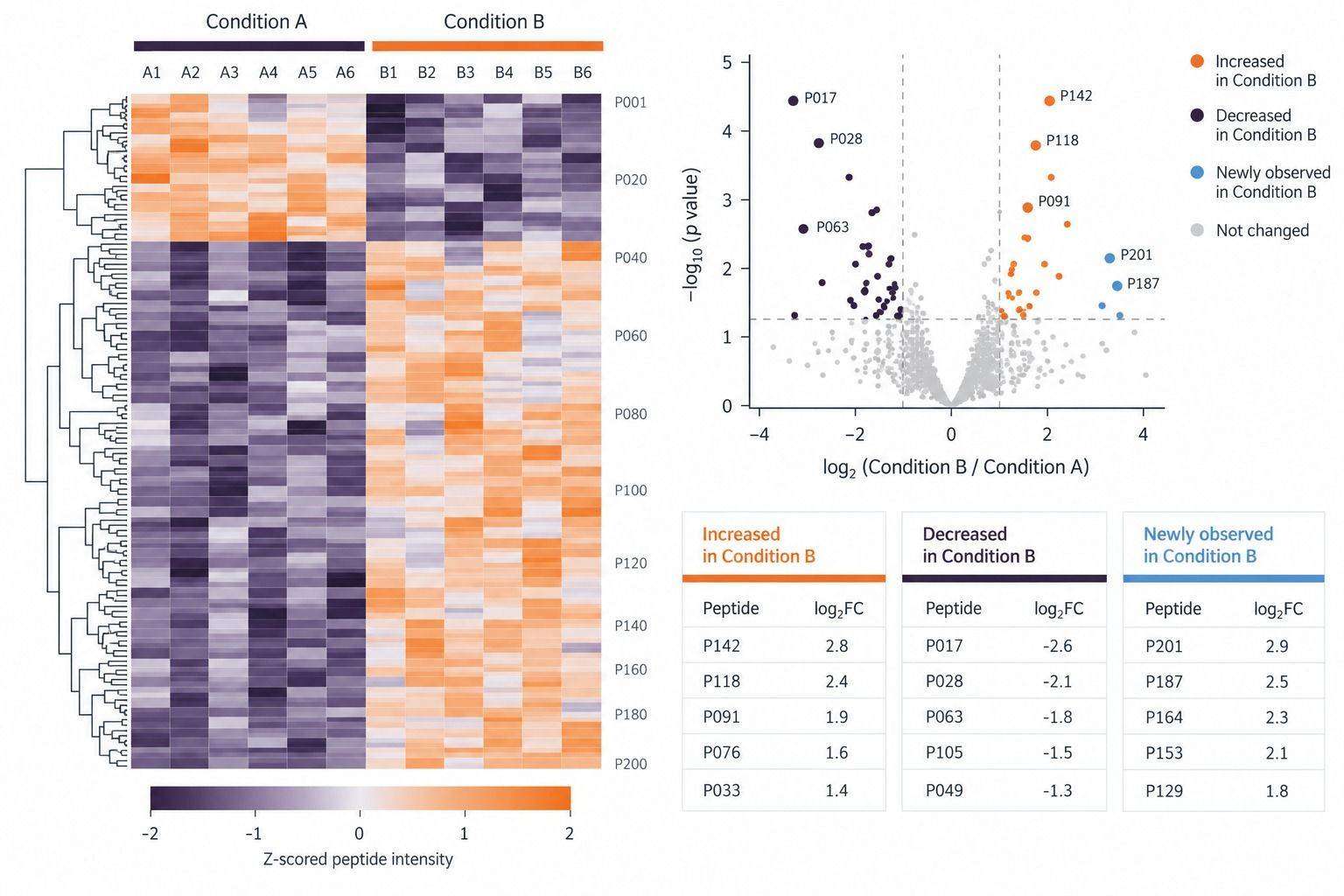
Representative multi-group output highlighting peptides that are gained, lost, or altered between experimental states within a balanced study design.
Targeted Confirmation of an HLA-I Candidate
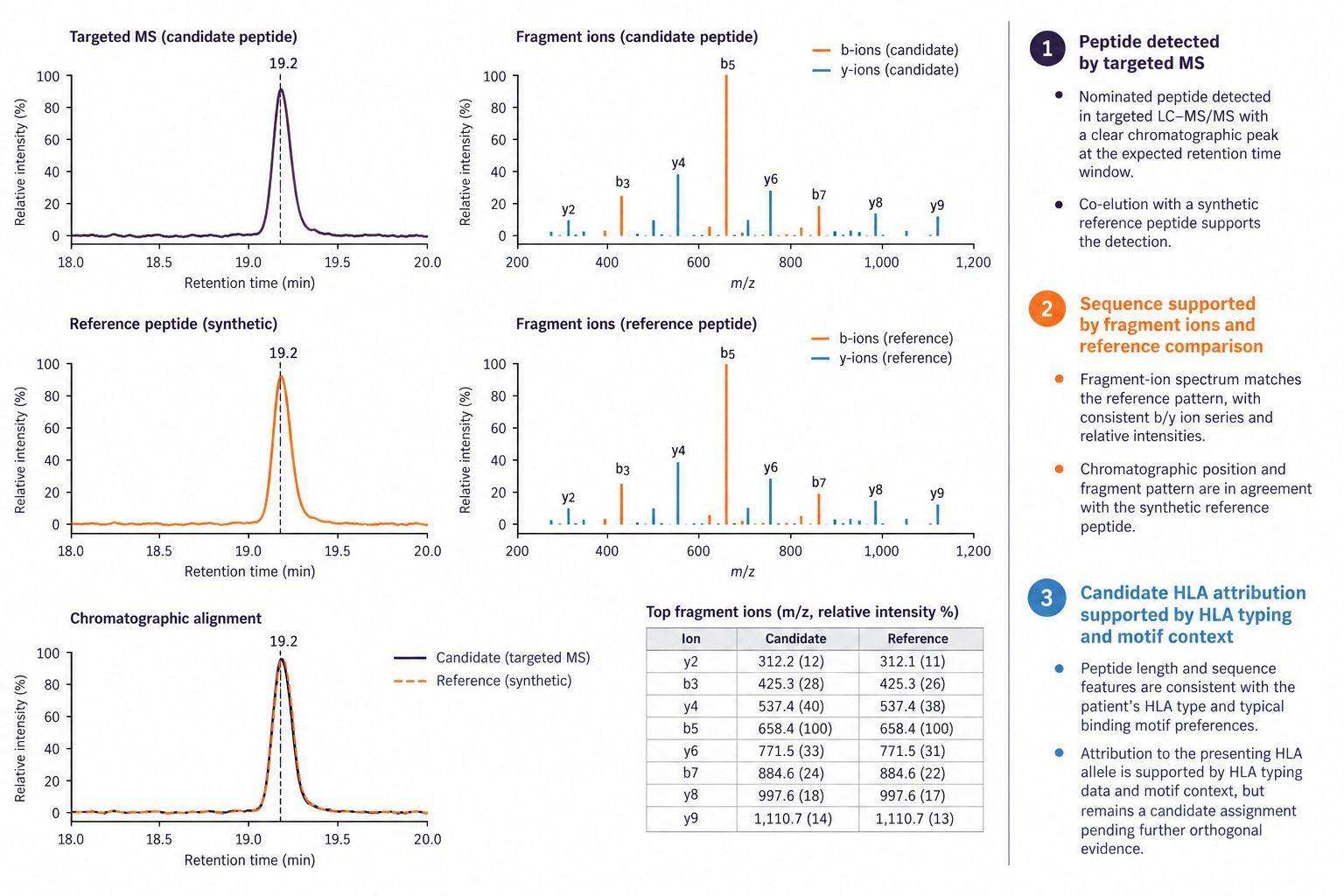
Targeted-MS output linking a nominated peptide to chromatographic and fragment-ion evidence, with source-protein context and candidate HLA attribution kept separate from the direct MS identification evidence.
Representative outputs are illustrative and are not presented as data from a specific customer project.
Typical Deliverables
- HLA-I Peptide Identification Table
Identified peptide sequences with peptide-level MS evidence, precursor information, retention information where relevant, and search-confidence fields appropriate to the workflow. - HLA-A/B/C Annotation
HLA typing context, motif clusters, candidate peptide-to-allele assignments, and confidence notes for multiallelic samples. - Peptide Length and Motif Analysis
Length distributions and sequence-motif visualizations used to assess HLA-I repertoire structure and enrichment consistency. - Source-Protein Mapping
Mapping of HLA-I ligands to source proteins and positions, with antigen-category or pathway annotation when requested. - Comparative Presentation Results
For appropriately designed studies, quantitative or presence/absence summaries of condition-associated HLA-I peptide changes. - Candidate Prioritization and Next-Step Matrix
Selected ligands ranked using direct presentation evidence, HLA context, source-protein information, project-specific annotation, and the recommended validation route for the intended research claim. - Analytical Report and Data Package
Methods, quality-control summaries, key figures, processed tables, interpretation notes, and project-specific data files.
References
- Abelin JG, Keskin DB, Sarkizova S, et al. Mass Spectrometry Profiling of HLA-Associated Peptidomes in Mono-allelic Cells Enables More Accurate Epitope Prediction. Immunity. 2017;46(2):315-326. https://doi.org/10.1016/j.immuni.2017.02.007
- Solleder M, Guillaume P, Racle J, et al. Mass Spectrometry Based Immunopeptidomics Leads to Robust Predictions of Phosphorylated HLA Class I Ligands. Mol Cell Proteomics. 2020;19(2):390-404. https://doi.org/10.1074/mcp.TIR119.001641
- Förster JD, Becker JP, Vučković N, Riemer AB. Systematic Workflow Optimization for Ultra-sensitive Targeted Immunopeptidomics. Mol Cell Proteomics. 2026;25(9):101634. https://doi.org/10.1016/j.mcpro.2026.101634
- Rogue L, Monneuse JM, Béchon C, et al. Identification of immunopeptides (pHLA) as candidate therapeutic targets in chondrosarcoma. J Bone Oncol. 2026;59:100780. https://doi.org/10.1016/j.jbo.2026.100780
- Sinharay R, Nolan DS, Bauer J, et al. Identification of novel HLA class I-restricted hepatitis B virus peptides and their modulation by peptide editor TAPBPR. Front Immunol. 2026;17:1892820. https://doi.org/10.3389/fimmu.2026.1892820
- Olsson N, Heberling ML, Zhang L, et al. An Integrated Genomic, Proteomic, and Immunopeptidomic Approach to Discover Treatment-Induced Neoantigens. Front Immunol. 2021;12:662443. https://doi.org/10.3389/fimmu.2021.662443
For research use only. Not for use in diagnostic or therapeutic procedures.
FAQ for HLA Class I Peptidomics
How is HLA class I peptidomics different from HLA class II peptidomics?
+
HLA-I peptidomics focuses on peptides presented by HLA-A, HLA-B, and HLA-C in the
context of CD8+ T-cell recognition. HLA-II peptidomics focuses on HLA-DR, HLA-DQ, and HLA-DP and CD4+
T-cell antigen recognition. HLA-I ligands are generally shorter and more length-constrained, while
HLA-II ligands are usually longer and often occur as nested peptide sets. The enrichment and
interpretation strategies should therefore be class-specific.
How does HLA-I immunopeptidomics differ from peptide-HLA binding prediction?
+
Binding prediction estimates whether a peptide sequence is likely to bind a
selected HLA-I molecule. Immunopeptidomics measures peptides recovered from HLA-I complexes in a
biological sample, so it captures the combined effects of source-protein availability, processing,
transport, loading, HLA expression, and presentation. Prediction is useful for annotation and
prioritization but is not a substitute for direct presentation evidence.
Can HLA-A, HLA-B, and HLA-C all be analyzed?
+
Projects can be scoped around broad HLA-I coverage or a defined HLA-A, HLA-B, or
HLA-C question. The achievable locus or allele resolution depends on the sample, HLA expression, capture
strategy, available antibodies, and HLA typing. In multiallelic samples, peptide-to-allele assignment
may remain probabilistic unless the experimental system provides direct allele-specific evidence.
Do I need HLA typing before HLA-I immunopeptidomics?
+
HLA typing is strongly recommended when allele-aware interpretation is important.
It helps constrain motif deconvolution and binding predictions and improves the defensibility of
candidate peptide-to-HLA assignments. A broader HLA-I ligand survey may still be possible without
complete typing, but allele attribution will be more limited.
What sample types are suitable for HLA-I immunopeptidomics?
+
HLA-I-expressing cell lines, primary-cell preparations, tissue-derived research
material, organoids, and other suitable biological models may be evaluated. Feasibility depends on HLA-I
abundance, sample quality, biological heterogeneity, handling history, and the evidence depth required
by the project.
How much material is required for HLA-I immunopeptidomics?
+
There is no single input requirement that applies to every project. Required
material depends on HLA-I expression, sample type, ligand abundance, capture efficiency, project scope,
and whether the goal is broad discovery or targeted candidate confirmation. Material requirements should
be defined after reviewing the sample and study objective.
How are HLA-I peptides assigned to individual alleles?
+
Assignment can integrate HLA typing, peptide length, sequence motifs, motif
deconvolution, and peptide-HLA binding predictions. In monoallelic or experimentally restricted systems,
the assignment can be direct. In multiallelic samples, the result may remain probabilistic and should be
reported with the evidence supporting the proposed HLA restriction.
Does identification of an HLA-I peptide prove that it is immunogenic?
+
No. Detection provides evidence that the peptide was observed in the enriched
HLA-I ligand pool under the selected analytical conditions. Immunogenicity additionally depends on
peptide-HLA stability, peptide abundance, T-cell repertoire, receptor recognition, and biological
context. Functional immune assays are required when a T-cell response is the claim of interest.
Does non-detection mean a predicted HLA-I epitope is absent?
+
No. A peptide may remain unobserved because of low HLA abundance, limited sample
input, inefficient recovery, poor ionization, chromatographic behavior, acquisition depth, or
search-space constraints. Non-detection should be interpreted as not observed under the selected
workflow rather than proof of biological absence.
Can HLA-I peptide presentation be compared between experimental conditions?
+
Yes, when study groups are balanced and samples are processed with appropriate
biological replication and consistent enrichment and MS acquisition. Comparative interpretation should
consider changes in HLA-I abundance and cell state as well as changes in the peptide repertoire itself.
Can HLA-I peptidomics identify neoantigens, pathogen peptides, PTMs, or non-canonical peptides?
+
Potentially, but each expanded search space increases identification complexity.
Variant sequences, pathogen proteins, selected PTMs, or non-canonical sources should be added only when
supported by the biological question, reference data, search controls, and validation strategy.
Dedicated neoantigen or cryptic-antigen workflows are preferable when those sources are the primary
project objective.
Should I use discovery immunopeptidomics or targeted MS for a known HLA-I candidate?
+
Use broad discovery when the presented repertoire is unknown or when many
candidates must be generated without preselection. If one or a few HLA-I peptides are already
nominated—especially low-abundance targets or peptides missed in untargeted data—a targeted MS strategy
may provide a more focused presentation check. The choice depends on the candidate sequence, available
material, expected abundance, and the evidence needed for the next decision.
Does HLA-I immunopeptidomics measure absolute cell-surface pHLA abundance?
+
Not by default. Discovery immunopeptidomics identifies peptides recovered with
HLA-I complexes and may support relative comparisons when the study is designed appropriately, but raw
MS signal should not be interpreted automatically as absolute cell-surface copy number. Absolute or
calibrated pHLA abundance requires a dedicated quantitative strategy matched to that claim.