Peptide-Drug Conjugate Development and Analytical Strategy
A peptide-drug conjugate (PDC) is not simply a peptide with a payload attached. The targeting or functional peptide, conjugation site, linker, payload, and overall physicochemical properties interact as a single construct. A change that improves one element can weaken another: conjugation can alter peptide binding or conformation, a stable linker can delay payload release, and a hydrophobic payload can change solubility, retention behavior, nonspecific binding, or clearance.
Our PDC development and characterization service is designed for research teams moving from a peptide concept, conjugation plan, or early PDC candidate toward analytically defined constructs. Programs may enter with a known targeting peptide, a peptide lead emerging from discovery or screening, or an existing conjugate that requires characterization or troubleshooting. Depending on project stage, peptide-drug conjugation can be integrated with purification, LC-MS characterization, and stability or release studies, or the project can begin with client-supplied PDCs. The analytical plan is built around the development decision: confirm what molecular species were produced, determine how the peptide-linker-payload construct changes under relevant conditions, and compare candidates using evidence that supports the next research step.
This page sits within our Peptidomics-Based Drug Discovery portfolio. It focuses on peptide-drug conjugates rather than general peptide synthesis, manufacturing, or regulatory CMC release testing.
PDC Design: Peptide, Conjugation Site, Linker, and Payload
Most PDC programs require coordinated decisions across four design variables. The optimal combination depends on the biological target, required intracellular or extracellular release mechanism, payload properties, and the analytical behavior of the complete construct.
PDC Characterization by LC-MS and LC-MS/MS
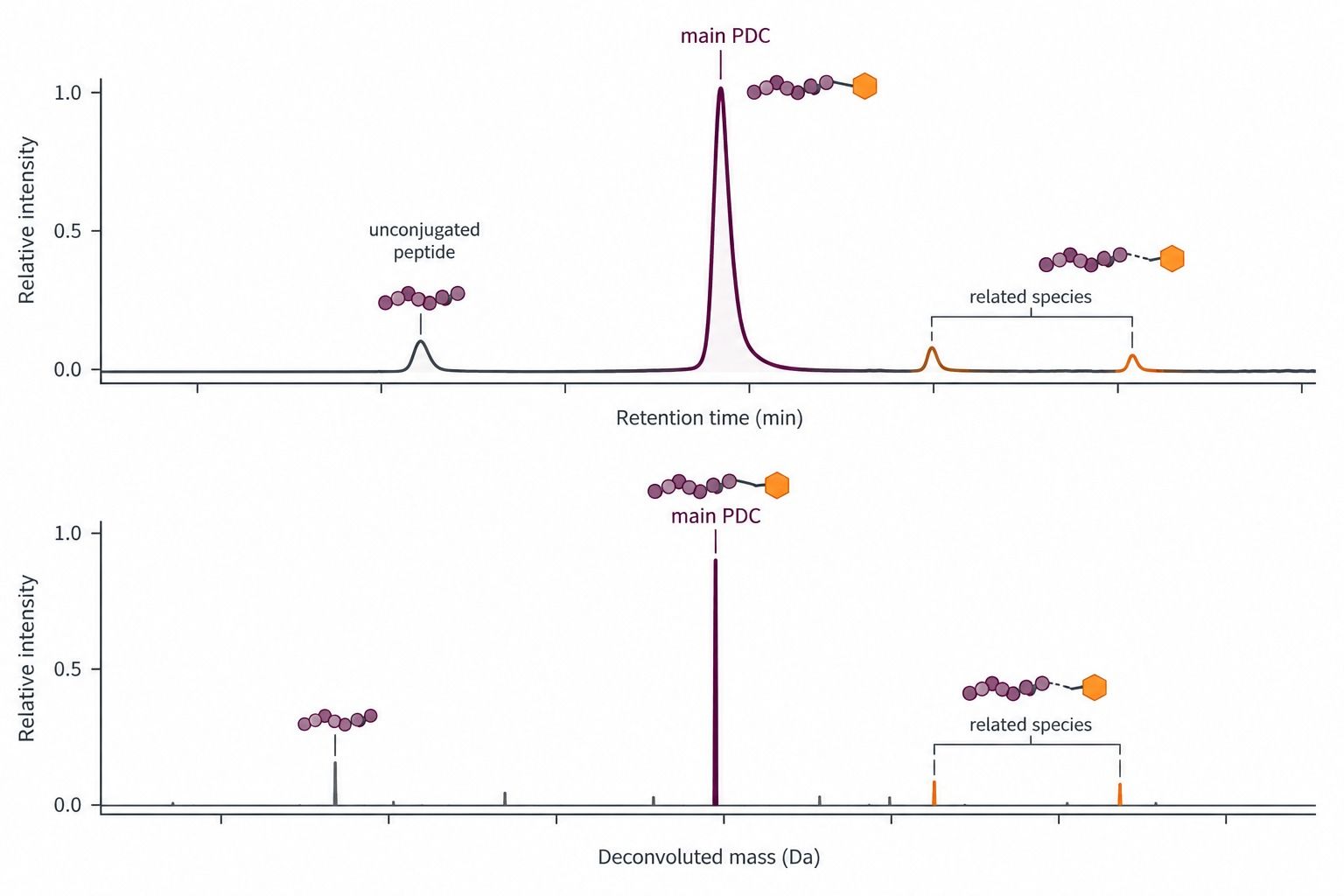
Analytical characterization should establish the molecular identity of the conjugate before biological or stability data are interpreted. For PDCs, an expected nominal mass alone is not sufficient when incomplete conjugation, alternative attachment sites, residual unconjugated peptide, free payload, side products, oxidation, truncation, or linker-derived species may be present.
Linker Stability, Deconjugation, and Payload Release
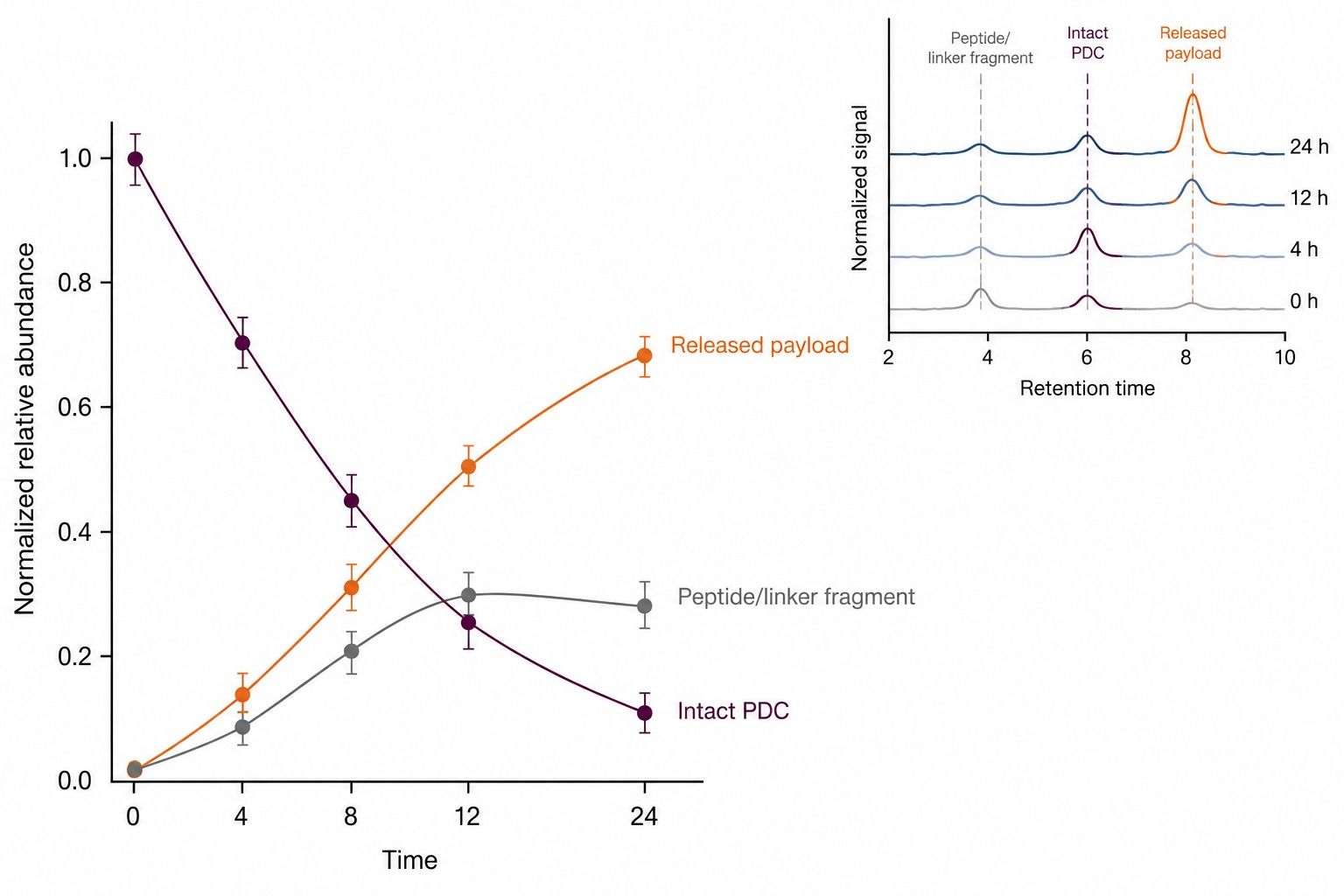
A central PDC development question is whether the conjugate remains intact under the conditions where stability is required and releases the payload when the intended trigger is encountered. Loss of intact PDC signal alone does not identify the mechanism. A more informative study follows the intact conjugate together with released or transformed species.
| Analytical Species | What It Can Indicate | Interpretation Considerations |
|---|---|---|
| Intact PDC | Persistence of the complete peptide-linker-payload construct over time or across test conditions. | A decrease can reflect linker cleavage, peptide degradation, adsorption, precipitation, or another transformation; mechanism requires supporting species-level evidence. |
| Released Payload | Payload liberation under spontaneous, matrix-driven, or trigger-specific conditions. | Quantitation strategy depends on payload chemistry, matrix, calibration approach, and whether free payload is stable after release. |
| Peptide or Peptide-Linker Fragments | Proteolysis, linker cleavage, or catabolic processing of the carrier portion. | Fragment mapping helps distinguish peptide degradation from true payload deconjugation. |
| Other PDC-Related Species | Oxidation, hydrolysis, adduct formation, rearrangement, or other project-specific transformations. | Identification confidence depends on chromatographic behavior, accurate mass, fragmentation evidence, and availability of relevant controls or standards. |
Stability and release experiments can be configured for project-appropriate buffers, biological matrices, enzymes, reducing conditions, pH ranges, or other mechanistic triggers. Conditions and time points are defined during scoping rather than treated as a universal PDC protocol.
Common PDC Development Projects
PDC projects often begin with a specific design uncertainty or an unexpected analytical result rather than with a generic request for "PDC development." The study can be organized around the variable that must be resolved before the next candidate-selection decision.
| Project Scenario | Typical Starting Point | Decision Supported |
|---|---|---|
| Linker Comparison | Related PDCs that share the peptide and payload but differ in linker chemistry or release trigger. | Determines which design provides the most appropriate balance between construct stability and intended payload release under the study conditions. |
| Conjugation-Site Comparison | The same peptide-linker-payload concept attached through alternative residues or reactive handles. | Tests whether attachment position changes product profile, stability, or the peptide-related function that matters for the project. |
| Payload Comparison | Matched constructs in which peptide and linker are controlled while payload chemistry is varied. | Shows how payload choice changes chromatographic behavior, related species, stability, release behavior, or downstream assay performance. |
| Matrix Stability and Release | A selected PDC exposed to project-relevant buffer, biological matrix, enzyme system, or mechanistic trigger. | Distinguishes peptide degradation, linker cleavage, deconjugation, and payload release instead of treating loss of intact PDC as a single mechanism. |
| PDC Failure Investigation | An existing construct with unexpected instability, extra chromatographic peaks, premature payload appearance, or loss of intended activity. | Helps determine whether the problem is associated with peptide degradation, linker transformation, payload instability, alternative conjugation products, or another construct-specific species. |
When target engagement, cell uptake, internalization, or activity is central to candidate selection, project-specific functional follow-up can be interpreted alongside the analytical data where appropriate. A chemically correct PDC does not by itself demonstrate preserved peptide function, so matched unconjugated-peptide, PDC, and free-payload controls are considered when they help isolate the effect of conjugation.
PDC Candidate Comparison and Control Strategy
Well-chosen controls make PDC data easier to interpret because they separate effects of conjugation from effects of the peptide, linker, or payload alone. The exact control set depends on the project, but the following comparisons are often informative.
| Control or Comparator | Primary Purpose | Example Question |
|---|---|---|
| Unconjugated Peptide | Separates peptide behavior from effects introduced by linker or payload attachment. | Did conjugation alter retention, stability, or target-related performance? |
| Free Payload | Distinguishes conjugate-associated behavior from payload behavior after release. | Is observed payload signal caused by intended release, nonspecific hydrolysis, or carryover from unconjugated material? |
| Linker or Peptide-Linker Intermediate | Provides a reference for linker-related transformations where the intermediate is available and analytically informative. | Which degradation products originate from the linker rather than the peptide or payload? |
| Alternative PDC Candidate | Supports head-to-head comparison of peptide sequence, conjugation site, linker, or payload design. | Which construct provides the best balance of identity, stability, controlled release, and downstream assay performance? |
PDC Development Workflow
Project & Construct Review
Define peptide, target, attachment site, linker, payload, controls, and
development question
PDC Generation or Sample Intake
Receive client material or establish a project-specific conjugate
preparation route
Identity & Conjugation Characterization
Confirm intact construct, chromatographic profile, attachment evidence,
and related species
Stability, Release & Bioanalysis
Track intact PDC, released payload, peptide fragments, and transformation
products
Candidate Comparison & Reporting
Integrate analytical evidence and rank constructs for the next research
stage
1
Project and Construct Review
The study begins with the intended biological target or
delivery concept, peptide sequence and modifications, conjugation handle, linker class,
payload chemistry, available controls, and the decision the data must support. Existing
constructs can be reviewed directly, while early concepts can be scoped around the analytical
questions that will determine whether a PDC candidate is worth advancing.
2
PDC Generation or Sample Intake
Client-supplied conjugates can enter directly into
characterization. When project scope includes conjugate generation, the peptide, linker,
payload, attachment chemistry, protecting-group requirements, purification strategy, and
reference controls are aligned before analytical confirmation. Exact chemistry and scale
remain project-dependent.
3
Identity and Conjugation Characterization
Chromatographic and mass-spectrometric evidence is used to
assess the intended intact PDC, related species, unconjugated components, and conjugation-site
evidence where technically feasible. This stage establishes the molecular basis for subsequent
stability, release, and biological interpretation.
4
Stability, Release, and Bioanalytical Follow-Up
The selected PDC is evaluated under project-appropriate
stability or trigger conditions. Intact conjugate, released payload, peptide-derived
fragments, and other transformation products can be followed as separate analytical species.
When broader PK, metabolic stability, or ADME questions become primary, the project can
transition to our Therapeutic Peptide
Bioanalysis or Peptide
DMPK and ADME workflows.
5
Candidate Comparison and Reporting
Analytical results are integrated across identity, conjugate
homogeneity, stability, release behavior, related species, and any project-specific functional
or bioanalytical readouts. The final report distinguishes measured evidence from mechanistic
interpretation and identifies unresolved risks that should be addressed before further
development.
PDC Candidate Selection and Development Decisions
PDC characterization should follow the development question rather than a fixed list of assays. The same construct may require different evidence during design selection, stability optimization, and later bioanalytical work.
| Development Question | Primary Analytical Readout | Decision Supported |
|---|---|---|
| Was the intended PDC produced? | Intact mass, chromatographic profile, related-species review, and attachment evidence where feasible. | Confirms whether downstream testing is being performed on the intended molecular construct. |
| Is the conjugate stable enough for the intended experiment? | Time-resolved intact PDC together with released payload and peptide/linker-derived products. | Identifies premature cleavage, peptide degradation, or other loss pathways that can confound biological interpretation. |
| Does the linker release the payload under the intended condition? | Trigger-dependent payload release and transformation-product profiling. | Tests whether linker behavior matches the proposed release mechanism rather than relying on linker classification alone. |
| Does conjugation preserve the intended peptide function? | Project-specific binding, internalization, or activity readout interpreted alongside matched peptide and PDC controls. | Distinguishes a chemically correct conjugate from a construct in which attachment has compromised target engagement or functional delivery. |
| Which candidate should advance? | Comparable identity, stability, release, and project-specific functional or bioanalytical metrics across constructs. | Supports evidence-based selection among peptide, site, linker, or payload variants. |
Projects whose primary goal is routine release-style testing of a peptide drug substance rather than PDC discovery should be routed to our Peptide Drug Quality Control service instead.
Information Needed to Start a PDC Project
A useful PDC inquiry does not require a completed protocol, but it should define the molecular components, current project stage, and the decision the study needs to support. The information below allows the analytical route to be scoped around the actual construct rather than a fixed assay package.
| Project Information | What to Provide | Why It Matters |
|---|---|---|
| Peptide | Sequence or molecular description, linear or cyclic format, terminal groups, noncanonical residues, and other known modifications. | Defines molecular identity, available conjugation handles, expected MS behavior, and possible stability liabilities. |
| Payload | Payload identity or structure, approximate molecular properties, available functional group, and reference material if available. | Guides conjugation compatibility, chromatographic strategy, released-payload analysis, and interpretation of transformed species. |
| Conjugation Design | Proposed or known attachment site, reactive handle, linker structure or class, and intended release mechanism. | Determines which attachment, stability, and release questions can be tested analytically. |
| Project Stage | Concept stage, components in hand, purified PDC, candidate panel, or an existing construct requiring troubleshooting. | Determines whether the project should begin with design review, conjugation support, characterization, comparison, or failure investigation. |
| Study Objective | Identity confirmation, conjugation-site evidence, linker comparison, stability, payload release, degradation mapping, or candidate ranking. | Keeps the analytical package focused on the decision that will advance or deprioritize the construct. |
| Material and Test Matrix | Available material, concentration if known, solvent or formulation, biological matrix or trigger condition, and relevant storage history. | Supports realistic method selection and helps identify matrix, solubility, adsorption, or stability constraints before testing begins. |
To scope a PDC project efficiently, send the peptide sequence or molecular description, payload and linker information, material status, proposed attachment chemistry if known, test matrix or trigger condition, and the decision you need the study to support. If some design elements are still open, identify the variables you want compared so the project can be built around those choices.
Representative Results
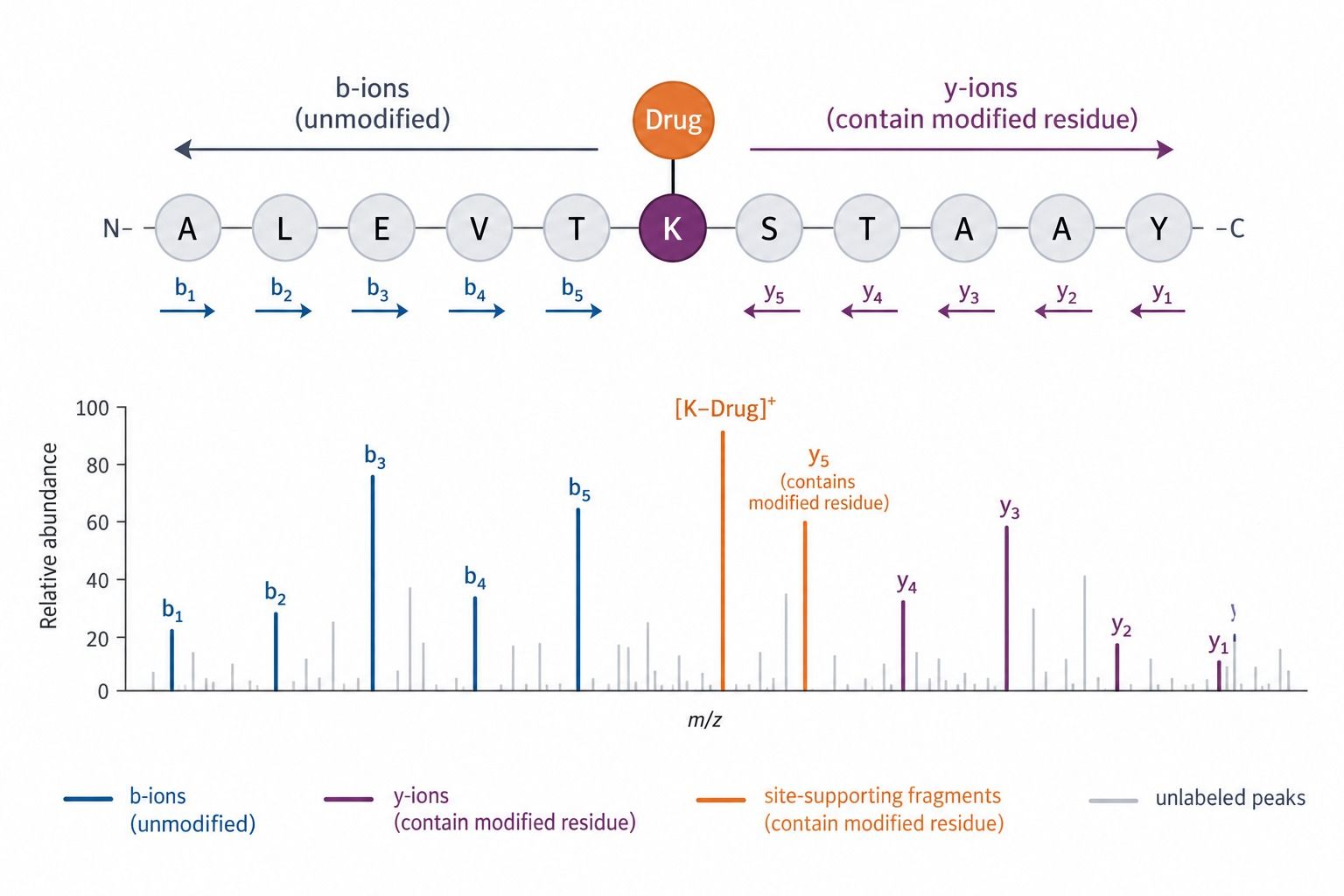
The visualizations below illustrate analytical outputs that can support peptide-drug conjugate development. They are representative reporting formats, not data from a specific customer project.
Intact PDC Identity and Chromatographic Profile
Conjugation-Site Evidence
PDC Stability and Payload Release
PDC Degradation and Catabolite Map
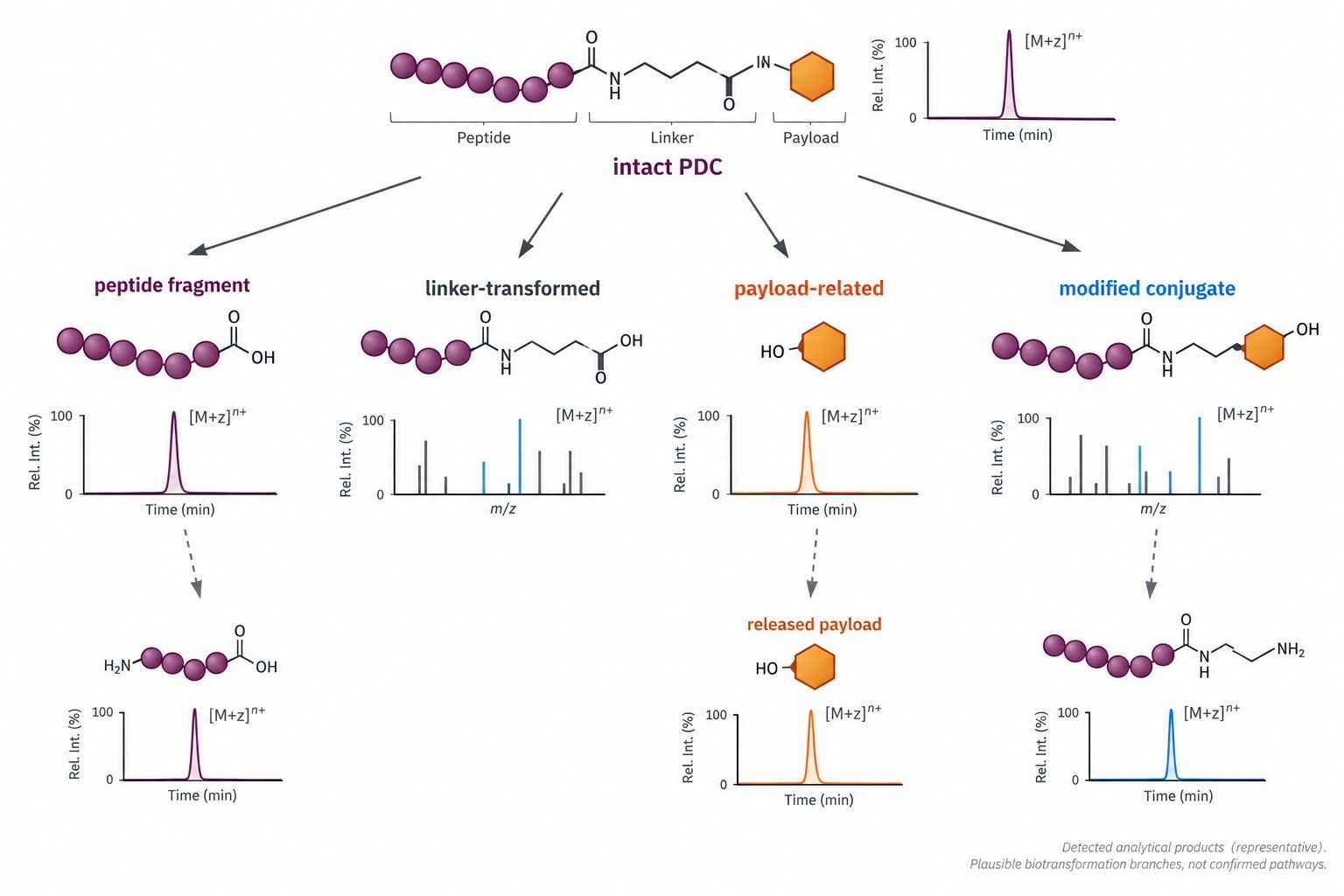
Representative outputs are illustrative. Final analyses depend on PDC structure, linker chemistry, payload, sample matrix, standards, and data quality.
Typical Deliverables
Project deliverables are defined during scoping and may include:
- PDC Design and Analytical Strategy Summary
A structured review of peptide, conjugation site, linker, payload, controls, and the recommended analytical questions for the project. - Conjugate Identity and Related-Species Dataset
Chromatographic and mass-spectrometric evidence for the intended PDC together with observed unconjugated, partially transformed, or other project-relevant species. - Conjugation-Site or Stoichiometry Evidence
Project-appropriate evidence supporting the intended attachment pattern where the chemistry and fragmentation behavior permit confident interpretation. - Stability and Payload-Release Results
Time- or condition-dependent measurements of intact PDC, released payload, peptide/linker fragments, and other selected transformation products. - Degradation or Biotransformation Map
Annotated pathways for observed PDC-related species when sufficient chromatographic and MS/MS evidence is available. - Comparative Candidate Summary
Side-by-side assessment of constructs differing in peptide, attachment site, linker, payload, or another controlled design variable. - Analytical Report and Data Package
A structured report containing methods, QC, representative chromatograms or spectra, interpretation notes, and project-specific processed or raw data files.
References
- Hoppenz P, Els-Heindl S, Beck-Sickinger AG. Peptide-Drug Conjugates and Their Targets in Advanced Cancer Therapies. Front Chem. 2020;8:571. https://doi.org/10.3389/fchem.2020.00571
- Gong L, Zhao H, Liu Y, et al. Research advances in peptide-drug conjugates. Acta Pharm Sin B. 2023;13(9):3659-3677. https://doi.org/10.1016/j.apsb.2023.02.013
- Dean TT, Jelu-Reyes J, Allen AC, Moore TW. Peptide-Drug Conjugates: An Emerging Direction for the Next Generation of Peptide Therapeutics. J Med Chem. 2024;67(3):1641-1661. https://doi.org/10.1021/acs.jmedchem.3c01835
- Rizvi SFA, Zhang L, Zhang H, Fang Q. Peptide-Drug Conjugates: Design, Chemistry, and Drug Delivery System as a Novel Cancer Theranostic. ACS Pharmacol Transl Sci. 2024;7(2):309-334. https://doi.org/10.1021/acsptsci.3c00269
- Armstrong A, Coburn F, Nsereko Y, Al Musaimi O. Peptide-Drug Conjugates: A New Hope for Cancer. J Pept Sci. 2025;31(8):e70040. https://doi.org/10.1002/psc.70040
- Kumar A, Sharma R, Yadav AK. Engineering peptide-drug conjugates for targeted cancer therapy: design principle, theranostic imaging, and translational challenges. Adv Drug Deliv Rev. 2026;239:115960. https://doi.org/10.1016/j.addr.2026.115960
For research use only. Not for use in diagnostic or therapeutic procedures.
FAQ for PDC Development and Characterization
What information should I provide to scope a PDC project?
+
Provide the peptide sequence or molecular form, payload and linker information,
intended or known attachment site, current project stage, available material, test matrix or trigger
condition, and the decision the study needs to support. If some elements are still undecided, indicate
the variables you want compared so the analytical plan can be built around those choices.
Can you work with client-supplied PDC candidates?
+
Yes. Client-supplied PDCs can be scoped for identity confirmation, chromatographic
profiling, related-species analysis, conjugation-site evidence, stability, payload release, or
comparative candidate studies. The analytical plan is defined from the construct chemistry and the
development question.
Can the project include PDC design or conjugate generation?
+
Project scope can include design review and project-specific conjugate generation
when the required peptide, linker, payload, and chemistry are compatible with the available workflow.
Exact synthetic route, scale, purification strategy, and material requirements are confirmed during
scoping rather than assumed from a fixed catalog process.
How do cleavable and non-cleavable linkers differ in PDC development?
+
Cleavable linkers are designed to release the payload in response to a defined
chemical or biological trigger, whereas non-cleavable linkers rely on a different release mechanism,
often involving breakdown of the carrier portion. The correct choice depends on the biological route,
required stability, payload chemistry, and whether the proposed trigger operates under the intended
experimental conditions.
How is the conjugation site confirmed?
+
Confirmation can combine intact-mass evidence, chromatographic behavior, known
conjugation chemistry, and MS/MS of modified peptide species when fragmentation provides
site-informative ions. Not every payload-linker combination fragments cleanly enough for residue-level
localization, so the confidence level is reported according to the available evidence.
Do PDCs use a drug-to-carrier ratio like ADCs?
+
Many PDCs are designed as chemically defined small conjugates with a specified
peptide-to-payload stoichiometry, so ADC-style drug-to-antibody ratio terminology is often not the most
informative description. We instead report the intended construct, observed related species, and
stoichiometric or site-specific evidence appropriate to the PDC design.
Can intact PDC, free peptide, and released payload be distinguished in the same study?
+
They can often be followed as separate analytical species when the chemistry,
chromatography, ionization, and available standards support that design. In complex matrices, separate
sample-preparation or quantitative methods may be needed for the intact conjugate and released payload.
Which stability conditions can be evaluated?
+
Studies can be designed around project-appropriate buffers, plasma or serum,
enzymes, reducing conditions, pH, or other mechanistic triggers. The exact matrix, temperature,
duration, and time points depend on the intended PDC mechanism and the decision the study must support.
Can PDC degradation products and catabolites be identified?
+
Yes, when the species are detectable and generate sufficient chromatographic and
mass-spectrometric evidence. Analysis may distinguish peptide cleavage, linker transformation,
deconjugation, payload release, and other PDC-related products. Structural assignments are reported with
an evidence level appropriate to the available MS/MS and reference information.
Can cyclic or otherwise modified peptides be used in PDC projects?
+
Potentially. Cyclization, terminal modification, lipidation, PEG-related elements,
noncanonical residues, or other peptide modifications can change conjugation chemistry,
mass-spectrometric behavior, stability, and bioanalysis. Compatibility is therefore reviewed at the
construct level before the analytical or synthetic workflow is finalized.
How much PDC material is required?
+
Material requirements are project-dependent and vary with the number of
constructs, analytical methods, matrices, time points, replicates, standards, and whether functional or
bioanalytical follow-up is included. A practical input requirement is defined after the study design is
reviewed.