
Discover HLA Antigens Beyond the Canonical Proteome
Many antigen-discovery workflows begin with annotated protein-coding sequences. That approach is useful, but it can miss peptides produced from alternative translation events, aberrant transcripts, retained introns, untranslated regions, non-coding RNAs, transposable elements, endogenous retroviral sequences, alternative reading frames, and other sequence sources outside conventional protein databases. When such peptides are processed and loaded onto HLA molecules, they become part of the experimentally observable immunopeptidome.
Cryptic antigen discovery extends the search space beyond canonical proteins and asks whether these unconventional sequence sources generate HLA-presented peptides in the biological system of interest. Our project design can combine HLA peptide enrichment and LC-MS/MS with custom or sample-specific sequence databases, proteogenomic evidence, de novo sequencing support, HLA annotation, normal-reference comparison, and downstream validation modules. For broad HLA ligand profiling, see our HLA Peptidomics platform.
Non-Canonical Antigen Sources We Can Investigate
The sequence space can be tailored to the project rather than restricted to one predefined class of cryptic peptide. Depending on the available biological data and supplier-supported workflow, discovery modules may include the following sources.
Integrated Discovery Strategy
Cryptic antigen discovery is most informative when direct HLA presentation evidence is connected to the sequence source that could generate each peptide. A project can therefore combine immunopeptidomics with one or more genomic, transcriptomic, translation-aware, or computational layers. The exact combination is selected according to the research question and available material.
Projects focused on a broader mutation-driven or personalized tumor antigen pipeline can also be integrated with our Proteogenomic Neoantigen Analysis service. When the central goal is direct MS confirmation across a wider neoantigen space, Mass Spectrometry Neoantigen Discovery can be incorporated into the same project plan.
Cryptic Antigen Discovery Workflow
Study Design and HLA Context
Define the biological comparison, HLA background, candidate source
classes, and available multi-omics data
HLA Peptide Enrichment and MS Acquisition
Recover naturally presented HLA ligands and acquire LC-MS/MS data for
discovery
Expanded Sequence-Space Construction
Build project-specific search space from canonical and non-canonical
sequence sources
Identification and Evidence Integration
Integrate MS evidence with HLA, genomic, transcriptomic, and
translation-aware context
Candidate Prioritization and Validation
Prioritize cryptic antigens for confirmation and downstream functional
studies
1
Study Design and HLA Context
Define sample groups, HLA background, the non-canonical antigen
sources to investigate, and the genomic, transcriptomic, or translation-aware datasets
available for integration.
2
HLA Peptide Enrichment and MS Acquisition
Enrich HLA-associated peptide complexes, release the presented
peptide fraction, and acquire tandem mass spectrometry data for direct detection of naturally
presented ligands.
3
Expanded Sequence-Space Construction
Construct a project-specific search space that can incorporate
canonical proteins, alternative ORFs, UTRs, intronic and intergenic regions, ncRNAs,
repeat-associated sequences, splice events, and sample-specific variants as appropriate.
4
Peptide Identification and Evidence Integration
Evaluate candidate peptide-spectrum evidence and integrate
source uniqueness, HLA context, transcript evidence, translation evidence, recurrence, and
reference-sample occurrence where those data are available.
5
Candidate Prioritization and Validation Planning
Rank cryptic antigen candidates according to the evidence
required by the project and define appropriate follow-up options such as synthetic-peptide
confirmation, targeted MS, peptide-HLA studies, TCR screening, or functional immune assays.
Confidence Assessment for Non-Canonical Peptides
Expanding a database increases the number and diversity of candidate peptide sequences, which can also increase ambiguous or false-positive spectrum assignments if evidence is interpreted too loosely. For cryptic antigen discovery, confidence should therefore be built from multiple independent evidence layers rather than from a single peptide-spectrum match.
Applications of Cryptic Antigen Discovery
Sample and Multi-Omics Study Design
The most informative design depends on the claim the project needs to support. Direct immunopeptidomics is central when natural HLA presentation must be demonstrated, while genomic, transcriptomic, or translation-aware datasets improve interpretation of where a cryptic peptide came from and how selectively it is expressed.
| Input or Evidence Layer | Role in the Project | Typical Use |
|---|---|---|
| HLA immunopeptidomics sample | Provides direct evidence of naturally presented HLA-bound peptides | Core discovery layer for experimentally observed cryptic antigens |
| HLA typing | Supports allele-aware interpretation and candidate presentation plausibility | Useful for donor-derived, primary, or multiallelic material |
| RNA-seq | Supports expression, aberrant splicing, intron retention, transcript structure, and condition specificity | Recommended when transcript-derived candidate origin is important |
| WES or WGS | Provides sample-specific sequence variants and personalized reference information | Useful for mutation-containing or individualized cryptic antigen searches |
| Ribosome profiling or translation-aware data | Provides direct or indirect evidence that unconventional ORFs are translated | Valuable for difficult ncORF or alternative-translation hypotheses |
| Matched control or benign reference | Helps evaluate recurrence, enrichment, and off-target normal-tissue presentation | Important when tumor or condition specificity is a prioritization criterion |
| Follow-up validation material | Supports targeted MS, synthetic-peptide confirmation, binding, pMHC/TCR, or cellular testing | Used to increase evidence depth for prioritized candidates |
Representative Results
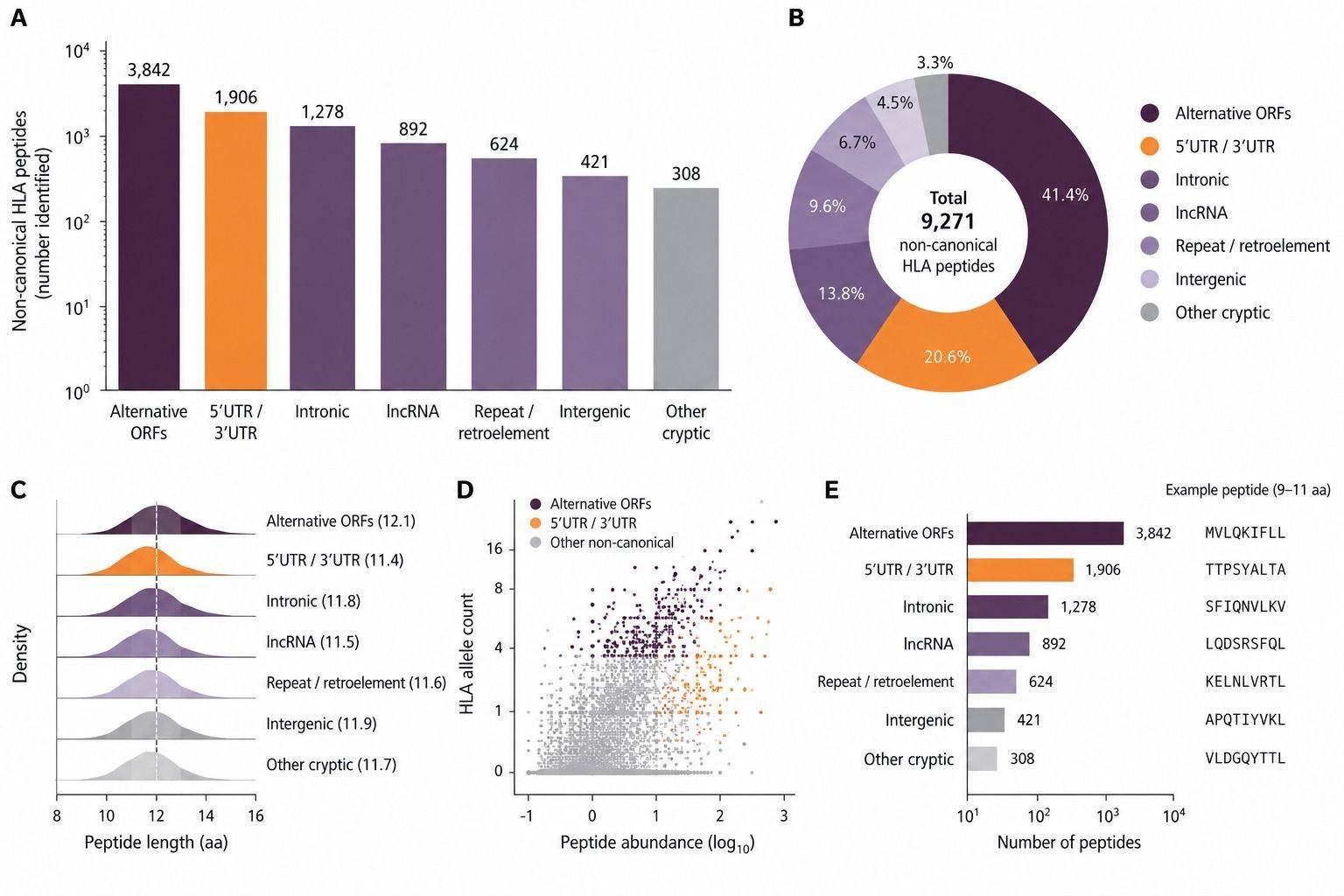
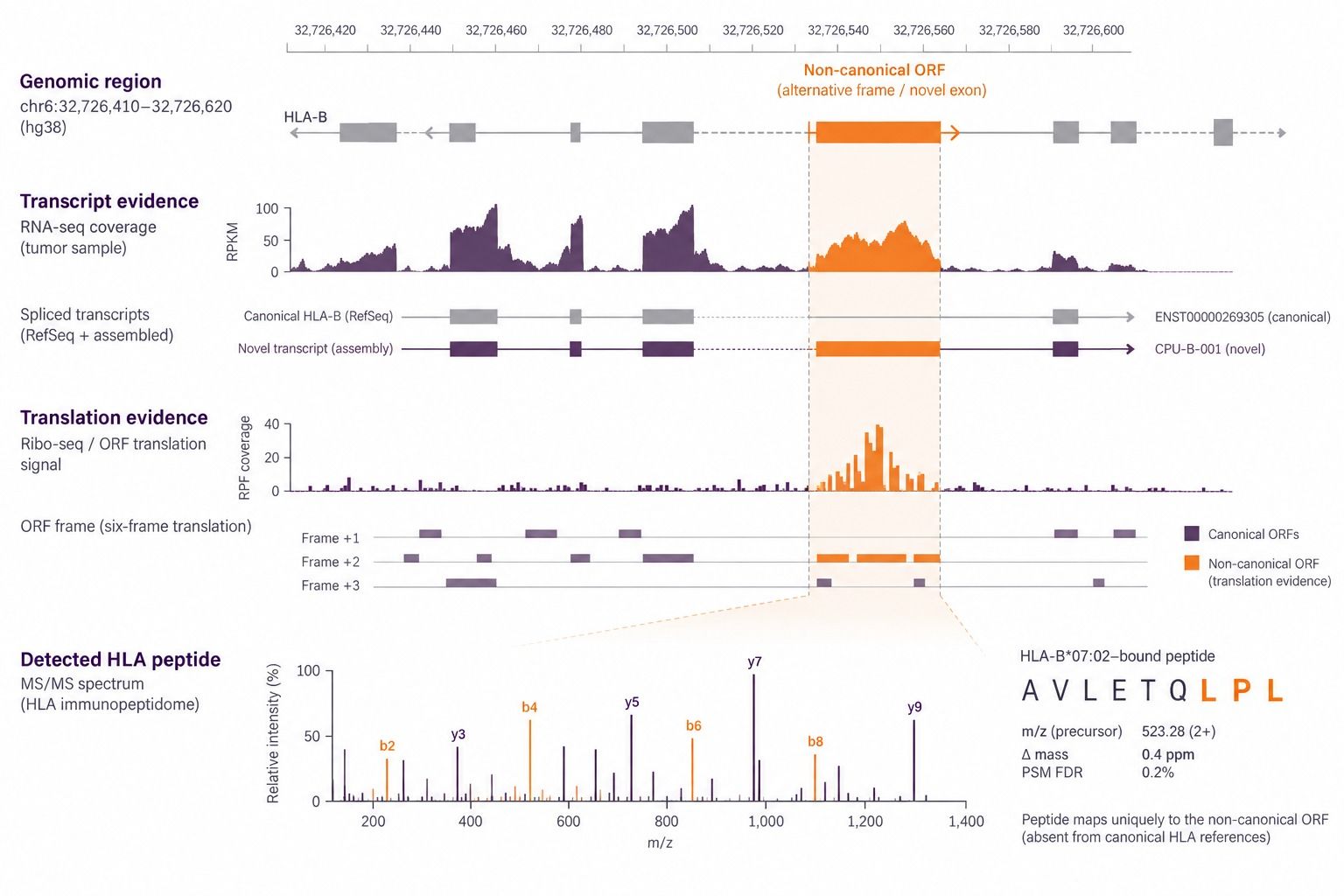
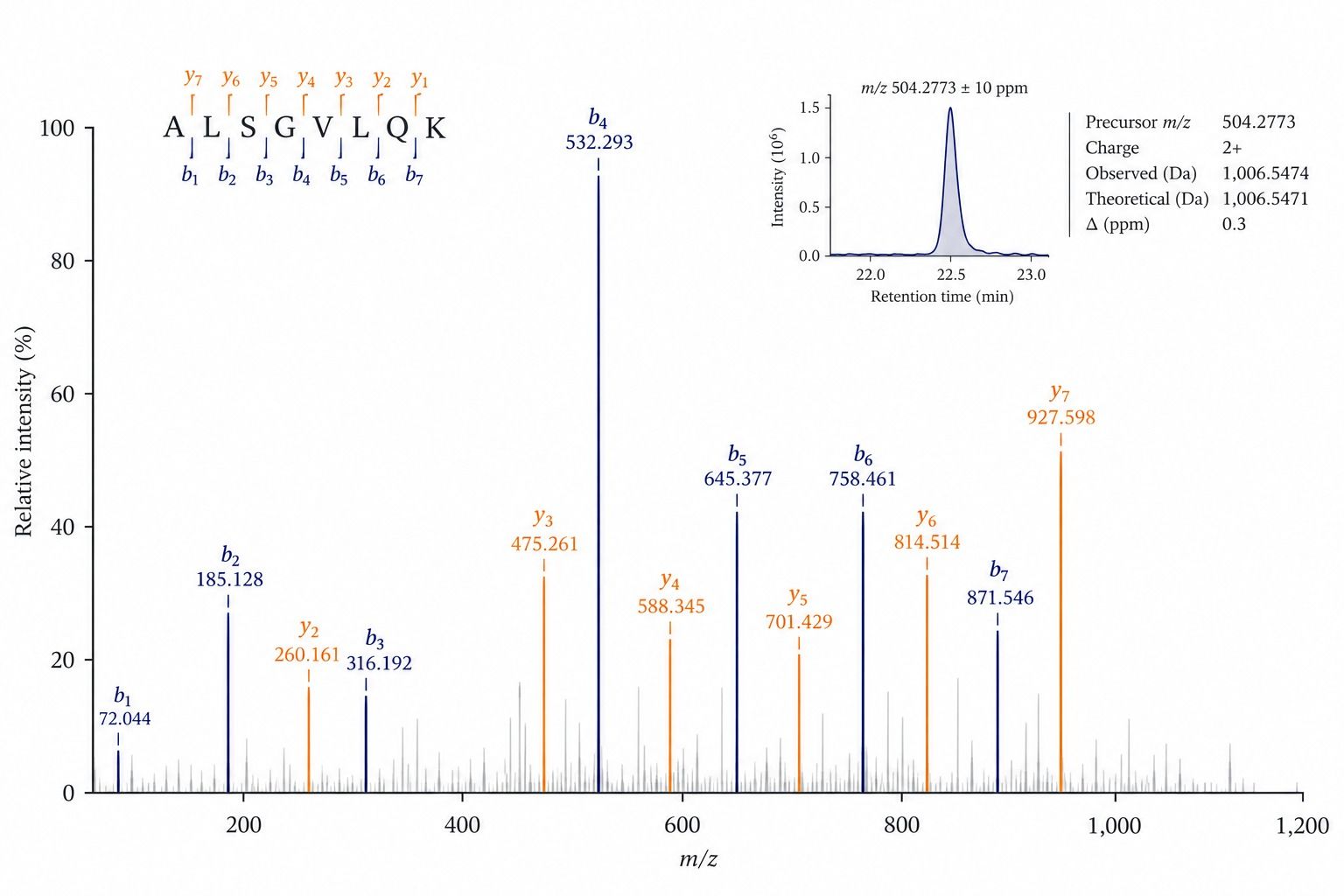
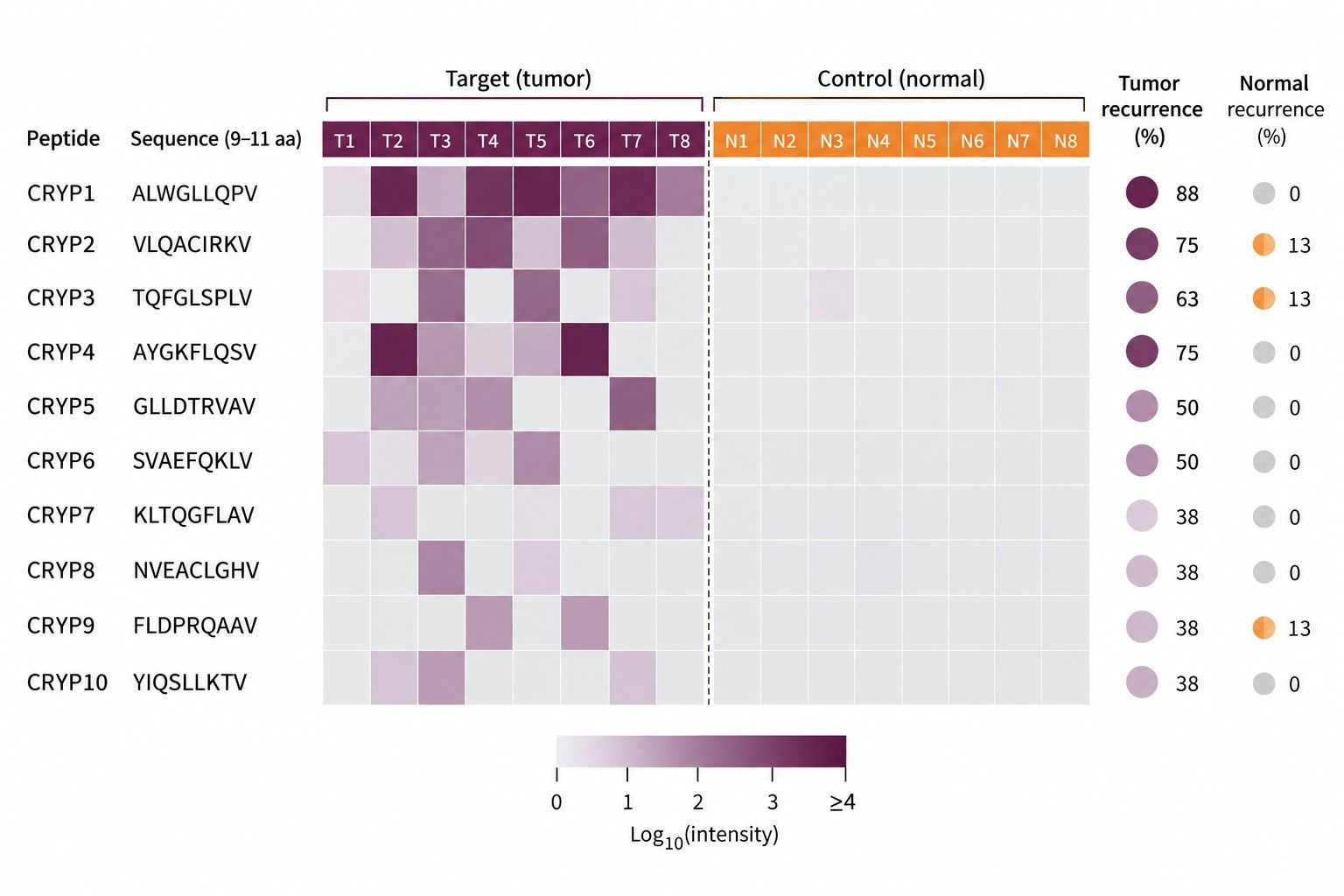
The examples below illustrate common analytical outputs for cryptic antigen discovery. Actual plots and evidence layers depend on the search space, available multi-omics data, HLA context, and validation strategy.
Origin of Non-Canonical HLA Peptides
Proteogenomic Evidence for a Cryptic Antigen
MS/MS Confirmation of a Candidate Peptide
Target-Context Specificity Across Reference Samples
Typical Deliverables
Deliverables are assembled according to the experimental design and may include:
- HLA-Bound Peptide Identification Table
Detected peptide sequences with MS evidence, source mapping, and project-specific annotation fields. - Cryptic Source Annotation
Classification of candidates by alternative ORF, UTR, intronic, intergenic, lncRNA, repeat, aberrant transcript, variant, or other custom source categories. - Genomic and Transcript Mapping
Coordinates and sequence context linking candidate peptides to their proposed genomic, transcriptomic, or translated origin. - HLA Presentation Annotation
HLA typing context, motif or binding-prediction support, and other project-appropriate evidence for peptide-HLA compatibility. - Multi-Omics Evidence Matrix
Integrated view of MS, RNA, DNA, translation-aware, recurrence, and reference-sample evidence when these data layers are included. - Specificity and Prioritization Results
Candidate ranking by presentation evidence, source plausibility, context enrichment, normal-reference occurrence, recurrence, and downstream validation relevance. - Representative Visualizations
Source-category summaries, spectrum evidence, genomic/transcript context, HLA annotations, specificity plots, and project-specific comparison figures. - Validation Candidate List
Shortlisted peptides suitable for synthetic-peptide confirmation, targeted MS, binding assays, pMHC/TCR studies, or functional T-cell testing. - Analytical Report and Data Package
Methods summary, quality-control notes, interpretation, data tables, visualizations, and project-specific files required for downstream analysis.
Related Antigen Discovery and Validation Options
Cryptic antigen discovery can be used as a focused service or combined with broader antigen-discovery and validation modules. The appropriate configuration depends on whether the project begins with unexplored sequence space, known genomic variants, predefined peptides, or candidate immune targets.
| Project Need | Recommended Module | Role in an Integrated Program |
|---|---|---|
| Expand discovery beyond annotated proteins | Cryptic Antigen Discovery | Build and interrogate non-canonical antigen space with direct presentation evidence |
| Combine multiple tumor antigen sources in one program | Neoantigen Discovery | Integrate mutation-derived, non-canonical, viral, shared, or other antigen classes into a broader discovery strategy |
| Rank candidates computationally before or after MS | Neoantigen Prediction & Prioritization | Add HLA presentation, binding, processing, or immunogenicity-oriented prioritization |
| Test receptor-level recognition after candidate selection | TCR-pMHC Validation | Advance selected peptide-HLA candidates into receptor-binding or functional recognition studies |
References
- Chong C, Coukos G, Bassani-Sternberg M. Identification of tumor antigens with immunopeptidomics. Nat Biotechnol. 2022;40:175-188. https://doi.org/10.1038/s41587-021-01038-8
- Zhang B, Bassani-Sternberg M. Current perspectives on mass spectrometry-based immunopeptidomics: the computational angle to tumor antigen discovery. J Immunother Cancer. 2023;11:e007073. https://doi.org/10.1136/jitc-2023-007073
- Ehx G, et al. Atypical acute myeloid leukemia-specific transcripts generate shared and immunogenic MHC class-I-associated epitopes. Immunity. 2021;54:737-752.e10. https://doi.org/10.1016/j.immuni.2021.03.001
- Marcu A, et al. HLA Ligand Atlas: a benign reference of HLA-presented peptides to improve T-cell-based cancer immunotherapy. J Immunother Cancer. 2021;9:e002071. https://doi.org/10.1136/jitc-2020-002071
- Bonté PE, et al. Single-cell RNA-seq-based proteogenomics identifies glioblastoma-specific transposable elements encoding HLA-I-presented peptides. Cell Rep. 2022;39:110916. https://doi.org/10.1016/j.celrep.2022.110916
For research use only. Not for use in diagnostic or therapeutic procedures.
FAQ for Cryptic Antigen Discovery
What is a cryptic or non-canonical antigen?
+
A cryptic or non-canonical antigen is an HLA-presented peptide that originates
from a sequence source or peptide-generation mechanism not captured well by standard annotated protein
databases. Examples include alternative ORFs, untranslated regions, intronic or intergenic translation,
lncRNAs, transposable elements, aberrant splicing, non-coding variants, and other unconventional
translation or processing events.
Is cryptic antigen discovery limited to cancer?
+
No. Cancer is a major application because tumors frequently alter transcription,
splicing, epigenetic regulation, and translation, but the same discovery logic can be applied to
infection, vaccine research, autoimmune mechanisms, stress responses, engineered systems, and other
biological contexts that may generate unconventional HLA ligands.
Which non-canonical sequence sources can be included?
+
Projects can be configured to investigate upstream or alternative ORFs, UTRs,
introns, intergenic regions, lncRNAs, transposable elements, endogenous retroviral sequences,
alternative splice products, non-coding variants, and other project-specific sequence hypotheses. The
final search space depends on the available data and the evidence threshold required.
Do I need RNA-seq or ribosome profiling?
+
Not for every project. HLA immunopeptidomics can identify candidate non-canonical
peptides directly, while RNA-seq strengthens transcript-origin and specificity interpretation. Ribosome
profiling or other translation-aware evidence can add support for unconventional ORFs. The most useful
combination depends on whether the goal is broad discovery, mechanistic source assignment, or
high-confidence target nomination.
Can WES or WGS be integrated with cryptic antigen discovery?
+
Yes. Sample-specific DNA sequencing can contribute mutations and personalized
sequence information, including unconventional sequence changes that fall outside standard coding exons.
These data can be integrated with RNA evidence and HLA immunopeptidomics in a project-specific
proteogenomic workflow.
How are false-positive non-canonical peptide identifications controlled?
+
Expanded databases require stricter interpretation because more candidate
sequences create more opportunities for ambiguous matches. Confidence can be strengthened by spectrum
quality, sequence uniqueness, canonical-proteome exclusion, HLA compatibility, transcript or translation
evidence, recurrence, reference-sample screening, and targeted or synthetic-peptide confirmation for
high-priority candidates.
Can de novo sequencing be used for cryptic antigen discovery?
+
Yes, as a complementary strategy. De novo sequencing can nominate peptide
sequences that are not readily recovered by a fixed database search. Candidate de novo sequences should
then be mapped back to plausible genomic or transcript sources and evaluated with additional MS and
biological evidence before being treated as high-confidence cryptic antigens.
Can both HLA class I and HLA class II cryptic antigens be investigated?
+
Yes, depending on the HLA expression, sample type, enrichment strategy, and
project goal. HLA-I is the most established context for many non-canonical tumor-antigen studies, while
HLA-II can also present peptides from unconventional protein sources. Class-specific enrichment and
bioinformatics should be planned separately when both compartments are important.
Does a non-canonical peptide automatically mean tumor-specific?
+
No. Healthy tissues can also present peptides from non-canonical genomic regions.
Tumor or condition specificity must be evaluated independently using matched controls, benign-tissue
references, expression evidence, recurrence patterns, and the biological context of the source
transcript or translated region.
Does MS detection prove that a cryptic antigen is immunogenic?
+
No. MS-based immunopeptidomics provides evidence that a peptide is present in the
enriched HLA ligand pool. Immunogenicity additionally depends on peptide-HLA stability, abundance,
T-cell repertoire, receptor recognition, and biological context. Functional immune assays are required
when the project needs evidence of T-cell recognition or activity.
How can prioritized cryptic antigens be validated?
+
Validation can be staged according to the claim required. Options include
synthetic-peptide spectrum matching, targeted MS, peptide-HLA binding assays, pMHC reagent studies, TCR
screening, and cellular T-cell assays. Higher-priority development programs can combine several evidence
layers rather than relying on a single validation method.
Can cryptic antigen discovery be combined with conventional neoantigen analysis?
+
Yes. Mutation-derived neoantigens, non-canonical antigens, viral peptides, shared
tumor antigens, and other candidate classes can be analyzed within an integrated antigen-discovery
program. This is often useful when the goal is to maximize target space rather than restrict the project
to one antigen origin.