Venom Peptide Ion Channel Profiling for Drug Discovery
Ion channels — Nav, Kv, Cav, and TRP families — are central to excitable cell function and represent high-value drug targets for pain, epilepsy, cardiac arrhythmias, and hypertension. Venom peptides (toxins) have evolved over millions of years to precisely modulate these channels, often with subtype selectivity that synthetic small molecules cannot match. A single venom can contain dozens of peptide toxins, each evolutionarily refined to target specific ion channel subtypes with nanomolar affinity.
The challenge is deorphaning: a novel venom peptide may be highly active in a functional assay, but which specific ion channel subtype does it target? And with what selectivity? Venom peptide ion channel profiling systematically screens a peptide (or peptide library) against a comprehensive panel of ion channel subtypes using electrophysiology and binding assays. The output is a selectivity profile — IC50 (or % inhibition) for each subtype — that guides lead optimisation and target validation decisions.
Venom Peptide Ion Channel Profiling: Key Services
Ion Channel Subtypes Profiled: Nav, Kv, Cav and TRP
The platform covers the major ion channel families targeted by venom peptides. The table below summarises the subtypes included in the standard profiling panel.
| Ion Channel Family | Subtypes Covered | Assay Format | Typical Venom Peptide Targets |
|---|---|---|---|
| Nav (Voltage-Gated Sodium) | Nav1.1, Nav1.2, Nav1.3, Nav1.4, Nav1.5, Nav1.6, Nav1.7, Nav1.8, Nav1.9 | Binding + Manual Patch Clamp | Tetrodotoxin (TTX) analogues, conotoxins, spider toxins (Nav1.7-selective) |
| Kv (Voltage-Gated Potassium) | Kv1.1–1.8, Kv2.1, Kv3.1–3.4, Kv4.1–4.3, Kv7.1, Kv11.1 (hERG) | Binding + Manual Patch Clamp | Dendrotoxins, kunitz peptides, scorpion alpha-KTx toxins |
| Cav (Voltage-Gated Calcium) | Cav1.1, Cav1.2, Cav1.3, Cav1.4, Cav2.1, Cav2.2, Cav2.3 | Binding + Manual Patch Clamp | omega-Conotoxins (Cav2.2-selective), spider toxins |
| TRP (Transient Receptor Potential) | TRPV1, TRPV2, TRPV3, TRPV4, TRPA1, TRPM8 | Ca2+ Flux (FLIPR) + Patch Clamp | TRPV1-activating peptides (pain), TRPA1 modulators |
- Custom ion channel subtypes (e.g., Nav1.7 disease mutants, Kv1.3 immune-related) can be added upon request.
- hERG (Kv11.1) profiling is included by default for cardiac safety assessment of lead peptides.
- All electrophysiology data are provided as raw traces and analysed data (pClamp format for manual patch; Nanion/Sophion export for automated patch).
Technical Platform: MS Characterisation + Electrophysiology
- HRMS Peptide Characterisation: Orbitrap Fusion Lumos and timsTOF Pro confirm peptide identity (mass error ≤2 ppm), purity (>95%), and disulfide bond pattern before any ion channel profiling. This eliminates false results from degraded or mis-identified peptides.
- Radioligand & Fluorescence Binding Panel: 96-well format screening across Nav, Kv, Cav, and TRP subtype panels. FLIPR-based Ca2+ flux for TRP channels. Throughput: 1000+ peptides/day with Z'-factor >0.5.
- Manual & Automated Patch Clamp: Axon Patch 200B (pClamp 11) for gold-standard IC50 curves; Nanion Port-a-Patch and Sophion QPatch for 96-well automated profiling at 100+ peptides/day.
- 30+ Ion Channel Subtypes: Standard panel covers Nav1.1–1.9, Kv1.x–Kv11.x, Cav1.1–1.4/Cav2.1–2.3, and TRPV1–4/TRPA1/TRPM8 — far exceeding the 5–10 subtype coverage offered by most CROs.
- Publication-Ready Data: IC50 tables (Excel), concentration-response curves (GraphPad Prism), raw traces (pClamp .abf), and selectivity heatmaps formatted for direct manuscript inclusion.
Why Our Ion Channel Profiling Platform
Venom Peptide Ion Channel Profiling Workflow
The profiling workflow integrates peptide characterisation with functional screening, ensuring that only confirmed, pure peptides are submitted for ion channel profiling.
Peptide Receipt & MS Characterisation
HRMS confirmation of identity, purity, and disulfide bond pattern
Binding Pre-Screen
Radioligand or fluorescence-based screening against Nav/Kv/Cav/TRP panels
Electrophysiology Profiling
Manual or automated patch clamp for IC50 determination on active subtypes
Selectivity Profile & Deorphaning
IC50 table across all subtypes, identification of primary target
Lead Optimisation (Optional)
SAR support: analogue design, alanine scan, disulfide bond engineering
1
Peptide Receipt & MS Characterisation
All venom peptides are first characterised by high-resolution LC-MS/MS (Orbitrap or timsTOF) for identity confirmation, purity assessment (>95% target), and disulfide bond pattern verification (non-reduced + reduced MS). This step eliminates false positives from mis-identified or degraded peptides before costly electrophysiology resources are committed.
2
Binding Pre-Screen
Active peptides from the binding pre-screen advance to electrophysiology. The binding panel covers 30+ ion channel subtypes: Nav1.1–1.9, Kv1.1–1.8, Kv2.1, Kv3.1–3.4, Kv4.1–4.3, Kv7.1, Kv11.1 (hERG), Cav1.1–1.4, Cav2.1–2.3, TRPV1–4, TRPA1, TRPM8. Radioligand assays use [3H]-saxitoxin (Nav), [125I]-dendrotoxin (Kv), [3H]-PN200-110 (Cav), [45Ca2+] uptake (TRP). Fluorescence-based assays (FLIPR) provide higher throughput for initial screening.
3
Electrophysiology Profiling
Peptides that show >50% inhibition in binding pre-screen are profiled by patch clamp electrophysiology. Manual patch clamp (Axon Patch 200B, pClamp 11) delivers gold-standard IC50 values with full concentration-response curves. Automated patch clamp (Nanion, Sophion) is available for higher-throughput screening of large peptide libraries. All reports include raw traces, analysis, and IC50 with 95% confidence intervals.
4
Selectivity Profile & Deorphaning
The final deliverable is a comprehensive selectivity profile: IC50 (nM) for each ion channel subtype tested. For deorphaning projects, the primary target is identified as the subtype with the lowest IC50 (highest potency). Selectivity ratios (IC50 primary / IC50 off-target) are calculated to guide lead optimisation. Representative publications from our platform have utilised these workflows for Nav1.7-selective peptide discovery (non-opioid analgesics) and Kv1.3-selective peptide characterisation (autoimmune applications).
5
Lead Optimisation (Optional)
For peptides progressing to lead optimisation, we provide SAR support: alanine scan (identify critical residues), disulfide bond engineering (stabilise active conformation), and N/C-terminal truncation. MS characterisation confirms each analogue before re-profiling against the ion channel panel. This iterative cycle accelerates lead optimisation while maintaining ion channel subtype selectivity.
Sample Requirements for Venom Peptide Profiling
The table below summarises standard requirements for common starting materials.
| Sample Type | Minimum Amount | Preferred Format | Shipping Condition | Notes |
|---|---|---|---|---|
| Synthetic Peptide | 1–5 mg | Lyophilized powder, sequence confirmed | Ambient (room temperature) | Include peptide sequence, disulfide bond pattern (if known), and expected mass for MS verification. |
| Recombinant Peptide | 1–5 mg (purified) | Lyophilized, tag cleaved | Ambient (room temperature) | Provide expression system details; MS confirmation of identity and disulfide bonds is performed before profiling. |
| Venom / Crude Extract | 10–50 mg (lyophilized) | Lyophilized venom, reconstituted in water or buffer | Dry ice (for lipid-containing venoms) or ambient (for dried venoms) | Crude venoms require fractionation and peptide identification (by MS) before ion channel profiling. Discuss workflow during consultation. |
| Peptide Library (Synthetic) | 0.5–1 mg per peptide | 96-well plate (lyophilized), or individual tubes | Ambient | Library screening uses binding pre-screen first; active peptides advance to electrophysiology. Throughput: 1000+ peptides in binding pre-screen. |
| Peptide Library (Phage Display) | Phage stock (10^12 pfu/mL) | Liquid, 4°C short-term, −80°C long-term | Dry ice | Phage display libraries require expression and purification before ion channel profiling. Peptide expression and MS characterisation are included in the workflow. |
Representative Results: Selectivity Profiles and IC50 Curves
The following representative results illustrate key analytical outputs from venom peptide ion channel profiling projects on our platform.
Ion Channel Selectivity Heatmap
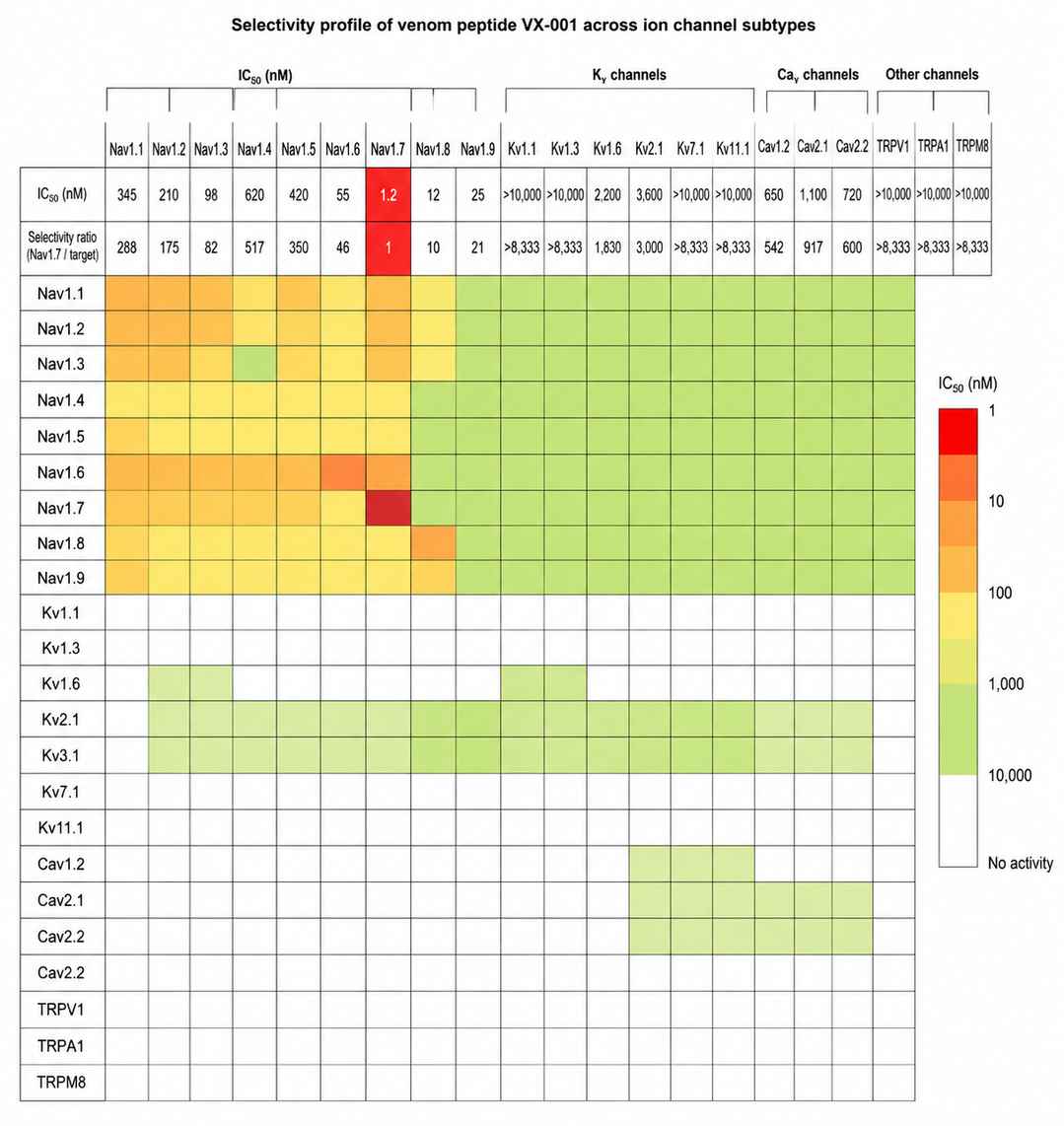
Figure 1: Selectivity heatmap for a spider venom peptide. IC50 values (nM) are colour-coded across Nav1.1–1.9, Kv subtypes, Cav subtypes, and TRP channels. Nav1.7 IC50 = 12 nM with >100-fold selectivity over other Nav subtypes and >1000-fold selectivity over Kv, Cav, and TRP channels.
Concentration-Response Curve — Nav1.7 Inhibition
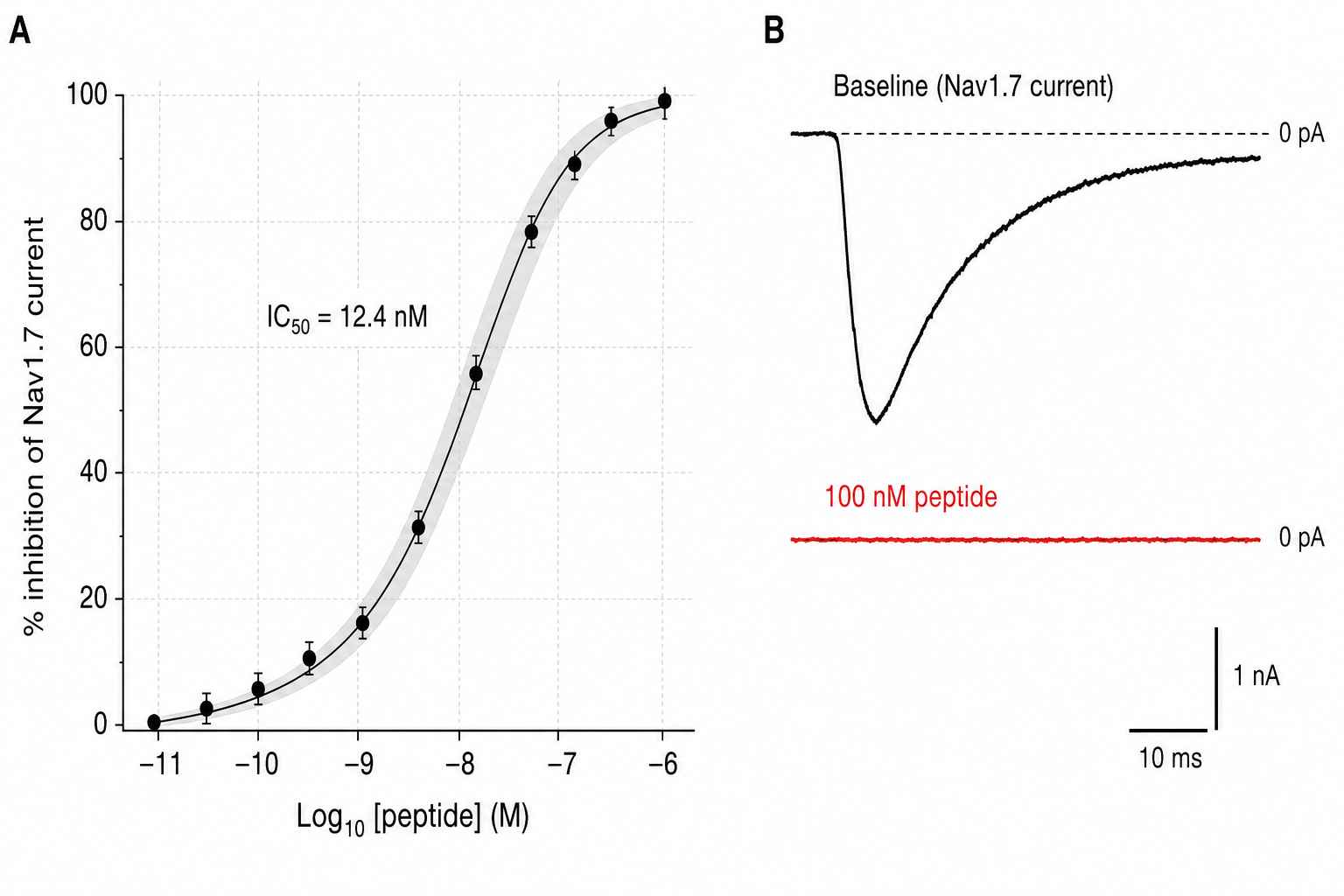
Figure 2: Concentration-response curve for Nav1.7 inhibition, measured by manual patch clamp in HEK293 cells (holding potential −80 mV, test potential −10 mV). IC50 = 12.4 nM (95% CI: 9.8–15.7 nM), Hill slope = 1.2. Inset: current traces before (black) and after (red) 100 nM peptide application.
Selectivity Comparison — Nav1.7 vs. Off-Target Subtypes
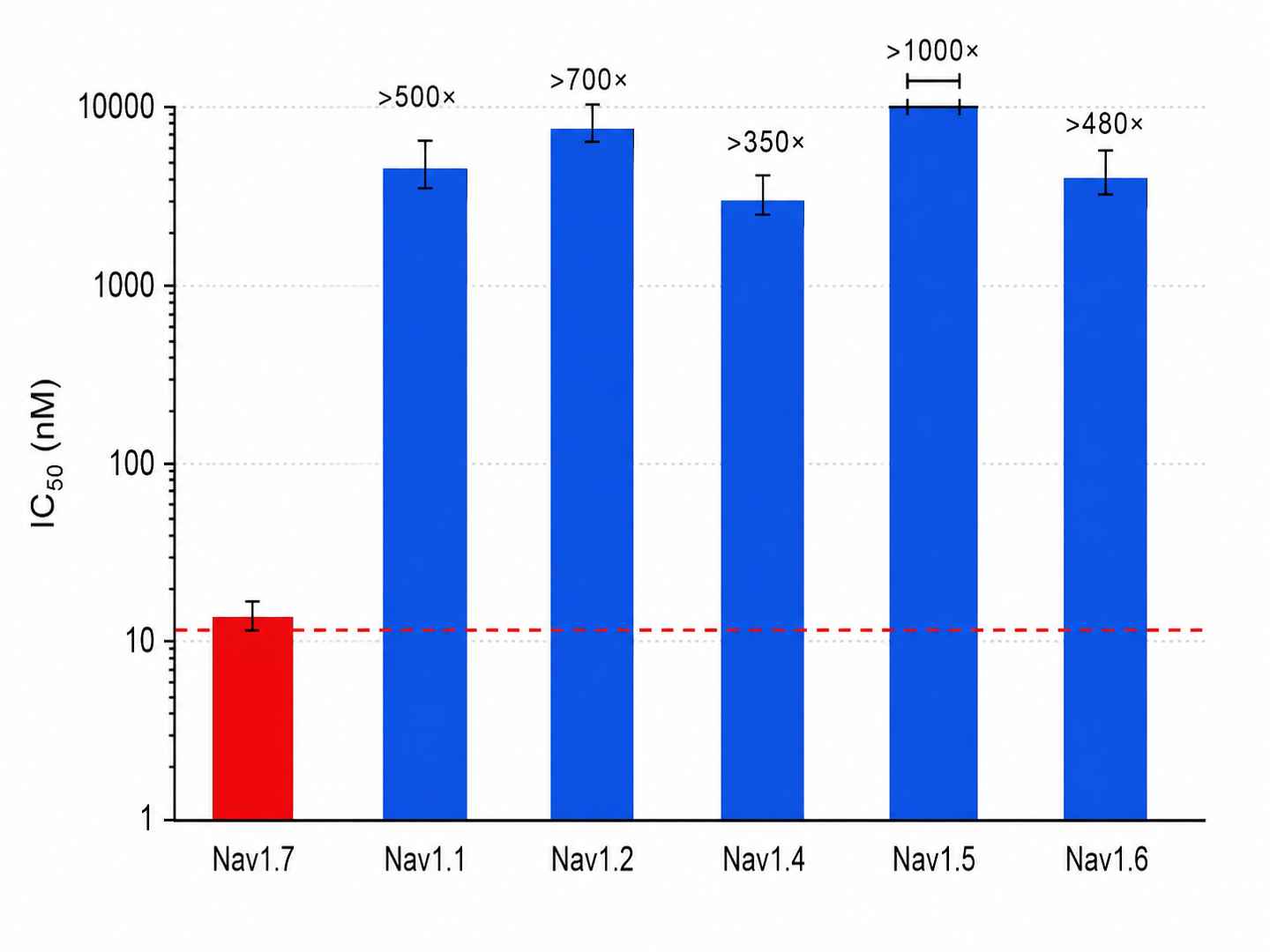
Figure 3: Selectivity comparison across Nav1.7 and off-target Nav subtypes (Nav1.1, Nav1.2, Nav1.4, Nav1.5, Nav1.6) on a log scale. Nav1.7 selectivity is >500-fold over Nav1.1/Nav1.2, and >1000-fold over Nav1.4/Nav1.5/Nav1.6, supporting non-opioid analgesic lead development.
HRMS Characterisation — Disulfide Bond Confirmation
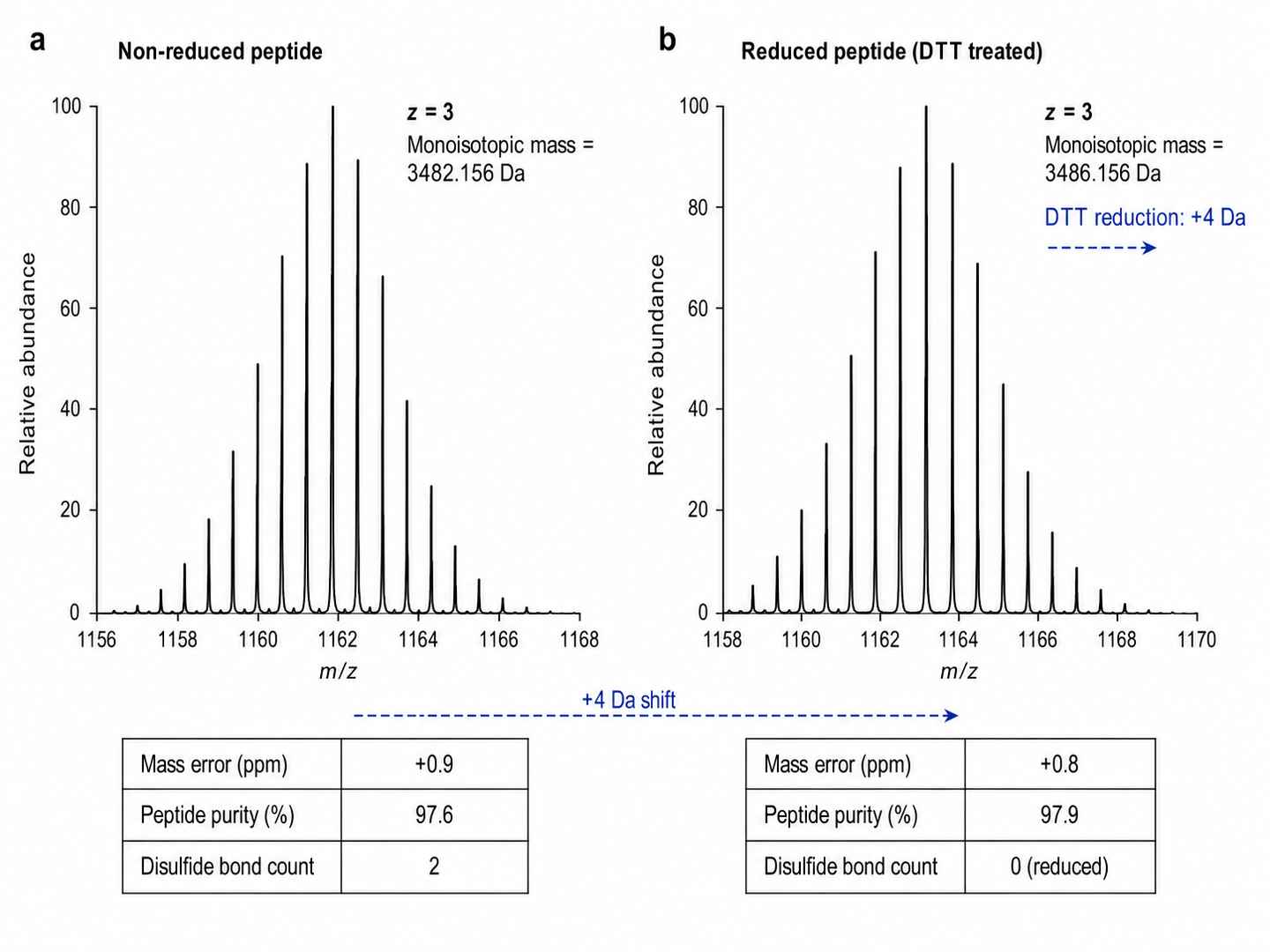
Figure 4: HRMS characterisation. Non-reduced MS: (M+H)+ = 3482.156 Da (mass error = 0.8 ppm). Reduced MS (DTT): mass shift consistent with two disulfide bonds. Purity assessed at 96.8% by LC-UV at 214 nm. ETD fragmentation confirmed disulfide connectivity.
Applications in Drug Discovery and Research
- Non-Opioid Analgesic Discovery: Nav1.7 and Nav1.8 are validated pain targets. Venom peptides with Nav1.7 selectivity offer a non-opioid analgesic development path. Our non-opioid analgesic peptide discovery service builds on this profiling to advance Nav1.7-selective leads.
- Autoimmune Disease Research: Kv1.3 channels are upregulated in effector memory T cells in autoimmune diseases (MS, T1D, RA). Kv1.3-selective venom peptides (kunitz-type, dendrotoxins) are investigated as immunosuppressants.
- Cardiac Safety Assessment: hERG (Kv11.1) blockade causes QT prolongation. All lead peptides are profiled against hERG as part of the standard panel. Optional Cav1.2 profiling provides additional cardiac safety data.
- Neuroscience Research & Tool Compounds: Subtype-selective venom peptides serve as research tools for ion channel gating studies, neuronal culture experiments, and synaptic transmission research.
- Venom Peptide Library Screening: For researchers with peptide libraries (synthetic, recombinant, or venom fractions), the platform provides high-throughput screening against the full ion channel panel, delivering a ranked list of active peptides with selectivity profiles.
- Deorphaning & Target Identification: Novel venom peptides are frequently sequenced but their ion channel target is unknown. The deorphaning workflow systematically identifies the primary target, enabling mechanism-of-action studies and IP positioning.
Service Deliverables
- Peptide MS characterisation report: HRMS spectrum, identity confirmation, purity assessment, disulfide bond pattern
- Binding pre-screen results: Z'-factor, signal-to-noise, % inhibition at test concentration for each ion channel subtype
- Electrophysiology IC50 report: concentration-response curves, raw traces, IC50 with 95% confidence intervals, selectivity ratios
- Ion channel subtype selectivity profile (table): IC50 (nM) for each subtype; selectivity score calculation
- Deorphaning report: primary target identification, off-target profile, mechanism of action (activator vs. inhibitor)
- Raw data files: pClamp .abf/.atf (manual patch), Nanion/Sophion export (automated patch), FLIPR data (TRP Ca2+ flux)
- Publication-ready figures: IC50 curves, selectivity heatmaps, representative traces (GraphPad Prism format)
- Expert interpretation: summary of selectivity findings, comparison to known venom peptide toxins, recommendations for lead optimisation
What ion channel subtypes are covered by the standard profiling panel? +
The standard panel covers 30+ subtypes: Nav1.1-1.9, Kv1.1-1.8, Kv2.1, Kv3.1-3.4, Kv4.1-4.3, Kv7.1, Kv11.1 (hERG), Cav1.1-1.4, Cav2.1-2.3, TRPV1-4, TRPA1, TRPM8. Custom subtypes (e.g., Nav1.7 disease mutants, Kv1.3 immune-related) can be added upon request.
Can you profile synthetic peptide libraries, or only native venom? +
Both. We profile native venom fractions, synthetic peptides, recombinant expressed peptides, and phage display peptide libraries. For libraries >100 members, we recommend a tiered approach: binding pre-screen then targeted electrophysiology validation.
What is the throughput of the profiling service? +
Binding pre-screen: 1000+ peptides/day (96-well format). Manual patch clamp: 8-12 peptides/week (gold-standard IC50). Automated patch clamp (Nanion/Sophion): 100+ peptides/day. The tiered model matches throughput to your library size and budget.
Do you provide MS characterisation of the peptides before profiling? +
Yes. All peptides are characterised by HRMS (Orbitrap or timsTOF) for identity confirmation, purity assessment (>95%), and disulfide bond pattern verification before ion channel profiling. This step is included in the service and eliminates false results from degraded or mis-identified peptides.
What deliverables are provided for a deorphaning project? +
Deorphaning deliverables include: (1) IC50 table across all tested subtypes, (2) Selectivity score calculation, (3) Primary target identification, (4) Mechanism of action (activator vs. inhibitor), (5) Raw electrophysiology traces, (6) Summary report with recommendations for follow-up studies.
Disclaimer: The services described herein are for research use only (RUO). The data and methods are not for clinical diagnostic or therapeutic use. All third-party trademarks and product names are the property of their respective owners.