Why Venom Peptide Lead Discovery Requires Specialized Structural Support
Animal venoms produce peptide toxins of extraordinary potency and selectivity against ion channels, GPCRs, and other membrane receptors — the result of millions of years of evolutionary pressure. This makes venom-derived peptides, particularly disulfide-rich conotoxins, spider toxins, and scorpion venom peptides, premier starting points for peptide drug discovery. Eleven venom-derived drugs have already reached approval, spanning chronic pain (ziconotide) to hypertension (captopril) and diabetes (exenatide).
The transition from venomics screening hit to development-ready lead is where most programs stall. The pharmacological activity of disulfide-rich venom peptides depends entirely on their three-dimensional structure — determined by disulfide connectivity and post-translational modifications (PTMs). A correct amino acid sequence is necessary but not sufficient: without knowing cysteine pairing, C-terminal amidation status, or oxidative folding state, activity data can be misleading or irreproducible. Standard peptide synthesis QC — HPLC purity and mass confirmation — cannot answer these questions. Creative Proteomics addresses this gap with a purpose-built characterization platform: non-reducing LC-MS, ETD/ECD fragmentation for disulfide connectivity mapping, PTM profiling, and oxidative folding assessment, delivered as an integrated service from sample receipt to SAR-ready data package.
From Screening Hit to Characterized Lead: What Creative Proteomics Delivers
A structured analytical service designed to support each stage of the venom peptide lead optimization workflow — from confirming the activity of your screening hit to delivering the structural data package needed for publication and IP.
Detectable Venom Peptide Classes and Scaffold Types
The table below maps the major venom peptide scaffold classes to their structural characteristics and recommended analytical approach.
| Venom Source | Scaffold Class | Disulfide Bonds | Typical Targets | Recommended Analysis |
|---|---|---|---|---|
| Cone snail (Conus) | ω-Conotoxin (ICK) | 3 disulfides | N-type CaV2.2 channel | ETD + partial reduction; see also non-opioid analgesic applications |
| Cone snail (Conus) | α-Conotoxin | 2 disulfides | nAChR | ETD straightforward |
| Spider (GsMTx4 family) | GsMTx4-derived | 0–1 (linear/truncated) | TRPV4, ASIC | Intact mass + PTM |
| Spider (Phoneutria) | Phα1β (ICK) | 3–6 disulfides | CaV2.1/2.2/2.3, TRPA1 | ETD + partial reduction |
| Scorpion | Short-chain toxin | 2–3 disulfides | K+ channels | ETD straightforward |
| Scorpion | Long-chain toxin | 4 disulfides | Na+ channels | Partial reduction recommended |
| Snake (mamba) | Mambalgin (3FTx) | 4 disulfides | ASIC1a/1b | ETD + partial reduction |
| Sea anemone | ShK-like | 1 disulfide | KV1.3 | ETD straightforward |
| Wasp/Bee | Linear amphipathic | 0 | Membrane disruption | Intact mass only |
Key Analytical Capabilities for Venom Peptide Lead Optimization
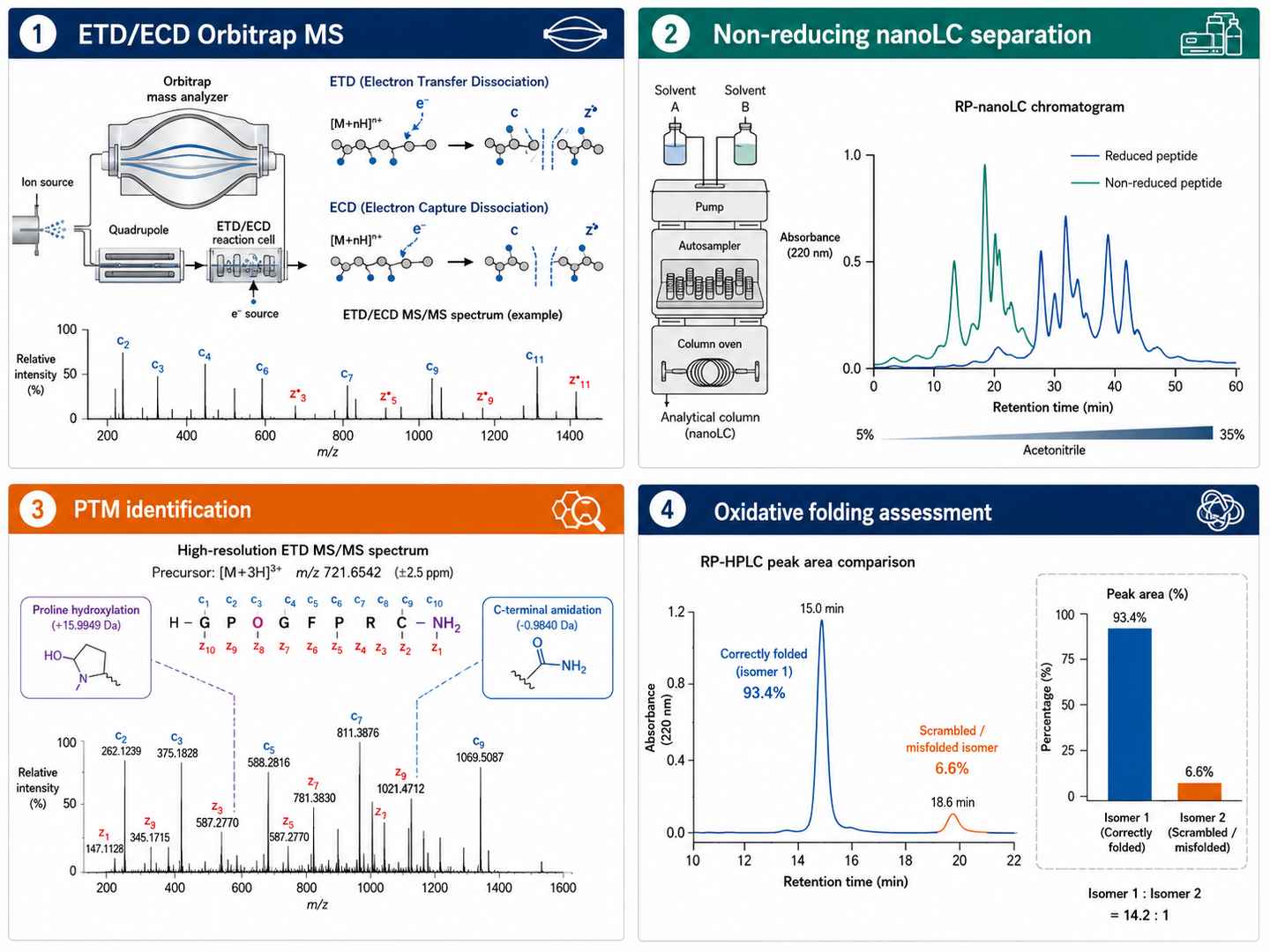
The Creative Proteomics platform integrates high-resolution Orbitrap mass spectrometry with nonreducing nanoLC separation and ETD/ECD fragmentation — specifically configured for the structural complexity of venom peptide scaffolds.
- Orbitrap HRMS with sub-ppm mass accuracy for monoisotopic mass confirmation of venom peptide leads
- ETD and ECD fragmentation modes — disulfide bonds remain intact during backbone cleavage, generating b- and y-ion pairs that directly reveal cysteine pairings; disulfide connectivity mapping capabilities detailed below
- Nonreducing LC-MS workflow under native electrospray ionization; no DTT/TCEP pre-treatment that would destroy connectivity information
- Stepwise partial reduction with controlled TCEP exposure for venom peptides with three or more disulfide bonds (conotoxin, spider toxin ICK scaffolds)
- PTM-aware fragmentation: C-terminal amidation, pyroglutamylation, proline hydroxylation, and N-/O-linked modifications identified alongside connectivity in a single analytical run
- Oxidative folding homogeneity assessment by nonreducing RP-HPLC + HRMS overlay — distinguishes correctly folded from scrambled disulfide isomers in the same sample
- Capillary and nanoLC coupling for low-input venom peptide samples (25–100 µg minimum; μg-scale protocols available)
- Structured data packages formatted for journal supplementary material and patent dossiers; raw instrument files archived on request
| Analytical Capability | Creative Proteomics | General Peptide Synthesis Vendor | General Proteomics Core |
|---|---|---|---|
| Disulfide Connectivity Assignment | ETD/ECD + partial reduction workflow | None (HPLC purity only) | Limited (standard digestion destroys connectivity) |
| Non-Reducing LC-MS Workflow | Yes — native electrospray optimized for DRPs | No | Occasional; not purpose-built for venom peptides |
| PTM + Connectivity (single run) | Yes | No | No |
| Oxidative Folding Assessment | Nonreducing RP-HPLC + HRMS overlay | None | Rarely offered |
| Low-Input DRP Characterization (≤100 µg) | Yes — nanoLC-HRMS calibrated for μg-scale | No | Sometimes; ≥500 µg typical |
| Venom Peptide Scaffold Experience | Yes — conotoxin, ICK, scorpion, linear | No | No |
Sample Requirements and Project Planning
| Peptide Type | Minimum Amount | Preferred Format | Storage / Shipping | Special Notes |
|---|---|---|---|---|
| Conotoxin / ω-conotoxin analogue | ≥50 µg | Lyophilized powder | −20 °C, dry ice | Include predicted connectivity if known; ETD/ECD used for 3-disulfide scaffolds |
| Spider toxin (ICK scaffold, ≥3 disulfides) | ≥100 µg | Lyophilized powder | −80 °C, dry ice | Partial reduction recommended for ≥3 disulfides |
| Linear / non-disulfide venom peptide | ≥25 µg | Lyophilized or solution | −20 °C | Reduced LC-MS sufficient; intact mass + sequence confirmation |
| Crude venom fraction / venom gland extract | ≥100 µg total peptide | Solution in 0.1% FA or ACN/H₂O | −80 °C, dry ice | Enrichment step may be required; contact us before submission |
| Phage-display selected venom peptide | ≥10 µg | Lyophilized | −20 °C | Confirm peptide sequence before submission; ETD for disulfide confirmation |
Deliverables: What You Receive After Characterization
- Nonreducing intact mass spectrum with deconvoluted mass (monoisotopic and average)
- Oxidative folding homogeneity report: RP-HPLC peak areas + HRMS confirmation of correctly folded vs isomer peaks
- ETD/ECD fragmentation data with annotated connectivity map (b- and y-ion assignments)
- Partial reduction data for venom peptides with three or more disulfide bonds
- PTM inventory with site-specific assignments where fragmentation quality permits (amidation, pyroglutamylation, hydroxylation)
- Disulfide connectivity map figure (visual representation of Cys–Cys pairings)
- Structured SAR data package in Word/PDF format, formatted for journal supplementary material and patent dossiers
- Raw instrument files (raw, mzML) archived and available on request
Why Choose Our Venom Peptide Lead Characterization Platform
Demo Results: Representative Data from Venom Peptide Lead Characterization
ETD-MS/MS Disulfide Connectivity Map
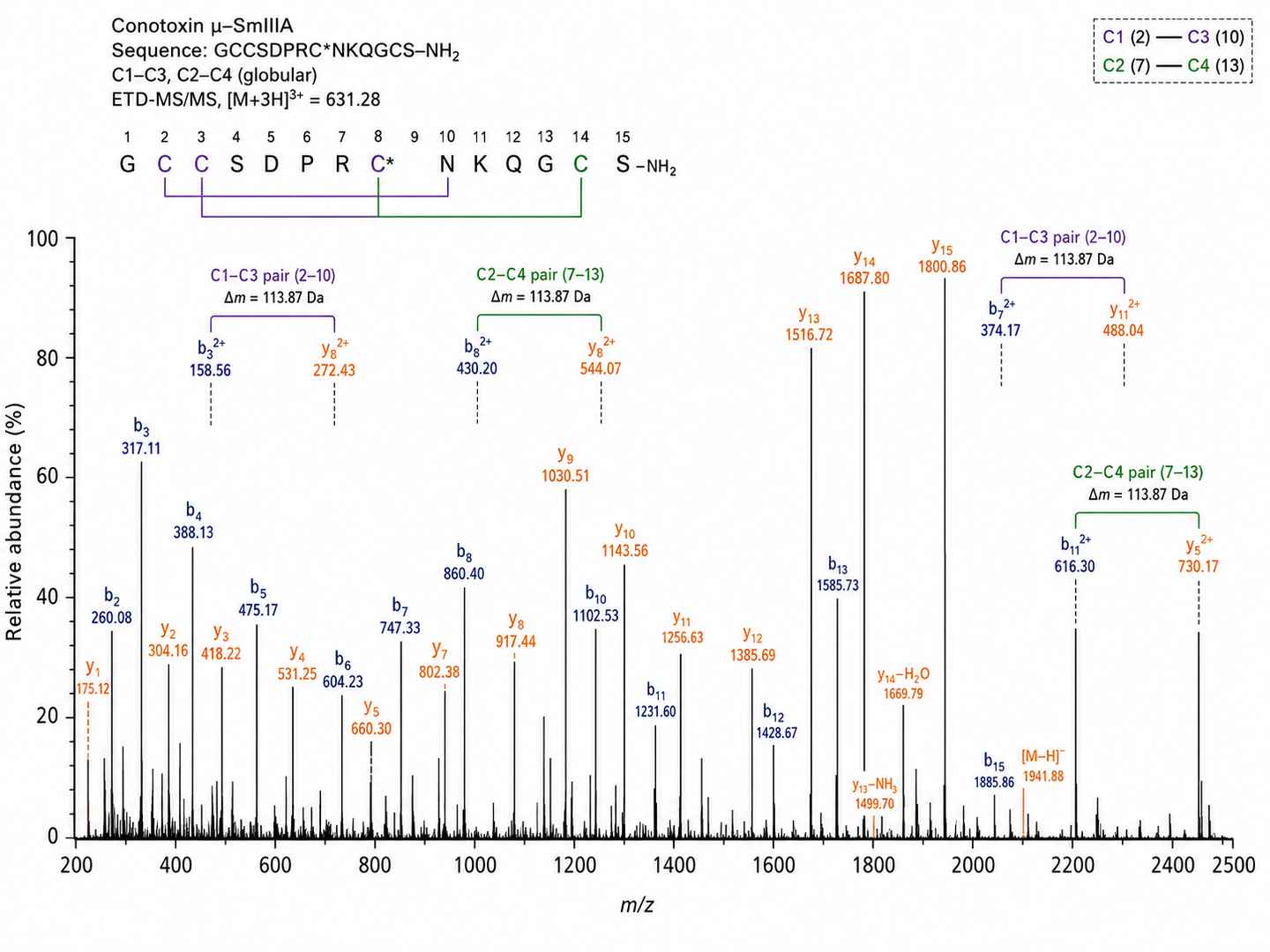
Annotated ETD fragmentation spectrum showing disulfide-linked fragment ion pairs; mass difference directly assigns cysteine pairings for an ICK-scaffold conotoxin with three disulfide bonds.
Oxidative Folding QC by Non-Reducing RP-HPLC
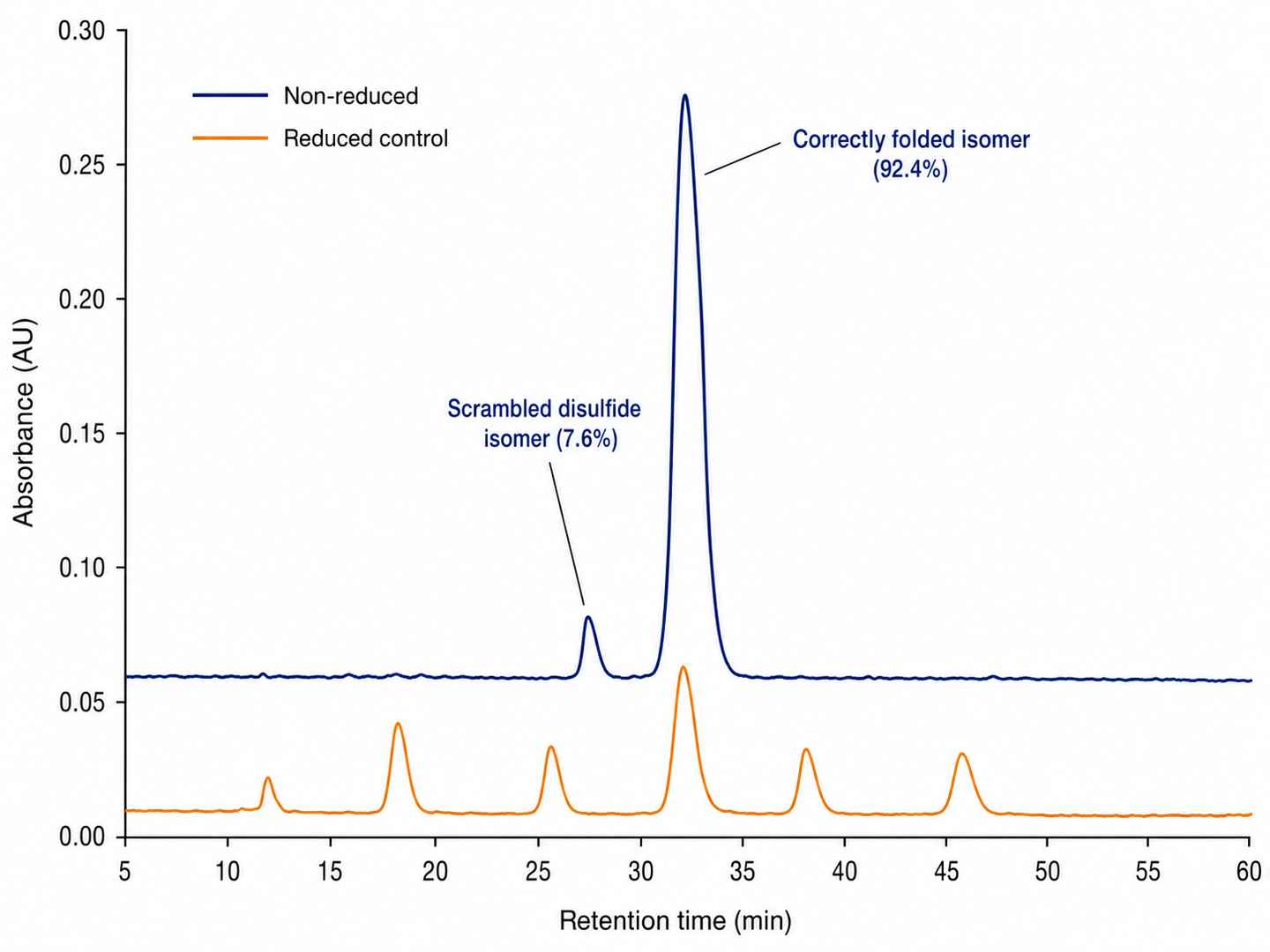
Nonreducing RP-HPLC profile overlaid with HRMS confirms correctly folded peptide fraction vs scrambled disulfide isomers; peak area quantification distinguishes native fold from oxidative by-products in the same analytical run.
*For Research Use Only. Not for use in diagnostic procedures.*
Can you confirm disulfide connectivity for my screening hit? +
Yes. Our Orbitrap-based ETD/ECD platform specifically preserves intact disulfide bonds during ionization and backbone fragmentation, enabling direct assignment of cysteine pairings from the mass difference between linked fragment ions. For ICK-scaffold conotoxins and spider toxins with six cysteine residues, our stepwise partial reduction workflow generates overlapping connectivity subsets that resolve all possible pairing combinations.
How much sample do I need for a complete characterization? +
Minimum requirements vary by scaffold complexity: 25 µg for synthetic linear venom peptides; 50–100 µg for disulfide-rich conotoxin or spider toxin analogues; ≥100 µg for crude venom fractions or venom gland extracts. Lower amounts may be discussed on a case-by-case basis for screening purposes — contact us with your available quantity before sample submission.
Can you assess oxidative folding quality alongside connectivity? +
Yes. Nonreducing RP-HPLC + HRMS quantifies oxidative folding heterogeneity by comparing peak areas of native vs scrambled disulfide isomers. This heterogeneity assessment runs in the same analytical workflow as connectivity mapping — without additional sample preparation or separate experiments.
What venom types and scaffold structures can you analyze? +
We routinely characterize conotoxins (ω, α, and other frameworks), spider toxins (GsMTx4-derived, Phα1β family, ICK scaffolds), scorpion venom peptides (short-chain and long-chain toxins), and linear amphipathic venom peptides. Disulfide bond counts from 0 to 8 are supported; partial reduction is recommended for peptides with three or more disulfide bonds.
Can the data package support patent filings? +
Yes. All deliverables — annotated ETD fragmentation spectra, connectivity maps, PTM inventories, and folding homogeneity reports — are formatted to meet peer-reviewed journal standards for supplementary material and patent dossiers. Raw instrument files are archived and retrievable for regulatory audit purposes.
Case Study: A Machine Learning-Enabled Venom Peptide Platform for Rapid Drug Discovery
Based on: A Machine Learning-Enabled Venom Peptide Platform for Rapid Drug Discovery — Cai F, Zhou L, Delgado B, et al., Pharmaceuticals, 2026
DOI: 10.3390/ph19020288
Background
Animal venoms represent millions of years of evolutionary optimization for targeting complex membrane proteins — including ion channels, GPCRs, and transporters — with potency and selectivity that conventional small molecule or antibody libraries struggle to match. The 11 venom-derived drugs approved to date span indications from chronic pain to hypertension and diabetes, demonstrating the clinical tractability of venom peptide scaffolds. Yet despite this validated starting point, the transition from venomics screening to a development-ready venom peptide lead remains analytically demanding: the potency of disulfide-rich venom peptides is entirely dependent on their three-dimensional structure, which cannot be inferred from sequence alone.
A 2026 study by Cai, Zhou, and colleagues at Genentech and DeepSeq.AI addressed this gap by combining AI-guided venom library design with recombinant expression and high-throughput characterization. The study establishes a framework for venom peptide lead discovery that integrates structural validation at every stage — directly illustrating why early-stage disulfide connectivity and PTM characterization are essential for downstream success.
Study Objectives
The study aimed to establish a scalable, generalizable platform for venom peptide lead discovery by:
- Constructing a high-diversity venom peptide library using 482 natural scaffolds
- Applying machine learning to predict mutation-tolerant residues and optimize peptide foldability
- Screening against diverse target classes (ion channels, GPCRs, immune checkpoints) to validate platform generality
- Demonstrating that structural characterization of screening hits accelerates lead optimization
Key Findings
VCX Library Design and Expression: The team constructed the VCX (Venom-Conotoxin) phage display library using 482 venom-derived peptide scaffolds, including conotoxin ICK frameworks, spider toxin scaffolds, scorpion toxins, and other disulfide-rich motifs. Peptides were expressed as thioredoxin (Trx) fusion proteins in E. coli, enabling high-throughput recombinant expression with proper disulfide bond formation in the periplasmic compartment.
Screening Across Diverse Target Classes: The platform was challenged with four targets spanning different protein families: the immune checkpoint CD47, the DLL3 tumor marker, the IL33 cytokine, and the P2X7R ion channel. Remarkably, the screening achieved a 100% hit rate across all four targets — yielding strong binders for every target class tested, including the ion channel P2X7R at nanomolar affinity.
Structural Validation as a Discovery Multiplier: The study emphasizes that lead optimization is only as reliable as the structural data underpinning it. Venom peptide scaffolds with incorrect disulfide connectivity or scrambled folding will yield misleading activity data — wasting downstream resource allocation on false leads. Early structural validation (connectivity mapping + PTM profiling) accelerates the identification of genuine high-quality leads and reduces late-stage program failures.
Implications for Venom Peptide Drug Discovery: This platform demonstrates that venom peptide libraries are a rich and tractable source of high-affinity leads across diverse target classes. The key bottleneck for programs pursuing this strategy is not the availability of active scaffolds — it is the capacity to rapidly confirm structural integrity (disulfide connectivity, PTM status, folding homogeneity) for screening hits before committing to SAR studies and medicinal chemistry investment.
How the Creative Proteomics Platform Addresses These Needs
Creative Proteomics delivers the venom peptide lead characterization capabilities that drug discovery programs require at the hit-to-lead transition. Our ETD/ECD nonreducing LC-MS workflow resolves disulfide connectivity for all common venom peptide scaffolds — from two-disulfide conotoxin frameworks to six-disulfide ICK spider toxins. Oxidative folding assessment by nonreducing RP-HPLC + HRMS distinguishes correctly folded from scrambled isomers before connectivity assignment begins. PTM characterization is integrated into the same analytical run, providing a complete structural profile in a single project. Low-input protocols (25–100 µg minimum) preserve precious screening hit material for downstream biological assays and medicinal chemistry.
References
- Cai F, Zhou L, Delgado B, et al. A Machine Learning-Enabled Venom Peptide Platform for Rapid Drug Discovery. Pharmaceuticals. 2026;19(2):288. doi:10.3390/ph19020288
- Zhou L, Cai F, Li Y, et al. Disulfide-Constrained Peptide Scaffolds Enable a Robust Peptide-Therapeutic Discovery Platform. PLOS ONE. 2024;19(3):e0300135. doi:10.1371/journal.pone.0300135
- Freuville L, Matthys C, Quinton L, Gillet J-P. Venom-Derived Peptides for Breaking Through the Glass Ceiling of Drug Development. Frontiers in Chemistry. 2024;12:1465459. doi:10.3389/fchem.2024.1465459
- Cheng X, Wu C. Directing the Oxidative Folding of Disulfide-Rich Peptides for Enhanced Engineering and Applications. Chemical Science. 2025. doi:10.1039/D5SC05617A