Why the Analgesic Pipeline Needs Non-Opioid Peptide Approaches
The global opioid overdose crisis has driven intensifying research into analgesic agents that operate independently of the mu-opioid receptor. Venom-derived peptides and endogenous neuropeptides represent two of the most structurally distinct and pharmacologically validated classes under active development.
Venomous organisms — cone snails, spiders, scorpions, and snakes — have evolved peptide toxins precisely calibrated to modulate ion channels and receptors in the mammalian nervous system. The most clinically advanced example is ziconotide (Prialt), an omega-conotoxin (MVIIA) from Conus magus that blocks N-type calcium channels (CaV2.2) and received FDA approval in 2004 — the first non-opioid peptide analgesic to reach the market.
Beyond ziconotide, a new generation of non-opioid analgesic peptides is advancing through preclinical and clinical development, including spider toxin-derived ASIC and TRPV4 channel inhibitors, snake venom mambalgins targeting acid-sensing ion channels, and engineered bifunctional opioid/NPFF receptor ligands designed to minimise tolerance and dependence. A 2026 study in Acta Pharmacologica Sinica demonstrated that GsMTx4-derived peptides selectively inhibit TRPV4 channels and relieve mechanical pain in rodent models — without producing opioid-associated tolerance or respiratory depression.
The defining analytical challenge across all these programmes: the pharmacological activity of disulfide-rich analgesic peptides depends on their three-dimensional structure, determined by disulfide connectivity and PTMs. Mass confirmation alone cannot establish these structural features. Creative Proteomics addresses this gap with a purpose-built non-reducing LC-MS workflow — delivering disulfide connectivity mapping, PTM profiling, and oxidative folding assessment in a single integrated project.
What Creative Proteomics Delivers for Non-Opioid Analgesic Peptide Characterisation
A comprehensive analytical platform purpose-built for venom-derived and endogenous neuropeptide characterisation — delivering the structural data needed to progress analgesic peptide candidates from hit confirmation through SAR studies and IND-enabling characterisation.
Pain-Relieving Peptide Classes and Their Ion Channel Targets
The non-opioid analgesic peptide landscape spans multiple structural classes, each with distinct disulfide topologies, ion channel targets, and clinical development status. The table below maps primary analgesic peptide scaffolds to their mechanism of action.
| Peptide Class | Representative Peptides | Ion Channel / Receptor Target | Key Structural Feature | Clinical Status |
|---|---|---|---|---|
| Omega-Conotoxin | Ziconotide (MVIIA), GVIA, CVIID | N-type CaV2.2 channel blocker | 3 disulfide bonds, Cys framework VI/VII | FDA approved (ziconotide, Prialt); others in trials |
| Spider Toxin (GsMTx4 family) | Pept 01, Pept 03 (TRPV4 inhibitors) | TRPV4 mechanosensitive channel | GsMTx4-derived linear/truncated peptides; no disulfide in engineered derivatives | Preclinical; Pept 03 active in rodent pain models (Acta Pharmacol. Sin. 2026) |
| Spider Toxin (Phα1β family) | Phα1β, PnTx3-3, PnTx3-5 | CaV2.1/CaV2.2/CaV2.3; TRPA1 | ICK motif; 3–6 disulfide bonds | Preclinical; enhanced analgesic effect vs morphine reported |
| ASIC Inhibitor (Spider/Snake) | Hi1a (funnel-web spider), Mambalgin (mamba snake) | ASIC1a / ASIC1b | 6–8 disulfide bonds (ICK knot scaffold) | Hi1a: neuroprotection indication in development (Aus. Gov.) |
| Endogenous Opioid Peptide | Endomorphin-1/2, Biphalin | MOR / DOR dual agonist | Amide C-terminus critical for activity; linear or cyclised | Biphalin: ~1000× morphine potency intrathecally; less dependence than morphine |
| NaV1.7 Targeting Toxin | Hainantoxin-IV, JzTx-34, β-TRTX-Cd1a | NaV1.7 channel blocker | ICK scaffold; 3 disulfide bonds | Validated genetic target (congenital insensitivity to pain); no approved drugs yet |
| Kappa-Current Modulator | ShK-186 / Dalazatide (sea anemone) | KV1.3 channel antagonist | Linear peptide; single disulfide | Phase I complete (plaque psoriasis); autoimmune pain indication |
| Bifunctional Opioid/NPFF Agonist | OFP011, KGFF09 | MOR agonist + NPFF receptor antagonist | Cyclised opioid scaffold with NPFF-address sequence | Preclinical; non-tolerance-forming analgesic profile reported |
Platform Capabilities for Venom and Toxin Peptide Characterisation
The Creative Proteomics platform integrates high-resolution Orbitrap mass spectrometry with non-reducing nanoLC separation and ETD/ECD fragmentation — specifically configured for the structural complexity of venom-derived and endogenous analgesic peptides.
- Orbitrap HRMS with sub-ppm mass accuracy for monoisotopic mass confirmation of analgesic peptide candidates
- ETD and ECD fragmentation modes — disulfide bonds remain intact during backbone cleavage, generating b- and y-ion pairs that directly reveal cysteine pairings
- Non-reducing LC-MS workflow under native electrospray ionisation; no DTT/TCEP pre-treatment that would destroy connectivity information
- Stepwise partial reduction with controlled TCEP exposure for analgesic peptides with ≥3 disulfide bonds (conotoxin, spider toxin ICK scaffolds)
- PTM-aware fragmentation: C-terminal amidation, pyroglutamylation, proline hydroxylation, and N-/O-linked modifications identified alongside connectivity in a single analytical run
- Oxidative folding homogeneity assessment by non-reducing RP-HPLC + HRMS overlay — distinguishes correctly folded from scrambled disulfide isomers in the same sample
- Capillary and nanoLC coupling for low-input analgesic peptide samples (25–100 µg minimum; μg-scale protocols available)
- Structured data packages formatted for journal supplementary material and patent dossiers; raw instrument files archived on request
| Analytical Capability | Creative Proteomics (Analgesic Peptide Platform) | Commercial Peptide Synthesis | General Proteomics Core |
|---|---|---|---|
| Disulfide Connectivity Assignment | ETD/ECD + partial reduction workflow | None (HPLC purity only) | Limited (standard protease digestion destroys connectivity) |
| Non-Reducing LC-MS Workflow | Yes — native electrospray optimised for DRPs | No | Occasional; not purpose-built for venom peptides |
| PTM + Connectivity (single run) | Yes | No | No |
| Oxidative Folding Assessment | Non-reducing RP-HPLC + HRMS overlay | None | Rarely offered |
| Low-Input DRP Characterisation (≤100 µg) | Yes — nanoLC-HRMS calibrated for μg-scale | No | Sometimes; ≥500 µg typical |
| Ion Channel Target Support Data | Yes — SAR package for NaV, CaV, TRPV4, ASIC targets | No | No |
Analytical Workflow — From Venom Sample to Characterised Hit
A four-step integrated workflow for complete structural characterisation of non-opioid analgesic peptide candidates, from initial sample receipt through to delivery of a publication-grade data package.
Sample Receipt & Sequence Review
Peptide sequence, number of Cys residues, and available quantity confirmed; non-reducing preparation protocol selected
Non-Reducing LC-MS Characterisation
Intact mass confirmed under native conditions; oxidative folding heterogeneity assessed by RP-HPLC co-elution
ETD/ECD Fragmentation & Connectivity Mapping
Disulfide-linked b- and y-ion pairs generated; cysteine pairings assigned; PTMs identified in the same analytical run
SAR Data Package & Structural Report
Annotated fragmentation spectra, connectivity map, PTM inventory, and folding homogeneity report compiled for publication and IP
1
Sample Receipt & Sequence Review
Upon receipt, the submitted peptide sequence is reviewed for cysteine count, predicted disulfide framework, and net charge. For venom gland extracts or fractionated samples, an initial RP-HPLC purity check and MALDI-TOF screen are performed before committing to the full non-reducing characterisation workflow. Sample integrity and storage conditions are verified upon receipt.
2
Non-Reducing LC-MS Characterisation
The intact peptide is analysed by nanoLC-HRMS under native, non-reducing electrospray ionisation. Oxidative folding state is assessed by comparing the elution profile against a reduced control (run in parallel on a separate aliquot). RP-HPLC peak shape and MS1 isotopic envelope quality are assessed before proceeding to fragmentation. This step confirms the correct oxidised mass and provides a first assessment of folding homogeneity.
3
ETD/ECD Fragmentation & Connectivity Mapping
The native (non-reduced) peptide is subjected to ETD or ECD fragmentation on an Orbitrap Fusion Lumos or timsTOF Pro. Backbone cleavage occurs while disulfide bonds remain intact; the mass difference between linked b- and y-ion pairs directly reveals which cysteine residues are paired. For peptides with ≥3 disulfide bonds, a stepwise partial reduction protocol generates overlapping connectivity subsets for unambiguous assignment. PTMs — including C-terminal amidation, pyroglutamylation, and proline hydroxylation — are identified in the same MS/MS dataset.
4
SAR Data Package & Structural Report
All analytical results — intact mass, oxidative folding purity, ETD/ECD connectivity assignments, and PTM inventory — are compiled into a structured SAR data package in Word/PDF format. Annotated fragmentation spectra with b- and y-ion assignments, a visual disulfide connectivity map, and a PTM summary table are included. The report is formatted for journal supplementary material and patent dossiers. Raw instrument files (raw, mzML) are archived and available on request.
Representative Results: From Native Venom to Analgesic Hit
Non-Reducing LC-MS Profile of a Conotoxin Analogue
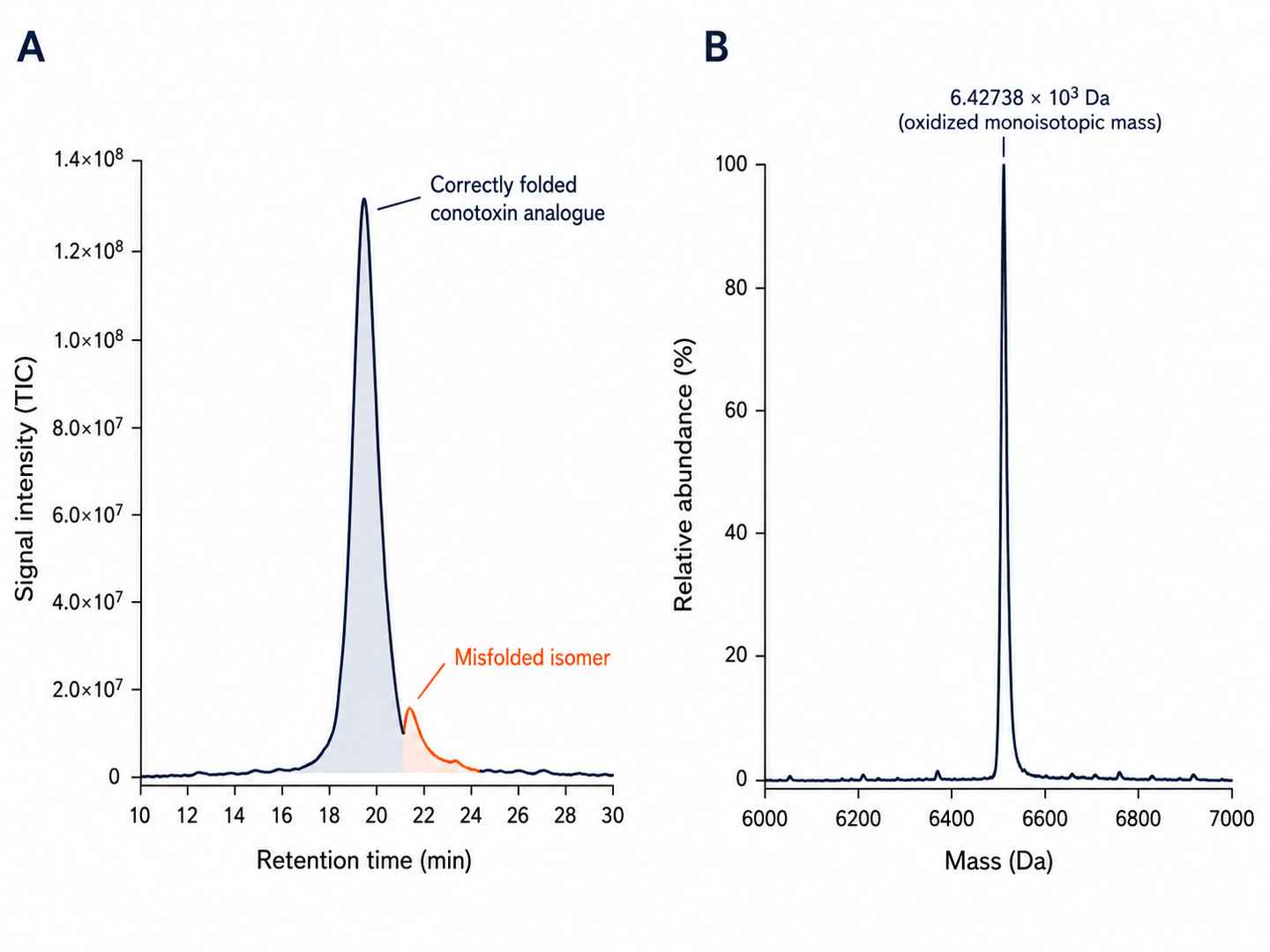
Overlaid total ion chromatogram (TIC) of reduced vs non-reduced conotoxin analogue acquired by nanoLC-HRMS. Deconvoluted intact mass confirmed. Oxidative folding heterogeneity quantified from peak area integration of native vs misfolded isomers.
ETD Fragment Ion Map Confirming Disulfide Connectivity
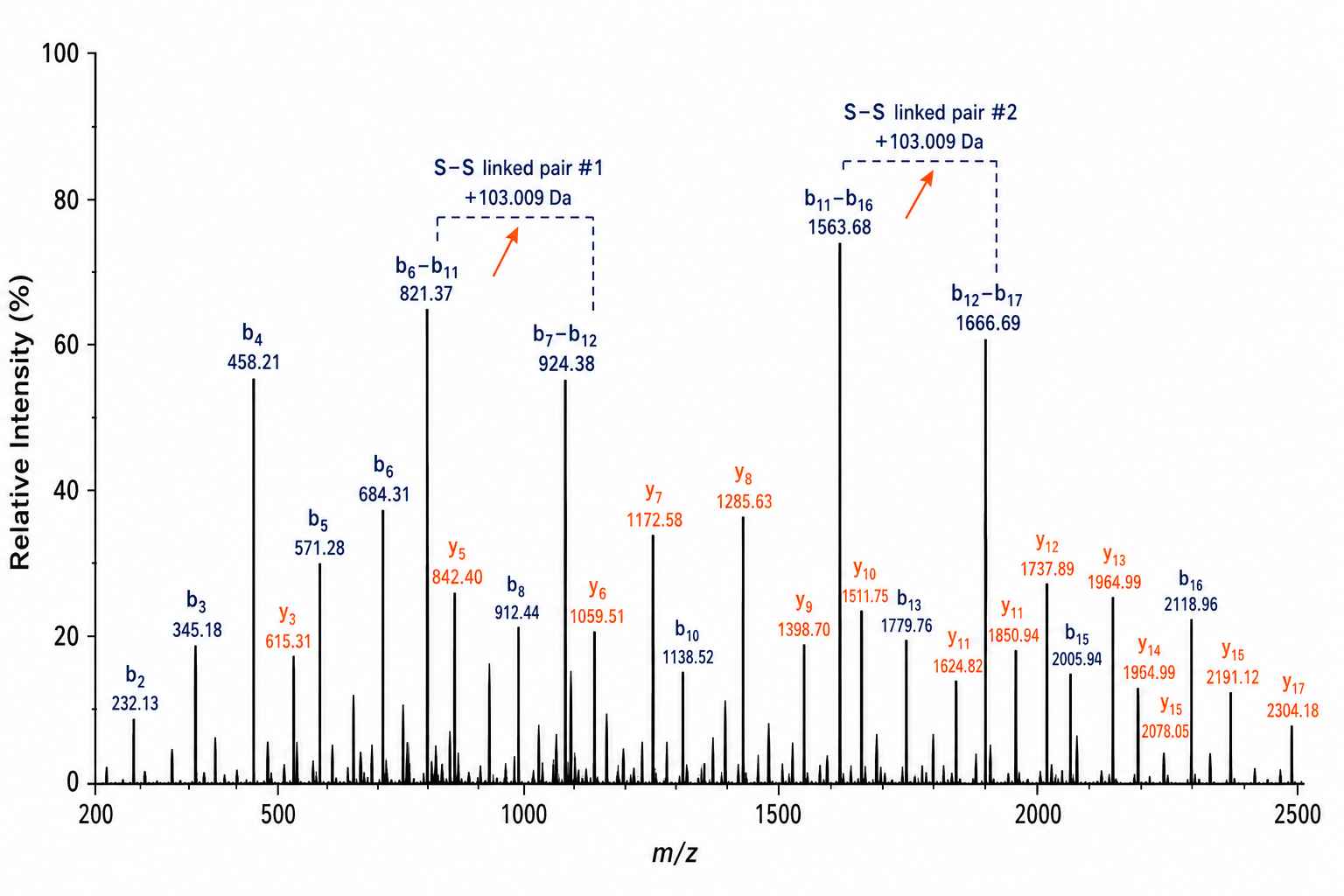
ETD-MS/MS spectrum with annotated b- and y-ion series confirming specific Cys–Cys pairing in an analgesic conotoxin. The mass difference between disulfide-linked fragment ion pairs directly reveals cysteine connectivity across the scaffold.
PTM Characterisation: C-Terminal Amidation and Hydroxylation in a Spider Toxin
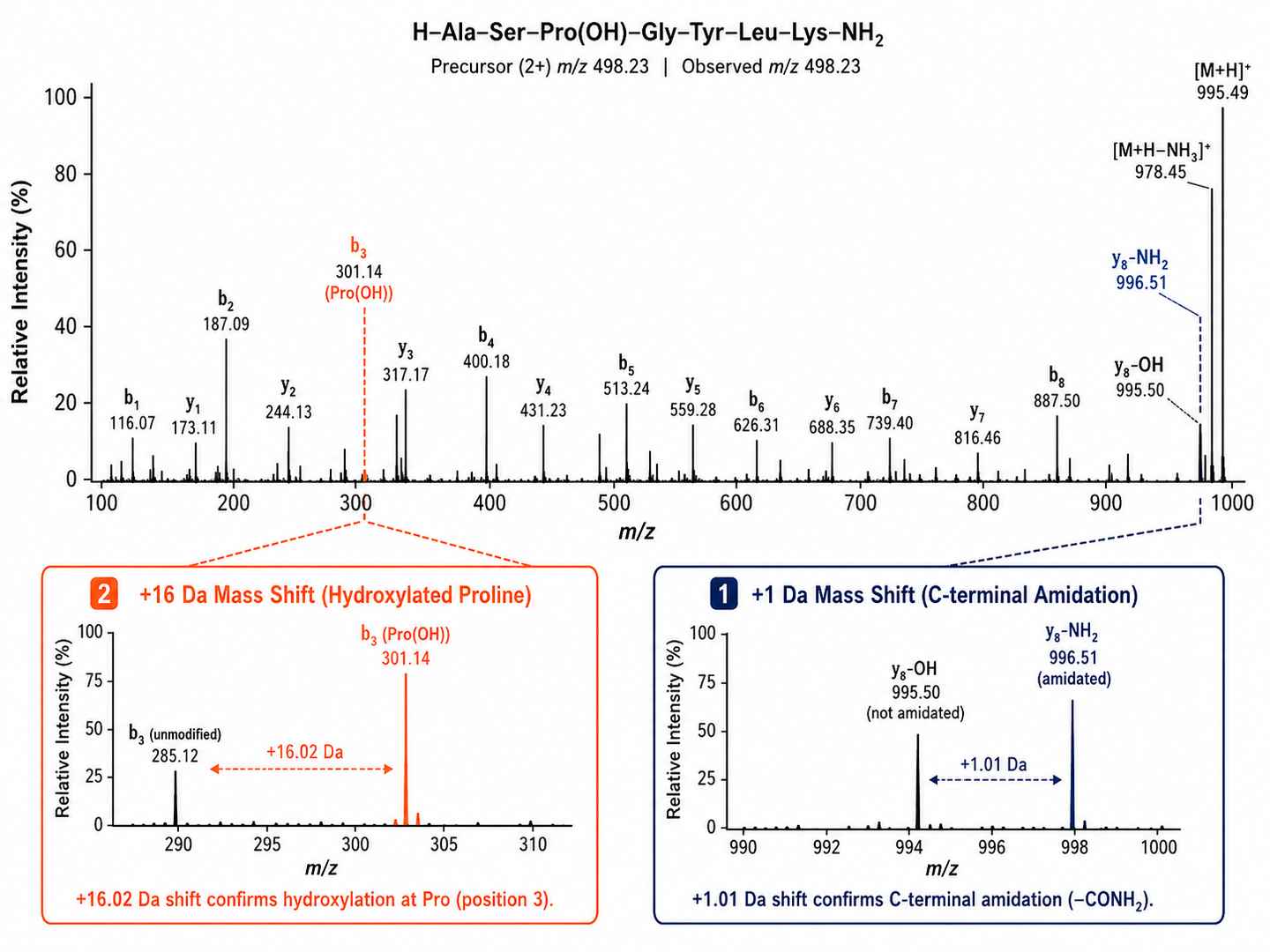
High-resolution MS/MS spectrum identifying C-terminal amidation and proline hydroxylation modifications co-occurring with disulfide mapping in a spider toxin analgesic peptide. PTM site-specific assignments confirmed by fragmentation pattern.
Disulfide Connectivity Map Across an Analgesic Peptide Library
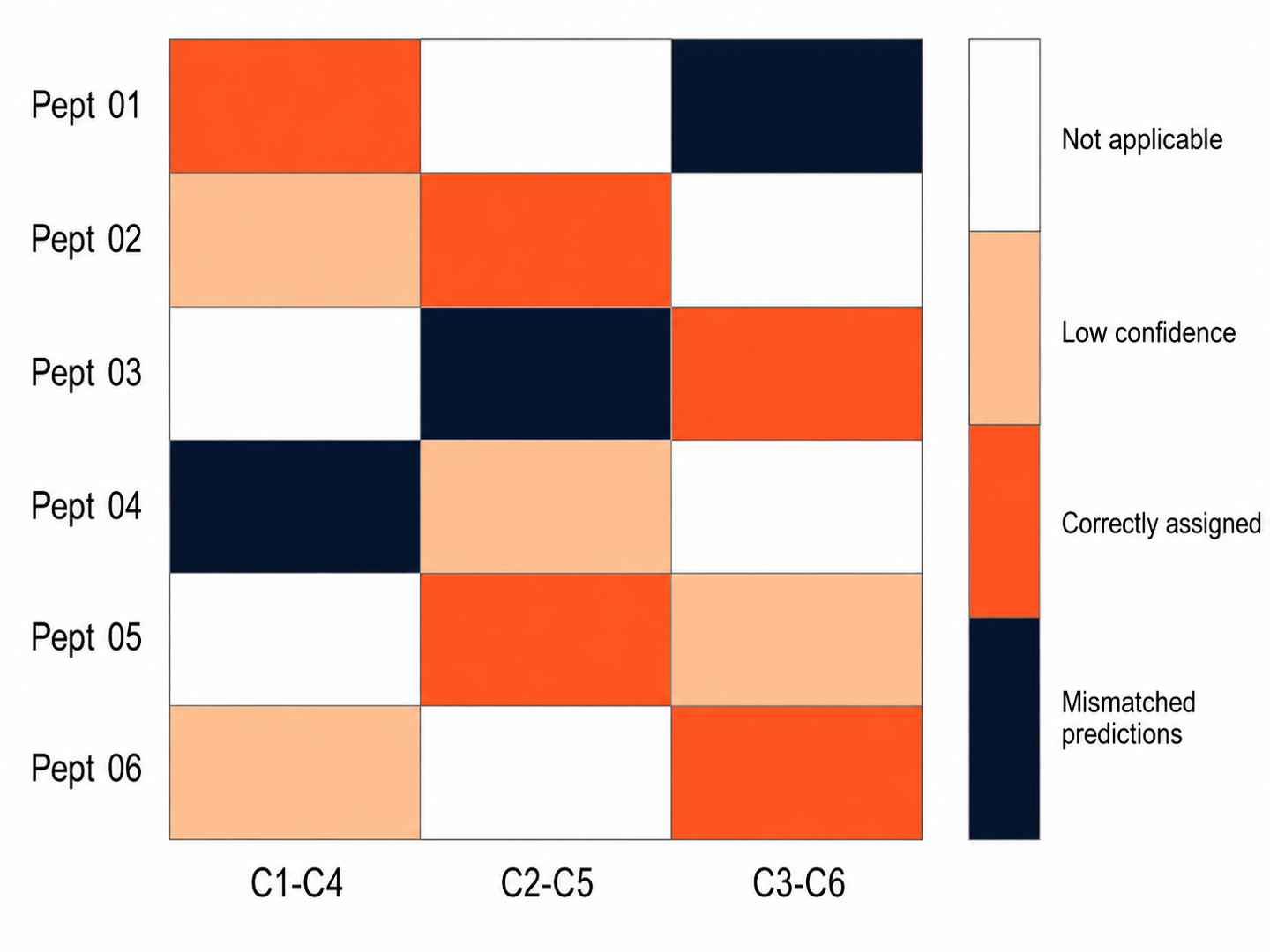
Heatmap showing predicted vs observed disulfide connectivity for a panel of analgesic peptide analogues. Orange indicators flag mismatches where connectivity deviates from the predicted canonical framework — enabling rapid prioritisation of correctly folded library members for SAR studies.
Sample Requirements and Project Planning
| Peptide Type | Minimum Amount | Preferred Format | Storage / Shipping | Special Notes |
|---|---|---|---|---|
| Conotoxin / Omega-conotoxin analogue | ≥ 50 µg | Lyophilized powder | −20 °C, dry ice | Include predicted connectivity if known; ETD/ECD used for 3-disulfide scaffolds |
| Spider toxin (GsMTx4-derived, TRPV4 inhibitor) | ≥ 25 µg | Lyophilized or 0.1% FA solution | −20 °C, dry ice | Linear/truncated versions may not require partial reduction; consult with sample quantity |
| ASIC/Nav channel-targeting spider toxin | ≥ 100 µg | Lyophilized powder | −80 °C, dry ice | ICK scaffold with 3–6 disulfide bonds; partial reduction recommended for ≥3 disulfides |
| Endogenous opioid peptide (synthetic) | ≥ 25 µg | Lyophilized powder | −20 °C | C-terminal amidation confirmed by intact mass shift (+1 Da vs free acid) |
| Venom gland extract / semi-purified fraction | ≥ 100 µg (total peptide) | Solution in 0.1% FA or ACN/H₂O | −80 °C, dry ice | Enrichment step may be required; contact us before submission |
| Bifunctional / engineered analgesic peptide | ≥ 50 µg | Lyophilized or in solution | −20 °C or −80 °C | Confirm cyclisation type (head-to-tail vs stapled) and disulfide count before submission |
Deliverables: What You Receive After Characterisation
- Non-reducing intact mass spectrum with deconvoluted mass (monoisotopic and average)
- Oxidative folding homogeneity report: RP-HPLC peak areas + HRMS confirmation of correctly folded vs isomer peaks
- ETD/ECD fragmentation data with annotated connectivity map (b- and y-ion assignments)
- Partial reduction data for analgesic peptides with ≥3 disulfide bonds
- PTM inventory with site-specific assignments where fragmentation quality permits (amidation, pyroglutamylation, hydroxylation)
- Disulfide connectivity map figure (visual representation of Cys–Cys pairings)
- Structured SAR data package in Word/PDF format, formatted for journal supplementary material and patent dossiers
- Raw instrument files (raw, mzML) archived and available on request
Why Choose Our Non-Opioid Analgesic Peptide Characterisation Platform
Can you confirm disulfide connectivity for my analgesic peptide candidates? +
Yes. Our Orbitrap-based ETD/ECD platform specifically preserves intact disulfide bonds during ionisation and backbone fragmentation, enabling direct assignment of cysteine pairings from the mass difference between linked fragment ions. For analgesic peptides with ≥3 disulfide bonds — such as ICK-scaffold spider toxins with six cysteine residues — our stepwise partial reduction workflow generates overlapping connectivity subsets that resolve all possible pairing combinations.
My venom extract contains many peptides — can you characterise the active fraction? +
We offer fraction profiling and characterisation for venom matrices. The workflow includes RP-HPLC fractionation guidance, MALDI-TOF or nanoLC-HRMS intact mass profiling, and targeted ETD/ECD fragmentation of the active fraction — with sufficient sample quantity (≥100 µg total peptide). We can advise on enrichment strategies before you commit to a full characterisation project.
Can you analyse PTMs alongside disulfide connectivity in the same run? +
Yes. C-terminal amidation, N-terminal pyroglutamylation, proline hydroxylation, and other PTMs are captured alongside disulfide connectivity data in the same HRMS analytical run. PTM assignments are included in the structured report with site-specific localisation where fragmentation quality permits. This is critical for analgesic peptide scaffolds — C-terminal amidation in particular is a common potency determinant in endogenous opioid and venom-derived analgesic peptides.
What sample amount is required for a complete analgesic peptide characterisation? +
Minimum requirements vary by scaffold complexity: 25–50 µg for synthetic linear endogenous opioid peptides; 50–100 µg for disulfide-rich conotoxin or spider toxin analogues; ≥100 µg for crude venom fractions. Lower amounts may be discussed on a case-by-case basis for screening purposes — contact us with your available quantity before sample submission.
Can the data be used for grant applications or publication? +
Yes. All deliverables — raw HRMS files, annotated fragmentation spectra, connectivity maps, and PTM inventories — are formatted to meet peer-reviewed journal standards for supplementary material and patent dossiers. We provide structured reports in Word or PDF format on request. Raw instrument files are archived and retrievable for regulatory audit purposes.
Case Study: Structural Characterisation of Non-Opioid Analgesic Peptides — From Venom to Validated Hit
Based on: Analgesic Peptides: From Natural Diversity to Rational Design — Gach-Janczak et al., Molecules, 2024
Background
Chronic pain affects approximately one-third of the global population, yet decades of opioid-based analgesia have exposed the fundamental limitations of mu-opioid receptor agonists: tolerance, dependence, respiratory depression, and overdose risk. This unmet need has catalysed research into non-opioid analgesic mechanisms, with venom-derived peptides and engineered endogenous opioid analogues emerging as two of the most structurally distinct and pharmacologically validated classes under development.
A 2024 review by Gach-Janczak and colleagues surveyed the analgesic peptide landscape across five source categories: sea snail conotoxins, spider toxins, scorpion venoms, amphibian skin peptides, and endogenous opioid systems. The review highlighted the structural diversity underpinning analgesic activity and identified the key analytical challenges that must be resolved to advance candidates from discovery into development.
Study Objectives
The review synthesised evidence across the analgesic peptide field to identify:
- The structural determinants of analgesic activity across venom peptide classes (conotoxins, spider toxins, scorpion toxins)
- The role of disulfide connectivity and PTMs in modulating receptor affinity and selectivity
- The modification strategies — cyclisation, D-amino acid substitution, bifunctional design — required to improve metabolic stability and BBB permeability
- The analytical capabilities required to support SAR programmes and advance candidates towards IND
Key Findings Relevant to Peptide Characterisation
The review identified four analgesic peptide scaffolds that illustrate the structural complexity requiring analytical support:
Ziconotide (omega-conotoxin MVIIA): A 25-residue peptide from Conus magus with three disulfide bonds forming an ICK scaffold. Blocks N-type calcium channels (CaV2.2) and received FDA approval in 2004. Disulfide connectivity must be confirmed to interpret potency changes across analogue series.
GsMTx4-derived TRPV4 inhibitors (Pept 03 family): A 2026 study in Acta Pharmacologica Sinica demonstrated that GsMTx4-derived peptides selectively inhibit TRPV4 channels and relieve mechanical pain in rodent models — without producing opioid-associated tolerance or respiratory depression. Pept 03 achieved analgesic efficacy comparable to morphine (270 μg/kg, i.p.), with activity fully blocked in TRPV4 knockout mice.
Mambalgins (snake venom ASIC inhibitors): Isolated from Dendroaspis mamba snakes, mambalgins contain 49–55 amino acids with four disulfide bonds and block ASIC1a/ASIC1b. Their potent analgesic effect — without opioid side effects — is attributed to the intact disulfide scaffold and specific loop geometry. Structural confirmation of the disulfide network is essential for interpreting analogue potency differences.
Biphalin (engineered MOR/DOR dual agonist): A dimeric enkephalin analogue approximately 1,000-fold more potent than morphine intrathecally, with reduced dependence liability. Metabolically stable analogues require cyclisation, fluorination, or PEGylation — each requiring characterisation for connectivity, PTM status, and folding homogeneity.
Implications for Drug Discovery Analytical Support
This landscape analysis reveals three recurring analytical requirements for non-opioid analgesic peptide programmes:
- Disulfide connectivity verification is non-negotiable for venom peptide scaffolds. The ICK scaffold common to conotoxins and spider toxins requires non-reducing ETD/ECD fragmentation to confirm native connectivity. Well-characterised superfamilies can exhibit non-canonical disulfide pairings that alter pharmacological activity.
- PTM characterisation must accompany connectivity mapping. C-terminal amidation, pyroglutamylation, and hydroxylation directly modulate receptor affinity and cannot be predicted from gene sequence alone.
- Oxidative folding assessment distinguishes active from inactive isomers. Synthetic and recombinant analgesic peptides frequently yield scrambled disulfide isomers. Non-reducing RP-HPLC + HRMS quantifies this heterogeneity, enabling researchers to attribute activity data to the correctly folded fraction.
How the Creative Proteomics Platform Addresses These Challenges
Creative Proteomics delivers the structural characterisation capabilities that non-opioid analgesic peptide drug discovery programmes require. The ETD/ECD non-reducing LC-MS workflow resolves disulfide connectivity for all common analgesic peptide scaffolds — from two-disulfide conotoxin frameworks to six-disulfide ICK spider toxins. Oxidative folding assessment distinguishes correctly folded from scrambled isomers before connectivity assignment begins. PTM characterisation is integrated into the same analytical run, providing a complete structural profile in a single project. Low-input protocols (25–100 µg minimum) preserve precious samples for downstream biological assays.
References
- Gach-Janczak K, Biernat M, Kuczer M, Adamska-Bartłomiejczyk A, Kluczyk A. Analgesic Peptides: From Natural Diversity to Rational Design. Molecules. 2024;29(7):1544. doi:10.3390/molecules29071544
- Freuville L, Matthys C, Quinton L, Gillet J-P. Venom-Derived Peptides for Breaking Through the Glass Ceiling of Drug Development. Frontiers in Chemistry. 2024;12:1465459. doi:10.3389/fchem.2024.1465459
- Anand P, Grigoryan A, Bhuiyan MH, Ueberheide B, Russell V, Quinoñez J, Moy P, Chait BT, Poget SF, Holford M. Sample Limited Characterisation of a Novel Disulfide-Rich Venom Peptide Toxin from Terebrid Marine Snail Terebra variegata. PLoS ONE. 2014;9(4):e94222. doi:10.1371/journal.pone.0094122