
Unknown Peptide Impurity Identification and Structural Assignment
A peptide sample can meet an apparent chromatographic purity target and still contain structurally distinct related species that coelute, ionize differently, or are not resolved by one separation method. When an unexpected peak appears after synthesis, purification, storage, formulation work, or a stress study, the central question is no longer only how much impurity is present, but what molecular species is present and how it formed.
Our peptide impurity analysis and profiling services combine chromatographic separation, high-resolution mass spectrometry, tandem MS, and project-specific orthogonal methods to investigate unknown or suspected peptide-related impurities and degradation products. Projects can begin with a single unexplained peak, a complex impurity profile, a batch-to-batch difference, or a structured forced-degradation study. We tailor the analytical plan to peptide sequence, modifications, cyclization or disulfide state, available prior data, and the decision the study must support.
Typical reasons to initiate a peptide impurity investigation include:
- a new minor peak appears after peptide synthesis, purification, storage, or formulation work;
- an impurity coelutes with the parent peptide or remains unresolved by the current purity method;
- a related species has the same or nearly the same intact mass as the expected peptide;
- a forced-degradation study generates products that require structural assignment; or
- two lots, synthesis routes, or suppliers show materially different impurity profiles.
For projects that require more than a purity percentage, impurity characterization can determine the molecular identity, structural change, and likely origin of peptide-related species. Routine purity assessment is available through our Peptide Purity Analysis services, while broader peptide quality-control programs can be supported through Peptide Drug Quality Control.
Peptide-Related Impurities and Degradation Pathways
Peptide impurities can originate during synthesis and purification or develop later during handling, storage, formulation, and stress exposure. Because the same observed mass shift can sometimes have more than one structural explanation, impurity classification should be treated as a hypothesis that is strengthened by retention behavior, fragmentation, sequence context, reference material, or another orthogonal measurement.
| Impurity Class | Representative Origins or Species | Analytical Question |
|---|---|---|
| Synthesis- and Process-Related Species | Deletion or truncation sequences, insertion or misincorporation products, incomplete deprotection, side-reaction products, residual precursor-related species, and process-associated adducts. | Does the impurity arise from sequence assembly, protection/deprotection chemistry, cyclization, purification, or another production step? |
| Oxidation Products | Residue-dependent oxidation involving methionine, tryptophan, cysteine, tyrosine, histidine, proline, or other susceptible sites depending on sequence and conditions. | Which residue or structural region is modified, and does more than one oxidation product coexist? |
| Deamidation and Related Rearrangements | Asparagine or glutamine deamidation and sequence-dependent intermediates or rearranged products such as succinimide-associated species. | Can the mass shift be localized, and is an isomeric product such as Asp/isoAsp a plausible contributor requiring additional confirmation? |
| Hydrolysis and Truncation | Backbone cleavage, terminal clipping, side-chain hydrolysis, linker cleavage in modified peptides, or other sequence-dependent fragmentation. | Where did cleavage occur, and does the pattern indicate a reproducible chemical degradation pathway? |
| Isomeric or Epimeric Impurities | D-amino-acid epimers, Asp/isoAsp-related species, conformational or positional isomers, and other same- or near-mass species. | Can the species be chromatographically resolved, and what stereochemistry-sensitive or orthogonal evidence is required beyond intact mass? |
| Disulfide-Related Species | Incorrect disulfide connectivity, disulfide exchange or scrambling, free-thiol species, partially oxidized forms, and intermolecular disulfide products. | Is the intended connectivity preserved, or is a same-mass structural isomer present? |
| Association and Higher-Order Species | Dimers, oligomers, aggregates, or covalent cross-linked products when relevant to the peptide format and sample condition. | Is the observed impurity a covalent peptide-related species, a reversible association, or a separate higher-order phenomenon requiring an orthogonal method? |
Not every peptide is susceptible to every pathway. Sequence composition, termini, disulfide architecture, lipidation, conjugation, cyclization, formulation environment, pH, light, temperature, oxidants, trace metals, and handling history can all change which products are plausible. Sequence- and chemistry-dependent side reactions may also include aspartimide formation, N-terminal pyroglutamate formation, diketopiperazine formation, or beta-elimination when the relevant residues and conditions permit them. We therefore tailor the investigation to the actual peptide structure and sample history rather than applying a fixed degradation checklist.
Complex and Modified Peptide Candidates
Impurity investigations can be adapted to linear synthetic peptides, cyclic and disulfide-rich peptides, lipidated or acylated peptide analogs, stapled peptides, peptide conjugates, and other modified candidates. These formats can introduce additional questions involving cyclization, disulfide connectivity, lipid or linker integrity, positional isomers, and modification-associated degradation.
For long-acting or lipidated incretin peptide analogs, the analytical plan can address backbone degradation, isomerization, oxidation, and modification-associated changes within the same impurity program. Evaluating both the peptide backbone and appended chemical functionality helps distinguish liabilities that could be missed by treating the molecule as an unmodified linear peptide.
Analytical Strategy for Peptide Impurity Identification
A confident impurity assignment usually requires complementary evidence rather than a single analytical readout. We use chromatography to separate or enrich related species, LC-HRMS to define intact molecular species and candidate mass shifts, and MS/MS to localize sequence changes or modified residues when fragmentation is informative. Ambiguous assignments can be escalated to targeted isolation, alternate separation, synthetic reference material, chiral analysis, disulfide mapping, or another structure-sensitive method.
Isomeric and Difficult-to-Resolve Peptide Impurities
Some of the most important peptide impurities cannot be identified from intact mass alone. D- and L-amino-acid-containing peptides have the same elemental composition, and Asp/isoAsp or alternative disulfide connectivities can also produce species with identical or nearly identical intact masses. Coelution further complicates interpretation because one chromatographic peak may contain more than one molecular species.
For these cases, we escalate from HRMS screening to targeted separation and orthogonal confirmation as needed. Depending on the structural ambiguity, this may include controlled hydrolysis followed by chiral derivatization or stereochemistry-sensitive separation, comparison with a chemically synthesized suspected impurity, alternate fragmentation, selective chemistry, non-reduced mapping, or other structure-sensitive analysis. We select the confirmation strategy according to the impurity chemistry instead of treating every species as a simple mass-shift problem.
Impurity Quantification and Reference Standards
MS signal intensity is useful for comparative impurity profiling but should not automatically be interpreted as an absolute mass fraction. Different peptide-related species may have different chromatographic recovery, ionization efficiency, charge-state distribution, and detector response. When accurate impurity quantification is required, we can incorporate an appropriate reference standard, calibration approach, or another fit-for-purpose quantitative method. Suspected impurity standards can also be synthesized or isolated for retention-time, spiking, and MS/MS confirmation where appropriate.
Forced Degradation and Stress-Condition Studies
Forced-degradation studies can be designed to reveal likely degradation pathways, generate degradants for structural characterization, compare stress susceptibilities, and assess whether an analytical method is stability-indicating. Stress conditions are selected around peptide chemistry and the development question rather than applied as a one-size-fits-all panel.
| Stress Category | What It Can Reveal | Interpretation Considerations |
|---|---|---|
| Acidic or Basic Conditions | Hydrolysis, deamidation, rearrangement, terminal or side-chain reactions, and sequence-dependent cleavage. | Stress severity should generate interpretable degradation without forcing the sample into chemistry that is unrelated to the intended use condition. |
| Oxidative Conditions | Primary and secondary oxidation products and residue-specific oxidative liabilities. | Oxidation can occur at more than one residue and may generate isomeric or sequentially oxidized products. |
| Thermal Stress | Accelerated formation of hydrolysis, deamidation, rearrangement, aggregation, or other temperature-dependent products. | Observed products should be interpreted in the context of formulation, pH, peptide sequence, and exposure duration. |
| Photolytic Stress | Light-associated oxidation, cleavage, or chromophore-dependent transformation. | Photochemical pathways can differ from thermal or oxidative stress and may require comparison with protected controls. |
| Handling or Formulation-Related Stress | Effects associated with pH, excipients, surfaces, agitation, dilution, freeze-thaw, or other project-specific handling variables. | These studies are most useful when linked to a real instability or unexplained impurity observed in the project. |
We integrate stress condition, chromatographic behavior, molecular assignment, modification-site or sequence-level evidence, and time- or condition-dependent formation to build a degradation-pathway hypothesis. Where a degradant cannot be assigned confidently, the report distinguishes a supported structure from a tentative identity.
Stability-Indicating Method Support
Forced-degradation data can be used to assess whether the selected chromatographic method separates the parent peptide from major relevant degradants and whether additional selectivity or an orthogonal separation is needed. This is especially useful when a purity method appears adequate for the parent peptide but does not resolve a newly formed related species.
Projects can include stress-condition comparison, degradant identification, and analytical-selectivity assessment. Formal method validation, regulated release testing, or submission-ready quality packages require a separately defined quality-system scope.
Common Peptide Impurity Projects
Peptide Impurity Characterization Workflow
Problem Review
Define peptide structure, sample history, impurity question, existing
chromatogram, and required evidence level
Separation & Stress Design
Optimize impurity separation and select project-relevant stress
conditions or comparison samples when needed
LC-HRMS Profiling
Detect related species, evaluate mass shifts, inspect coelution, and
generate structural hypotheses
MS/MS & Orthogonal Confirmation
Localize modifications or sequence changes and escalate difficult
identities to reference or structure-sensitive methods
Quantification & Pathway Reporting
Summarize impurity levels, confidence, formation pathways, comparisons,
and recommended next analytical steps
1
Sample and Impurity Problem Review
Review peptide sequence, termini, modifications, cyclization or
disulfide status, synthesis or storage history, formulation context, existing HPLC/UPLC or MS
data, and the exact question to be answered. The review defines whether the priority is
unknown-peak identification, comparative profiling, forced degradation, targeted
quantification, or structural confirmation.
2
Separation and Stress-Study Design
Select a chromatographic strategy that resolves the parent and
critical related species as far as practical. If degradation pathways are the focus, choose
stress conditions and controls that are informative for the peptide chemistry and project
context.
3
LC-HRMS Impurity Profiling
Profile intact peptide-related species using high-resolution
MS, compare control and test samples, inspect extracted-ion and charge-state behavior, and
prioritize candidate structures based on observed mass shifts, retention changes, sequence
context, and sample history.
4
MS/MS and Orthogonal Structural Confirmation
Use tandem MS to localize sequence changes or modifications
when fragmentation is informative. Same-mass or otherwise ambiguous species can be
investigated with optimized separation, fraction isolation, synthetic references, chiral or
stereochemistry-sensitive workflows, disulfide mapping, or another fit-for-purpose orthogonal
method.
5
Quantification, Pathway Mapping, and Reporting
Report impurity abundance using the agreed relative or targeted
quantitative strategy, assign confidence levels, compare lots or conditions, and organize
confirmed or proposed structures into a formation or degradation pathway. The report
distinguishes direct analytical evidence from mechanistic interpretation.
Information Needed to Start an Impurity Investigation
| Project Information | What to Provide |
|---|---|
| Peptide Identity | Sequence, expected molecular mass, termini, known modifications, and any noncanonical residues. |
| Peptide Format | Linear, cyclic, disulfide-rich, lipidated, conjugated, stapled, or another relevant structural format. |
| Sample Stage | Crude synthesis material, purified peptide, research drug substance, formulation sample, stored sample, or stressed material. |
| Existing Analytical Data | HPLC/UPLC chromatogram, MS spectrum, prior impurity list, expected mass shift, fraction information, or other evidence already available. |
| Synthesis or Process History | Known synthesis route, cyclization, protection/deprotection, purification, lyophilization, or other process details that may help explain a related species. |
| Storage or Stress History | Temperature, pH, light exposure, oxidation risk, formulation changes, handling history, or specific stress treatment when known. |
| Suspected Impurity | Any proposed identity, sequence variant, degradation mechanism, retention time, or standard available for comparison. |
| Project Decision | Unknown-peak identification, impurity comparison, forced-degradation mapping, targeted quantification, reference-standard confirmation, or troubleshooting. |
Exact material requirements depend on peptide concentration, impurity abundance, separation complexity, and whether fraction isolation, orthogonal confirmation, or reference-standard work is needed. We define the required input during project scoping rather than applying one fixed amount to every project.
Discuss Your Peptide Impurity Project
Representative Results
Unknown Impurity Peak Identification
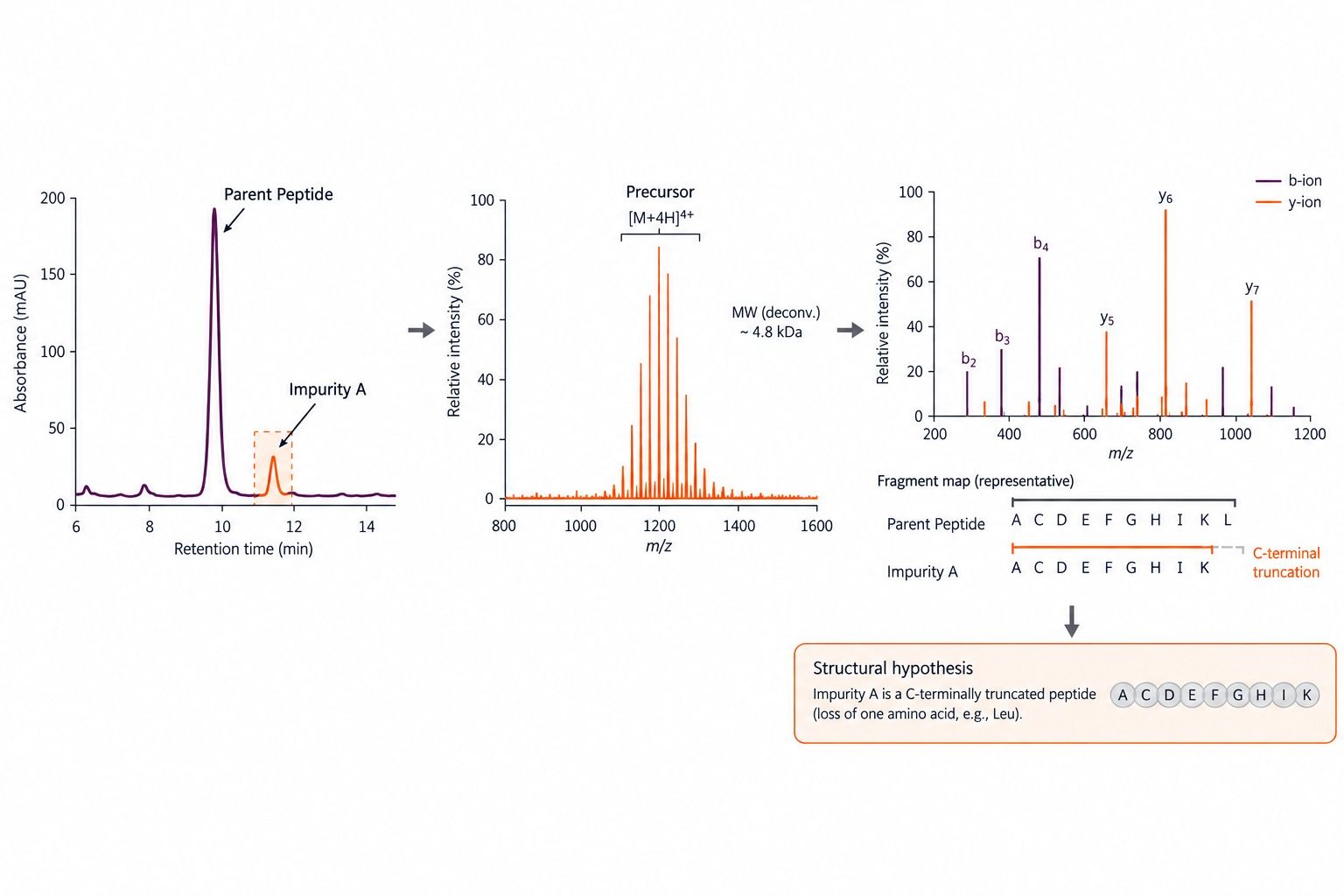
Representative output linking a minor chromatographic feature to intact-mass evidence and sequence-level MS/MS information for structural assignment.
Peptide Degradation Pathway Map
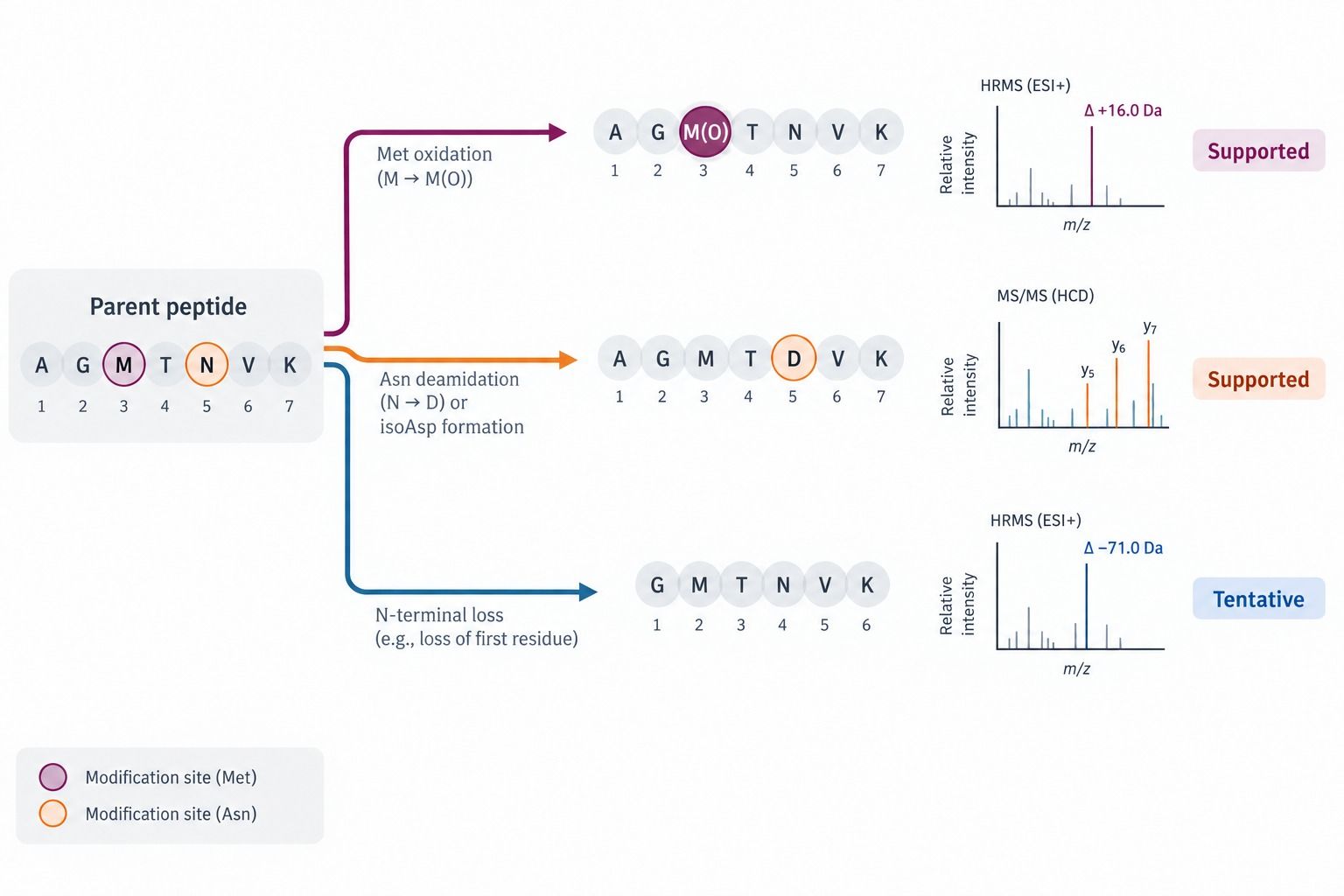
Condition- and structure-aware mapping of parent peptide, observed degradants, modification sites, and supported transformation relationships.
Forced-Degradation Impurity Profile
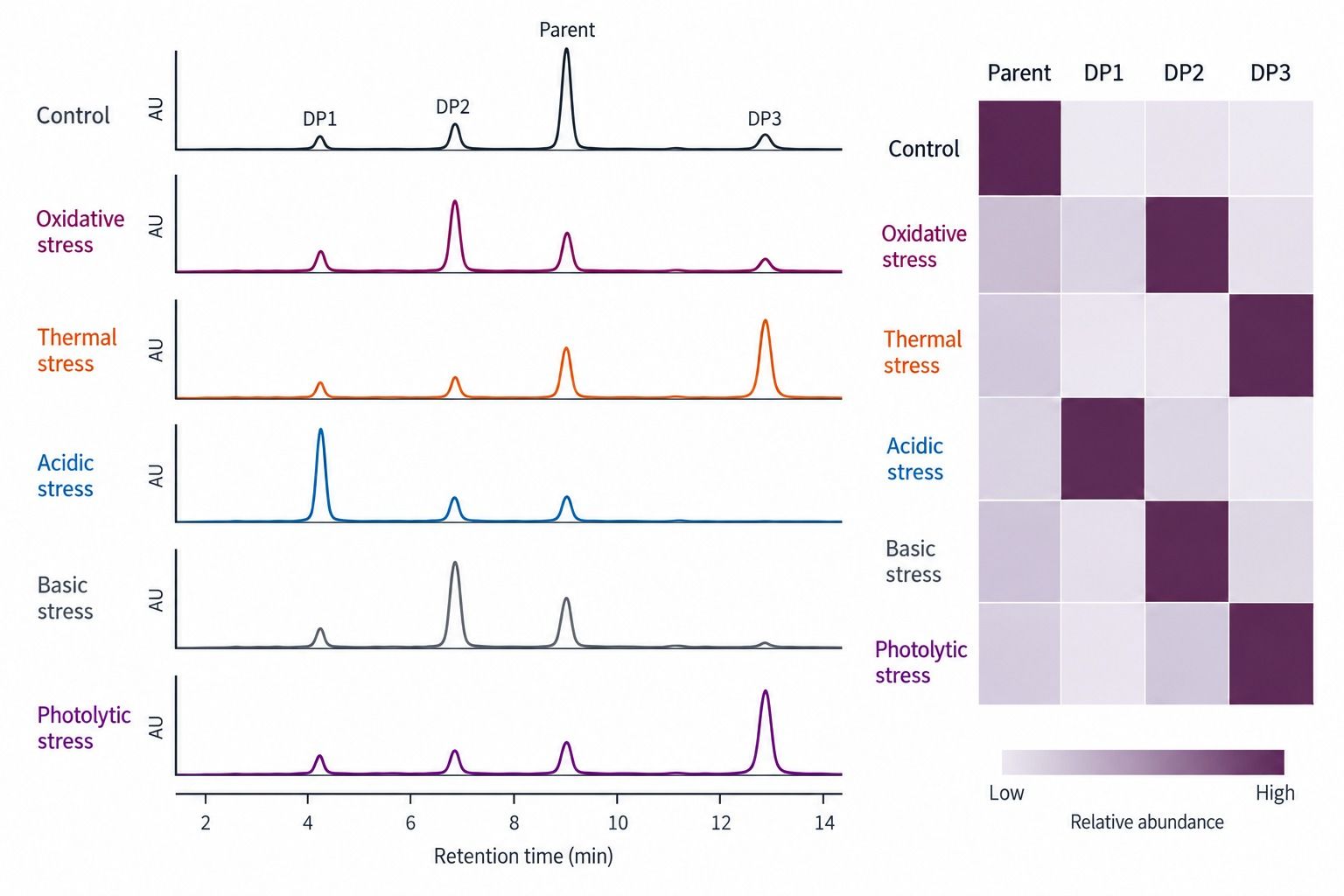
Comparative chromatographic or mass-spectrometric profiles showing how selected stress conditions generate distinct related-species patterns.
Coeluting or Isomeric Impurity Investigation
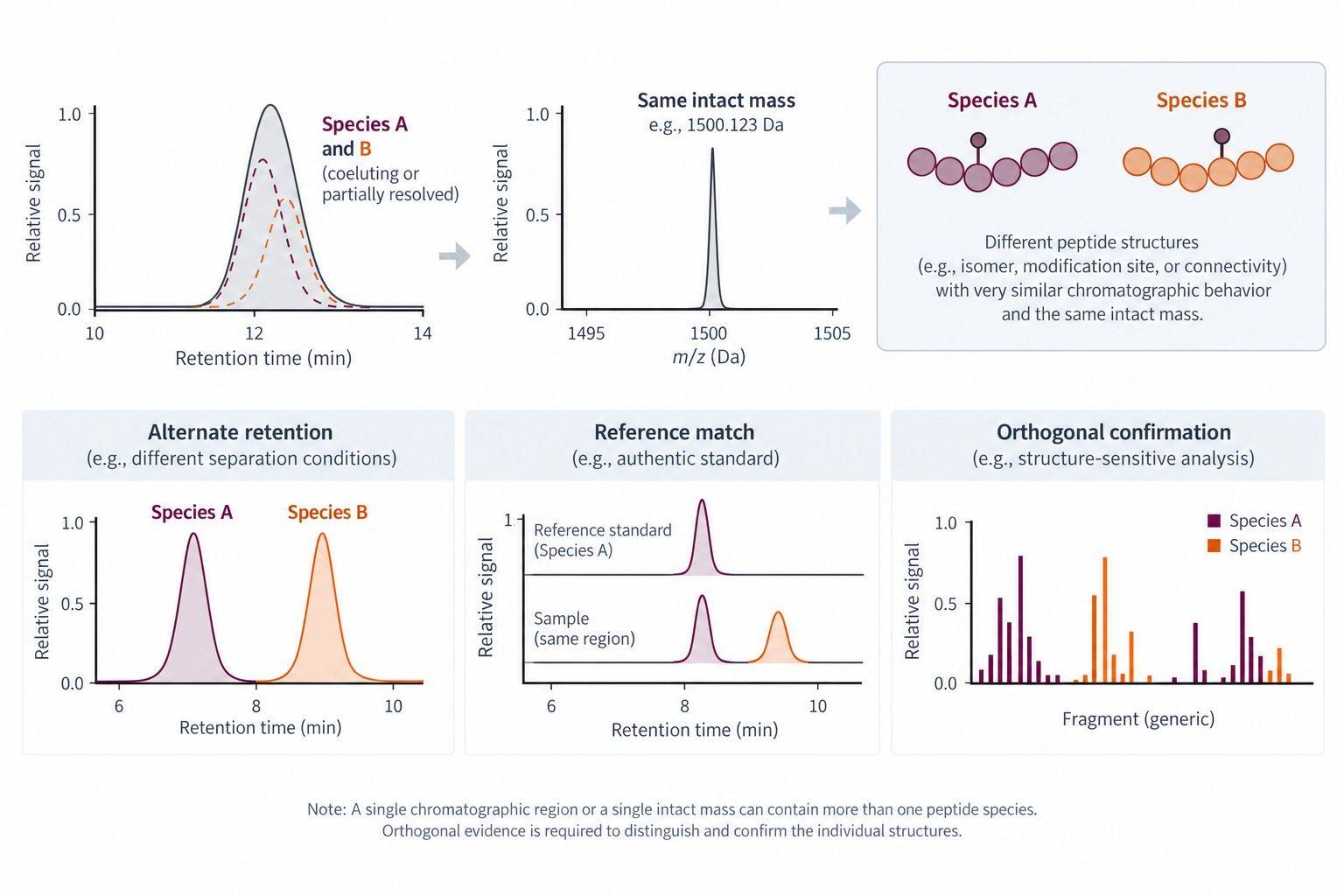
Orthogonal evidence showing why one chromatographic region or identical intact mass does not necessarily represent one molecular structure.
Typical Deliverables
- Impurity Profile
Chromatographic and mass-spectrometric summary of parent peptide and detected related species, including comparison across samples, lots, or stress conditions when included. - Impurity Identity and Confidence Table
Confirmed, supported, or tentative structural assignments with observed mass, retention information, fragment evidence, proposed modification or sequence change, and confidence notes. - Modification-Site and Sequence Evidence
MS/MS or orthogonal evidence used to localize oxidation, deamidation, truncation, sequence changes, disulfide-related variation, or other structurally informative features. - Forced-Degradation Comparison
Condition-specific impurity profiles and parent-peptide changes for selected stress studies, together with interpretation of major degradation routes. - Degradation Pathway Summary
A structured map connecting the parent peptide to observed degradation products and plausible sequential transformations, with evidence level clearly indicated. - Quantitative Impurity Results
Relative profiling or targeted impurity quantification according to the agreed method and reference-standard strategy. - Analytical Report and Data Package
Methods, chromatograms, spectra, extracted-ion views, relevant MS/MS evidence, processed tables, interpretation notes, and project-specific data files.
When the primary question is peptide degradation in plasma, serum, S9, hepatocytes, or another biological matrix, the project is better handled through Therapeutic Peptide Metabolic Stability Profiling. For complex disulfide connectivity or free-cysteine questions, deeper structural follow-up can use Peptide Disulfide Bond & Free Cysteine Detection.
References
- Sharma N, Kukreja D, Giri T, Kumar S, Shah RP. Synthetic pharmaceutical peptides characterization by chromatography principles and method development. J Sep Sci. 2022;45(13):2200-2216. https://doi.org/10.1002/jssc.202101034
- Li M, Josephs RD, Daireaux A, et al. Structurally related peptide impurity identification and accurate quantification for synthetic oxytocin by liquid chromatography-high-resolution mass spectrometry. Anal Bioanal Chem. 2021;413(7):1861-1870. https://doi.org/10.1007/s00216-021-03154-5
- Huo Y, Xu K, Lu Y, et al. Characterization of structurally related peptide impurities using HPLC-QTOF-MS/MS: application to Cbf-14, a novel antimicrobial peptide. Anal Bioanal Chem. 2022;414(22):6485-6495. https://doi.org/10.1007/s00216-022-04205-1
- Zhang B, Xu W, Yin C, Tang Y. Characterization of low-level D-amino acid isomeric impurities of Semaglutide using liquid chromatography-high resolution tandem mass spectrometry. J Pharm Biomed Anal. 2023;224:115164. https://doi.org/10.1016/j.jpba.2022.115164
- Datola A, Pistacchio A, Simone P, et al. Characterization by LC-MS/MS of oxidized products identified in synthetic peptide somatostatin and cetrorelix submitted to forced oxidative stress by hydrogen peroxide: Two case studies. J Mass Spectrom. 2023;58(5):e4919. https://doi.org/10.1002/jms.4919
- Kodidasu A, Acharyya K, Ganga Ramu V. Absolute Quantitation of Coeluting Impurities in Peptide Drugs Using High Resolution Mass Spectrometry: Glucagon a Case Study in Pharmaceutical Development. J Am Soc Mass Spectrom. 2025;36(10):2072-2078. https://doi.org/10.1021/jasms.5c00105
- Badgujar D, Bawake S, Yuvaraaj VK, Ghava D, Sharma N. Assessment of Thermal and Photolytic Stress Effects on the Stability of Primary Structure of Synthetic Liraglutide Using LC-HRMS/MS. J Pept Sci. 2025;31(9):e70050. https://doi.org/10.1002/psc.70050
- Cheng J, Zhang T, Cui X, et al. Identification and Quantification of Structurally Related Peptide Impurity in Linaclotide by Liquid Chromatography-High Resolution Mass Spectrometry. Rapid Commun Mass Spectrom. 2026;40(7):e70030. https://doi.org/10.1002/rcm.70030
- Long Z, Zhang W, Zhu X, Luo X. Strategies for the Identification of Cyclic Peptide Drugs and Their Impurities. J Am Soc Mass Spectrom. 2026;37(8):1792-1803. https://doi.org/10.1021/jasms.6c00023
For research use only. Not for use in diagnostic or therapeutic procedures.
FAQ for Peptide Impurity and Degradation Product Characterization
What is the difference between peptide purity analysis and impurity characterization?
+
Purity analysis estimates how the sample separates under a defined analytical
method and can show the relative size of chromatographic or electrophoretic components. Impurity
characterization asks what those components are. A minor peak may represent a deletion sequence,
oxidation product, deamidated species, truncation, adduct, isomer, disulfide-related form, or another
structure that requires MS/MS or orthogonal evidence for assignment.
Can you identify an unknown HPLC or UPLC impurity peak?
+
Often, yes. The investigation can combine the original chromatographic data,
optimized separation, LC-HRMS, tandem MS, and synthesis or storage history. If the impurity is low
abundance, coeluting, or structurally ambiguous, fraction isolation, a suspected reference standard, or
another orthogonal method may be needed before a confident assignment is possible.
Which peptide degradation products can be investigated?
+
Projects can investigate sequence- and condition-dependent oxidation, deamidation,
hydrolysis, truncation, rearrangement, terminal reactions, disulfide exchange or scrambling, covalent
dimers, and other peptide-related degradation products. Not every pathway is relevant to every peptide,
so the study is designed from sequence, structural format, formulation, and stress history.
Can forced degradation be included in the project?
+
Yes. Research-stage stress studies can be designed around acidic or basic
conditions, oxidation, heat, light, or project-specific handling and formulation variables. The purpose
is to generate informative degradants, characterize major pathways, compare conditions, and support a
stability-indicating analytical strategy rather than applying an identical stress panel to every
peptide.
Can LC-MS distinguish a D-amino-acid impurity from the corresponding L-peptide?
+
Not from intact mass alone. D- and L-containing peptides have the same elemental
composition, and their intact masses are therefore identical. These cases may require chromatographic
resolution plus chiral or stereochemistry-sensitive analysis, controlled hydrolysis and derivatization,
comparison with standards, or another orthogonal strategy appropriate to the peptide.
Can Asp and isoAsp or alternative disulfide isomers be distinguished by mass spectrometry?
+
They can be challenging because the intact masses may be identical. Specialized
fragmentation, optimized chromatography, selective chemistry, disulfide mapping, reference standards, or
other orthogonal methods may be required. The report should distinguish a directly supported structure
from a tentative isomer assignment.
Can coeluting peptide impurities be identified?
+
Potentially. High-resolution MS and selective extracted-ion analysis can reveal
multiple molecular species within one chromatographic region, and additional separation or fractionation
can be used when needed. Accurate quantification of a coeluting impurity may require a dedicated
calibration strategy rather than relying on the parent peptide response.
Can peptide impurities be quantified?
+
Yes, but the evidence level should match the purpose. Relative impurity profiling
can compare species across lots or stress conditions. More accurate targeted quantification may require
an impurity reference standard, calibration curve, response-factor strategy, or another fit-for-purpose
quantitative approach because different peptide-related species can have different MS and
chromatographic responses.
Can a suspected impurity be synthesized for confirmation?
+
Yes, where chemically practical. A suspected impurity or degradant can be
synthesized or isolated and compared by retention time, co-injection or spiking, intact mass, and MS/MS.
This is particularly useful when two structural hypotheses produce similar mass-spectrometric evidence.
Can you compare impurity profiles between batches or suppliers?
+
Yes. Comparative studies can align chromatographic and mass-spectrometric profiles
across batches, synthesis routes, purification conditions, storage states, or suppliers and then
investigate species that are new, missing, or materially changed. Interpretation should consider
differences in sample preparation and analytical history before assigning a process-related cause.
Is metabolic stability the same as degradation product characterization?
+
No. Impurity and degradation-product characterization addresses species associated
with synthesis, processing, storage, formulation, and chemical or physical stress. Degradation in
plasma, serum, S9, hepatocytes, or another biological matrix is a metabolic-stability question and is
better handled with a dedicated therapeutic-peptide stability workflow.
What information should I provide to start a peptide impurity project?
+
Provide the peptide sequence and modifications, expected mass, structural format,
sample stage, available HPLC/UPLC or MS data, known synthesis or storage history, the suspected impurity
or degradation event if any, and the decision you need the study to support. Exact material requirements
can then be determined from impurity abundance and the level of structural confirmation required.