Quantitative Peptide Profiling with DIA-MS
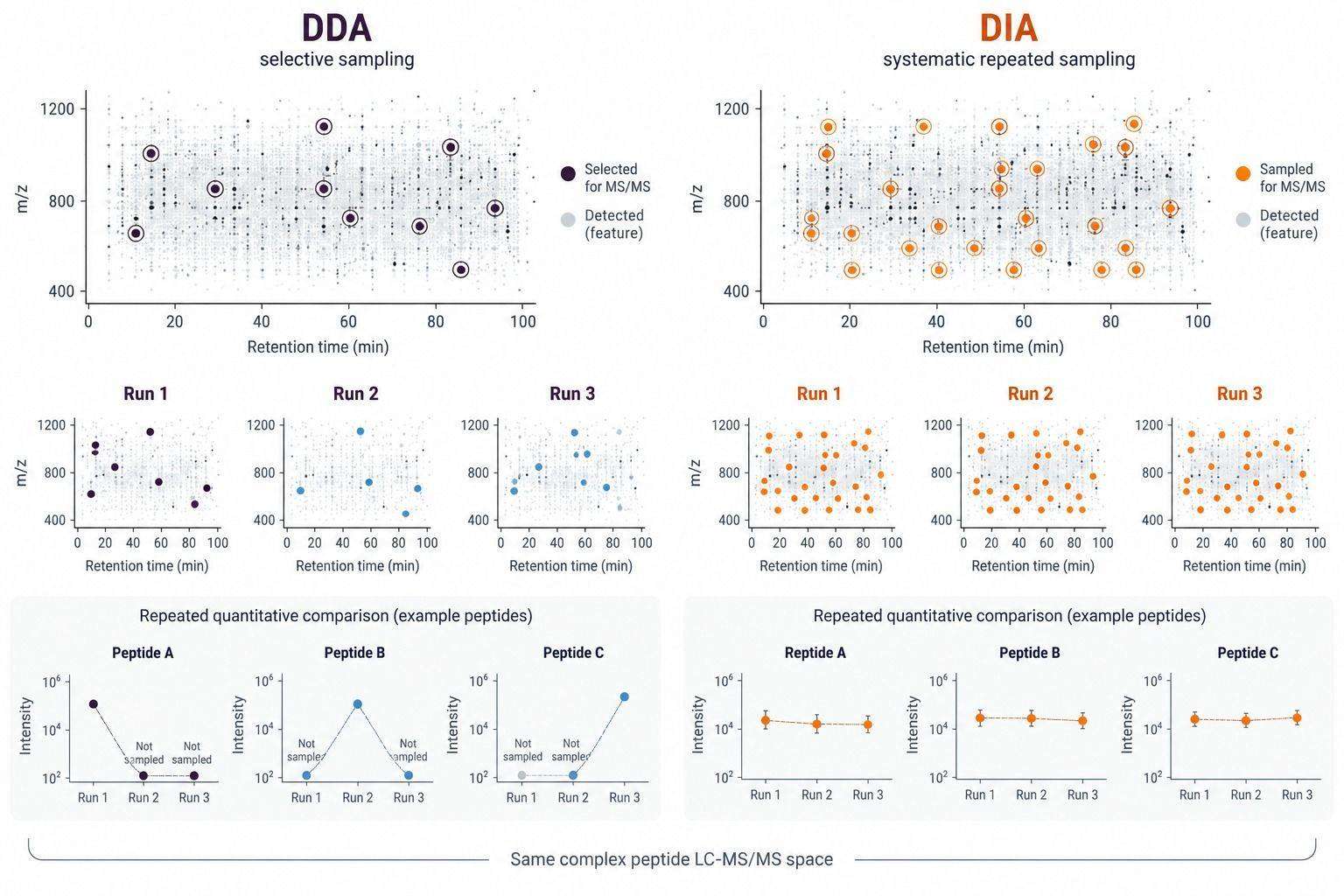
DIA peptidomics is most useful when a study needs to compare peptide signals repeatedly across multiple samples rather than obtain a one-time discovery list. In data-independent acquisition (DIA), precursor populations are fragmented systematically across defined isolation windows throughout the chromatographic run. This reduces the dependence on intensity-prioritized precursor selection that characterizes conventional data-dependent acquisition (DDA) and creates a data structure suited to repeated peptide-centric extraction and relative quantification.
The practical value of DIA depends on the peptide space being measured. A conventional enzymatic peptide mixture, an endogenous non-tryptic peptidome, and an HLA immunopeptidome differ in sequence-space complexity, peptide-length distribution, abundance, spectral-library requirements, and identification risk. DIA acquisition therefore should not be treated as a single fixed protocol. Acquisition, library strategy, search logic, interference review, and evidence thresholds are selected together according to the study design.
This page focuses specifically on DIA as a peptide acquisition and quantitative-analysis strategy. For a broader overview of relative, label-based, targeted, and absolute peptide quantification options, see our Peptide Quantification & Bioanalysis Services.
Method Selection: DIA, DDA, and Targeted MS
DIA is not automatically the best acquisition mode for every peptidomics study. The appropriate route depends on whether the main objective is broad discovery, repeated comparative quantification, or sensitive measurement of a predefined peptide list.
| Decision Point | DIA Peptidomics | DDA Peptidomics | PRM / MRM |
|---|---|---|---|
| Primary objective | Broad, repeated relative quantification across multiple samples | Exploratory identification and discovery-oriented sequencing | Focused measurement of predefined peptide targets |
| Precursor sampling | Systematic fragmentation across isolation windows | Intensity-prioritized precursor selection | Selected precursor or transition monitoring |
| Best fit | Cohort comparisons, repeated perturbation studies, quantitative immunopeptidomics, and reprocessable peptide datasets | Discovery studies, exploratory sequencing, and empirical library generation | Candidate verification, high-sensitivity targeted measurement, or controlled absolute quantification workflows |
| Main analytical challenge | Complex multiplexed fragment data, interference control, and peptide-space-specific search strategy | Run-to-run stochastic precursor selection and incomplete repeated sampling | Target selection, assay development, and limited discovery breadth |
| Retrospective interrogation | Often useful when relevant fragment evidence was acquired and a suitable analysis strategy is available | Limited to precursors that were selected and fragmented in the original run | Generally limited to the predefined target panel |
For studies whose main need is broad label-free relative quantification without a requirement to specify DIA as the acquisition strategy, see our Label-Free Peptide Quantification service. When the project already has a defined candidate list and sensitivity or assay control is more important than discovery breadth, PRM peptide quantification or MRM peptide quantification may be the more appropriate follow-up.
Peptide-Space-Specific DIA Strategies
The same DIA raw-data concept can support different peptidomics applications, but identification and interpretation rules must match the biological peptide space.
Spectral Library and Library-Free DIA Analysis
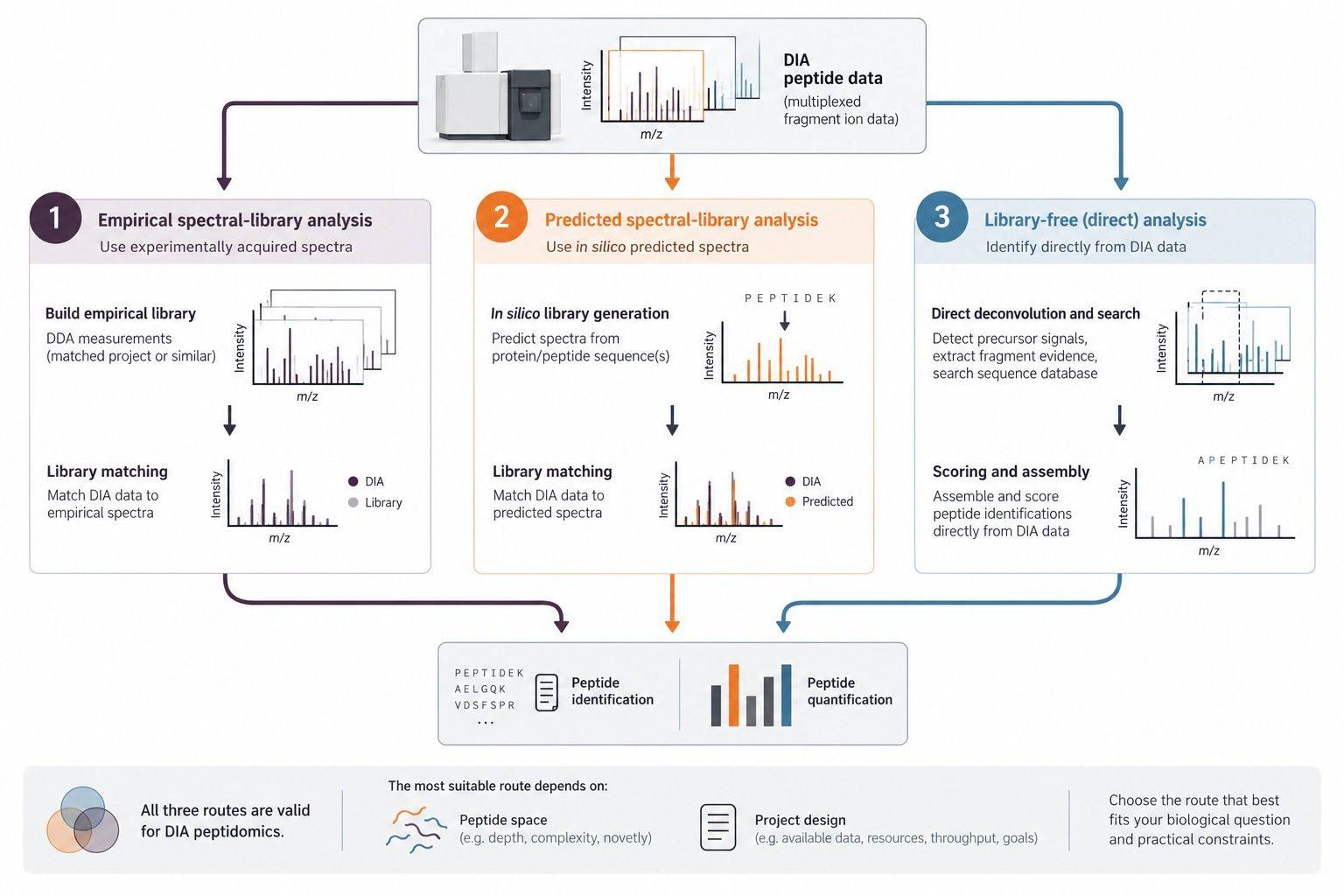
Library strategy is a project-design decision rather than a universal requirement. The best route depends on whether the peptide space is well represented by reference sequences, whether project-specific material is available for deep library generation, and whether novel, variant, non-canonical, or HLA-restricted peptides are central to the study.
No single software pipeline is treated as universally optimal across all peptide classes. For example, benchmark studies in DIA immunopeptidomics show meaningful trade-offs among coverage, reproducibility, and false-positive control across different analysis tools. Project-specific evidence review is therefore more defensible than selecting a pipeline by software name alone.
DIA Peptidomics Workflow
Study & Peptide-Space Design
Define peptide class, comparison structure, quantitative endpoint, and library strategy
Peptide Preparation & LC-MS/MS
Prepare or enrich the relevant peptide fraction and acquire DIA data using a project-matched method
Library / Search-Space Construction
Use empirical, predicted, direct, or custom sequence-space strategies according to peptide biology
Peptide-Centric Extraction & QC
Evaluate fragment evidence, interference, retention behavior, cross-run consistency, and quantitative quality
Comparative Analysis & Interpretation
Normalize, compare study groups, prioritize peptides, and define targeted or orthogonal follow-up
1
Study and Peptide-Space Design
The project begins by defining the peptide class, biological groups, replication, sample complexity, expected sequence novelty, and the decision the quantitative data must support. This step determines whether the analysis should prioritize broad cohort consistency, endogenous non-tryptic peptides, HLA ligands, or another specialized peptide space.
2
Peptide Preparation and LC-MS/MS
The relevant peptide fraction is extracted, cleaned, enriched, or otherwise prepared according to sample type and project goal. DIA acquisition settings are selected to balance chromatographic peak sampling, precursor-space coverage, fragment complexity, and the properties of the peptide population being measured.
3
Library or Search-Space Construction
The analysis may use an empirical spectral library, predicted spectra, direct library-free processing, or a project-specific custom sequence space. Endogenous, variant, non-canonical, and HLA peptide projects require particularly careful control of search-space expansion and peptide-level evidence.
4
Peptide-Centric Extraction and Quality Control
Candidate peptide signals are evaluated using fragment-ion evidence, chromatographic behavior, interference review, replicate and cross-run consistency, missingness patterns, and other project-appropriate quality measures before comparative interpretation.
5
Comparative Analysis and Interpretation
Quantitative peptide matrices are normalized and compared according to the study design. Results can be summarized through differential peptide analysis, clustering, peptide-class or source-protein annotation, and candidate prioritization for PRM/MRM, synthetic-peptide confirmation, or other orthogonal follow-up.
Study Design, QC, and Cross-Run Consistency
DIA becomes most valuable when repeated measurement quality is planned before acquisition. A strong study design prevents biological groups from being confounded with preparation batch, injection order, or other technical structure and defines how missing or weak peptide evidence will be interpreted.
DIA Data Analysis and Interpretation
DIA analysis converts multiplexed fragment-ion data into peptide-centric evidence and quantitative matrices. The analytical route is adapted to the peptide class rather than assuming that a workflow optimized for tryptic proteomics will transfer unchanged to endogenous or HLA peptide data.
| Analysis Layer | What Is Evaluated | Why It Matters |
|---|---|---|
| Peptide identification | Sequence assignment, fragment evidence, retention behavior, search-space context, and confidence control | Prevents an expanded peptide search space from being mistaken for equally strong identification evidence |
| Peptide quantification | Consistent fragment-ion or peptide-level signal extraction across samples | Builds the quantitative matrix used for comparative analysis |
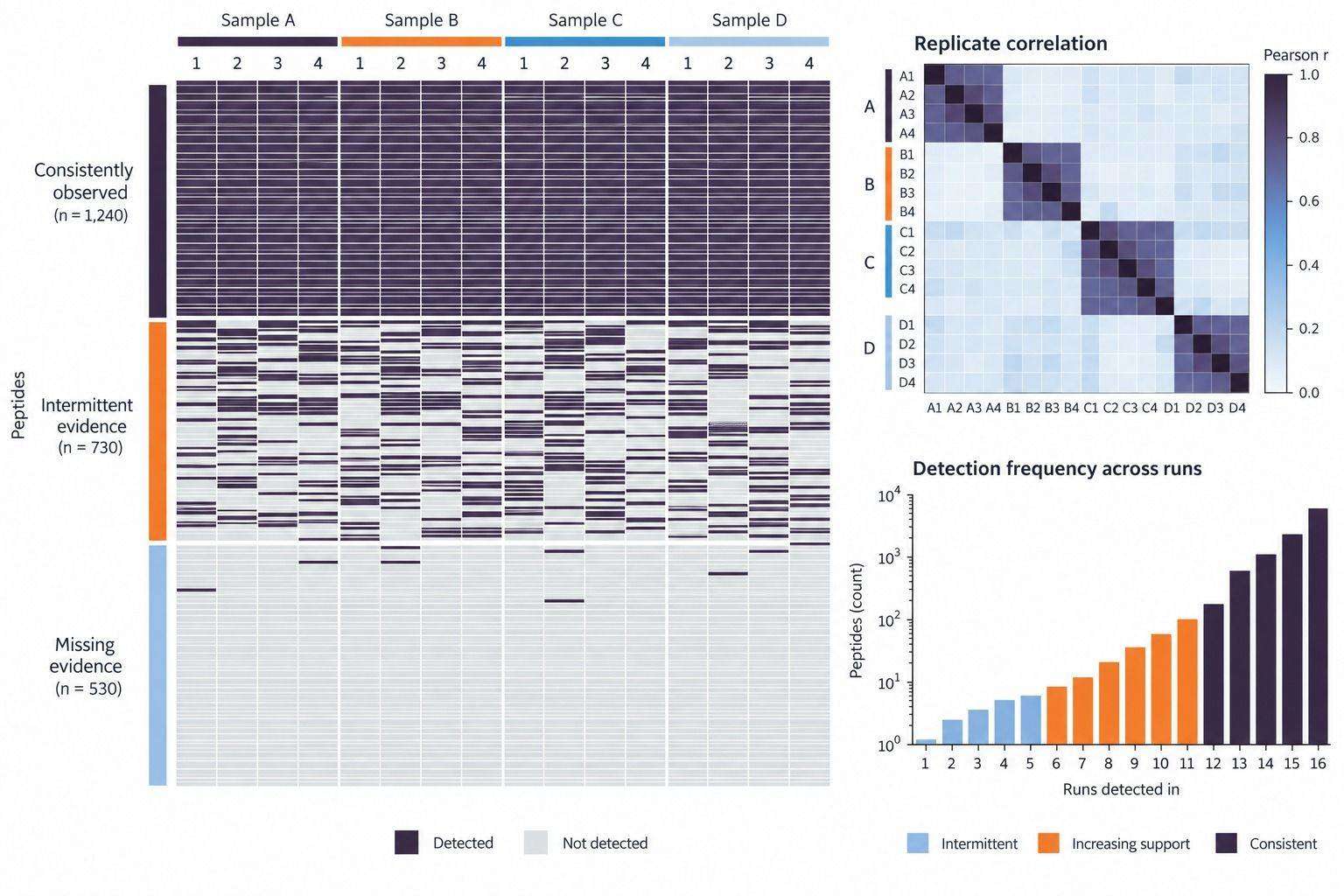
| Cross-run consistency | Replicate behavior, missingness, run-order effects, and sample-level QC | Distinguishes technical instability from biological differences |
| Differential analysis | Defined group contrasts, effect direction, statistical evidence, and peptide-level patterns | Prioritizes reproducible changes rather than isolated high-intensity signals |
| Biological interpretation | Source proteins, peptide classes, HLA context, pathway or functional annotation when appropriate | Connects quantitative peptide behavior to the biological question while preserving uncertainty |
Representative Results
The visualizations below illustrate DIA-specific analytical questions and output types. They are representative formats rather than data from a specific customer project.
DIA vs. DDA Peptide Sampling
DIA Library Strategy
Cross-Run Peptide Detection Consistency
DIA Immunopeptidomics Profile
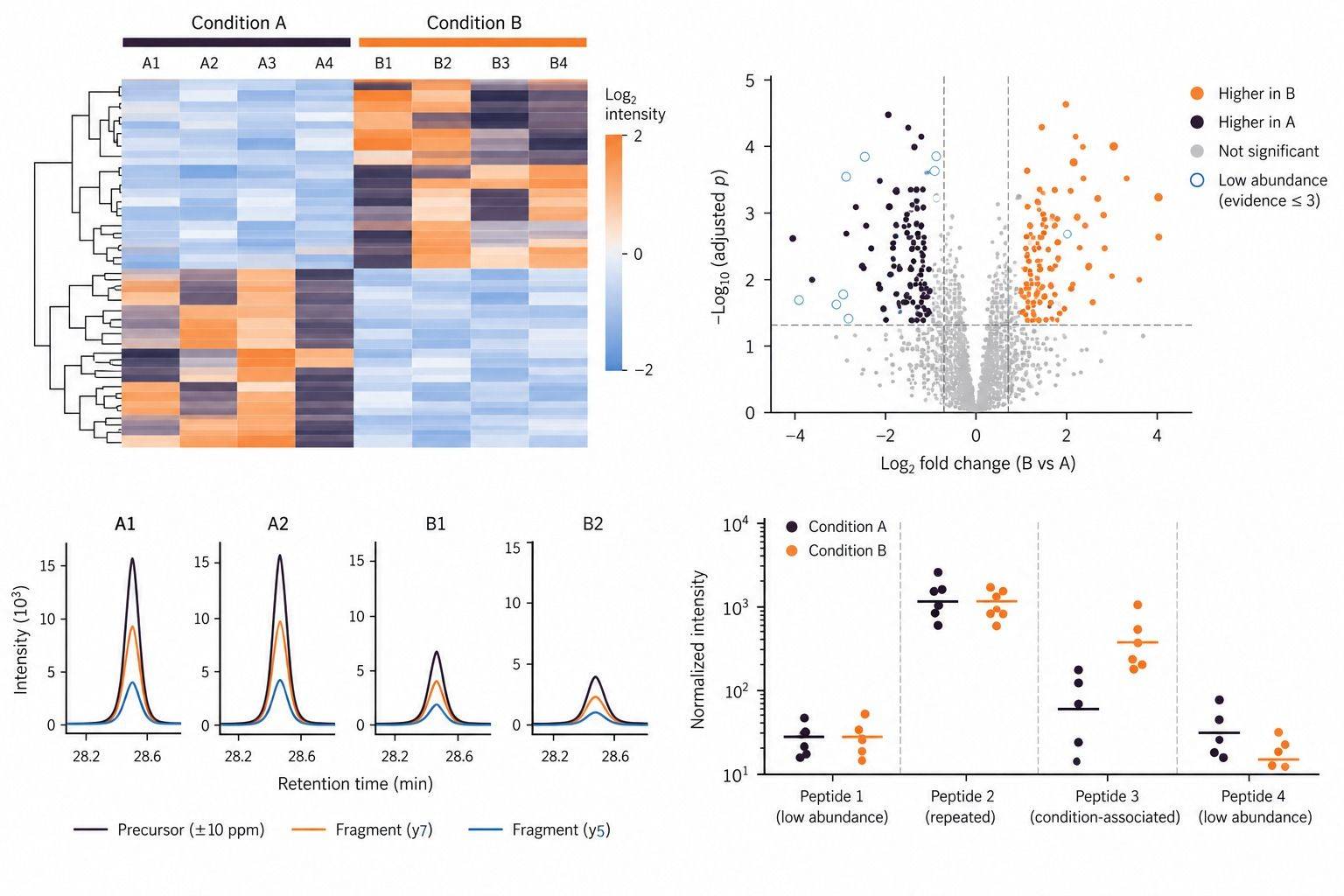
Actual figures depend on peptide class, library strategy, sample quality, acquisition design, and project-specific comparison structure.
Typical Deliverables
Deliverables are matched to the peptide space and quantitative objective and may include:
- DIA Peptide Identification Table
Peptide sequences with precursor, fragment-ion, search-space, and confidence fields appropriate to the selected workflow. - Quantitative Peptide Matrix
Cross-sample peptide abundance values with filtering and normalization definitions documented for the project. - QC and Cross-Run Consistency Summary
Sample-level and peptide-level summaries of repeatability, missingness, run-order behavior, reference QC, and other project-specific quality indicators. - Differential Peptide Analysis
Designed group comparisons with effect estimates, statistical summaries, clustering or heatmap views, and candidate ranking where appropriate. - Peptide-Space-Specific Annotation
Source-protein mapping, endogenous peptide classes, HLA context, selected modifications, or custom sequence annotations when included in project scope. - Candidate Follow-Up List
Prioritized peptides suitable for targeted PRM/MRM, synthetic-peptide confirmation, or other orthogonal verification. - Analytical Report and Data Package
Methods, analysis settings, QC summaries, key visualizations, interpretation notes, and project-specific raw or processed data files as scoped.
References
- Zhang F, Ge W, Ruan G, Cai X, Guo T. Data-Independent Acquisition Mass Spectrometry-Based Proteomics and Software Tools: A Glimpse in 2020. Proteomics. 2020;20:e1900276. https://doi.org/10.1002/pmic.201900276
- Shahbazy M, Ramarathinam SH, Illing PT, et al. Benchmarking Bioinformatics Pipelines in Data-Independent Acquisition Mass Spectrometry for Immunopeptidomics. Mol Cell Proteomics. 2023;22:100515. https://doi.org/10.1016/j.mcpro.2023.100515
- Bichmann L, Marcu A, Kowalewski DJ, et al. HLA Ligand Atlas DIA: extending the benign immunopeptidomics resource with increased sensitivity through data-independent acquisition mass spectrometry. J Immunother Cancer. 2025;13:e012083. https://doi.org/10.1136/jitc-2025-012083
- Oliinyk D, Gurung HR, Zhou Z, et al. diaPASEF Analysis for HLA-I Peptides Enables Quantification of Common Cancer Neoantigens. Mol Cell Proteomics. 2025;24:100938. https://doi.org/10.1016/j.mcpro.2025.100938
- Saidi M, Kamali S, Beaudry F. Neuropeptidomics: Comparison of parallel reaction monitoring and data-independent acquisition for the analysis of neuropeptides using high-resolution mass spectrometry. Biomed Chromatogr. 2019;33:e4523. https://doi.org/10.1002/bmc.4523
For research use only. Not for use in diagnostic or therapeutic procedures.
FAQ for DIA Peptidomics
What is DIA peptidomics? +
DIA peptidomics uses data-independent acquisition mass spectrometry to fragment precursor populations systematically across predefined isolation windows and then extracts peptide-centric evidence computationally. It is particularly useful for repeated relative quantification across multiple samples, but the identification strategy must be adapted to the peptide class being measured.
Is DIA peptidomics a label-free quantification method? +
DIA is an acquisition strategy and is commonly used for label-free relative quantification, but the terms are not identical. Label-free quantification is the broader quantitative concept, while DIA describes how precursor and fragment data are acquired. Label-free studies can also use other acquisition modes.
How does DIA differ from DDA peptidomics? +
DDA selects a subset of precursor ions for MS/MS based largely on signal intensity at each survey scan, while DIA fragments precursor populations systematically across isolation windows. DIA can improve repeated sampling across runs, but it produces more complex fragment data and requires appropriate peptide-centric analysis and interference control. DDA remains useful for exploratory discovery and empirical library generation.
Do I need a spectral library for DIA peptidomics? +
Not always. DIA data can be analyzed with empirical spectral libraries, predicted libraries, or direct/library-free strategies. The appropriate route depends on the peptide class, available project material, sequence novelty, desired depth, and the confidence requirements of the study.
Can DIA be used for endogenous peptides and neuropeptides? +
Yes, but endogenous peptides require additional care because they do not follow a fixed enzymatic cleavage rule and may span a broad range of lengths, modifications, and abundances. Search-space design and spectral evidence should therefore be adapted specifically to endogenous peptide biology rather than copied directly from conventional tryptic proteomics.
Can DIA be used for immunopeptidomics? +
Yes. DIA has been applied to HLA class I and class II immunopeptidomes for peptide identification and quantitative comparison. HLA projects require dedicated sequence spaces, peptide-length expectations, spectral-library or prediction strategies, and evidence controls because immunopeptides are non-tryptic and often low abundance.
Does DIA eliminate missing values? +
No. DIA can reduce some forms of run-to-run stochastic sampling, but peptides can still be missing or weakly supported because of abundance, ionization, chromatographic behavior, matrix interference, extraction efficiency, search-space limitations, or quality filtering. Missingness should be reviewed as part of the study design rather than treated as automatically solved by DIA.
Can DIA data be re-analyzed later for additional peptides? +
Often, yes. Because DIA records fragment data across broad precursor windows, raw data can sometimes be reprocessed with updated libraries, sequence databases, or analysis strategies. Re-analysis cannot recover a peptide that was not acquired with sufficient signal or fragment evidence, so retrospective analysis remains constrained by the original experiment.
Can DIA be combined with ion mobility? +
Yes, when the analytical platform supports an ion-mobility-enabled DIA workflow. Ion mobility adds a gas-phase separation dimension that can help resolve complex peptide mixtures, but platform choice and the resulting data-analysis strategy should be matched to the sample and peptide space rather than added automatically.
When should I use PRM or MRM instead of DIA? +
PRM or MRM is usually preferable when the target list is already defined and the project requires focused, high-sensitivity, assay-controlled measurement rather than broad discovery. DIA is better suited to wider quantitative coverage and comparative profiling; prioritized DIA candidates can then be transferred into targeted follow-up workflows.
What sample types can be analyzed by DIA peptidomics? +
Potential inputs include prepared peptide fractions from cells, tissues, biofluids, endogenous peptidomics workflows, enriched HLA peptide samples, and other research matrices. Feasibility depends on peptide abundance, matrix complexity, preparation strategy, study size, and the intended quantitative endpoint, so input requirements should be defined during project scoping rather than by one universal minimum amount.