Introduction
Protein glycosylation is the binding of sugar chains to specific amino acid residues in proteins under the action of
glycosyltransferases, which is an important post-translational modification of proteins. At present, at least 1/2 of
mammalian proteins are known to be glycoproteins, and which widely distributes in various tissues and cells. The
sugar chain has more branched structure, connection mode and spatial conformation due to the non-templated nature of
biosynthesis and the slight heterogeneity of structure. Therefore, the modified sugar proteins will grow a variety
of biological activities and play a crucial role in the growth, development and even survival of organisms. Protein
glycosylation is closely related to the development of many diseases. In some disease states, the relative abundance
and score structure of glycans changes compared with normal. These abnormal changes can provide help for early
diagnosis and treatment of diseases.
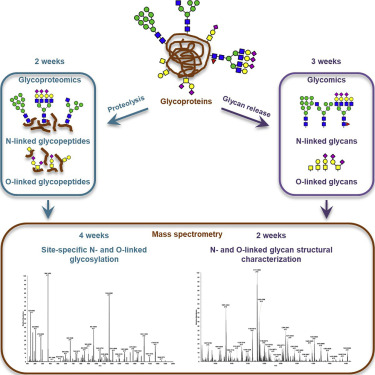 Fig.
1. Glycomics-informed glycoproteomic analysis of site-specific glycosylation for biotherapeutics. (Rosenbalm K E,
et al., 2020)
Fig.
1. Glycomics-informed glycoproteomic analysis of site-specific glycosylation for biotherapeutics. (Rosenbalm K E,
et al., 2020)
Our Services
Among the numerous post-translational modifications of proteins, glycosylation is one of the most common and complex
post-translational modifications. Protein glycosylation is involved in specific biological processes such as cell
signaling, host-pathogen interactions, and immune responses. Therefore, the analysis of glycosylation sites and
glycoforms at this site is of great significance. Creative Proteomics provides glycosylation sites
and glycoform analysis services based on LC-MS/MS.
At Creative Proteomics, our experienced technicians usually choose a variety of enzymes to digest
the target protein, covering the target protein sequence as completely as possible. The glycosylation sites in the
protein are then analyzed. After determining the peptide segment with glycosylation modification, the target protein
is re-enzymatically hydrolyzed, and the glycosyl group on the peptide segment is retained.
When performing LC-MS/MS analysis, the combined fragmentation method of ETD\HCD\CID is used to obtain as much
information as possible for secondary fragmentation of peptides. Through the software analysis and manual
identification of the secondary map of glycosylation-modified peptides, the accurate information of the
glycosylation site and the glycoform of the site in the target protein is obtained.
Our scientists with extensive experience have developed a set of glycosylation sites and glycoform analysis services
workflow.
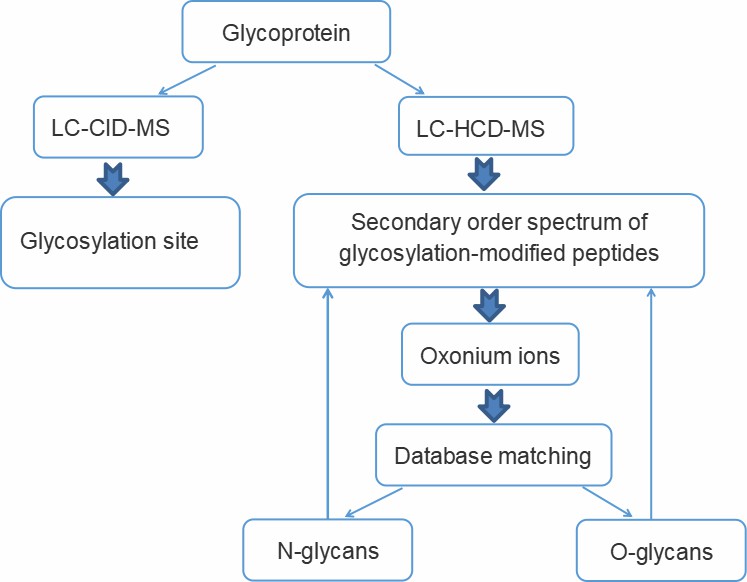 Fig. 2. Workflow of our
glycosylation sites and glycoform analysis services.
Fig. 2. Workflow of our
glycosylation sites and glycoform analysis services.
Advantages of Our Glycosylation Sites and Glycoform Analysis Services
- Direct identification of glycosylation sites without labeling.
- Provide statistics of glycoform distribution and relative content ratio of each glycosylation site.
- The qualitative and quantitative analysis of N/O-glycosylation sites and glycoforms in glycosylated proteins are
simultaneously completed.
- The glycoform corresponding to the glycosylation site in the target protein is accurately analyzed.
- High sensitivity and good accuracy.
Applications
- Glycosylation characterization and production quality control of antibody and recombinant protein drugs.
- Identify glycoforms corresponding to N-glycosylation sites in glycosylated proteins.
- Identify glycoforms corresponding to O-glycosylation sites in glycosylated proteins.
Creative Proteomics is a trusted provider of glycoproteomics analysis services. We offer a range of
glycosylation sites and glycoform analysis services for global customer. Our services guarantee accurate and
reliable results, at quick turnaround time! If you would like more information about specific aspects of our
services, feel free to contact us and we will be happy to answer any
questions.
References
- Rosenbalm K E, Tiemeyer M, Wells L. et al. (2020) Glycomics-informed glycoproteomic analysis of
site-specific glycosylation for SARS-CoV-2 spike protein. STAR Protoc. 1(3):100214.