Introduction
Peptide mapping, one of the important means for the quality control of biological drugs, has become one of the
routine indicators for the quality standard control of protein and peptide drugs. It is used to compare the identity
between recombinant and natural protein results, whether there are post-translational modifications and unknown
amino acid variations in recombinant products, but also compare the peptide maps of different batches of products to
verify the stability of the process. The principle of peptide mapping analysis is to use a variety of proteases to
digest and identify target proteins according to the molecular weight and amino acid composition characteristics of
proteins and peptides, then the entire amino acid of the protein can be obtained through splicing.
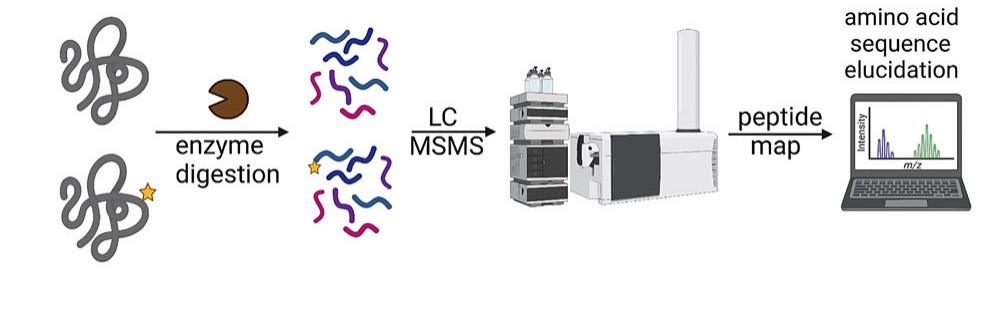 Fig. 1.
Peptide mapping analysis of AAV capsids using LC-MS/MS. (Lam AK, et al., 2022)
Fig. 1.
Peptide mapping analysis of AAV capsids using LC-MS/MS. (Lam AK, et al., 2022)
Our Services
Peptide mapping is a key tool in pharmaceutical research and drug development to biomanufacturing and clinical
testing, which has been used in many recombinant drugs as an important part of primary structure confirmation and
quality control. As the world's leading provider of protein sequencing services, Creative
Proteomics has developed a peptide mapping analysis platform based on liquid chromatography and tandem
mass spectrometry (LC-MS/MS) for biological drug primary structure confirmation.
Our peptide mapping service can be used to analyze the sequence of biopharmaceuticals and confirm the complete
expression of recombinant proteins in compliance with ICH Q6B.
It is worth noting that some residues such as isoleucine and leucine have the same mass, so mass spectrometry
programs cannot distinguish between them. For studies requiring complete primary amino acid sequencing, our Edman
degradation is best choice to analyze the pooled peptides.
In addition, some biopharmaceuticals should undergo de novo amino acid sequencing, of which sequences cannot be found
in protein databases.
Peptide Mapping Service Process
- Reduction and alkylation of the protein of interest (this step is optional).
- Multiple proteases (trypsin, chymotrypsin, ASP-N, Glu-C, LYS-C, and LYS-N) are used to digest and identificate
the target proteins.
- Analyze samples by LC-MS/MS.
- Compare the complete sequence of the obtained peptide mapping with the theoretical sequence you provided.
- Obtain and confirm comparison results.
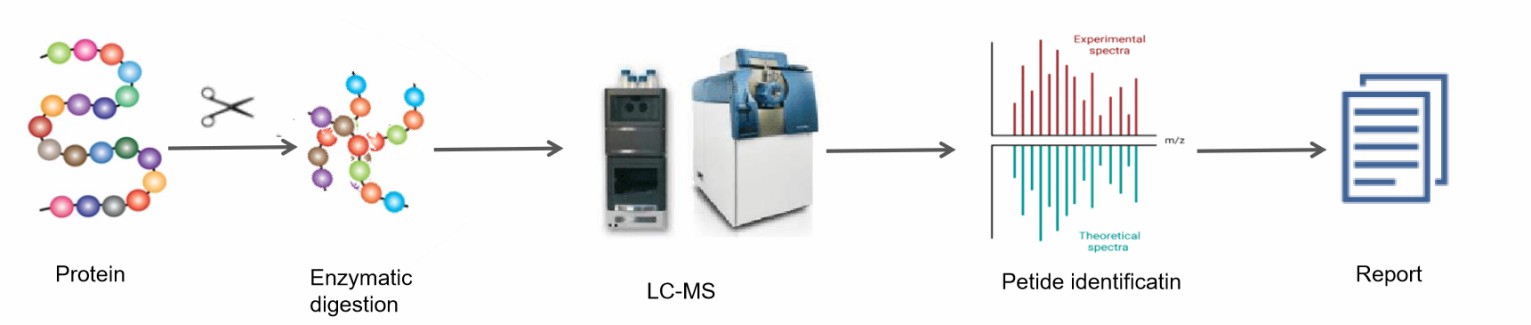 Fig. 2. Workflows of our
biopharmaceutical peptide mapping analysis service.
Fig. 2. Workflows of our
biopharmaceutical peptide mapping analysis service.
Applications of Biopharmaceuticals Peptide Mapping Analysis
Peptide mapping enable you to meet the structural characterization requirements of the ICH Q6B guidelines, including
determining the primary structure of proteins, assessing post-translational modifications (PTMs), and analyzing
product-related impurities. Our biopharmaceutical peptide mapping analysis can provide you with a large amount of
information on the following protein primary structures, including but not limited to.
- Sequence Conformation
- Glycosylation
- N-Terminal Pyroglutamination
- Disulfide Bond
- Heavy Chain C-Terminal Lysine
- Deamidation
- Oxidation
- Product-related mpurities, including degradation products.
Advantages of Our Biopharmaceutical Peptide Mapping Service
- Based on LC-MS/MS technology, peptide mapping can sequence peptides with high confidence.
- 100% coverage by using specific and non-specific proteases.
- Confirmation of each peptide is based on the MS/MS fingerprint of the sample, which is more accurate than MS
analysis.
- High resolution, reproducibility and sensitivity
- Wide dynamic range ensures detection of peptides in extreme molar ratios even at the lowest quantitation limits.
Creative Proteomics is a reliable biopharmaceutical partner. Our professional team can provide
customers with comprehensive biopharmaceutical peptide mapping information, and realizing the analysis of protein
advanced structure and modification sites. We will provide you with detailed experimental procedures and data
reports. Please contact us immediately If you are interested in our
services.
References
- Lam A K, Zhang J, Frabutt D, et al. (2022) Fast and high-throughput LC-MS characterization, and peptide
mapping of engineered AAV capsids using LC-MS/MS. Mol Ther Methods Clin Dev. 27:185-194.
- Veenstra T D, Van Q N, Fox S D, et al. (2013) Protein and Metabolite Identification[D]. Proteomic
and Metabolomic Approaches to Biomarker DiscoveryEditor. Chapter 16:245-258.