Introduction
Glycosylation affects the spatial conformation, biological activity, transport, and localization of proteins, but
also plays a vital role in specific biological processes such as molecular recognition, cell communication, and
signal transduction. As one of the important structural modifications that occur during the production of many
protein-based drugs, glycosylation plays an important role in ensuring the correct structure and function of most
biotherapeutic proteins, even small changes in glycan composition, structure, or position can have dramatic effects
on drug safety and efficacy. In the context of ongoing biopharmaceutical innovations, accurate and detailed analysis
of protein glycosylation is of critical importance to biopharmaceutical companies and government regulators alike.
At present, Mass spectrometry (MS) is a promising technique for high-quality analytical characterization of
glycosylation, from early drug development to final batch release.
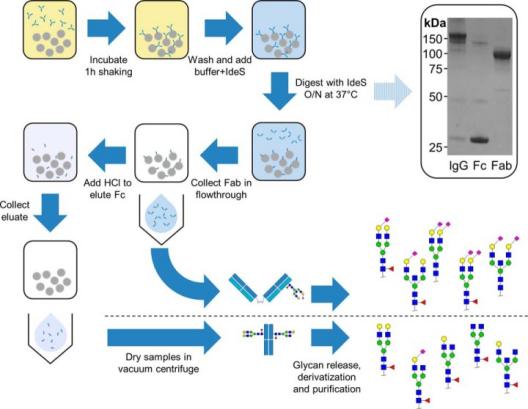 Fig.
1. Workflow of IgG Fab and Fc glycosylation analysis. (Bondt A, et al., 2014)
Fig.
1. Workflow of IgG Fab and Fc glycosylation analysis. (Bondt A, et al., 2014)
Our Services
Glycosylation has profound effects in ensuring the correct structure and function of most biotherapeutic proteins. As
a forward-looking company and a market leader in the field of mass spectrometry, Creative
Proteomics has successfully completed many challenging projects in the analysis of glycosylation sites
in biopharmaceuticals. Here, we provide one-stop glycosylation analysis services for your biopharmaceutical research
and development.
Our biopharmaceutical glycosylation analysis solution can perform precise positioning analysis of N-glycosylation and
O-glycosylation of therapeutic glycoproteins, and can also provide glycan chain composition information. Data
analysis adopts Byonic, the current international mainstream glycosylation data analysis software, which greatly
improves the reliability of the identification results of glycosylation modification sites.
To obtain all the glycosylation information required for the complete structural characterization of therapeutic
glycoproteins, Creative Proteomics uses the following protocol for analysis.
- Select the appropriate protease according to the amino acid sequence of the target protein.
- Carry out enzymatic hydrolysis.
- The peptide mixture after enzymatic hydrolysis is separated on high performance nanoliter liquid chromatography
and detected by ultra-high resolution mass spectrometer.
- Data analysis: the current international mainstream glycosylation data analysis software Byonic is used for data
retrieval, which can effectively remove false positive results and improve the reliability of identification
results.
To provide further structural details, Creative Proteomics also provides services such as glycan
analysis, glycosylation site occupancy analysis, and monosaccharide analysis. This is very important because the
production of biosimilars must match the innovator drug in structure.
Applications
The ICH Q6B guideline requires comprehensive characterization of biopharmaceutical samples glycosylatio. Our
glycosylation site analysis service can help you with the following, but not limited to.
- Analyze glycosylation profiles of proteins, antibodies, cells and cell lysates.
- Carbohydrate biomarker discovery and analysis.
- Comparison of differences or alterations in glycosylation patterns.
- Identification of abnormally glycosylated cells, proteins or antibodies.
- Demonstrate batch-to-batch consistency.
- Meet ICH Q6B requirements for biopharmaceutical characterization and validation for new market applications.
Creative Proteomics is a reliable biopharmaceutical partner. Our professional team can provide a
wide range of glycosylation site analysis services to our clients worldwile. Our services guarantee accurate and
reliable results, at quick turnaround time! If you would like more information about specific aspects of our
services, feel free to contact us.
References
- Bondt A, Rombouts Y, Selman M H, et al. (2014) Immunoglobulin G (IgG) Fab glycosylation analysis using
a new mass spectrometric high-throughput profiling method reveals pregnancy-associated changes. Mol Cell
Proteomics. 13(11):3029-3039.