Introduction
Protein phosphorylation, a reversible post-translational modification (PTM) in various organisms, plays a key role in
the regulation of signal transduction, transcriptional and translational regulation, and the regulation of
intracellular biological processes such as metabolism. The study of protein phosphorylation helps to understand life
activities and helps to elucidate the mechanism of diseases related to abnormal protein phosphorylation.
Mass spectrometry (MS) is a promising tool for analyzing protein phosphorylation, capable of analyzing thousands of
proteins in a single analysis. However, it is necessary to enrich phosphorylated peptides to improve the abundance
of modified proteins before quantitative analysis of phosphorylated protein samples by quantitative proteomics
analysis due to the low content and wide dynamic range of phosphorylated proteins in biological samples. Currently,
a variety of enrichment techniques, including immunoprecipitation (IP), chemical modification, immobilized metal
affinity chromatography (IMAC), and metal oxide affinity chromatography (MOAC), have been developed and applied to
study phosphorylation of different biological samples.
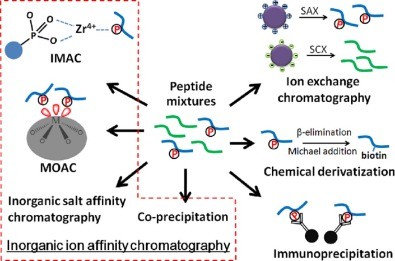 Fig.1.
Different strategies of phosphopeptide enrichment. (Li X S, et al., 2016)
Fig.1.
Different strategies of phosphopeptide enrichment. (Li X S, et al., 2016)
Our Services
With a powerful mass spectrometry sequencing platform and multi-pathway enrichment kit, Creative
Proteomics pushs out a multi-pathway phosphorylated proteome analysis platform, a complement to
phosphorylated protein analysis, to help you understand phosphorylation more easily.
At Creative Proteomics, our specialists use the multi-pathway enrichment kit to enrich
phosphorylated peptides prior to mass spectrometry analysis. Compared with other phosphopeptide enrichment methods,
multi-pathway enrichment kit enrichment is easy to operate and enables large-scale analysis of phosphorylated
proteins.
With cutting-edge equipment and expertise in protein sequencing and mass spectrometry, we provide one-stop
multi-pathway phosphorylated protein analysis service. You only need to tell us the purpose of your experiment and
send your samples to us, we will take care of all the follow-up matters of the project. The simple process of our
service includes:
- Protein extraction.
- Protein digestion.
- Phosphorylated peptide enrichment (multi-pathway enrichment kit is used).
- Peptide fragmentation separation.
- Mass spectrometry analysis.
- Bioinformatics analysis.
Advantages of Our Services
- High precision: Targeted screening and quantitative analysis of a defined set of protein sites and signal
transduction nodes are allowed.
- High-throughput: 4000 phosphorylation sites are easily detected.
- High specificity and sensitivity: Specialized kits for quantitative analysis of post-translational modification
(PTM) sites in cellular proteins.
- Advanced mass spectrometry platform: With high resolution and high scanning speed mass spectrometry, the
detection speed is nearly doubled.
- Fast turnaround time: Full report available in 5-7 days.
- Customized service: The most efficient and economical solution is customized by our experts according to your
requirements.
Sample Requirements
- Tissue samples: Plant tissue samples > 200 mg, blood samples > 1 mL (with EDTA for anticoagulation of
plasma), serum > 0.5 mL, urine> 2 mL, animal tissue samples > 1 g, cell samples > 5X10⁷
cells, microorganisms > 200 mg (dry weigh).
- Protein samples > 1 mg.
Thanks to our powerful mass spectrometry sequencing platform, Creative Proteomics provides a
one-stop multi-channel hosphorylated rotein analysis service. Our experienced scientists work with you to develop
tailor-made analytical solutions. Please feel free to contact us with any
questions regarding multi-channel hosphorylated rotein analysis.
References
- Yang C, Zhong X, Li L. (2014) Recent advances in enrichment and separation strategies for mass
spectrometry-based phosphoproteomics. Electrophoresis. 35(24):3418-3429.
- Li X S, Yuan B F, Feng Y Q. (2016) Recent advances in phosphopeptide enrichment: Strategies and techniques.
TrAC Trends in Analytical Chemistry. 78:70-83.