Introduction
The synthesis and application of peptides has become increasingly popular due to developments inin the fields of
biotechnology and bioengineering and for a number of research purposes such as cancer diagnosis and treatment,
antibiotic drug development, epitope mapping, production of antibodies, and vaccine design. With greater efficacy,
safety, and tolerability in humans as compared to small molecules, peptides are drawing more attention as potential
drug candidates targeting a wide variety of diseases. Edman degradation is commonly used for peptide sequencing both
in solution and on solid support. The method is applicable to natural and non-natural α-amino acid residues located
at the N-terminus, as long as their α-amino groups are unprotected. The usefulness of this method is based on the
high yield of amino acid-PTH formation, suitable for identification using chromatography, electrophoresis or mass
spectrometry.
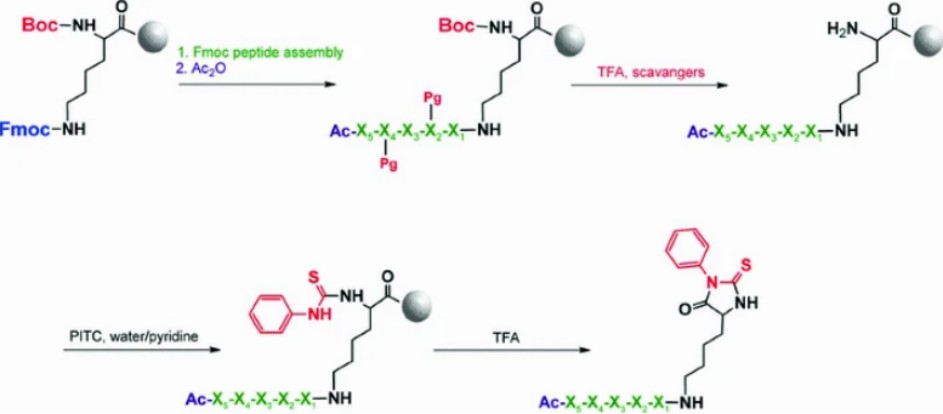 Fig. 1.
Proposed peptide cleavage method based on Edman degradation. (Bąchor R, et al., 2013)
Fig. 1.
Proposed peptide cleavage method based on Edman degradation. (Bąchor R, et al., 2013)
Our Services
Synthetic peptide sequence verification refers to the determination of the amino acids that constitute the structural
sequence of the peptide chain. Creative Proteomics provides comprehensive synthetic peptide
sequence verification services to accelerate the research of your project.
At Creative Proteomics, for short peptides, our scientists generally employ Edman degradation, the
standard for peptide sequencing, to analysis your amino acids sequence of synthetic peptide. Here, we have developed
a complete sequencing process for you.
Ⅰ. Under alkaline conditions, PITC binds to the free amino group at the N-terminus of the protein.
Ⅱ. In acidic solution, the N-terminal residue is cleaved.
Ⅲ. The PITC-bound residues were converted into more stable PTH residues.
Ⅳ. The amino acid species was determined by on-line HPLC analysis according to the elution time.
If Edman degradation is not suitable for your synthetic peptide. Don't worry, here's another sequencing
method to meet your demand. For synthetic peptides containing more than 70 amino acid residues, our scientists will
use specific protein enzymes to digest them into small fragments according to the molecular weight of your synthetic
peptide and the characteristics of amino acid composition, and then analyze the sequence of each small fragment. As
the complement of the Edman degradation, the method ensure the smooth progress of the verification of synthetic
peptide sequence services.
At Creative Proteomics, in addition to highquality results, you will also receive:
- Extremely high sensitivity, capable of sequencing at the low picomole level.
- Rapid return of high quality results.
- Expert advice from our highly trained staffs.
- Clear and understandable reports, including specific experimental procedures and proteome identification and
quantitative results (bioinformatics analysis).
Bioinformatics analysis includes:
Peptide and protein
identification;
Characteristic analysis of identification results: peptide degree distribution, protein
identification coverage, and unique peptide number distribution, etc.
Creative Proteomics provides global customers with professional verification of synthetic peptide
sequence service to speed up your peptide project journey. At Creative Proteomics, our highly
qualified team works with our customers stand together on the front lines to help you solve tough research
challenges. If you are interested in our services, please contact us
immediately.
References
- Bąchor R, Kluczyk A, Stefanowicz P, et al. (2013) New method of peptide cleavage based on Edman
degradation. Molecular diversity. 17(3):605–611.
- Grant G. A. (2003). Synthetic peptides for production of antibodies that recognize intact proteins. Current
protocols in immunology. Chapter 9:Unit 9.2.