Introduction
Histones are a class of highly conserved proteins with many types of histone modifications, including acetylation,
methylation, ubiquitination, citrullination, and phosphorylation of specific amino acids within histones. The
analysis of these covalent modifications can provide valuable information for the study of diseases such as cancer.
Genomics and mass spectrometry is most widely used for histon analysis. Notably, Mass spectrometry typically is the
technique of choice for the discovery and quantification of histone PTMs with high sensitivity analysis due to
combine high speed (scan rate >10 Hz), high resolution (> 60,000), and combine MS acquisition with online
separation techniques such as nano-liquid chromatography. so taht it can be used in a quantitative manner for
comparative analysis of protein expression levels as well as differential expression analysis of protein
modifications.
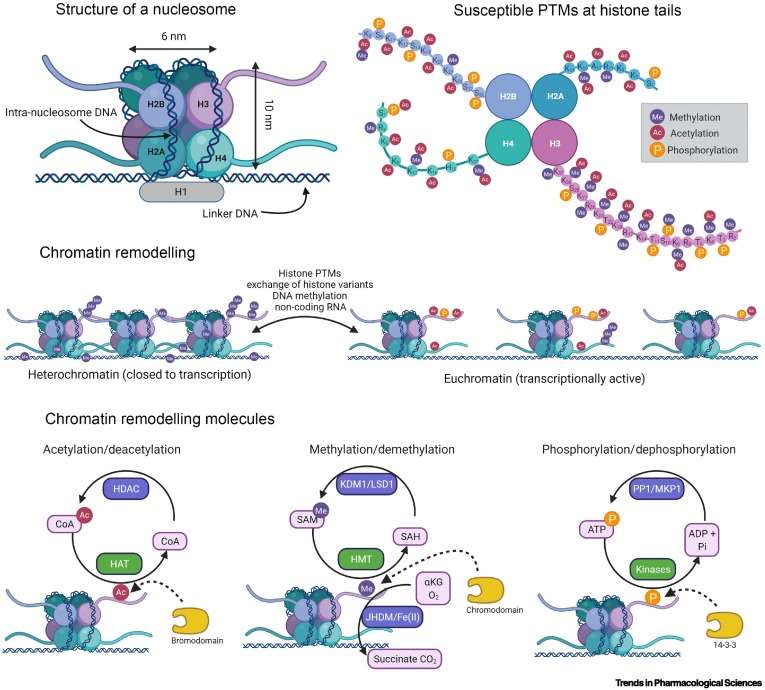 Fig.
1. Post-translational modifications (PTMs) at histone tails and their impact on chromatin remodelling. (Roux P P,
et al., 2013)
Fig.
1. Post-translational modifications (PTMs) at histone tails and their impact on chromatin remodelling. (Roux P P,
et al., 2013)
Our Services
Creative Proteomics has launched a dedicated histone modification analysis platform with advanced
mass spectrometer and Nano-LC for histone modification analysis services on the basis of extensive experience in
mass spectrometry.
At Creative Proteomics, our highly qualified scientists provide you with professional histone
isolation and purification technology to obtain high-purity histones for mass spectrometry analysis, while
preserving post-translational modifications (PTMs) of histones. In order to reduce the generation of small
hydrophilic peptides by tryptic proteolysis below the mass dynamic range of the MS detector and to identify and
quantify more information on histone post-translational modifications, chemical derivatization is used as a means of
increasing the hydrophobicity of the peptides during the digestion process. In addition, 2-3 different enzymes are
used by our scientists to digest protein samples, thus improving the sequence coverage of histone MS peptide maps to
identify more PTM sites.
With cutting-edge equipment and expertise in protein sequencing and mass spectrometry, we provide one-stop histone
modification analysis service. You only need to tell us the purpose of your experiment and send your samples to us,
we will take care of all the follow-up matters of the project.
Our simple experimental process includes:
- Protein separation and purification.
- In-gel or in-solution enzymatic hydrolysis.
- Peptide separation.
- Mass spectrometry analysis.
- Bioinformatics analysis.
What Can We Offer You?
- Histone Analysis
- Histone Variant Analysis
- Histone Modification Analysis
- Histone Modification Site Recognition
- Quantitative Analysis of Histone Modifications
- Validation of Novel Histone PTMs
Advantages of Our Services
- High throughput: Multiple PTMs are able to detect simultaneously.
- High sequence coverage: Chemical derivatization and multi-enzymatic hydrolysis are adopted to improve sequence
coverage.
- High sensitivity: State-of-the-art HPLC/MS/MS system for detection of histones present at low stoichiometry (1%
or less).
- Bioinformatics analysis: A professional bioinformatics analysis team realizes comprehensive mining of
experimental data.
- Fast turnaround time: 5-7 days for full reporting.
- Customized service: The most economical and professional solution will be tailored accordingto your project and
sample.
Sample Requirements
- Tissue samples: Plant tissue samples > 200 mg, blood samples > 1 mL (with EDTA for anticoagulation of
plasma), serum > 0.5 mL, urine> 2 mL, animal tissue samples > 1 g, cell samples > 5X10⁷
cells, microorganisms > 200 mg (dry weigh).
- Protein samples > 1mg.
Thanks to our powerful mass spectrometry sequencing platform, Creative Proteomics provides a
one-stop histone modification analysis service. Our experienced scientists work with you to develop tailor-made
analytical solutions. Please feel free to contact us with any questions
regarding histone modification analysis service.
References
- Torres-Perez J V, Irfan J, Febrianto M R, et al. (2021) Histone post-translational modifications as
potential therapeutic targets for pain management. Trends Pharmacol Sci. 42(11):897-911.
- Önder Ö, Sidoli S, Carroll M, et al. (2015) Progress in epigenetic histone modification analysis by
mass spectrometry for clinical investigations. Expert Rev Proteomics. 12(5):499-517.