Introduction
Characterization of protein glycosylation can be a complex and time-consuming process, especially for prokaryotic
O-linked glycoproteins, which often contain unusual oligosaccharide structures with no known glycosylation motifs.
However, the top-down analysis approach enables the study of purified glycoprotein samples directly to identify the
full molecular weight distribution by direct MALDI-TOF MS or ES-MS. Information on the degree of glycosylation,
molecular weight, and structure of oligosaccharide residues is obtained by subtracting the known or inferred masses
of protein components and then extrapolating. Compared to tedious and often time-consuming "bottom-up"
methods involving proteolytic digestion and LC-MS-MS analysis of glycopeptides, this method allows analysis of
intact proteins without the need to digest peptides, and requires minimal sample preparation and can be performed in
minutes.
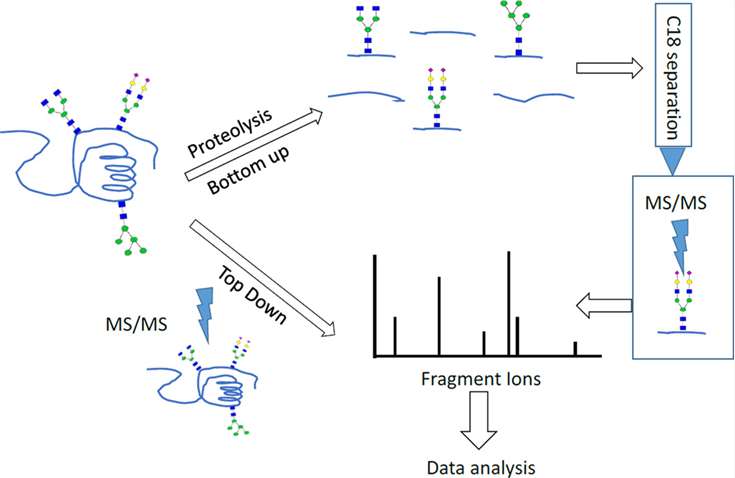 Fig. 1. The
glycoprotein and glycopeptide analysis procedure. (Kailemia M J, et al., 2017)
Fig. 1. The
glycoprotein and glycopeptide analysis procedure. (Kailemia M J, et al., 2017)
Our Services
Top-down analysis is a means of intact glycoprotein analysis, mainly used in the characterization of monoclonal
antibodies (mAB). With advanced mass spectrometry platforms and rich experience in proteomics analysis,
Creative Proteomics provides you with top-down glycoprotein analysis services to help your research
projects.
At Creative Proteomics, our experienced proteomics scientists and technicians take a top-down
approach to decoding your glycoproteins. Our top-down analysis service provides complementary structural information
for monoclonal antibody markers and allows assignment of individual protein forms. And by providing a general
overview of the total glycosylation patterns of glycomes, glycoproteins, glycolipids, or other types of
biomolecules, it then reveals the complexity of glycoprotein samples.
Top-Down Glycoprotein Analysis Technique
The general glycan pattern and glycan heterogeneity of intact glycoproteins can be directly analyzed by top-down
glycoprotein technique. Additionally, it has the potential to diagnose different stages of cancer and various other
disease states, facilitating the discovery of new biomarkers. We offer a variety of techniques for complete
glycoprotein analysis, including but not limited to:
Advanced electrospray ionization mass spectrometry (ESI-MS) technology is our most commonly used top-down
glycoprotein analysis method, which accurates mass determination and characterization of intact glycoproteins. To
the client's satisfaction, our ESI-MS enables the placement of multiple charges on specific species, enabling
the analysis of bulk intact glycoproteins in the traditional mass range. In addition, our expert team provides more
precise glycoprotein analysis services by combining ESI-MS with reversed phase (RP) HPLC or size exclusion
chromatography (SEC).
Matrix-assisted laser desorption/ionization time-of-flight mass spectrometry (MALDI-TOF MS) is another
high-throughput method we use for the structural characterization of glycosylated compounds, which recognizes the
entire set of glycans in small intact proteins with with high sensitivity and robustness.
It is worth noting that top-down glycoproteomics is still under development and faces technical challenges in sample
preparation, but the unique advantages mentioned above still make it a promising technical solution for
characterizing glycoproteins. During a service cycle, our experienced scientists typically use antibody-based
enrichment of target proteins to increase detection sensitivity prior to top-down analysis.
Advantages of Our Top-down Glycoprotein Analysis Services
- Information on the entire protein is obtained, complete coverage of the protein can be achieved, and almost all
glycosylation sites can be identified.
- Characterization of glycoproteins in bottom-up glycoproteomics due to unfavorable conditions of digestion
difficulty, HPLC separation, and MS ionization
- Less time-consuming, the detection can be completed within a few minutes.
With years of experience and an experienced scientific team, Creative Proteomics provides one-stop
top-down glycoprotein analysis service. If you are interested, please contact
us or send us an inquiry directly.
References
- Kailemia M J, Park D, Lebrilla C B. (2017) Glycans and glycoproteins as specific biomarkers for cancer. Anal
Bioanal Chem. 409(2):395-410.
- Tissot B, North S J, Ceroni A, et al. (2009) Glycoproteomics: past, present and future. FEBS
Lett. 583(11):1728-1735.