Introduction
Polypeptides are chemical compounds composed of a series of amino acids. They are similar in structure to proteins,
and play an important role in physiological processes such as blood pressure regulation, analgesia, and glucose
metabolism. Peptide identification refers to detecting the sequence information of the polypeptide, so as to obtain
the sequence or post-translational modification information of the polypeptide. Peptide identification is commonly
performed by tandem mass spectrometry, and MS-based peptide identification typically involves fragmentation of
tryptic peptides (tandem MS or MS 2) and their identification by searching protein sequence databases.
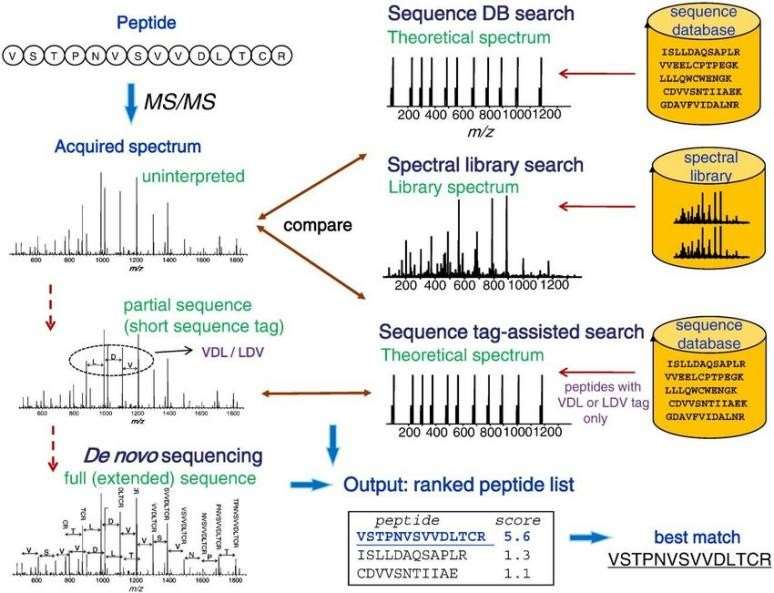 Fig.
1. Four peptide identification strategies Sequence DB search, spectral library search, sequence tag-assisted search
and De novo sequencing search are used for peptide identification. (Chen Y Y, et al., 2012)
Fig.
1. Four peptide identification strategies Sequence DB search, spectral library search, sequence tag-assisted search
and De novo sequencing search are used for peptide identification. (Chen Y Y, et al., 2012)
Our Services
Creative Proteomics is a world-leading provider of protein sequencing services. We have a powerful
mass spectrometry platform combined with bioinformatics to provide you with high-quality services. Here, our expert
team provides you with comprehensive mass spectrometry-based peptide identification services.
Peptide Identification Process
In order to accurately identify the peptides of interest, first the peptides of interest are separated by liquid
chromatography coupled to a mass spectrometer. In the mass spectrometer, the masses of the peptides are determined,
then their sequences were determined by MS/MS, and then the detection any peptide sequence obtained is matched with
the database, so that the peptide can be accurately identified and analyzed. The analysis process of our peptide
mass spectrometry identification is as follows:
- Extract the peptide from the test item.
- Separation of peptide samples by chromatography.
- First-level mass spectrometry detection.
- Secondary mass spectrometry detection.
- Bioinformatics analysis.
It is worth noting that the secondary mass spectrometry is similar to the primary mass spectrometry. The primary mass
spectrometry detects the mass-to-charge ratio of the ionized intact peptide ion, while the secondary mass
spectrometry detects the fragmented peptide ion.
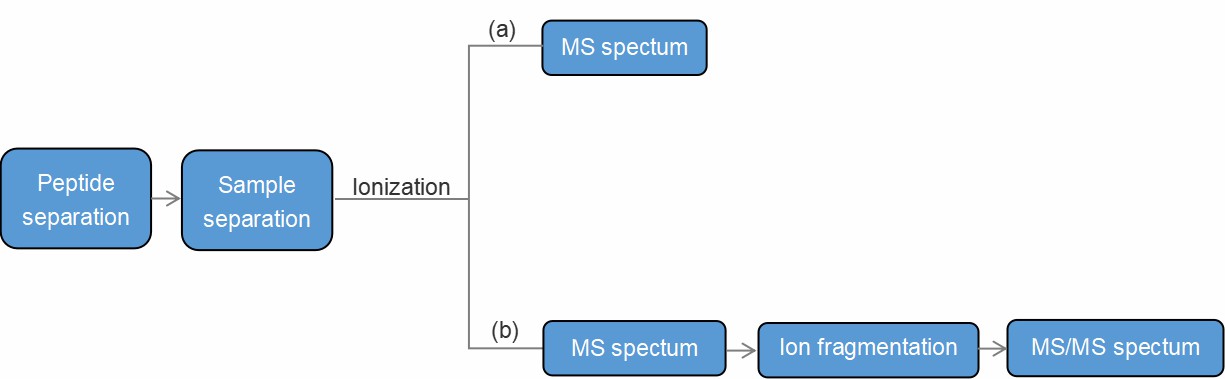 Fig.
2. Workflow of our peptide mass spectrometry identification service: (a) MS experiment workflow; (b) MS/MS
experiment workflow.
Fig.
2. Workflow of our peptide mass spectrometry identification service: (a) MS experiment workflow; (b) MS/MS
experiment workflow.
What Can We Provide?
- Extract and identify peptides from gels.
- Peptide identification from solution.
- Peptide sequencing using a variety of MS/MS fragmentation techniques.
Advantages of Our Peptide Mass Spectrometry Identification
- Using a real nano-flow liquid phase system with higher sensitivity.
- Tandem mass spectrometry provides sequence information and high reliability of protein identification.
- Adopt LC-ESI-MS/MS (Liquid Chromatography Electrospray Ionisation Tandem Mass Spectrometry) configuration that
it is suitable for complex samples.
Creative Proteomics is a trusted provider of proteomics analysis services. Thanks to the superior
resources of technology, equipments and personnels, we offer professional peptide analysis and identification
methods for our customers. Our services guarantee accurate and reliable results, at quick turnaround time! If you
have any questions or specific requirements, please feel free to contact
us. We will fulfill your goal.
References
- Chen Y Y, Dasari S, Ma Z Q, et al. (2012) Refining comparative proteomics by spectral counting to
account for shared peptides and multiple search engines. Anal Bioanal Chem. 404(4):1115-1125.